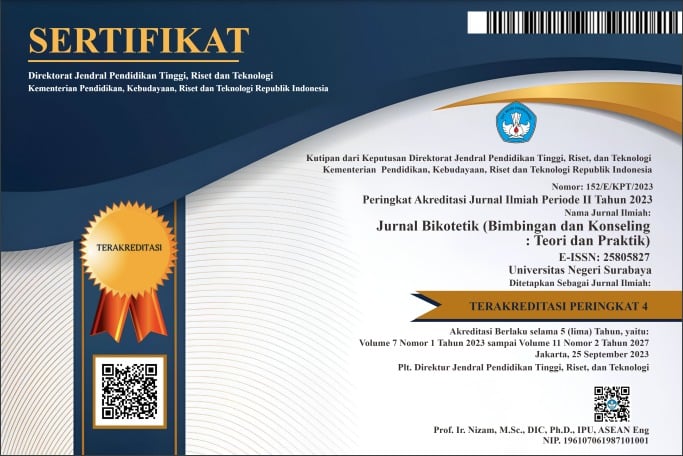
Accredited
In collaboration with

Asosiasi Bimbingan dan Konseling Indonesia (ABKIN)




Jurnal Bikotetik (Bimbingan dan Konseling : Teori dan Praktik) is committed to maintaining an impartial, transparent, and independent publication process. Authors, reviewers, and editors must disclose interests or relationships that could affect, or reasonably be perceived to affect, their professional judgment.
A conflict of interest may be financial or nonfinancial. Disclosure enables the journal to assess and manage potential influences; it does not, by itself, imply misconduct.
All authors must disclose relationships, activities, or interests relevant to the submitted work that could influence its design, conduct, analysis, interpretation, or reporting.
Relevant interests may include:
Research grants, sponsorship, employment, consultancy fees, honoraria, or other financial support.
Ownership interests, patents, royalties, or commercial interests in counseling instruments, interventions, training programs, or digital services discussed in the manuscript.
Personal relationships, professional rivalries, institutional commitments, or leadership and advisory roles relevant to the research.
Every manuscript must include a Conflict of Interest statement, including an explicit declaration when no relevant conflicts exist. The corresponding author must obtain and accurately report disclosures from all co-authors.
Funding sources must be reported separately, together with the funder’s role in the research and publication process. Authors must state when funders had no involvement in study design, data collection, analysis, interpretation, manuscript preparation, or the decision to submit.
Authors must update their disclosures if relevant circumstances change during the editorial process.
Reviewers must assess whether any relationship or interest could compromise their impartiality before accepting an invitation. Relevant circumstances may include recent collaboration, supervisory relationships, shared institutional affiliations, personal connections, direct competition, or financial interests related to the work.
When a potential conflict exists, reviewers must inform the handling editor before proceeding. Reviewers must decline assignments when the conflict prevents an objective assessment. If a conflict becomes apparent during review, they must promptly notify the editor and suspend their assessment pending guidance.
Reviewers must preserve confidentiality and must not use unpublished information obtained through peer review for personal, professional, or financial advantage.
Editors must disclose relevant conflicts and refrain from managing or deciding on manuscripts when their impartiality could reasonably be questioned.
Such manuscripts must be assigned to an appropriately qualified editor without the relevant conflict. The conflicted editor must not select reviewers, access confidential review discussions, or participate in the publication decision.
Submissions authored by editors, editorial board members, or journal staff must undergo the journal’s regular assessment and peer-review procedures under independent editorial oversight. Their position must not confer preferential treatment.
Editorial decisions must be based on the manuscript’s scholarly contribution, originality, methodological or analytical rigor, ethical integrity, and relevance to the journal’s scope.
Article processing charges, fee waivers, sponsorship, advertising, institutional relationships, and other financial or external interests must not influence acceptance or rejection. Payment does not guarantee publication.
The journal will assess disclosed interests according to their relevance, significance, and potential influence on the research or publication process.
Where appropriate, the journal may request further clarification, appoint independent reviewers or editors, require additional disclosure in the published article, or implement other proportionate safeguards.
A disclosed conflict does not automatically prevent publication. The determining consideration is whether the interest can be managed while preserving the integrity of the work and the independence of editorial assessment.
Concerns about undisclosed interests may be raised with the editorial office and should be supported by relevant information.
If a potentially significant omission is identified, the journal will seek an explanation from the individuals concerned and assess its implications. Before publication, editorial processing may be paused while the matter is examined.
After publication, the journal may issue a correction to the disclosure statement or take further action when the reliability or integrity of the article is affected. Any action will follow the journal’s publication ethics, correction, and retraction policies and applicable publication ethics guidance. An omitted disclosure alone does not automatically warrant retraction.
When no relevant conflicts exist:
“The authors declare that they have no financial or nonfinancial conflicts of interest relevant to this work.”
When a relevant interest exists:
“(Author’s name or initials] reports [describe the relationship or interest) involving (organization or entity). The remaining authors declare no relevant conflicts of interest.”
When an author holds an editorial role at Jurnal Bikotetik (Bimbingan dan Konseling : Teori dan Praktik):
“[Author’s name or initials] serves as [editorial role] at Jurnal Bikotetik (Bimbingan dan Konseling : Teori dan Praktik). This author had no involvement in the peer-review process or publication decision for this manuscript, which was managed by an independent editor.”
Declarations must accurately reflect the circumstances of each submission. Jurnal Bikotetik (Bimbingan dan Konseling : Teori dan Praktik) expects all participants in the publication process to disclose relevant interests promptly and cooperate with measures intended to protect scholarly integrity.
Accredited
In collaboration with
Asosiasi Bimbingan dan Konseling Indonesia (ABKIN)


Publisher
Department of Guidance and Counseling
Faculty of Education
Universitas Negeri Surabaya
[email protected]