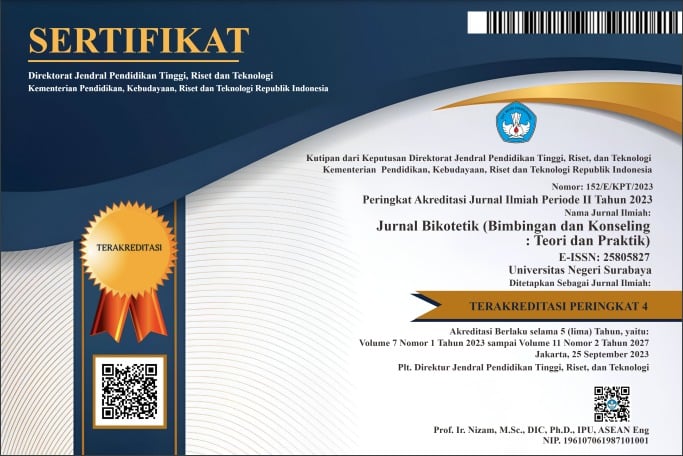
Accredited
In collaboration with

Asosiasi Bimbingan dan Konseling Indonesia (ABKIN)





Jurnal Bikotetik (Bimbingan dan Konseling : Teori dan Praktik) regards authorship as both recognition of scholarly contribution and acceptance of responsibility for the published work. This policy promotes transparent attribution, fair acknowledgment, and accountability in research and publication.
Jurnal Bikotetik (Bimbingan dan Konseling : Teori dan Praktik) adopts the following four criteria for authorship. Each author must:
Contribute substantially to the research conception or design, or to the acquisition, analysis, or interpretation of data.
Draft the manuscript or critically revise its intellectual content.
Approve the final manuscript and consent to its submission and publication.
Accept accountability for the work, including cooperation in investigating and resolving concerns about its accuracy or integrity.
All individuals who meet these criteria must be included as authors. Contributors who satisfy the first criterion should have an opportunity to participate in manuscript revision and final approval.
An Author Contributions statement is required for every manuscript. Authors should describe their roles using the Contributor Roles Taxonomy (CRediT), selecting the roles applicable to their work:
Conceptualization; Methodology; Software; Validation; Formal analysis; Investigation; Resources; Data curation; Writing – original draft; Writing – review & editing; Visualization; Supervision; Project administration; and Funding acquisition.
An author may hold multiple roles, and several authors may share the same role. Not every role is required for every study. CRediT describes contributions; it does not independently establish eligibility for authorship.
All authors must review and agree to the contribution statement before submission. The statement will be included in the published article.
The authors must jointly agree on the author order before submission. Any equal contributions should be clearly identified in the manuscript.
The corresponding author coordinates communication with the journal and ensures that author information, contributions, and required declarations are complete and agreed upon. The corresponding author must keep co-authors informed of editorial decisions and coordinate their responses during review and production.
After publication, the corresponding author must remain available to respond to questions and facilitate access to supporting information when appropriately requested.
Contributors who do not meet all authorship criteria should be recognized in the Acknowledgments section, with a description of their assistance.
Funding, administrative support, language editing, technical assistance, or general supervision alone does not qualify an individual for authorship. However, individuals performing these roles may qualify if they also meet all authorship criteria.
Authors must obtain permission from individuals named in the acknowledgments.
Requests to add or remove an author, change author order, or change the corresponding author after submission must be submitted to the editor by the corresponding author. Each request must include:
The manuscript title and identification number.
A clear explanation of the proposed change.
An updated author list and contribution statement.
Written agreement from all authors, including anyone being added or removed.
Changes require editorial approval. Review or publication may be paused while a request is assessed.
After publication, justified changes will be recorded through a formal correction that preserves the publication record. The journal will not silently alter authorship information.
Jurnal Bikotetik (Bimbingan dan Konseling : Teori dan Praktik) prohibits gift, guest, honorary, purchased, and ghost authorship, as well as the deliberate exclusion of eligible contributors. Listing an individual without their knowledge and consent is unacceptable.
Academic rank, institutional authority, personal relationships, or financial support alone must not determine authorship.
Artificial intelligence tools cannot be listed as authors because they cannot accept responsibility for the work. Authors must disclose substantive use of generative AI in manuscript preparation or research, identifying the tool and its purpose in an appropriate manuscript section. Human authors remain responsible for the accuracy, originality, citations, and integrity of all submitted content.
Authors should resolve authorship disagreements collaboratively and, when necessary, seek assistance from their institutions. Editors do not adjudicate competing claims about individual research contributions.
When a dispute or suspected authorship misconduct arises, Jurnal Bikotetik (Bimbingan dan Konseling : Teori dan Praktik) may request contribution records, written declarations, or institutional clarification. Editorial processing may be suspended pending resolution.
Where misconduct is established, the journal may reject the manuscript, publish a correction, or take other proportionate action in accordance with applicable COPE guidance and the journal’s publication ethics policy.
Accredited
In collaboration with
Asosiasi Bimbingan dan Konseling Indonesia (ABKIN)


Publisher
Department of Guidance and Counseling
Faculty of Education
Universitas Negeri Surabaya
[email protected]