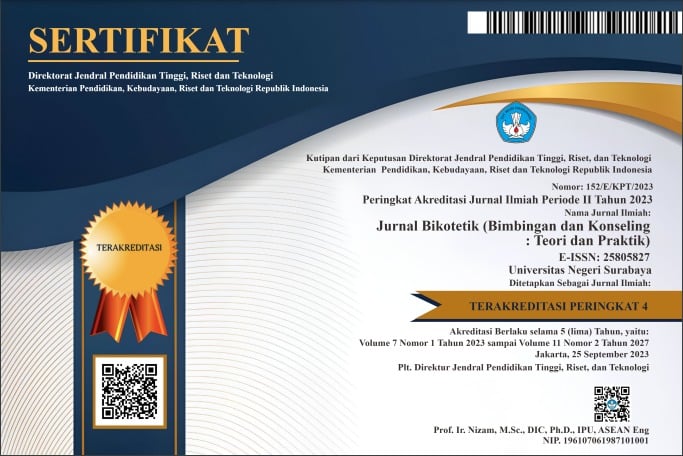
Accredited
In collaboration with

Asosiasi Bimbingan dan Konseling Indonesia (ABKIN)


Purpose and scope
These policies were developed in response to the rapid emergence of generative artificial intelligence (AI) and AI-assisted technologies, which are expected to be increasingly adopted by researchers. They have been updated to reflect evolving best practices in scholarly research and publication.
The purpose of these policies is to enhance transparency and to provide clear guidance for authors, reviewers, editors, readers, and other contributors involved in the publication process. The journal will continue to monitor developments in this area and will revise or refine these policies as necessary to ensure alignment with ethical standards and responsible use of AI in scholarly publishing.
Core principles for the Use of Artificial Intelligence
Human Accountability
The journal requires that authors, reviewers, and editors, when using AI tools, retain full responsibility to ensure the accuracy, integrity, originality, and legality of all scholarly content throughout the publication process.
Transparency
The journal mandates that all users, whenever AI assistance materially influences content, disclose such use to maintain transparency within manuscripts, reviews, or editorial records.
Research Integrity
The journal prohibits any user, under all circumstances, from using AI to fabricate, falsify, manipulate, or misrepresent research data, analyses, images, references, or conclusions in any submission or publication.
Confidentiality and Data Protection
The journal requires all participants, when handling unpublished or sensitive materials, to protect confidentiality by avoiding AI systems that store, reuse, or train on submitted content across all stages of peer review and editorial handling.
Authorship Integrity
The journal affirms that AI systems, regardless of capability, cannot qualify as authors to uphold authorship accountability in all published works.
Reproducibility and Verifiability
The journal requires authors, when AI assists analyses or code, to ensure reproducibility by providing transparent methods, parameters, and documentation for independent verification.
Fairness and Non-Discrimination
The journal expects all users, when employing AI outputs, to evaluate and mitigate bias to ensure fairness and inclusivity in scholarly communication.
Editorial Independence
The journal prohibits editors, at any stage, from delegating editorial judgement to AI systems to preserve independent decision-making in publication outcomes.
Compliance
The journal requires all users, when using AI tools, to comply with institutional, funder, legal, and ethical requirements to ensure alignment with journal publication policies.
For Authors
Review, verify, and edit all AI-generated outputs to ensure the accuracy, completeness, objectivity, and originality of the manuscript.
Disclose transparently any use of AI through a formal AI declaration at the time of manuscript submission (basic grammar, spelling, and punctuation checks do not require disclosure).
Protect data privacy, intellectual property, and confidentiality by ensuring that the AI tools used do not retain, reuse, or train models on uploaded materials, nor impose restrictions that could limit future publication.
Comply with authorship policies, under which AI tools may not be listed as authors or co-authors.
Refrain from using AI in figures, images, and artwork, except where AI forms an integral part of the research design or methodology and is fully described in a transparent and reproducible manner in the Methods section. Generative AI may not be used to create artwork or graphical abstracts and may be considered for cover images only with prior approval from the editor and publisher.
For Reviewers
Confidentiality
Reviewers must maintain strict confidentiality of manuscripts and peer review reports and must not upload manuscripts, data, or review reports to generative AI tools or any other systems that may store, reuse, or train models on such content.
Human Responsibility
Scholarly evaluation in the peer review process must be conducted entirely by reviewers. The use of generative AI to draft, assist, or replace a reviewer’s critical and professional judgement is not permitted.
Reviewer Accountability
Reviewers are fully responsible and accountable for the content, accuracy, and tone of the review reports submitted to the journal.
Limited AI Support by the Journal
The journal may use internal or licensed AI technologies to support editorial processes (e.g., plagiarism screening or reviewer selection), while ensuring confidentiality and data protection.
For Editors
During the editorial process, all manuscripts and related communications must be treated as confidential documents. Editors must not upload submitted manuscripts, any part thereof, or editorial communications (including decision letters) to generative AI tools or AI-assisted technologies, as doing so may breach confidentiality, authors’ intellectual property rights, and data privacy.
The management of peer review and editorial evaluation is entirely a human responsibility. Editors are therefore not permitted to use generative AI to assist with scholarly evaluation or editorial decision-making. Editors remain fully responsible and accountable for the editorial process, final decisions, and communications with authors.
Editors may review author disclosures regarding the use of AI as stated in the manuscript in accordance with journal policy. If an editor suspects a violation of the journal’s AI policy by an author or reviewer, the editor must notify the publisher for further investigation.
The journal and publisher may use internal or licensed AI technologies that comply with Responsible AI principles to support editorial processes, such as completeness checks, plagiarism detection, and reviewer selection. These technologies are designed to safeguard confidentiality, data privacy, and security, and are subject to rigorous bias evaluation.
Accredited
In collaboration with
Asosiasi Bimbingan dan Konseling Indonesia (ABKIN)


Publisher
Department of Guidance and Counseling
Faculty of Education
Universitas Negeri Surabaya
[email protected]