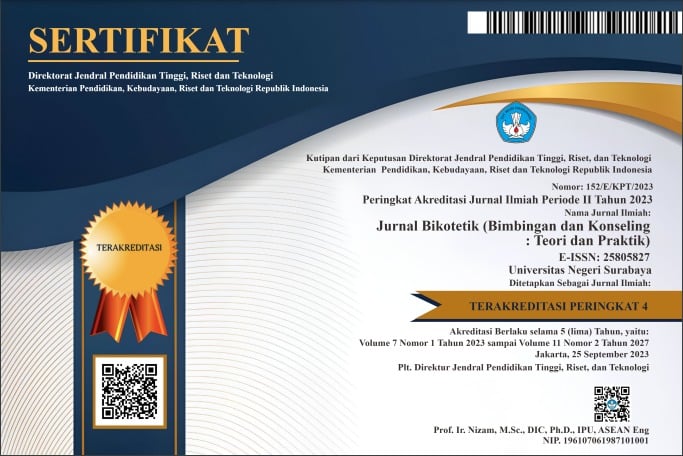
Accredited
In collaboration with

Asosiasi Bimbingan dan Konseling Indonesia (ABKIN)






AUTHOR GUIDELINES
Submission and Peer Review Process
Submission
Before submission
Before submitting the manuscript, authors are required to carefully read and adhere to the journal’s publication ethics, fully understand the peer-review process, and review and agree to the applicable copyright policy. Authors must also ensure that they are aware of and comply with the journal’s article processing charge (APC) policy, where applicable. Finally, the manuscript must be prepared and formatted strictly in accordance with the journal’s official article template prior to submission.
Manuscript Guidelines
The Introduction should establish the scientific context and significance of the study through a critical synthesis of relevant literature. Authors should clearly explain the research problem, theoretical or conceptual foundation, and current state of knowledge before identifying a specific research gap. The novelty and theoretical or practical contribution of the study must be explicitly stated and supported by relevant, recent, and authoritative sources. The section should conclude with clearly formulated research objectives, questions, or hypotheses. The Introduction should present a coherent argument rather than a descriptive list of previous studies and should not include detailed methods, results, or conclusions.
This section should describe the research design, approach, and procedures in sufficient detail to allow replication of the study. This section should include information on participants or samples, data collection methods, instruments or measures used, and data analysis techniques. Ethical considerations, including approval and informed consent where applicable, should also be clearly stated.
Design
In this section, clearly and explicitly describe the research design employed to ensure transparency and methodological rigor. State the specific type of research design adopted (e.g., experimental, quasi-experimental, cross-sectional, longitudinal, qualitative, or mixed methods)), and ensure that the chosen design aligns with the research objectives and research questions. Next, briefly justify the selection of the design by explaining why it is the most appropriate approach for addressing the focus of the study.
Participants
Participants section describes the individuals involved in the study and the procedures used for their selection. Authors should report the total number of participants and relevant characteristics, including age range, gender (when applicable), educational level, and attributes directly related to the research objectives. The research setting and general geographical context should be clearly stated without disclosing identifiable personal or institutional information. The sampling technique and inclusion–exclusion criteria must be explained to ensure transparency and replicability. Ethical considerations should be addressed by confirming voluntary participation, the provision of informed consent, and ethical approval from an institutional review board when applicable. Additional participant background information may be included if it is relevant to the interpretation of the findings. The demographic characteristics of both samples are presented in Table 1.
Data Collection
Data Collection should clearly articulate the rationale for instrument selection in direct alignment with the study objectives and targeted constructs. Authors are required to specify the theoretical foundation underlying each instrument and to describe the core constructs and their operational definitions, including key dimensions or indicators being measured. Instruments must demonstrate contextual and cultural appropriateness for the study population, either through the use of previously validated measures in comparable contexts, culturally adapted instruments with documented modifications, or newly developed instruments grounded in established theoretical frameworks. The manuscript should explicitly report the validation procedures undertaken to ensure measurement accuracy, such as content validity through expert review, construct validity using appropriate analytical techniques, and reliability estimation. This level of methodological transparency is essential to enable readers and reviewers to understand precisely what is being measured, how the data are obtained, and how the resulting data adequately support the study’s analytical and interpretive claims.
Data Analysis
Authors must clearly describe the data analysis procedures used to address the research objectives or research questions. The analysis methods should be appropriate to the research design, data type, and measurement instruments.
For quantitative studies, data should be analyzed using relevant descriptive and inferential statistical techniques. Descriptive statistics may include means, standard deviations, frequencies, and percentages. Inferential analyses may involve hypothesis testing such as t-tests, ANOVA, regression analysis, structural equation modeling (SEM), or item response theory (e.g., Rasch analysis), depending on the study objectives. Authors are required to report statistical assumptions, significance levels, confidence intervals, and effect sizes where applicable.
For qualitative studies, data should be analyzed using systematic qualitative approaches such as thematic analysis, content analysis, or grounded theory. The analysis process must be clearly described, including coding procedures, theme development, and strategies to ensure trustworthiness (e.g., triangulation, member checking, or audit trails).
For mixed-methods studies, quantitative and qualitative data should be analyzed using appropriate techniques and integrated systematically according to the research design. Authors are required to describe the design, sampling, data collection and analysis procedures, integration strategy, and measures used to ensure validity and trustworthiness.
For research and development (R&D) studies, data should be analyzed according to the selected development model and evaluation stages. These may include needs assessment, product design, expert validation, revision, pilot testing, and effectiveness testing. Authors are required to report validation criteria, analytical procedures, and evidence of product validity, feasibility, usability, and effectiveness where applicable. All results must be presented clearly, supported by appropriate tables or figures, and interpreted in relation to the research questions without redundancy.
For literature review studies, authors must clearly explain how the selected literature was analyzed and synthesized according to the review type. Narrative reviews should describe the organization and interpretation of key concepts, theories, trends, and gaps. Systematic and scoping reviews should report data extraction, coding, categorization, and synthesis procedures, preferably using guidelines such as PRISMA. Bibliometric studies should state the indicators, techniques, and software used, while meta-analyses should report effect size calculation, heterogeneity, publication bias, and the analytical model. Results should be presented systematically and critically to show patterns, gaps, and contributions to the field.
This section should present the findings of the study clearly and objectively, without interpretation. This section should report the key outcomes related to the research questions using appropriate text, tables, or figures. All results must be presented logically, with relevant statistical values where applicable, and should avoid redundancy with data shown in tables or figures. For qualitative studies, report the emerging themes or patterns, supported by brief illustrative quotations when appropriate. For quantitative studies, present the results of primary and secondary analyses, including significance levels, confidence intervals, and model-fit indices where relevant.
Table
Tables should be self-contained, provide information that complements rather than repeats the text, and be submitted as editable files, not images. Legends and footnotes must be concise yet sufficient to allow understanding without referring to the main text, and all abbreviations should be defined in the footnotes. Footnote symbols should follow the order. Statistical measures must be clearly stated in the table headings. (See table 1)
Figure
Figures should be able to stand alone and be easily understood without reading the full manuscript. The data presented should be clear and easy to interpret, with graphics that are simple yet informative. The use of color is encouraged, provided it supports clarity and maintains scholarly and professional standards. All figures must be entirely original, unpublished artwork created by one of the co-authors and should not include photographs, drawings, or caricatures of any person, whether living or deceased. See Figure 1
Figures legend
Figure legends should be clear, concise, and self-explanatory, allowing the figure to be understood without extensive reference to the main text. Each legend must briefly describe the content of the figure, explain all symbols, abbreviations, and color codes used, and define panel labels (e.g., (a), (b), (c)) where applicable. Legends should be placed below the figure and written in complete sentences or clear descriptive phrases. Avoid repeating detailed methodological information already provided in the Methods section. All figures must be cited in the main text in numerical order (Figure 1, Figure 2, etc.), and legends should not be embedded within the figure itself.
Color figures
Color Figures should use consistent and informative colors rather than decorative ones. Figures must remain legible when printed in grayscale; therefore, color combinations with low contrast should be avoided. For graphs, authors are encouraged to apply a simple color palette, using no more than 4–6 colors. All text, symbols, and lines should be clearly visible and provide sufficient contrast against the background. Whenever possible, solid colors should be used instead of gradients.
Figures size
Figure Size should be proportional and easily readable at the final printed size. The recommended dimensions are 8–9 cm in width for single-column figures and 16–18 cm in width for double-column figures. Figure height should be adjusted accordingly and must not exceed one page. The font size used within figures should be at least 8 pt at the final printed size to ensure readability.
Resolution figures
Figure Resolution requires all figures to be of high resolution to ensure both print quality and clear digital display. The minimum resolution is 600 dpi for line art (such as graphs, diagrams, and schematics) and 300 dpi for both grayscale and color images. Recommended file formats include PNG or JPEG for images and vector graphics. Authors should avoid enlarging low-resolution images, as this will reduce overall figure quality.
The Discussion begins with a brief statement of the research perspective and its urgency, followed by a general explanation of how the study addresses the research problem and a clear statement of its main contributions and findings. The Discussion then interprets the results to show how they extend, clarify, or challenge existing literature, without repeating the Introduction or Results sections. The primary focus is on the significance of the findings, their relevance to the research questions or hypotheses, and their alignment with or divergence from previous studies, including possible alternative explanations. The discussion should remain concise, data-driven, and avoid speculation, overstated conclusions, and exaggerated claims.
This section should succinctly summarize the main findings of the study and directly address the research objectives. This section should highlight the key contributions of the research, explain its significance within the field, and, where appropriate, outline practical or theoretical implications. Conclusions should not merely repeat the results but provide a clear take-home message and, if relevant, suggest directions for future research.
This section should be used to recognize individuals, institutions, or organizations that provided support for the research but did not meet the criteria for authorship. This section should also include information on funding sources, facilities, technical assistance, or other forms of support. Any contributions acknowledged must be accurate, appropriate, and relevant to the study.
Should clearly describe the specific roles and responsibilities of each author in the research and manuscript preparation. This section must indicate individual contributions to key aspects of the study, such as research conceptualization, methodology, data collection, data analysis, interpretation of results, manuscript drafting, and critical revision. All listed authors should have made a substantial intellectual contribution to the work and approved the final version of the manuscript. please describe the specific contributions of each author using author initials and the terms proposed by the Contributor Roles Taxonomy (see CRedit).
Authors should clearly acknowledge all sources of funding in the Acknowledgments section and ensure that the funder information is accurate.
Conflicts of interest should clearly disclose any financial, personal, or professional relationships that could be perceived as influencing the research or its interpretation. If no conflicts exist, authors should explicitly state that there are no conflicts of interest related to the study.
Ethical Approval should state whether the study received approval from an appropriate ethics committee or institutional review board. This section must include the name of the approving body and, where applicable, the approval number or reference. Authors should also confirm that the research was conducted in accordance with ethical standards and relevant guidelines, including informed consent procedures when human participants were involved.
References should be prepared in accordance with the Publication Manual of the American Psychological Association 7th edition (APA7). In text citations must use the author date format, indicating the author’s surname and year of publication within the text. The complete reference list should be presented alphabetically by author at the end of the manuscript.
Journals
Author, A. A., Author, B. B., & Author, C. C. (yyyy). Title of article in sentence-style capitalisation. Title of Journal in Italics and Heading-style Capitalisation, vol(issue), pp–pp. doi URL
Bannan-Ritland, B. (2003). The role of design in research: The integrative learning design framework. Educational Researcher, 32, 21–24. https://doi.org/10.3102/0013189X032001021
Koehler, M. J., & Mishra, P. (2009). What is technological pedagogical content knowledge? Contemporary Issues in Technology and Teacher Education, 9(1), 60–70.
Wilson, G., & Stacey, E. (2004). Online interaction impacts on learning: Teaching the teachers to teach online. Australasian Journal of Educational Technology, 20(1), 33–48. http://dx.doi.org/10.14742/ajet.1366.
Books
Author, A. A., & Author, B. B. (yyyy). Title of book in italics and sentence-style capitalization. Location: Publisher.
Schunk, D. H. (2004). Learning theories: An educational perspective (4th ed.). Upper Saddle River, NJ: Prentice-Hall.
Book Chapters
Author, A. A. (yyyy). Title of chapter in sentence-style capitalisation. In A. Editor, B. Editor, & C. Editor (Eds.), Title of book in italics and sentence-style capitalization (xx ed., Vol. xx, pp. xxx-xxx). Location: Publisher.
Mayer, R. E. (2005). Cognitive theory of multimedia learning. In R. E. Mayer (Ed.), The Cambridge handbook of multimedia learning (pp. 31–48). New York, NY: Cambridge University Press.
Conference paper
Author, A. A., & Author, B. B. (yyyy, Month). Title of paper in italics and sentence-style capitalization. Paper presented at the Name of the Conference, Location. Retrieved from http://www.xxx
Proceedings
Author, A. A., Author, B. B., & Author, C. C. (yyyy). Title of article in sentence-style capitalisation. Proceedings of the Name of Meeting, Location, pp–pp. doi:xxxx
Note: Proceedings published in book form should be referenced as for chapters in books.
Doctoral dissertation
Author, A. A. (yyyy). Title of dissertation in italics and sentence-style capitalization (Doctoral dissertation). Name of Institution, Location. Retrieved from http://www.xxx
Websites and online resources
If you refer to an entire website you do not need to include an entry in the reference list. Identify the title of the source and provide the URL in parentheses e.g., … the Australasian Society for Computers in Learning in Tertiary Education (http://www.ascilite.org.au/) provides …
More examples are available on the APA page (http://www.apastyle.org/).
Role
Author Name1: Conveys ideas (Example*)
Author Name2: Improves article writing (Example*)
Peer Review
All manuscripts submitted to this journal undergo a rigorous peer-review process to ensure scientific quality, academic integrity, and a meaningful contribution to the field. The journal aims to provide an initial editorial decision within 6 weeks of submission and a first decision following external peer review within 10 weeks. The overall review process generally takes 10-16 weeks, depending on reviewer availability, the extent of revisions required, and the authors’ response time. Overall, the entire process from submission to production takes approximately 20 weeks. The journal applies a double-blind peer review system, in which the identities of both authors and reviewers are kept confidential to ensure an objective and unbiased evaluation. In the initial stage, the editor conducts a preliminary screening to assess the manuscript’s alignment with the journal’s aims and scope, compliance with the author guidelines, and adherence to publication ethics, including an originality check using plagiarism detection software turnitin. Manuscripts that pass this screening are reviewed by at least two independent reviewers with relevant expertise in the subject area. Reviewers evaluate the manuscript based on its novelty, scientific significance, methodological rigor, quality of analysis and interpretation, clarity of presentation, and theoretical or practical contribution. Based on the reviewers’ recommendations, the editor makes an editorial decision: accepted, accepted with minor revisions, major revisions required, or rejected. When revisions are requested, authors are required to address all reviewer comments thoroughly and resubmit the revised manuscript within the specified timeframe. Revised manuscripts may be returned to the reviewers for further evaluation or assessed directly by the editor, depending on the extent of the revisions. The editor’s decision is final. The entire peer-review process is conducted in accordance with principles of transparency, accountability, and international publication ethics, as recommended by the Committee on Publication Ethics (COPE).
Accredited
In collaboration with
Asosiasi Bimbingan dan Konseling Indonesia (ABKIN)


Publisher
Department of Guidance and Counseling
Faculty of Education
Universitas Negeri Surabaya
[email protected]