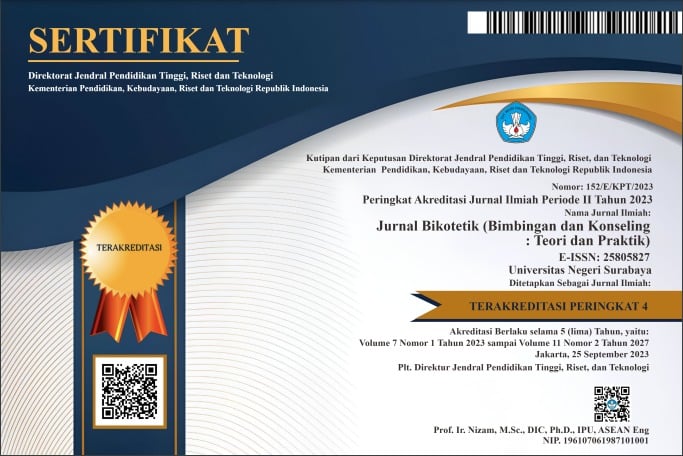
Accredited
In collaboration with

Asosiasi Bimbingan dan Konseling Indonesia (ABKIN)




The Editors of Jurnal Bikotetik (Bimbingan dan Konseling : Teori dan Praktik) issue a set of publication ethics as guidelines for authors engaged in the publication of scientific research to comply with COPE Core Practices and establishes a high-quality standard of ethics for journal publication.
1. Allegations of Misconduct
The purpose of this policy is to prevent any misconduct related to research conducted for the journals and to suggest the fundamental principles and structural procedures in relation to research integrity deliberation required to ensure research ethics.
The range of misconduct policy
Research misconduct suggested in this policy pertains to fraud and refers to data fabrication, falsification, plagiarism, and improper authorship.
How does the journal address misconduct
Editors and publishers have an ethical obligation to:
Editors/journals have an ethical obligation to respond and to address ethical allegations that may arise about published papers or papers in review. Systems and procedures are in place for investigating and addressing situations of misconduct, including cooperation with investigations from institutions or funding bodies.
Possible sanction
When the evidence of misconduct is confirmed the following procedures are to be applied:
2. Authorship and Contributorship
Authors are expected to comply with the following ethical guidelines. Any infringement may lead to a retraction of the article or even ban the author from journal publication.
Authors listed on an article must meet all of the following criteria.
3. Editorship
4. Complaints and Appeals
The below procedure applies to appeals to editorial decisions, complaints about failure of processes such as long delays in handling papers and complaints about publication ethics. The complaint should in first instance be handled by the Editor in Chief responsible for the journal and/or the Editor who handled the paper. If they are the subject of the complaint please approach the publisher contact.
Complaint about scientific content, e.g. an appeal against rejection The Editor in Chief or Handling Editor considers the authors’ argument, the reviewer reports and decides whether (1) The decision to reject should stand (2) Another independent opinion is required, and (3) The appeal should be considered. The complainant is informed of the decision with an explanation if appropriate. Decisions on appeals are final and new submissions take priority over appeals.
Complaint about processes, e.g. time taken to review The Editor in Chief together with the Handling Editor (where appropriate) and/or publisher contact (where appropriate) will investigate the matter. The complainant will be given appropriate feedback. Feedback is provided to relevant stakeholders to improve processes and procedures.
Complaint about publication ethics, e.g., researcher's author's, or reviewer's conduct The Editor in Chief or Handling Editor follows guidelines published by the Committee on Publication Ethics. The Editor in Chief or Handling Editor may ask the publisher for advice on difficult or complicated cases. The Editor-in-Chief or Handling Editor decides on a course of action and provides feedback to the complainant. If the complainant remains dissatisfied with the handling of their complaint, he or she can submit the complaint to the Committee on Publication Ethics.
5. Conflict of Interest Policy
Authors, Editors and Reviewers are expected to adhere to the following guidelines in compliance with COPE practices.
6. Data and Reproducibility
Data availability and reporting guidelines are available in the Author Guidelines section.
7. Research Ethics
All submitted articles and exchanging information involving authors and editors in Jurnal Bikotetik (Bimbingan dan Konseling : Teori dan Praktik) will be considered confidential. Communications related to the publication process should not be disclosed on any website without prior consent from the editors.
The names and email addresses entered in this journal site will be used exclusively for the stated purposes of this journal and will not be made available for any other purpose or to any other party.
All research studies on humans (individuals, samples, or data) must have been performed in accordance with the principles stated in the Declaration of Helsinki.
Prior to starting the study, ethical approval must have been obtained for all protocols from the local institutional review board (IRB) or other appropriate ethics committee to confirm the study meets national and international guidelines for research on humans. A statement to confirm this must be included within the manuscript, which must provide details of the name of the ethics committee and reference/permit numbers where available.
For non-interventional studies (e.g. surveys), where ethical approval is not required (e.g. because of national laws) or where a study has been granted an exemption by an ethics committee, this should be stated within the manuscript with a full explanation. Where a study has been granted exemption, the name of the ethics committee which provided this should also be included. However, if the researcher is in doubt, they should always seek advice from the relevant department before conducting the study.
Non-stigmatizing and non-discriminatory language should be used when describing different groups by race, ethnicity, age, disease, disability, religion, sex, gender, sexual orientation, etc. Human studies categorized by such groupings should include an explanation of the definitions and categories, including whether any rules of human categorization were required by the relevant funding agencies.
Ethical approval for all studies must be obtained before the research is conducted. Authors must be prepared to provide further information to the journal editorial office upon request.
8. Intellectual Properties
Disclaimer
The viewpoint of articles published in Jurnal Bikotetik (Bimbingan dan Konseling : Teori dan Praktik) are solely the authors’ and does not necessarily reflect the opinion of the editorial board of the publisher
Copyright
The author is responsible for acquiring permission(s) to reproduce any copyrighted figures, tables, data, or text that are being used in the submitted paper. Authors should note that text quotations of more than 250 words from a published or copyrighted work will require a grant of permission from the original publisher to reprint. The written permission letter(s) must be submitted together with the manuscript.
Publishing
This journal uses Open Journal System which is a journal management and publishing software developed, supported, and distributed by the Public Knowledge Project (PKP).
9. Journal Management
This Journal is available online and can be accessed for free
Publication in this journal is through Article Processing Charge scheme and all published papers are available online through open access.
10. Peer Review Process
All papers will be critically examined by anonymous reviewer/s, selected for their competencies in the subject area of the paper. Acceptance of the paper will depend upon its scientific merit and suitability for the Jurnal Bikotetik (Bimbingan dan Konseling : Teori dan Praktik). A paper may be accepted in its original form, subject to revision, or rejection.
The reviewers' (and editors’) suggestions will be conveyed to the author, who will then have an opportunity to revise the paper. Please see detailed information about our Peer Review Process.
11. Plagiarism
Jurnal Bikotetik (Bimbingan dan Konseling : Teori dan Praktik) maintains a strict policy against plagiarism and adheres to the guidelines set by the Committee on Publication Ethics (COPE). Plagiarism includes copying text, data, or ideas without proper citation, reusing significant portions of previous work without acknowledgment, or presenting fabricated data. Self-plagiarism, or reusing one's own work without proper citation, is also prohibited.
All submitted manuscripts will be checked for plagiarism using plagiarism detection tools. If any plagiarism is detected, the manuscript will be rejected, and the authors will be contacted for clarification. In cases where plagiarism is identified after publication, the article may be retracted, and the author’s institution may be notified if necessary.
To prevent plagiarism, authors are encouraged to properly cite all sources, paraphrase effectively, and ensure their work is original. We recommend using plagiarism detection tools before submitting and adhering to the COPE Code of Conduct and Core Practices. Serious cases of plagiarism may result in a ban from submitting future work to Jurnal Bikotetik (Bimbingan dan Konseling : Teori dan Praktik)
12.Publication Practices
Jurnal Bikotetik (Bimbingan dan Konseling : Teori dan Praktik) is committed to upholding the highest standards of publication ethics and follows the guidelines established by the Committee on Publication Ethics (COPE). We expect authors, reviewers, and editors to maintain transparency, honesty, and integrity throughout the publication process. All parties involved in the publishing process must adhere to the COPE Code of Conduct and Core Practices.
Author Responsibilities
Authors must ensure that their manuscripts are original, properly cited, and free from plagiarism. They must confirm that all co-authors have contributed to the manuscript, and they must disclose any potential conflicts of interest. Authors should also obtain necessary ethical approvals for studies involving humans, animals, or sensitive materials. Any errors identified post-submission or post-publication must be promptly addressed.
Reviewer and Editor Responsibilities
Reviewers must assess manuscripts objectively, without bias, and maintain confidentiality. They should declare any conflicts of interest and refrain from reviewing manuscripts where they have personal or professional connections with the authors. Editors are responsible for making unbiased decisions based on the quality and originality of the work and ensuring that ethical standards are maintained. Editors should also handle complaints and appeals fairly and transparently, in line with COPE guidelines.
Jurnal Bikotetik (Bimbingan dan Konseling : Teori dan Praktik) is dedicated to upholding these ethical standards, ensuring research integrity, and fostering a transparent and fair publishing environment. Any violations of these practices may result in the rejection of manuscripts, retraction of published articles, or other appropriate actions.
13. Diversity, Equity, Inclusion, and Accessibility (DEIA)
Jurnal Bikotetik (Bimbingan dan Konseling : Teori dan Praktik) is committed to promoting Diversity, Equity, Inclusion, and Accessibility (DEIA) in all aspects of our publication process. We aim to create a fair and inclusive environment where all voices, regardless of race, gender, ethnicity, nationality, disability, sexual orientation, or other identities, are respected and valued. We align with the Committee on Publication Ethics (COPE) to ensure that our editorial and review processes are free from discrimination and bias.
Commitment to Equal Opportunity
We strive to ensure that every manuscript, regardless of the background of the author(s), is treated with fairness and respect during the submission, review, and publication processes. Authors, reviewers, and editors are encouraged to promote inclusive practices, ensuring that diverse perspectives are represented. Manuscripts should avoid discriminatory language and be respectful of all communities and identities.
Inclusive Editorial Practices
We encourage diversity in our editorial and review board members, recognizing that varied perspectives enhance the quality and richness of the research we publish. We will make reasonable accommodations to ensure accessibility for authors, reviewers, and readers with disabilities. We also support efforts to elevate underrepresented voices in the academic community, including through targeted outreach and opportunities for early-career researchers.
Jurnal Bikotetik (Bimbingan dan Konseling : Teori dan Praktik) is committed to advancing DEIA principles in scholarly publishing, ensuring that our journal fosters an inclusive and supportive environment for all contributors and readers.
14. Post Publication - Discussion and Correction
Jurnal Bikotetik (Bimbingan dan Konseling : Teori dan Praktik) follows the guidance from COPE in regard to ethical concerns for published articles. Complaints and Appeal Editor in Chief email at [email protected] is available for contact should the authors have an objection or disagreement pertaining to the publication process in Jurnal Bikotetik (Bimbingan dan Konseling : Teori dan Praktik). Every complaint will be acknowledged and handled to resolve the issue accordingly. In addition, articles may be retracted due to both scientific and/or ethical reasons, which can be requested by the author(s) or by the Editor. Articles that are found to be seriously flawed or violated ethical guidance from COPE will be retracted in order to correct the scientific record. The retracted article will be noticed on the journal's website alongside information regarding the reason for the retraction.
Accredited
In collaboration with
Asosiasi Bimbingan dan Konseling Indonesia (ABKIN)


Publisher
Department of Guidance and Counseling
Faculty of Education
Universitas Negeri Surabaya
[email protected]