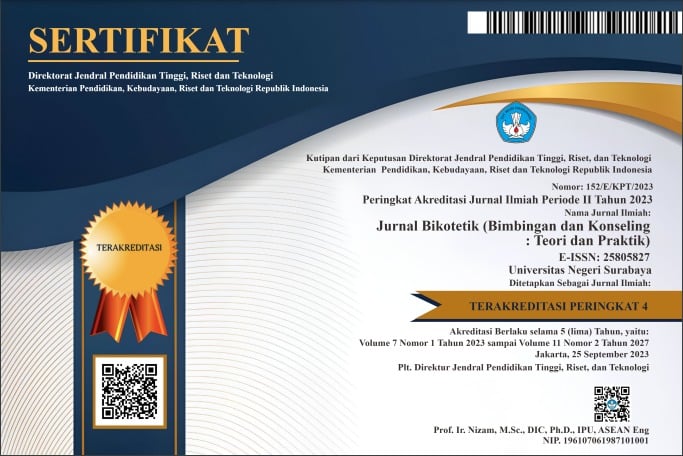
Accredited
In collaboration with

Asosiasi Bimbingan dan Konseling Indonesia (ABKIN)


Peer Review Process
Jurnal Bikotetik (Bimbingan dan Konseling : Teori dan Praktik) applies a double-blind peer review system in accordance with internationally recognized standards of publication ethics and best editorial practices. All manuscripts submitted to the journal are subject to peer review by a minimum of two independent reviewers with relevant expertise. This process aims to ensure the integrity, academic quality, originality, and scholarly contribution of published articles.
The peer review process consists of nine stages, as outlined below.
1.Manuscript Submission
Manuscripts are submitted through the Open Journal System (OJS).
2.Initial Editorial Assessment
The editor conducts an initial assessment to determine the manuscript’s suitability with the journal’s aims and scope and its compliance with the Author Guidelines. At this stage, the editor also evaluates the manuscript for basic academic quality, clarity, and the presence of any major methodological or ethical concerns. Manuscripts that pass this assessment are screened using plagiarism detection software (Turnitin) to identify potential text similarity.
3.Evaluation by the Editor-in-Chief
The Editor-in-Chief assesses the manuscript’s originality, relevance, and contribution to the field. Manuscripts may be desk rejected at this stage if they do not meet the journal’s editorial standards.
4.Reviewer Assignment
The handling editor assigns reviewers based on subject expertise, relevance to the manuscript topic, and the absence of conflicts of interest. The journal adheres to a double-blind review policy, whereby the identities of authors and reviewers are kept confidential throughout the review process.
5.Reviewer Acceptance
Invited reviewers evaluate the invitation based on their expertise, availability, and potential conflicts of interest. Reviewers who are unable to accept the invitation may recommend alternative qualified reviewers.
6.Peer Review
Reviewers conduct an objective and constructive evaluation of the manuscript and provide detailed feedback. Review outcomes may include a recommendation to accept, reject, or revise the manuscript (minor or major revision).
7.Editorial Decision
The Editor-in-Chief and handling editor consider all reviewer reports before making an editorial decision. In cases of divergent reviewer recommendations, an additional reviewer may be consulted to support a fair and balanced decision-making process.
8.Communication of Decision
The editorial decision, together with anonymized reviewer comments, is communicated to the corresponding author. Reviewers are also informed of the outcome of the review process.
9.Finalization and Publication
Manuscripts accepted for publication undergo copy-editing to ensure clarity, consistency, and adherence to journal style. Manuscripts requiring revision must be resubmitted with a clear response to reviewer comments. Minor revisions may be assessed by the editor, while major revisions are typically returned to the reviewers for further evaluation.
Once a manuscript is formally accepted, it is published online and made available in open-access PDF format.
Accredited
In collaboration with
Asosiasi Bimbingan dan Konseling Indonesia (ABKIN)


Publisher
Department of Guidance and Counseling
Faculty of Education
Universitas Negeri Surabaya
[email protected]