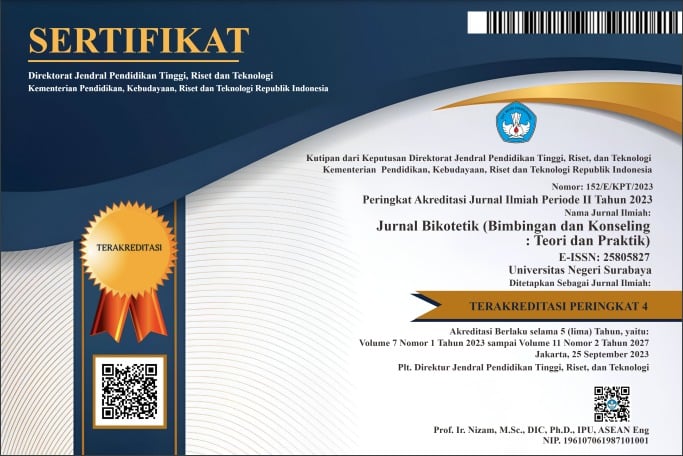
Accredited
In collaboration with

Asosiasi Bimbingan dan Konseling Indonesia (ABKIN)




Jurnal Bikotetik (Bimbingan dan Konseling : Teori dan Praktik) welcomes critical evaluation of published articles as part of continuing scholarly inquiry. Post-publication discussion provides a means to clarify findings, examine alternative interpretations, identify errors, and strengthen the integrity of the scholarly record.
Readers, researchers, and practitioners may submit comments concerning the scientific, theoretical, methodological, ethical, or practical aspects of articles published in the journal.
Submissions should address a clearly defined issue and explain its significance for understanding or evaluating the article. Critiques must engage with the published work through reasoned argument and, where appropriate, supporting evidence. Disagreement with an article’s conclusions is not, by itself, evidence of error or misconduct.
Correspondence must be submitted to the editorial office through the contact details provided on the journal’s official website. Submissions should include:
The title, authors, and DOI or URL of the article concerned.
The contributor’s name, affiliation where applicable, and contact information.
A concise explanation of the issue and its scholarly significance.
Relevant evidence, references, or supporting documentation.
A declaration of relevant financial or nonfinancial interests.
Contributors are responsible for the accuracy of their statements and must protect confidential information, including information concerning research participants and counseling clients.
Editors will assess correspondence for relevance, originality, accuracy, evidential support, and potential value to readers. Independent expert advice or external peer review may be sought when the issues require specialist assessment.
The journal may request revisions or decline submissions that lack a substantive scholarly basis, repeat previously addressed points without new evidence, disclose confidential information, or contain abusive language or personal attacks. Critical correspondence will not be rejected solely because it challenges the journal, its editors, or the conclusions of a published article.
Editors with relevant conflicts of interest will not participate in the assessment or decision-making process.
When correspondence raises a substantive issue, the original authors will normally be invited to respond within a period specified by the editor. Responses must address the concerns directly and support their explanations with evidence where appropriate.
An invitation to respond does not give authors authority to prevent publication of a substantiated critique. Failure to respond will not preclude editorial consideration, publication of correspondence, or further investigation.
Correspondence and author responses may be published when they make a meaningful contribution to scholarly understanding. Publication remains subject to editorial approval and, where appropriate, peer review.
Published contributions will be clearly identified and linked to the article concerned. Editors may publish an accompanying clarification when necessary to explain the issues, evidence, or editorial outcome.
The journal may conclude an exchange when the substantive issues have been adequately addressed or further correspondence offers no additional scholarly contribution.
Concerns about factual errors, analytical problems, ethical breaches, or the reliability of published findings will be assessed under the journal’s publication ethics and correction and retraction policies.
Editorial action will reflect the nature, extent, and consequences of the concern. Where warranted, the journal may issue a correction, an expression of concern, or a retraction. Differences in scholarly interpretation alone do not justify such notices.
Research integrity concerns may be investigated independently of any decision to publish correspondence. Confidential allegations and supporting documents will be handled with appropriate discretion and will not automatically become part of a public discussion.
Jurnal Bikotetik (Bimbingan dan Konseling : Teori dan Praktik) is committed to evaluating post-publication concerns impartially, allowing reasonable opportunities for clarification, and taking proportionate action when the published record requires amendment.
The purpose of post-publication discussion is to advance knowledge and preserve an accurate scholarly record through respectful, transparent, and evidence-based evaluation.
Accredited
In collaboration with
Asosiasi Bimbingan dan Konseling Indonesia (ABKIN)


Publisher
Department of Guidance and Counseling
Faculty of Education
Universitas Negeri Surabaya
[email protected]