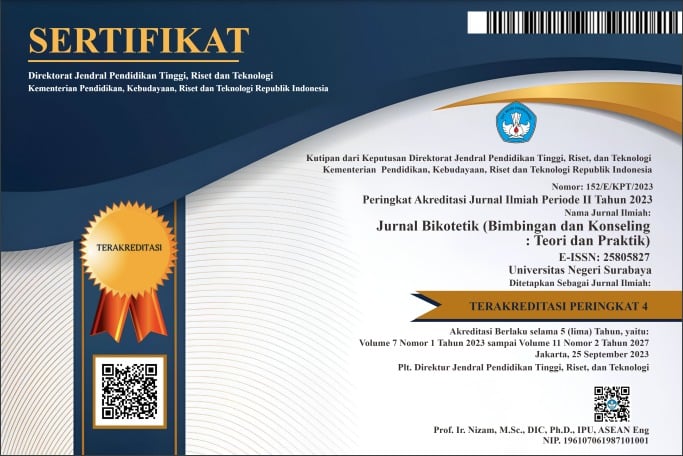
Accredited
In collaboration with

Asosiasi Bimbingan dan Konseling Indonesia (ABKIN)




Jurnal Bikotetik (Bimbingan dan Konseling : Teori dan Praktik) welcomes original scholarly contributions that advance knowledge and inform professional practice in guidance and counseling. Submissions should address a clearly defined question, engage critically with relevant scholarship, and explain how their contribution extends existing understanding within the journal’s focus and scope.
The journal considers the following manuscript types.
Original research articles report empirical investigations of issues relevant to guidance and counseling. Quantitative, qualitative, and mixed-methods studies are welcome, including research on counseling processes and outcomes, intervention development and evaluation, psychological and educational assessment, counselor preparation, and service delivery.
Manuscripts must establish a clear research rationale and demonstrate alignment among the research questions, design, data collection, and analytical procedures. Findings should be interpreted in relation to existing evidence, with appropriate consideration of methodological limitations and the boundaries of the conclusions.
Studies developing or adapting assessment instruments must provide evidence supporting the intended interpretation and use of scores. Intervention studies must describe the intervention, implementation procedures, and outcome assessment sufficiently to permit critical evaluation and, where applicable, replication.
Review articles provide a critical and methodologically transparent synthesis of evidence on a defined issue in guidance and counseling. Eligible submissions include systematic reviews, scoping reviews, meta-analyses, bibliometric and other structured approaches to evidence synthesis.
Manuscripts must justify the review approach and describe the information sources, search procedures, eligibility criteria, study selection, data extraction, and synthesis methods. Critical appraisal and assessment of bias should be undertaken when appropriate to the review design.
Reviews must move beyond summarizing individual publications to examine patterns, inconsistencies, limitations, and unresolved questions across the evidence base. Their contribution should be demonstrated through implications for theory, future research, policy, or counseling practice.
Conceptual and theoretical articles advance guidance and counseling scholarship through the development, refinement, integration, or critical examination of concepts, theories, and explanatory frameworks.
Submissions must identify a substantive conceptual problem, articulate a defensible line of reasoning, and engage critically with relevant literature. Authors should clarify the assumptions, scope, and limitations of their arguments and demonstrate how the proposed contribution differs from existing accounts.
Articles introducing a framework or model should explain its components and relationships, identify its conditions of applicability, and indicate how it may guide empirical inquiry or professional practice. Descriptive overviews without a distinct conceptual contribution are insufficient.
Policy and practice analyses examine consequential issues affecting the organization, accessibility, quality, or ethical delivery of guidance and counseling services. Topics may include professional standards, counselor education and supervision, program governance, culturally responsive services, digital counseling, and institutional or community-based provision.
Submissions must define the issue and context, explain the analytical framework or procedures, and evaluate relevant evidence. Recommendations should follow from the analysis and account for implementation conditions, stakeholder perspectives, and evidential limitations.
Practice-based submissions must generate insights that extend beyond a single activity or setting. Routine program descriptions, event reports, and unsupported opinion pieces do not meet the requirements of this category.
Regardless of manuscript type, submissions must:
Present a clearly identifiable contribution to guidance and counseling.
Situate the work within relevant scholarship and explain the gap or problem addressed.
Provide sufficient methodological or analytical transparency for informed evaluation.
Distinguish evidence-supported conclusions from interpretation, speculation, and recommendations.
Address limitations and avoid claims that exceed the study design or available evidence.
Comply with applicable research ethics, authorship, disclosure, and publication integrity requirements.
Follow the journal’s author guidelines and reporting guidance appropriate to the manuscript’s design.
Research involving human participants must explain applicable ethical review, informed consent or assent, confidentiality safeguards, and participant protection procedures. Any exemption or waiver must be identified and justified.
Submissions are initially assessed for scope, originality, scholarly contribution, methodological or analytical adequacy, and ethical compliance. Manuscripts that do not meet these requirements may be declined without external review.
Suitable submissions proceed to peer review under the journal’s review policy. Editors may request clarification, revision, or reclassification of the manuscript. Publication decisions reflect the quality and significance of the contribution, the strength of the supporting evidence or argument, and the manuscript’s relevance to guidance and counseling scholarship and practice.
Accredited
In collaboration with
Asosiasi Bimbingan dan Konseling Indonesia (ABKIN)


Publisher
Department of Guidance and Counseling
Faculty of Education
Universitas Negeri Surabaya
[email protected]