| ..:: MENU UTAMA ::.. |
Artificial Intelligence Policy

JDMP employs a blind peer-review process for research manuscripts. The editorial team ordinarily seeks assessments from at least two reviewers with relevant subject expertise. Review reports are advisory; the responsible editor makes the publication decision.
Editors and reviewers must protect unpublished manuscripts, avoid unauthorised disclosure, and disclose conflicts of interest. Reviewers should not use manuscript material for personal research or other advantage. The journal does not guarantee acceptance, a particular reviewer outcome, or an exact review duration.
When a revision is requested, authors should observe the deadline specified in the decision letter or request an extension in advance. JDMP's existing public guidance refers to a maximum revision period of eight weeks; any revision of this rule should be applied consistently in editorial correspondence.
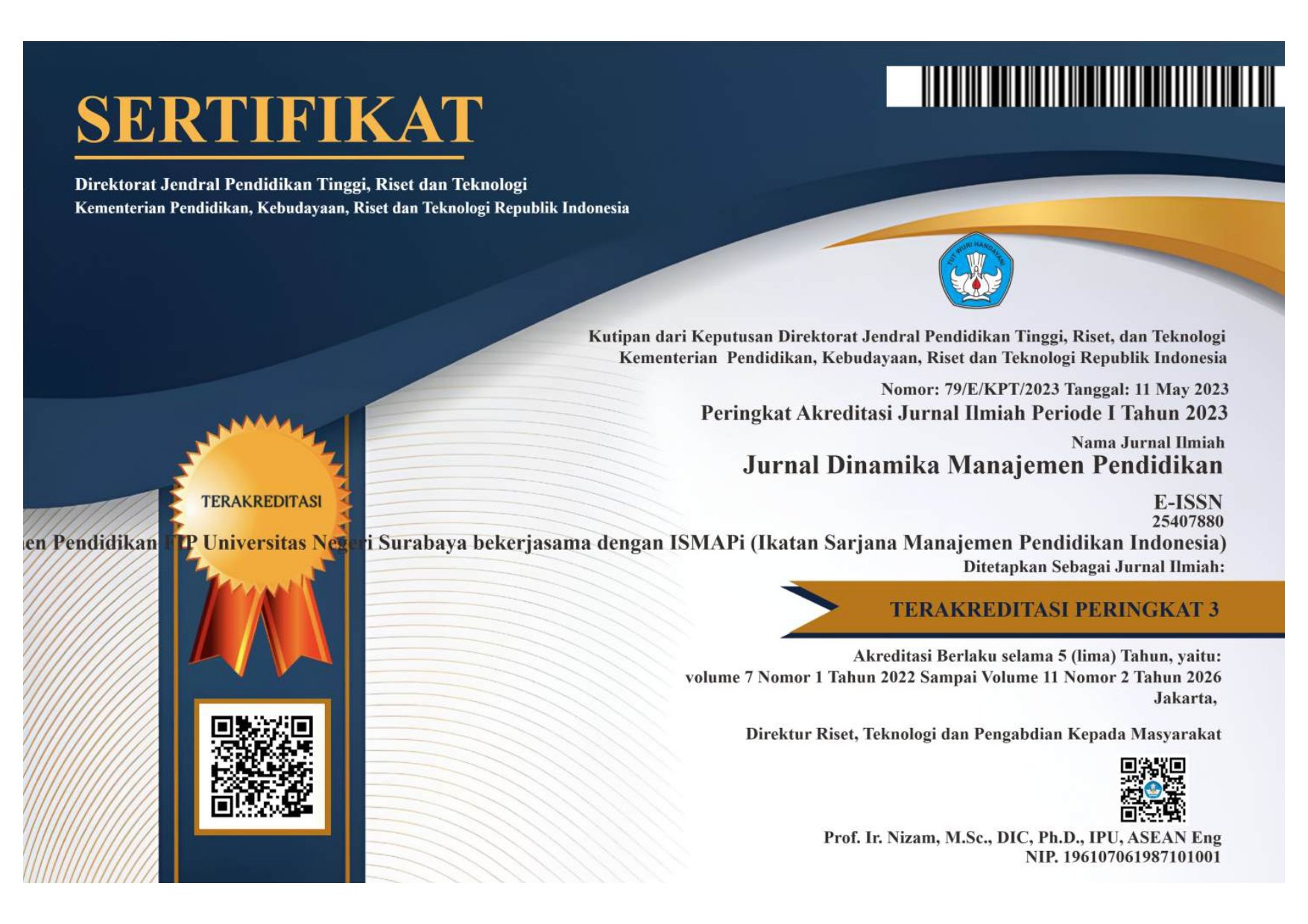
Jurnal Dinamika Manajemen Pendidikan (JDMP) E-ISSN : 2540-7880 Indexing by:









Publisher
Universitas Negeri Surabaya
Website: https://journal.unesa.ac.id/index.php/jdmp
Email: [email protected]
in collaboration with:
ISMAPI (Ikatan Sarjana Manajemen dan Administrasi Pendidikan Indonesia)
Website: http://www.ismapi.or.id/
MoA JDMP-ISMAPI: pdf
and
Asosiasi Prodi Manajemen/Administrasi Pendidikan Indonesia (APMAPI)
MoA JDMP-APMAPI: pdf
Jurnal Dinamika Manajemen Pendidiikan (JDMP) is licensed under a Creative Commons Attribution-ShareAlike 4.0 International License.