| ..:: MENU UTAMA ::.. |
Artificial Intelligence Policy

JDMP is committed to preserving an accurate and transparent scholarly record. Editorial action depends on the nature, severity, and evidential basis of an identified problem. Relevant procedures are informed by recognised publication-ethics guidance, including COPE.
When an error does not invalidate the main findings but requires public clarification, the journal may publish a correction or corrigendum. The notice should identify the original article, describe the amendment, and be linked to the article. Substantive changes should not be made silently.
A retraction may be considered when findings are unreliable, plagiarism or redundant publication is established, research was conducted unethically, the peer-review process was manipulated, or another serious problem materially undermines the article. Authors should have a fair opportunity to respond. A clearly labelled retraction notice explains the reason for retraction and links to the affected article; the original article normally remains accessible and marked as retracted.
When significant unresolved concerns require investigation and the reliability of an article is in doubt, the editor may publish an expression of concern, subject to later update or resolution.
Authors seeking to withdraw a manuscript that has not been published must promptly send a reasoned request to the editor. Requests will be considered in light of the manuscript's editorial status and documented circumstances. Withdrawal of an unpublished submission is distinct from retraction of a published article. JDMP does not impose automatic multi-year penalties merely for making a reasonable withdrawal request.
Complete removal of published material is considered only in exceptional circumstances, such as a serious legal or privacy risk. Whenever possible, a public notice and the bibliographic record should remain available.
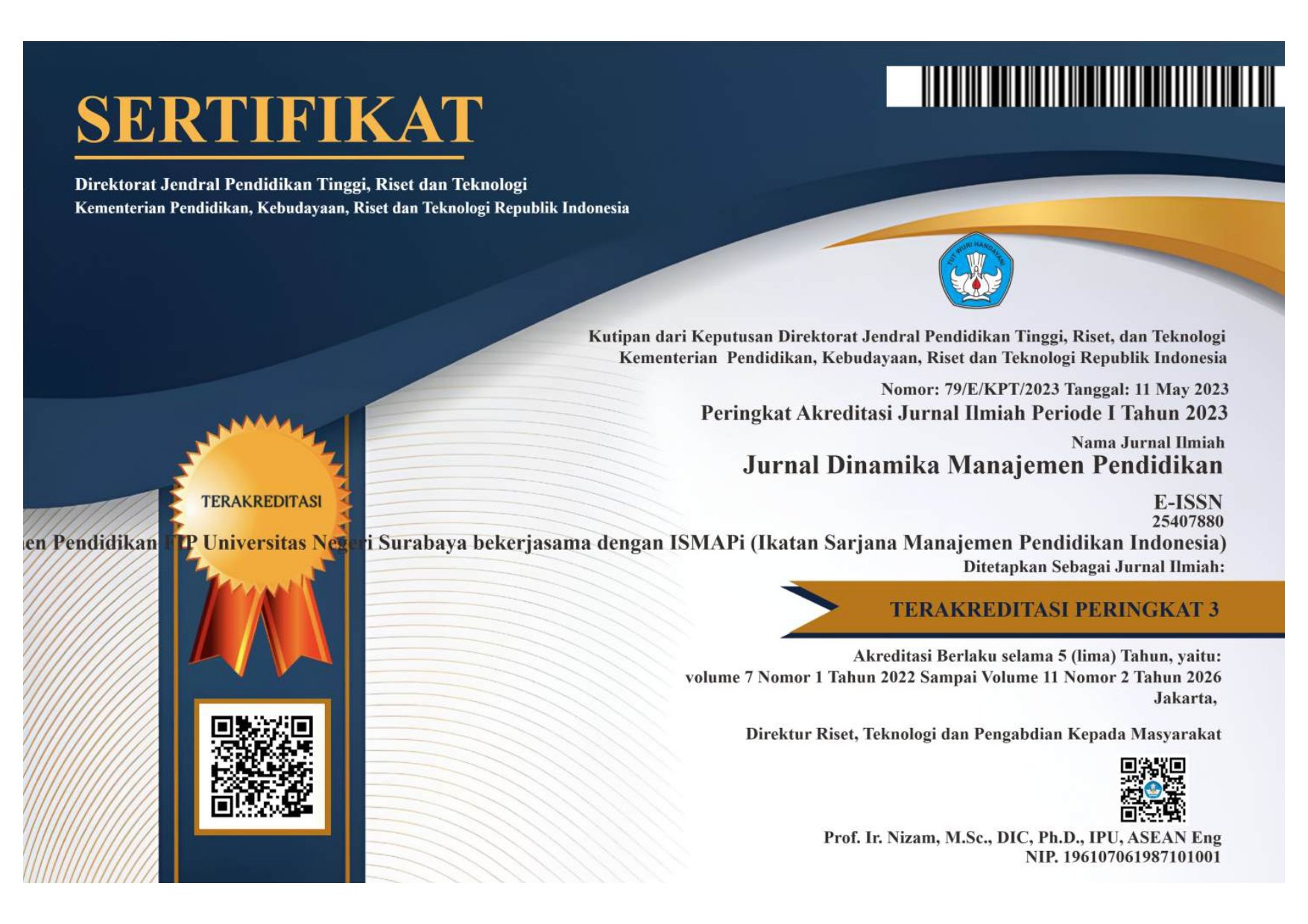
Jurnal Dinamika Manajemen Pendidikan (JDMP) E-ISSN : 2540-7880 Indexing by:









Publisher
Universitas Negeri Surabaya
Website: https://journal.unesa.ac.id/index.php/jdmp
Email: [email protected]
in collaboration with:
ISMAPI (Ikatan Sarjana Manajemen dan Administrasi Pendidikan Indonesia)
Website: http://www.ismapi.or.id/
MoA JDMP-ISMAPI: pdf
and
Asosiasi Prodi Manajemen/Administrasi Pendidikan Indonesia (APMAPI)
MoA JDMP-APMAPI: pdf
Jurnal Dinamika Manajemen Pendidiikan (JDMP) is licensed under a Creative Commons Attribution-ShareAlike 4.0 International License.