| ..:: MENU UTAMA ::.. |
Artificial Intelligence Policy
JDMP requires submissions to be original, properly attributed, and not simultaneously under consideration by another journal. Plagiarism, unattributed paraphrasing, fabricated citations, duplicate publication, and inappropriate reuse of an author's own previously published text are unacceptable.
Manuscripts are checked for textual similarity using Turnitin or an equivalent approved screening tool as part of editorial assessment. A similarity report is not a plagiarism verdict: editors examine the context of matches, the nature of the sources, quotations, references, methodology descriptions, and legitimate overlap.
Depending on the seriousness and nature of the concern, the journal may request explanation or revision, reject the manuscript, contact relevant parties or institutions, or initiate a post-publication investigation. Authors will ordinarily be given an opportunity to respond to substantive concerns.
Manuscripts derived from theses, dissertations, preprints, or related research outputs must disclose the relationship to earlier versions and provide appropriate citations. Legitimate prior dissemination does not automatically establish misconduct, but duplicate publication and misleading claims of originality are prohibited.
There is no automatic acceptance or rejection based solely on a single similarity percentage. Editorial decisions are based on a reasoned assessment of originality, attribution, and research integrity.
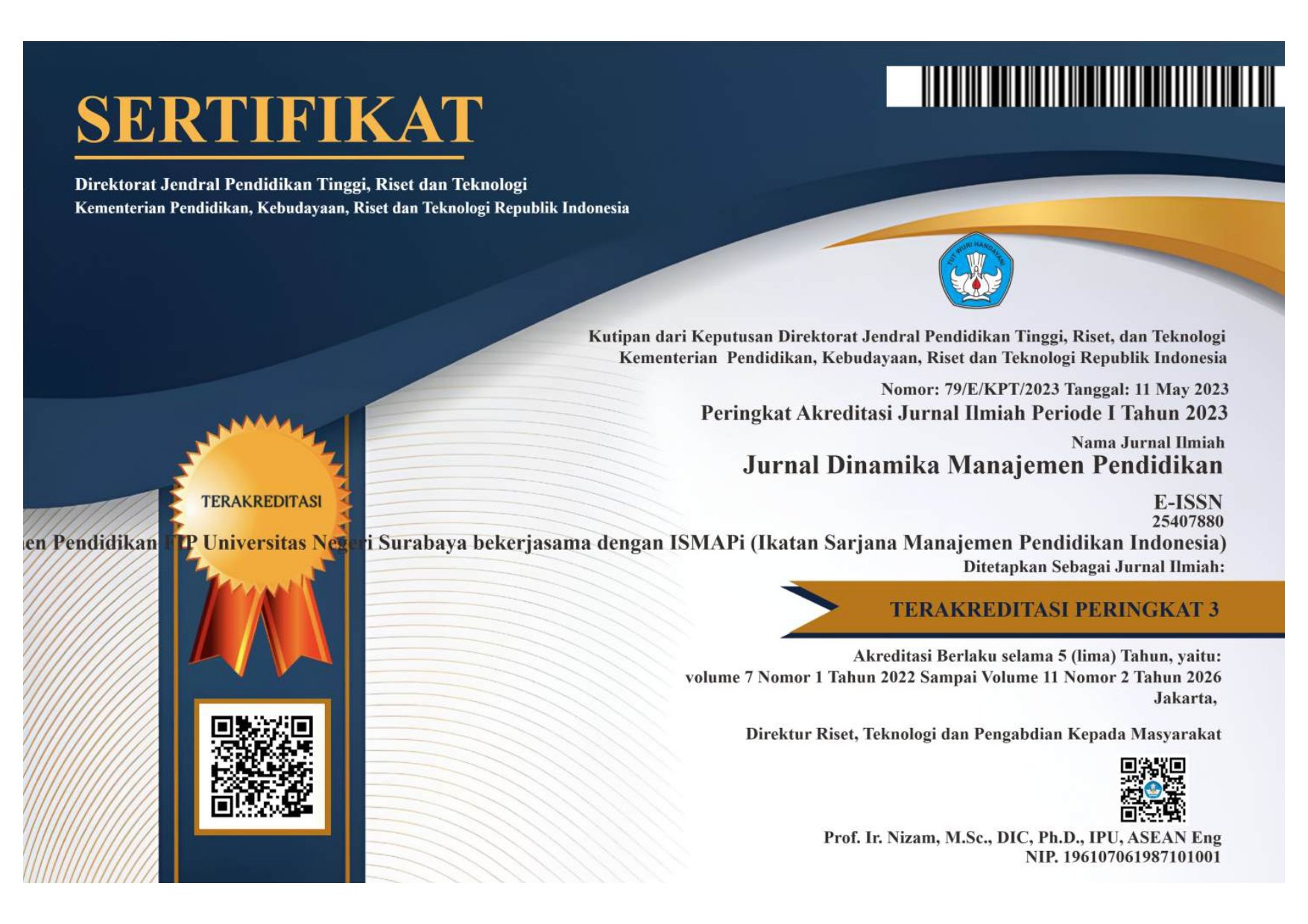
Jurnal Dinamika Manajemen Pendidikan (JDMP) E-ISSN : 2540-7880 Indexing by:









Publisher
Universitas Negeri Surabaya
Website: https://journal.unesa.ac.id/index.php/jdmp
Email: [email protected]
in collaboration with:
ISMAPI (Ikatan Sarjana Manajemen dan Administrasi Pendidikan Indonesia)
Website: http://www.ismapi.or.id/
MoA JDMP-ISMAPI: pdf
and
Asosiasi Prodi Manajemen/Administrasi Pendidikan Indonesia (APMAPI)
MoA JDMP-APMAPI: pdf
Jurnal Dinamika Manajemen Pendidiikan (JDMP) is licensed under a Creative Commons Attribution-ShareAlike 4.0 International License.