| ..:: MENU UTAMA ::.. |
Artificial Intelligence Policy
JDMP requires authors, reviewers, and editors to disclose interests or relationships that could influence, or be reasonably perceived to influence, their scholarly judgement. Relevant interests may be financial, institutional, professional, personal, academic, or otherwise related to the work.
Authors must disclose funding sources, relevant relationships, and competing interests at submission. Where no competing interests exist, authors may state: "The authors declare that they have no competing interests." Financial support should be acknowledged separately, even when it does not constitute a competing interest.
Invited reviewers must disclose conflicts involving the authors, institutions, subject matter, collaborations, competition, or personal relationships. They must decline the invitation when impartial review cannot be ensured and must not use confidential manuscript information for personal advantage.
An editor with a relevant conflict must not manage the affected manuscript. Responsibility should be transferred to another qualified editor or an independent person. Editorial decisions must be based on the quality and integrity of the work, not on payment of publication fees or institutional affiliations.
Disclosure does not automatically disqualify a manuscript. The editor evaluates the nature of the interest and may request clarification, independent handling, an amended disclosure, or another appropriate safeguard. Material undisclosed conflicts discovered after publication may lead to a public correction or other action.
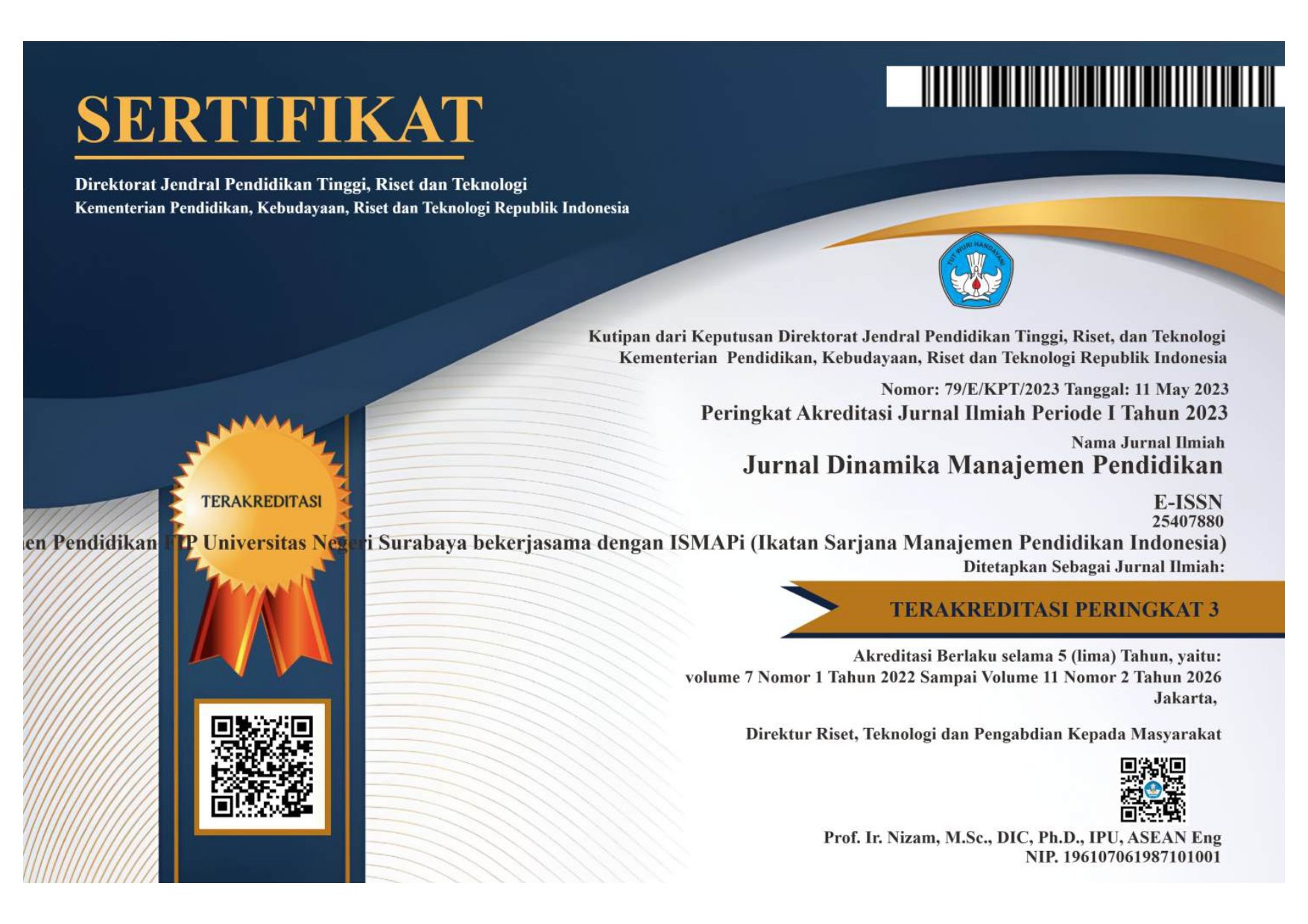
Jurnal Dinamika Manajemen Pendidikan (JDMP) E-ISSN : 2540-7880 Indexing by:









Publisher
Universitas Negeri Surabaya
Website: https://journal.unesa.ac.id/index.php/jdmp
Email: [email protected]
in collaboration with:
ISMAPI (Ikatan Sarjana Manajemen dan Administrasi Pendidikan Indonesia)
Website: http://www.ismapi.or.id/
MoA JDMP-ISMAPI: pdf
and
Asosiasi Prodi Manajemen/Administrasi Pendidikan Indonesia (APMAPI)
MoA JDMP-APMAPI: pdf
Jurnal Dinamika Manajemen Pendidiikan (JDMP) is licensed under a Creative Commons Attribution-ShareAlike 4.0 International License.