| ..:: MENU UTAMA ::.. |
Artificial Intelligence Policy

JDMP is committed to responsible scholarly publishing, editorial independence, fairness, confidentiality, and the integrity of the academic record. These principles apply to the publisher, editors, reviewers, authors, and all parties involved in publication. JDMP's procedures are informed by recognised good publication practices, including guidance issued by the Committee on Publication Ethics (COPE); this reference does not imply that JDMP is a COPE member.
Editors evaluate submissions on scholarly merit, relevance to educational management, originality, methodological quality, ethical compliance, and clarity. They maintain confidentiality of unpublished work, select qualified reviewers, manage conflicts of interest, and make independent decisions that are not influenced by publication charges or inappropriate outside interests. When credible concerns arise, editors seek evidence, provide reasonable opportunities to respond, and take proportionate corrective action.
Reviewers should accept assignments only when they possess appropriate expertise and can provide a timely, impartial assessment. They must protect confidential manuscripts and review materials, disclose conflicts of interest, avoid appropriating unpublished ideas, and provide constructive, evidence-based feedback. Reviewers must alert the editor to suspected plagiarism, overlapping publication, ethical issues, or major methodological weaknesses.
Authors must submit original work, accurately report methods and findings, appropriately acknowledge sources and contributions, identify all qualifying co-authors, and disclose funding and competing interests. They must obtain and report research ethics approval or exemption and informed consent where applicable, retain appropriate research records, respond professionally to peer review, and promptly report any material errors discovered after publication. Fabrication, falsification, plagiarism, manipulated citations, and simultaneous journal submission are prohibited.
Research involving people or identifiable institutional records must comply with applicable ethics and data-protection requirements. Participation should be voluntary where consent is required, and confidentiality should be protected. Authors should avoid sharing identifiable information without authorisation and must not make claims of ethical approval that they cannot substantiate.
The publishing institution supports suitable governance, operational continuity, transparent policies, ethical complaint-handling, and correction of the scholarly record when warranted. The publisher should safeguard editorial independence, ensure appropriate management of personal data, and support the investigation of credible concerns.
Suspected misconduct is assessed fairly, confidentially where appropriate, and with attention to evidence and due process. Depending on the case, JDMP may request clarification, reject a manuscript, notify relevant institutions, publish corrections or expressions of concern, or retract a published article. The full procedures are detailed in the journal's misconduct and correction policies.
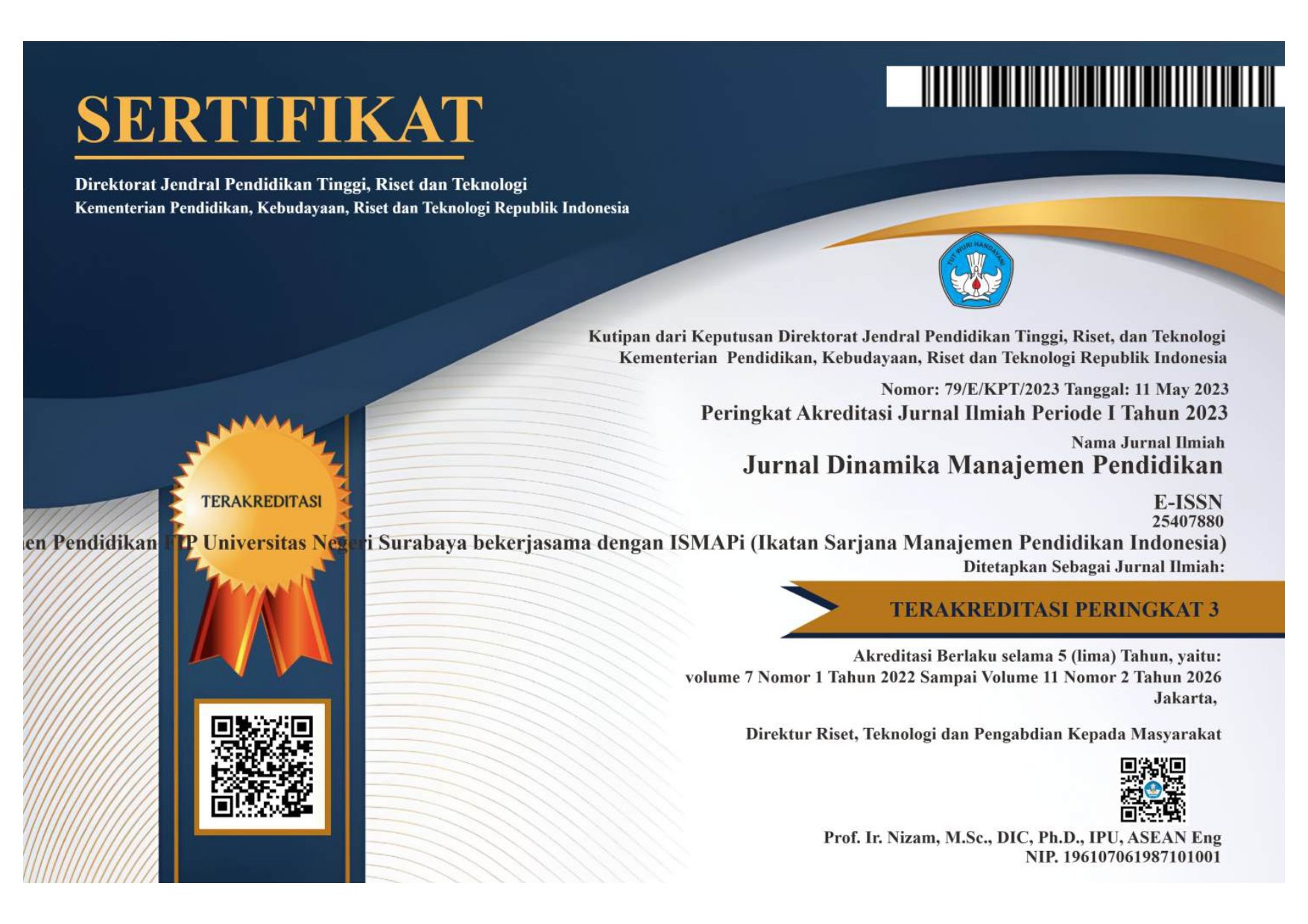
Jurnal Dinamika Manajemen Pendidikan (JDMP) E-ISSN : 2540-7880 Indexing by:









Publisher
Universitas Negeri Surabaya
Website: https://journal.unesa.ac.id/index.php/jdmp
Email: [email protected]
in collaboration with:
ISMAPI (Ikatan Sarjana Manajemen dan Administrasi Pendidikan Indonesia)
Website: http://www.ismapi.or.id/
MoA JDMP-ISMAPI: pdf
and
Asosiasi Prodi Manajemen/Administrasi Pendidikan Indonesia (APMAPI)
MoA JDMP-APMAPI: pdf
Jurnal Dinamika Manajemen Pendidiikan (JDMP) is licensed under a Creative Commons Attribution-ShareAlike 4.0 International License.