| ..:: MENU UTAMA ::.. |
Artificial Intelligence Policy

JDMP supports responsible and transparent use of artificial intelligence (AI) tools when such use assists, rather than replaces, human scholarship and editorial judgement. All authors remain fully responsible for the accuracy, originality, citations, analysis, and ethical integrity of their manuscripts.
AI-assisted tools may be used for language editing, readability, translation assistance, coding support, or other legitimate research-support tasks, provided authors independently verify the output and comply with research ethics, privacy, confidentiality, and intellectual-property obligations. Substantive AI use that affects manuscript development, analysis, visualisation, or writing should be transparently disclosed in an appropriate section, identifying the tool and the purpose of its use.
Authors must not fabricate research participants, data, results, citations, quotations, ethics approvals, or references by using AI. AI-generated material must not be presented as independently verified evidence. Images, tables, and analysis outputs must accurately represent the underlying study and be described honestly. Confidential personal or unpublished data must not be uploaded to external AI systems without proper authorisation and safeguards.
AI tools cannot qualify as authors, sign agreements, approve manuscripts, or take responsibility for scholarly claims. Human authors must check citations, calculations, interpretations, and statements produced with AI assistance.
Unpublished submissions and confidential reviewer reports must not be entered into unauthorised public AI tools. Editorial decisions, assessment of reviewer reports, ethical judgements, and final acceptance or rejection remain the responsibility of human editors. Reviewers are responsible for the substance and confidentiality of their assessments.
Where AI-related concerns arise, the editorial team evaluates them on a case-by-case basis in line with the journal's research-integrity procedures. Use of AI detection scores alone does not establish misconduct.
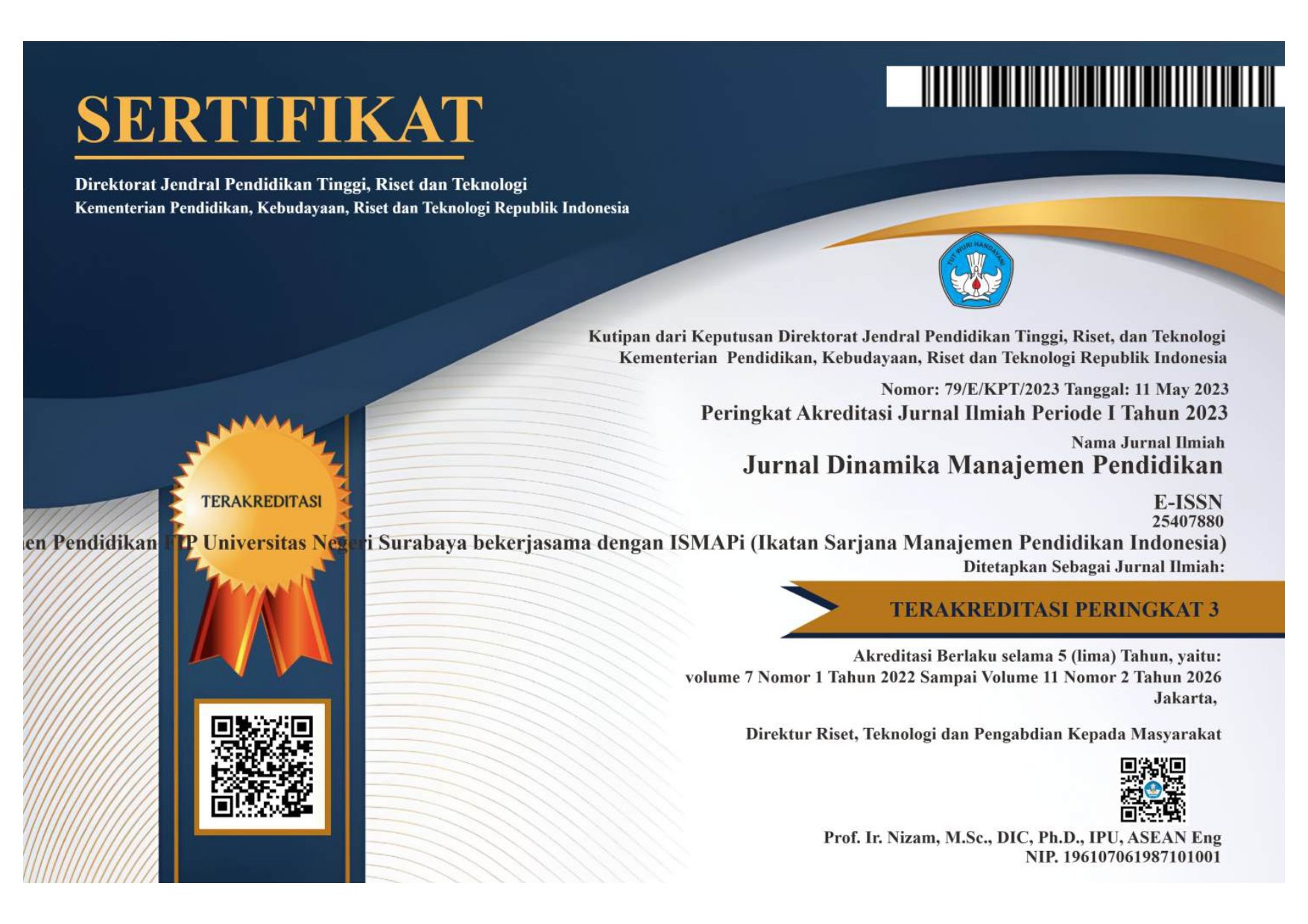
Jurnal Dinamika Manajemen Pendidikan (JDMP) E-ISSN : 2540-7880 Indexing by:









Publisher
Universitas Negeri Surabaya
Website: https://journal.unesa.ac.id/index.php/jdmp
Email: [email protected]
in collaboration with:
ISMAPI (Ikatan Sarjana Manajemen dan Administrasi Pendidikan Indonesia)
Website: http://www.ismapi.or.id/
MoA JDMP-ISMAPI: pdf
and
Asosiasi Prodi Manajemen/Administrasi Pendidikan Indonesia (APMAPI)
MoA JDMP-APMAPI: pdf
Jurnal Dinamika Manajemen Pendidiikan (JDMP) is licensed under a Creative Commons Attribution-ShareAlike 4.0 International License.