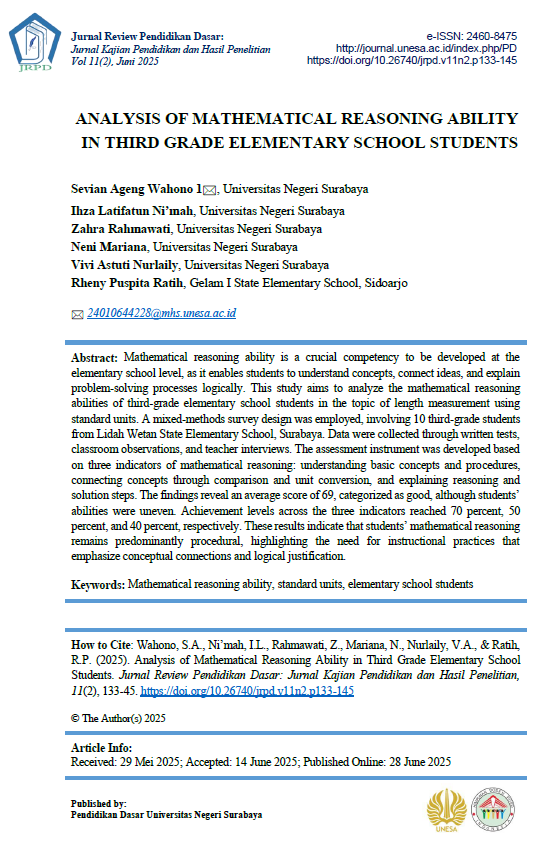
Analysis of Mathematical Reasoning Ability in Third Grade Elementary School Students
DOI:
https://doi.org/10.26740/jrpd.v11n2.p133-145Keywords:
Mathematical reasoning ability, Standard units, elementary school studentsAbstract
Mathematical reasoning ability is a crucial competency to be developed at the elementary school level, as it enables students to understand concepts, connect ideas, and explain problem-solving processes logically. This study aims to analyze the mathematical reasoning abilities of third-grade elementary school students in the topic of length measurement using standard units. A mixed-methods survey design was employed, involving 10 third-grade students from Lidah Wetan State Elementary School, Surabaya. Data were collected through written tests, classroom observations, and teacher interviews. The assessment instrument was developed based on three indicators of mathematical reasoning: understanding basic concepts and procedures, connecting concepts through comparison and unit conversion, and explaining reasoning and solution steps. The findings reveal an average score of 69, categorized as good, although students’ abilities were uneven. Achievement levels across the three indicators reached 70 percent, 50 percent, and 40 percent, respectively. These results indicate that students’ mathematical reasoning remains predominantly procedural, highlighting the need for instructional practices that emphasize conceptual connections and logical justification.
References
Akuba, S. F., Purnamasari, D., & Firdaus, R. (2020). Pengaruh Kemampuan Penalaran, Efikasi Diri dan Kemampuan Memecahkan Masalah Terhadap Penguasaan Konsep Matematika. JNPM (Jurnal Nasional Pendidikan Matematika), 4(1), 44–60. https://doi.org/10.33603/jnpm.v4i1.2827
Aprilianti, Y., & Zanthy, L. S. (n.d.). ANALISIS KEMAMPUAN PENALARAN MATEMATIK SISWA SMP PADA MATERI SEGIEMPAT DAN SEGITIGA. Journal On Education, 1(2), 524–534.
Arianto, A. S., Sulianto, J., & Azizah, M. (2019). ANALISIS KEMAMPUAN PENALARAN MATEMATIS SISWA KELAS IV SDN GAYAMSARI 02 DI KOTA SEMARANG. Jurnal Sinektik, 2(2), 136–149.
Ariawan, R., & Nufus, H. (2017). Hubungan Kemampuan Pemecahan Masalah Matematis dengan Kemampuan Komunikasi Matematis Siswa. Jurnal THEOREMS (The Original Research of Mathematics), 1(2), 82–91.
Belinda, L. N., Irianto, D. M., & Yuniarti, Y. (2023). ANALISIS KESULITAN BELAJAR OPERASI HITUNG PEMBAGIAN MATEMATIKA PADA SISWA KELAS 3. Jurnal Review Pendidikan Dasar, 9(1). http://journal.unesa.ac.id/index.php/PD
Bernard, M., & Senjayawati, E. (2019). Developing the Students’ Ability in Understanding Mathematics and Self-confidence with VBA for Excel. Journal of Research and Advances in Mathematics Education, 2019(1), 45–56. http://journals.ums.ac.id/index.php/jramathedu
Dewi, M. P., & Ansori, Y. Z. (2023). Penerapan Model Problem Based Learning Terhadap Kemampuan Penalaran Matematis Siswa. Jurnal Pendidikan Matematika, 2(1), 24–29.
Early childhood development For every child, early moments matter. (n.d.). Unicef. https://www.unicef.org/early-childhood-development
Fajri, M. (2017). KEMAMPUAN BERPIKIR MATEMATIS DALAM KONTEKS PEMBELAJARAN ABAD 21 DI SEKOLAH DASAR. Lemma : Letters of Mathematics Education, 3(2), 1–11. https://doi.org/https://doi.org/10.22202/jl.2017.v3i2.1884
Fu’adiah, D. (2017). Pengembangan Penalaran Kuantitatif di Sekolah Dasar untuk Mengembangkan Berpikir Aljabar di Sekolah Menengah Pertama. Jurnal Riset Pendidikan Dan Inovasi Pembelajaran Matematika, 1(1), 19–29.
Fuadi, R., Johar, R., & Munzir, S. (2016). Peningkatkan Kemampuan Pemahaman dan Penalaran Matematis melalui Pendekatan Kontekstual. Jurnal Didaktika Matematika, 3(1), 47–54.
Harvard University. (n.d.). Brain Architecture. Center on the Developing Child at Harvard University. https://developingchild.harvard.edu/key-concept/brain-architecture/
Hiebert, J., Carpenter, T. P., Fennema, elizabeth, Fuson, K. C., Wearne, D., Murray, H., Olivier, A., & Human, P. (1997). Making Sense: Teaching and Learning Mathematics with Understanding. Heinemann.
Huda, S., Mujib, A., & Ramdhani, S. (2024). Analisis Kemampuan Penalaran Matematis Siswa Kelas VII Berdasarkan Gaya Kognitif Field Independent dan Dependent. Jurnal Didaktika Pendidikan Dasar, 8(3), 1153–1176. https://doi.org/10.26811/didaktika.v8i3.1619
Jusniani, N., & Nurmasidah, L. (2021). PENERAPAN MODEL PEMBELAJARAN GENERATIF UNTUK MENINGKATKAN KEMAMPUAN KOMUNIKASI MATEMATIS SISWA. Jurnal Ilmiah Matematika Realistik (JI-MR, 2(2), 12–19.
Khoirina, H. P., Nengsih, M. R., & Riswari, L. A. (2023). ANALISIS PENALARAN MATEMATIS MATEMATIKA SISWA KELAS IV SD DI DESA GONDANGMANIS. Cartesius: Jurnal Pendidikan Matematika, 6(2), 47–54. https://ejournal.ust.ac.id/index.php/CARTESIUS/article/view/2764
Kilpatrick, J., Swafford, J., & Findell, B. (2001). Adding it all up : how children learn mathematics. National Academy Press ; BRAD.
Loliyana, Hermawan, J. S., Tias, I. W. U., Rohman, F., Izzatika, A., & Muafifah, S. (2023). 3D Geometry Learning Using GeoGebra on Students’ Mathematical Reasoning Ability. PRIMARY: JURNAL PENDIDIKAN GURU SEKOLAH DASAR, 12(6), 1407–1414. https://doi.org/10.33578/jpfkip.v12i6.10253
Manurung, O., & Kartono. (2016). KETERAMPILAN PENALARAN INDUKTIF DEDUKTIF DAN KEMAMPUAN REPRESENTASI MATEMATIS SISWA PADA PEMBELAJARAN CTL BERBASIS HANDS ON ACTIVITY. Unnes Journal of Mathematics Education Research, 5(2), 155–165. http://journal.unnes.ac.id/sju/index.php/ujmer
Muzaini, M., Hasbi, M., & Nasrun, N. (2021). The Role of Students’ Quantitative Reasoning in Solving Mathematical Problems Based on Cognitive Style. Vygotsky: Jurnal Pendidikan Matematika Dan Matematika, 3(2), 87. https://doi.org/10.30736/voj.v3i2.380
NCTM. (2000). Principles Standards and for.
Norlita, D., Nageta, P. W., & Riswaris, L. A. (2023). ANALISIS KEMAMPUAN PENALARAN MATEMATIKA TERHADAP SISWA SEKOLAH DASAR KELAS V. JISPENDIORA : JURNAL ILMU SOSIAL, PENDIDIKAN DAN HUMANIORA, 2(1).
Nurfitriyanti, M., Kusumawardani, R., & Lestari, I. (2020). Kemampuan Representasi Matematis Peserta Didik Ditinjau Penalaran Matematis pada Pembelajaran Berbasis Masalah. Jurnal Gantang, 5(1), 19–28. https://doi.org/10.31629/jg.v5i1.1665
Putri, D. K., Sulianto, J., & Azizah, M. (2019). Kemampuan Penalaran Matematis Ditinjau dari Kemampuan Pemecahan Masalah. International Journal of Elementary Education, 3(3), 351–357. https://ejournal.undiksha.ac.id/index.php/IJEE
Putri, N., & Satriyani, F. Y. (2024). Pengembangan Multimedia Fabel Berbasis Powerpoint Pada Materi Satuan Baku (Berat Dan Panjang) Di Kelas III SDN Kuningan Barat 01 Pagi Jakarta. Jurnal Wahana Pendidikan, 11(1), 1–12. https://doi.org/10.25157/jwp.v%vi%i.9730
Rahmadani, D., & Trimurtini. (2025). The Effectiveness of Realistic Mathematics Education and Audiovisual Media Learning on Student’s Mathematical Representation Ability Article Information. JURNAL GENTALA PENDIDIKAN DASAR, 10(3), 721–736. https://doi.org/10.22437/gentala.v4i1.xxxxx
Rahman, A., & Wandhini, R. R. (2024). Pengaruh Gaya Belajar dan Minat Belajar terhadap Penalaran Matematika di Sekolah Dasar. Jurnal Pendidikan Tambusai, 8(1), 2744–2746.
Ramadhanti, M. I., & Marlina, R. (2022). Analisis Kemampuan Penalaran Matematis Siswa Kelas VIII Dalam Menyelesaikan Soal Timss Pada Materi Aljabar. Jurnal Pendidikan Dan Konseling, 4(6), 6326–6333.
Rott, B. (2021). Inductive and deductive justification of knowledge: epistemological beliefs and critical thinking at the beginning of studying mathematics. Educational Studies in Mathematics, 106(1), 117–132. https://doi.org/10.1007/s10649-020-10004-1
Sari, D. P. (2016). BERPIKIR MATEMATIS DENGAN METODE INDUKTIF, DEDUKTIF, ANALOGI, INTEGRATIF DAN ABSTRAK. Delta-Pi: Jurnal Matematika Dan Pendidikan Matematika, 5(1), 79–89.
Skemp, R. R. (1978). Relational Understanding and Instrumental Understanding.
Solihin, A., & Rahmawati, I. (2024). KOMET-QR: KARTU EKSPLORASI ETNOMATEMATIKA-QR PADA MATERI BANGUN DATAR KELAS IV SEKOLAH DASAR. Jurnal Review Pendidikan Dasar, 10(01), 64–79. http://journal.unesa.ac.id/index.php/PD
Tampubolon, F., Yusmin, E., & Ahmad, D. (n.d.). PENALARAN KUANTITATIF SISWA SMA DALAM MENYELESAIKAN SOAL ESSAY MATERI TRIGONOMETRI.
Utama, R. W., & Masyhud, M. S. (2024). Hubungan antara Asesmen Kompetensi Minimum dan Kemampuan Berpikir Tingkat Tinggi pada Pembelajaran Matematika Siswa Kelas V di Sekolah Dasar. Jurnal Review Pendidikan Dasar, 10(03), 187–196. http://journal.unesa.ac.id/index.php/PD
Van den Heuvel-Panhuizen, M., & Elia, I. (2020). Mapping kindergartners’ quantitative competence. ZDM - Mathematics Education, 52(4), 805–819. https://doi.org/10.1007/s11858-020-01138-w
Wardani, I. K., Nugroho, A. C., Sabekti, M., Murtiyasa, B., & Setyaningsih, N. (2024). PENGARUH LINGKUNGAN BELAJAR TERHADAP HASIL BELAJAR MATEMATIKA SISWA SD. JRIP: Jurnal Riset Dan Inovasi Pembelajaran, 4(1), 534–546.
Wardani, R. K., & Amidi. (2025). Kemampuan Penalaran Matematis Ditinjau dari Minat Belajar Siswa dengan Model Problem Based Learning Berbantuan Mathigon. Jurnal Ilmiah Literasi Indonesia, 1(1), 183–193. https://doi.org/10.63822/s0amny98
Wulandari, D. A., Zaman, W. I., & Mukmin, B. A. (2020). STRATEGI PEMBELAJARAN PROBLEM POSING DALAM MENENTUKAN PANJANG SATUAN BAKU PADA SEKOLAH DASAR.
Downloads
Published
How to Cite
Issue
Section
License
Copyright (c) 2025 Jurnal Review Pendidikan Dasar : Jurnal Kajian Pendidikan dan Hasil Penelitian

This work is licensed under a Creative Commons Attribution 4.0 International License.
 Abstract views: 92
,
Abstract views: 92
, PDF Downloads: 92