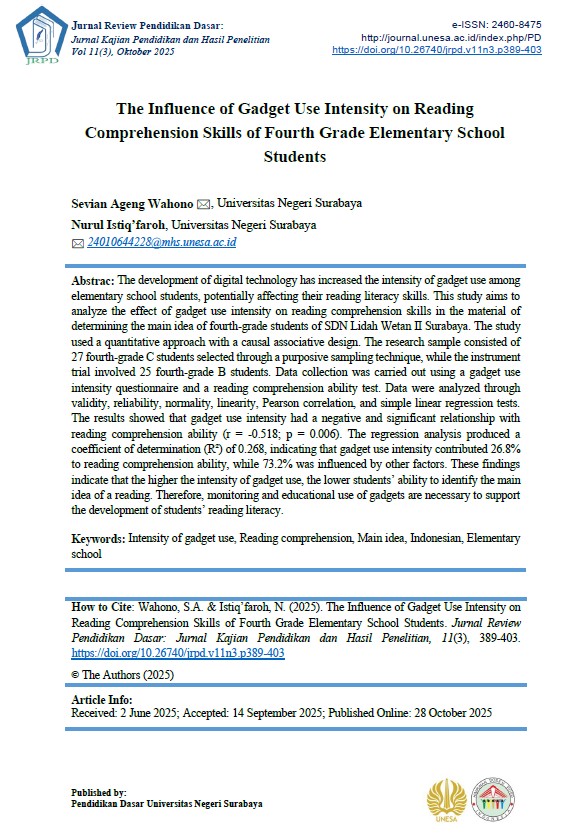
The Influence of Gadget Use Intensity on Reading Comprehension Skills of Fourth Grade Elementary School Students
DOI:
https://doi.org/10.26740/jrpd.v11n3.p389-403Keywords:
Reading Comprehension, The intencities using gadget, Elementary SchoolAbstract
The development of digital technology has increased the intensity of gadget use among elementary school students, potentially affecting their reading literacy skills. This study aims to analyze the effect of gadget use intensity on reading comprehension skills in the material of determining the main idea of fourth-grade students of SDN Lidah Wetan II Surabaya. The study used a quantitative approach with a causal associative design. The research sample consisted of 27 fourth-grade C students selected through a purposive sampling technique, while the instrument trial involved 25 fourth-grade B students. Data collection was carried out using a gadget use intensity questionnaire and a reading comprehension ability test. Data were analyzed through validity, reliability, normality, linearity, Pearson correlation, and simple linear regression tests. The results showed that gadget use intensity had a negative and significant relationship with reading comprehension ability (r = -0.518; p = 0.006). The regression analysis produced a coefficient of determination (R²) of 0.268, indicating that gadget use intensity contributed 26.8% to reading comprehension ability, while 73.2% was influenced by other factors. These findings indicate that the higher the intensity of gadget use, the lower students’ ability to identify the main idea of a reading. Therefore, monitoring and educational use of gadgets are necessary to support the development of students’ reading literacy.
References
Apfani, S., Suryani, A. I., Ramadhan, S., Sukma, E., Jamalluddin, N. B., & Sihes, J. Bin. (2026). Instructional Pedagogical Strategies for Reading Comprehension in Elementary Schools: A Problem-Based Analysis. Tekno-Pedagogi: Jurnal Teknologi Pendidikan, 16(1), 69-78.
Budiantoro, E., Sukartiningsih, W., & Istiq’faroh, N. (2024). Analisis kebutuhan awal keterampilan membaca pemahaman siswa sekolah dasar di era society 5.0. Pendas: Jurnal Ilmiah Pendidikan Dasar, 9(04), 231-242.
Chen, J., Lin, C.-H., & Chen, G. (2021). A cross-cultural perspective on the relationships among social media use, self-regulated learning and adolescents’ digital reading literacy. Computers & Education, 175, 104322.
Damaiyanti, R., Mardiana, D., & Dilla, W. P. (2024). Analisis kesulitan belajar Bahasa Indonesia materi menentukan ide pokok dan ide pendukung pada siswa kelas IV sekolah dasar. Jurnal Pendidikan Dasar Dan Menengah, 2(2), 103-120.
Dorris, C., Winter, K., O’Hare, L., & Lwoga, E. T. (2024). Mobile device use in the primary school classroom and impact on pupil literacy and numeracy attainment: A systematic review. Campbell Systematic Reviews, 20(2), cl2-1417.
Fierdiansyah, D. R., Sukartiningsih, W., Istiq’faroh, N., & Hendratno, H. (2024). Analisis Kebutuhan Awal Penggunaan Model Pembelajaran Berdeferensiasi Berbantuan Buku Cerita Bergambar terhadap Peningkatan Kemampuan Membaca Pemahaman dan Motivasi Belajar untuk Siswa Kelas IV Sekolah Dasar. Pendas: Jurnal Ilmiah Pendidikan Dasar, 9(04), 211-220.
Fitri, F., Arwan, A., & Suryaningsih, S. (2026). Hubungan Intensitas Penggunaan Gadget dengan Hasil Belajar Siswa Sekolah Dasar. Pendikdas: Jurnal Pendidikan Dasar, 7(1), 225-231.
Furenes, M. I., Kucirkova, N., & Bus, A. G. (2021). A comparison of children’s reading on paper versus screen: A meta-analysis. Review of Educational Research, 91(4), 483-517.
Gusmiva, A., Masyitah, A., Zuhriana, W. A., & Pangestuti, D. (2026). ANALISIS KESULITAN MEMBACA PEMAHAMAN SISWA KELAS IV SDN 14/I SUNGAI BAUNG DALAM PEMBELAJARAN BAHASA INDONESIA. Didaktik: Jurnal Ilmiah PGSD STKIP Subang, 12(02), 167-184.
Hafid, A., Pada, A., & Rosmalah, S. J. (2024). Investigating Elementary School Students’ Reading Comprehension Abilities: Responses to HOTS-Based Questions.
Hare, C., Johnson, B., Vlahiotis, M., Panda, E. J., Tekok‐Kilic, A., & Curtin, S. (2024). Children’s reading outcomes in digital and print mediums: A systematic review. Journal of Research in Reading, 47(3), 309-329.
Herlina, N., & Istiq’faroh, N. (2025). Pengembangan media buku digital cerita fabel bergambar menggunakan aplikasi PicsArt untuk keterampilan membaca pemahaman pada siswa sekolah dasar kelas IV. Jurnal Penelitian Pendidikan Guru Sekolah Dasar, 13(12), 3145-3157.
Istiq’faroh, N., Yasin, F. N., Wibowo, A. H., & Ghofur, A. (2025). Students’ Comprehensions Ability on a Digital Storybook: A Quasi Experiment Research with Fry Readability Analysis. International Journal of Language Education, 9(1), 114-131.
Kruidenier, J. (2002). Based principles for adult basic education reading instruction. DIANE Publishing.
Lei, H., Xiong, Y., Chiu, M. M., Zhang, J., & Cai, Z. (2021). The relationship between ICT literacy and academic achievement among students: A meta-analysis. Children and Youth Services Review, 127, 106123.
Lord, K. M. (2015). Determining the main idea: Instructional strategies that work. Kappa Delta Pi Record, 51(3), 138-142.
Manuain, Y., Istiq’faroh, N., & Sukartiningsih, W. (2024). ANALISIS KEBUTUHAN AWAL PENGEMBANGAN MEDIA PEMBELAJARAN ARTICULATE STORYLINE PADA PEMBELAJARAN MEMBACA DI SEKOLAH DASAR. Pendas: Jurnal Ilmiah Pendidikan Dasar, 9(4), 207-220.
Ningsih, S., & Shanie, A. (2023). Pengaruh penggunaan gadget terhadap kemampuan berpikir kritis peserta didik sekolah dasar. Muallimuna: Jurnal Madrasah Ibtidaiyah, 8(2), 52-61.
Ostiz-Blanco, M., Bernacer, J., Garcia-Arbizu, I., Diaz-Sanchez, P., Rello, L., Lallier, M., & Arrondo, G. (2021). Improving reading through videogames and digital apps: A systematic review. Frontiers in Psychology, 12, 652948.
Prameswari, S. C., & Subayani, N. W. (2024). Analisis faktor kesulitan membaca sekolah dasar. JIIP-Jurnal Ilmiah Ilmu Pendidikan, 7(10), 12425-12430.
Pratiwi, D. W., Rukayah, R., & Saputri, D. Y. (2022). Analisis kemampuan membaca pemahaman dalam menentukan ide pokok pada siswa kelas V sekolah dasar. Didaktika Dwija Indria, 10(2), 40-45.
Rahmawati, M., & Roshayanti, F. (2024). Analisis kesulitan siswa dalam menentukan ide pokok paragraf (studi pada siswa kelas IV sekolah dasar). Ainara Journal (Jurnal Penelitian Dan PKM Bidang Ilmu Pendidikan), 5(2), 165-171.
Rukmana, N. I. N., Fardana, N. A., Dewanti, L., & Mujtaba, F. (2021). Does the Intensity of Gadget Use Impact Social and Emotional Development of Children aged 48-72 Months? Al-Athfal: Jurnal Pendidikan Anak, 7(2), 135-144.
Sabaniah, N. R., Nuriyanti, R., & Sulaiman, Z. (2026). ANALISIS KEMAMPUAN MEMBACA PEMAHAMAN TEKS NARASI PADA SISWA KELAS IV SEKOLAH DASAR. Pendas: Jurnal Ilmiah Pendidikan Dasar, 11(03), 1-6.
Salwa, S. (2024). Pengaruh Model Pembelajaran Cooperative Integrated Reading And Composition (Circ) Terhadap Kemampuan Membaca Pemahaman Peserta Didik Kelas Iv Di Sdn 26 Gedong Tataan. Universitas Negeri Raden Intan Lampung.
Sari, E. I., Wiarsih, C., & Bramasta, D. (2021). Strategi guru dalam meningkatkan keterampilan membaca pemahaman pada peserta didik di kelas iv sekolah dasar. Jurnal Educatio Fkip Unma, 7(1), 74-82.
Savva, M., Higgins, S., & Beckmann, N. (2022). Meta‐analysis examining the effects of electronic storybooks on language and literacy outcomes for children in grades Pre‐K to grade 2. Journal of Computer Assisted Learning, 38(2), 526-564.
Tiatri, S., Khotimah, A. H., Shafira, Z., & Dinatha, V. O. D. (2025). THE ANALYSIS OF READING COMPREHENSION SKILLS IN ELEMENTARY SCHOOL CHILDREN: IMPLICATIONS FOR EFFECTIVE LEARNING STRATEGIES. International Journal of Application on Social Science and Humanities, 3(1), 123-130.
Triana, P. M., Pradana, A. B. A., & Wardana, A. E. (2024). Reading comprehension in elementary levels: a Systematic literature review. Jurnal Bidang Pendidikan Dasar, 8(2), 114-121.
Wolf, M., Barzillai, M., & Dunne, J. (2009). The importance of deep reading. Challenging the Whole Child: Reflections on Best Practices in Learning, Teaching, and Leadership, 130(21).
Yahya, A. M., & Husni Mubarak, N. (2024). ANALISIS KESULITAN MENENTUKAN IDE POKOK PARAGRAF PADA SISWA KELAS IV SDN 2 TANJUNG KUNYIT. CENDEKIA: Jurnal Ilmiah Pendidikan, 12(2), 245-254.
Downloads
Published
How to Cite
Issue
Section
License
Copyright (c) 2025 Jurnal Review Pendidikan Dasar : Jurnal Kajian Pendidikan dan Hasil Penelitian

This work is licensed under a Creative Commons Attribution 4.0 International License.
 Abstract views: 83
,
Abstract views: 83
, PDF Downloads: 54