Student Misconceptions In Elementary School When Solving Problems On Mathematical-Literacy-Based Question Types
DOI:
https://doi.org/10.26740/jrpd.v11n3.p373-388Keywords:
Mathematical Literacy, PBL, MisconceptionAbstract
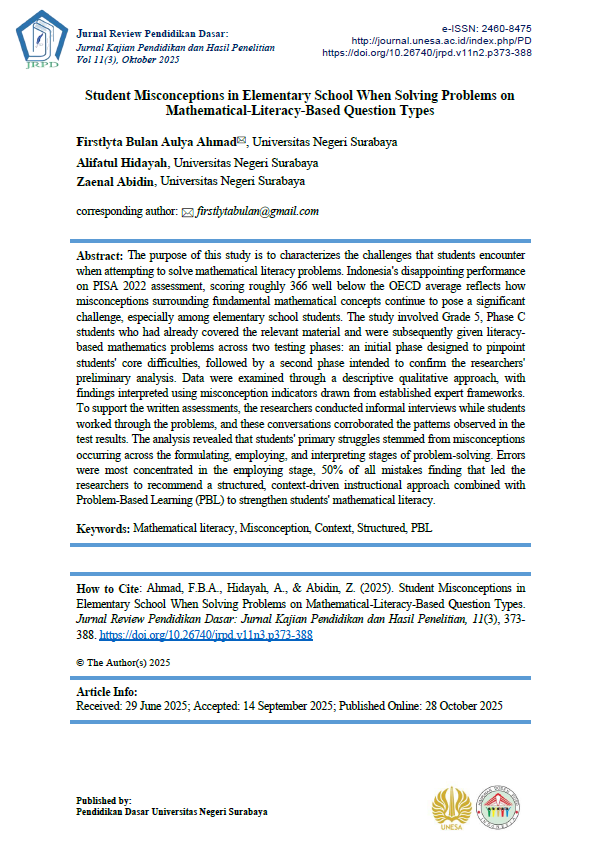
The purpose of this study is to characterizes the challenges that students encounter when attempting to solve mathematical literacy problems. Indonesia's disappointing performance on PISA 2022 assessment, scoring roughly 366 well below the OECD average reflects how misconceptions surrounding fundamental mathematical concepts continue to pose a significant challenge, especially among elementary school students. The study involved Grade 5, Phase C students who had already covered the relevant material and were subsequently given literacy-based mathematics problems across two testing phases: an initial phase designed to pinpoint students' core difficulties, followed by a second phase intended to confirm the researchers' preliminary analysis. Data were examined through a descriptive qualitative approach, with findings interpreted using misconception indicators drawn from established expert frameworks. To support the written assessments, the researchers conducted informal interviews while students worked through the problems, and these conversations corroborated the patterns observed in the test results. The analysis revealed that students' primary struggles stemmed from misconceptions occurring across the formulating, employing, and interpreting stages of problem-solving. Errors were most concentrated in the employing stage, 50% of all mistakes finding that led the researchers to recommend a structured, context-driven instructional approach combined with Problem-Based Learning (PBL) to strengthen students' mathematical literacy.
References
Amalia, P., & Putri, J. H. (2025). Analisis Miskonsepsi dalam Penyelesaian Soal Cerita Matematika pada Materi Bilangan Bulat di SDN 060907. JagoMIPA: Jurnal Pendidikan Matematika dan IPA, 5(3), 1094–1103. (2025)
Bolstad, O. H. (2021). Lower secondary students' encounters with mathematical literacy. Mathematics Education Research Journal, 35(2), 237–253. doi:10.1007/s13394-021-00386-7
Cahyanti, C., Putra, E. D., & Murtinasari, F. (2025). Analysis of student understanding in solving mathematical-literacy-based problems. Media Pendidikan Matematika, 13(1), 103–118.
Ericsson, K. A., & Simon, H. A. (1993). Protocol analysis: Verbal reports as data (Rev. ed.). Cambridge, MA: MIT Press.
Fatmasari, I. (2021). Analysis of elementary students' misconceptions in solving word problems on distance, time, and speed using the Certainty of Response Index (CRI). Jurnal Penelitian Pendidikan Guru Sekolah Dasar, 9(1), 1299–1312.
Fitry, R. S., Khamdun, K., & Ulya, H. (2022). Analysis of student errors in solving mathematics word problems in grade V at SDN Ronggo 03, Jaken District. Jurnal Inovasi Penelitian, 2(8), 2433–2442.
Hayati, M., & Jannah, M. (2024). The importance of mathematical literacy ability in mathematics learning. Griya Journal of Mathematics Education and Application, 4(1), 40–54.
Irawan, D., & Oktafiani, E. N. (2021). Analysis of students' difficulty in finding important information from a reading paragraph. Jurnal Muara Pendidikan, 6(2), 190–196.
Listiyani, Fitriani, O., Apsob, S., & Sugiri, A. (2026). Analysis of errors in solving numeracy problems based on the Newman procedure, viewed from the metacognition levels of fifth-grade elementary school students. Jurnal Review Pendidikan Dasar: Jurnal Kajian Pendidikan dan Hasil Penelitian, 12(2), 200–209. doi:10.26740/jrpd.v12n2.p200-209
Mahfudiah, L. (2022). Analysis of students' mathematical literacy ability in solving ethnomathematics-based problems (Unpublished undergraduate thesis). Institut Agama Islam Negeri Metro, Metro, Indonesia.
Mailani, E., Rarastika, N., Manurung, H. O., Gaol, R. L., Sihombing, I. I., & Perbina, S. D. (2024). Analysis of elementary school students' mathematical literacy in the concept of area and perimeter of squares and rectangles. Jurnal Teknologi Pendidikan dan Pembelajaran (JTPP), 2(2), 749–755.
Majoni, C. (2017). Curriculum overload and its impact on teacher effectiveness in primary schools. European Journal of Education Studies. doi:10.5281/ZENODO.290597
Masfufah, R., & Afriansyah, E. A. (2021). Analysis of students' mathematical literacy ability through PISA problems. Mosharafa: Jurnal Pendidikan Matematika, 10(2).
Mukhlisa, N. (2021). Misconceptions among students. SPEED Journal: Journal of Special Education, 4(2), 123–133.
Nuringtyas, T., & Setyaningsih, N. (2023). Analysis of HOTS-based mathematical literacy ability viewed from numeracy ability. Cendekia: Jurnal Pendidikan Matematika, 7(2), 1211–1224.
Organisation for Economic Co-operation and Development. (2023). PISA 2022 results (Volume I): The state of learning and equity in education. Paris, France: OECD Publishing.
Organisation for Economic Co-operation and Development. (2020). Curriculum overload: A way forward. Paris, France: OECD Publishing. doi:10.1787/3081ceca-en
Programme for International Student Assessment. (n.d.). Paris, France: OECD Publishing. doi:10.1787/53f23881-en
Pratiwi, F., Sugiarti, T., & Hutama, F. S. (2020). Application of Van Hiele's learning theory to improve student activity and learning outcomes on the topic of area of squares, rectangles, and triangles. Widyagogik: Jurnal Pendidikan dan Pembelajaran Sekolah Dasar, 7(2), 128–138.
Putri, M., Syam, S. S., & Chandra. (2025). Elementary students' difficulty in understanding the concept of fractions. Pentagon: Jurnal Matematika dan Ilmu Pengetahuan Alam, 3(2), 43–54. doi:10.62383/pentagon.v3i2.488
Sakahuni, & Ramadhanti, A. (2021). Comparison of learning outcomes using multiple-choice tests viewed from students' critical thinking ability. Integrated Science Education Journal (ISEJ), 2(3), 89–93. doi:10.37251/isej.v2i3.174
Samosir, E., Makmuri, & Aziz, T. A. (2022). Mathematical literacy ability: Its relation to problem-solving ability. JRPMJ: Jurnal Riset Pendidikan Matematika Jakarta, 4(1), 60–72.
Saaroh, F., Aziz, T. A., & Wijayanti, D. A. (2021). Analysis of students’ misconceptions on solving algebraic contextual problem. Risenologi, 6(1), 19–30. (2021, masih dalam 6 tahun terakhir)
Sadiah, D. S., & Afriansyah, E. A. (2023). Miskonsepsi siswa ditinjau dari tingkat penyelesaian masalah pada materi operasi pecahan. Jurnal Inovasi Pembelajaran Matematika: PowerMathEdu, 2(1), 31–44. (2023)
Safitri, N., Nuriman, N., Alfarisi, R., & Setya, C. (2024). The Problem Based Learning model assisted by flipbook media on elementary school students' mathematics learning outcomes. Jurnal Review Pendidikan Dasar: Jurnal Kajian Pendidikan dan Hasil Penelitian, 10(3), 248–254. doi:10.26740/jrpd.v10n3.p248-254
Selviani, M. T., Rasiman, R., & Pramasdyahsari, A. S. (2021). Profile of ethnomathematics problem-solving in geometry material among students with high mathematical ability. Prismatika: Jurnal Pendidikan dan Riset Matematika, 3(2), 141–153.
Suparno, P. (2013). Misconception and conceptual change in physics education. Jakarta, Indonesia: Grasindo.
Utari, D. R., Wardana, M. Y. S., & Damayani, A. T. (2019). Analysis of mathematics learning difficulties in solving word problems. Jurnal Ilmiah Sekolah Dasar, 3(4), 534–540.
Yulius, D., & Zainil, M. (2025). Literature analysis of Indonesian elementary students' mathematical literacy through word-problem solving. Harmoni Pendidikan: Jurnal Ilmu Pendidikan, 2(3), 193–201.
Zukhrufurrohmah, Z., & Putri, O. R. U. (2021). Development assistance for literacy-and-numeracy-based instruments in preparing elementary school teachers for the AKM. JPMB: Jurnal Pemberdayaan Masyarakat Berkarakter, 4(2), 249–260.
Downloads
Published
How to Cite
Issue
Section
License
Copyright (c) 2025 Jurnal Review Pendidikan Dasar : Jurnal Kajian Pendidikan dan Hasil Penelitian

This work is licensed under a Creative Commons Attribution 4.0 International License.
 Abstract views: 59
,
Abstract views: 59
, PDF Downloads: 77