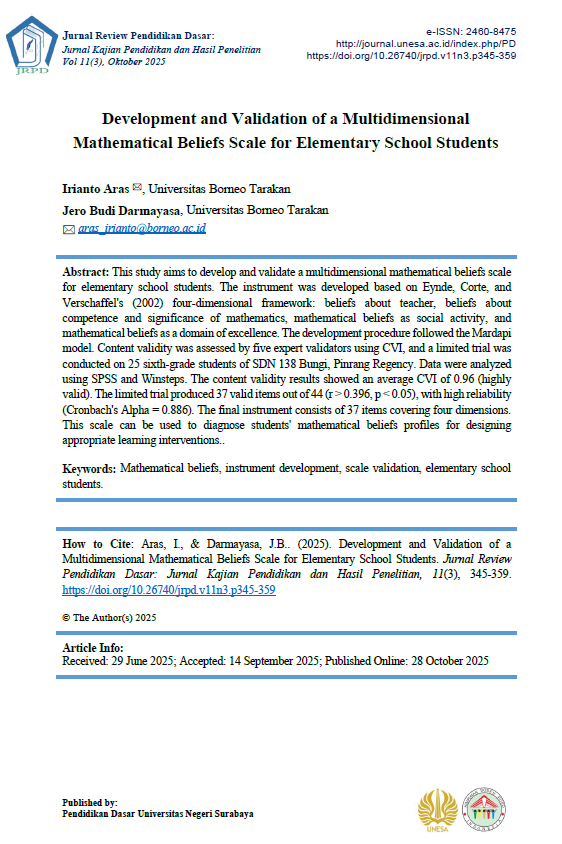
Development and Validation of a Multidimensional Mathematical Beliefs Scale for Elementary School Students
DOI:
https://doi.org/10.26740/jrpd.v11n3.p345-359Keywords:
Mathematical beliefs, instrument development, scale validationAbstract
This study aims to develop and validate a multidimensional mathematical beliefs scale for elementary school students. The instrument was developed based on Eynde, Corte, and Verschaffel's (2002) four-dimensional framework: beliefs about teacher, beliefs about competence and significance of mathematics, mathematical beliefs as social activity, and mathematical beliefs as a domain of excellence. The development procedure followed the Mardapi model. Content validity was assessed by five expert validators using CVI, and a limited trial was conducted on 25 sixth-grade students of SDN 138 Bungi, Pinrang Regency. Data were analyzed using SPSS and Winsteps. The content validity results showed an average CVI of 0.96 (highly valid). The limited trial produced 37 valid items out of 44 (r > 0.396, p < 0.05), with high reliability (Cronbach's Alpha = 0.886). The final instrument consists of 37 items covering four dimensions. This scale can be used to diagnose students' mathematical beliefs profiles for designing appropriate learning interventions..
References
Arikunto, S. (2010). Prosedur penelitian: Suatu pendekatan praktik. Rineka Cipta.
Atta, H. B., Vlorensiu, Aras, I., & Ikhsanudin. (2020). Developing an instrument for students scientific literacy. Journal of Physics: Conference Series, *1422*(1), 012019. https://doi.org/10.1088/1742-6596/1422/1/012019
Ball, D. L., & Forzani, F. M. (2011). Building a common core for learning to teach, and connecting professional learning to practice. American Educator, *35*(2), 17–21.
Bandura, A. (1997). Self-efficacy: The exercise of control. W.H. Freeman.
Beswick, K. (2006). Changes in preservice teachers' attitudes and beliefs: The net impact of two mathematics education units and intervening experiences. School Science and Mathematics, *106*(1), 36–47.
Boaler, J. (2016). Mathematical mindsets: Unleashing students' potential through creative mathematics, inspiring messages and innovative teaching. Jossey-Bass.
Children's Mathematics-Related Beliefs. (2024). Children's mathematics-related beliefs: A scoping review. Journal of Educational Psychology.
Clarke, D., & Clarke, B. (2003). Mathematical beliefs and their impact on teaching and learning. In International handbook of mathematics education (pp. 25–54). Kluwer Academic Publishers.
De Corte, E., Op't Eynde, P., & Verschaffel, L. (2002). Knowing what to believe: The relevance of students' mathematical beliefs for mathematics education. In B. K. Hofer & P. R. Pintrich (Eds.), Personal epistemology: The psychology of beliefs about knowledge and knowing (pp. 297–320). Lawrence Erlbaum Associates.
DeVellis, R. F. (2017). Scale development: Theory and applications (4th ed.). SAGE Publications.
Dewi, R. S. (2022). Analisis kesulitan siswa dalam menyelesaikan soal cerita matematika di sekolah dasar. Jurnal Pendidikan Matematika Indonesia.
Dweck, C. S. (2006). Mindset: The new psychology of success. Random House.
Ernest, P. (1989). The knowledge, beliefs and attitudes of the mathematics teacher: A model. Journal of Education for Teaching, *15*(1), 13–33.
Furinghetti, F., & Pehkonen, E. (2002). Rethinking characterizations of beliefs. In G. C. Leder, E. Pehkonen, & G. Törner (Eds.), Beliefs: A hidden variable in mathematics education? (pp. 39–57). Kluwer Academic Publishers.
Goldin, G. A. (2002). Affect, meta-affect, and mathematical belief structures. In G. C. Leder, E. Pehkonen, & G. Törner (Eds.), Beliefs: A hidden variable in mathematics education? (pp. 59–72). Kluwer Academic Publishers.
Hadi, S. (2005). Pendidikan matematika realistik dan implementasinya. Tulip.
Hair, J. F., Black, W. C., Babin, B. J., & Anderson, R. E. (2010). Multivariate data analysis (7th ed.). Pearson Prentice Hall.
Handal, B. (2003). Teachers' mathematical beliefs: A review. The Mathematics Educator, *13*(2), 47–57.
Hendriana, H., Johanto, T., & Sumarmo, U. (2014). The role of mathematical belief in improving students' mathematical problem solving ability. International Journal of Education and Research, *2*(6), 31–42.
Hwang, S. (2020). A systematic review of instruments measuring students' mathematics-related beliefs. International Journal of Educational Research.
Indrasari, S. (2017). Pengembangan instrumen keyakinan matematis untuk siswa sekolah dasar. Jurnal Penelitian dan Evaluasi Pendidikan.
Kislenko, K. (2006). Students' beliefs about mathematics: A review of the literature. In Proceedings of the 30th Conference of the International Group for the Psychology of Mathematics Education (Vol. 3, pp. 401–408). PME.
Kloosterman, P. (1996). Students' beliefs about knowing and learning mathematics: A review of the literature. In E. A. Silver & P. A. Kenney (Eds.), Results from the sixth mathematics assessment of the National Assessment of Educational Progress (pp. 203–231). National Council of Teachers of Mathematics.
Knoll, S. (2010). Cross-cultural comparison of students' mathematical beliefs. In Proceedings of the 34th Conference of the International Group for the Psychology of Mathematics Education (Vol. 1, pp. 189–196). PME.
Kurniasih, E. (2016). Kesulitan siswa dalam memahami soal cerita matematika. Jurnal Pendidikan Dasar.
Lawshe, C. H. (1975). A quantitative approach to content validity. Personnel Psychology, *28*(4), 563–575.
Leder, G. C., Pehkonen, E., & Törner, G. (Eds.). (2002). Beliefs: A hidden variable in mathematics education? (Vol. 1). Springer Science & Business Media.
Lindgren, S. (1996). Mathematical beliefs and their influence on teaching and learning. In Proceedings of the 20th Conference of the International Group for the Psychology of Mathematics Education (Vol. 1, pp. 35–42). PME.
Mardapi, D. (2017). Pengukuran, penilaian & evaluasi pendidikan. Parama Publishing.
McLeod, D. B. (1992). Research on affect in mathematics education: A reconceptualization. In D. A. Grouws (Ed.), Handbook of research on mathematics teaching and learning (pp. 575–596). Macmillan.
National Council of Teachers of Mathematics (NCTM). (2014). Principles to actions: Ensuring mathematical success for all. NCTM.
Nunnally, J. C. (1978). Psychometric theory (2nd ed.). McGraw-Hill.
Nunnally, J. C., & Bernstein, I. H. (1994). Psychometric theory (3rd ed.). McGraw-Hill.
Op't Eynde, P., & De Corte, E. (2003). Students' mathematics-related belief systems: Design and analysis of a questionnaire. In Proceedings of the 27th Conference of the International Group for the Psychology of Mathematics Education (Vol. 3, pp. 337–344). PME.
Op't Eynde, P., De Corte, E., & Verschaffel, L. (2002). Framing students' mathematics-related beliefs: A quest for conceptual clarity and a comprehensive categorization. In G. C. Leder, E. Pehkonen, & G. Törner (Eds.), Beliefs: A hidden variable in mathematics education? (pp. 13–37). Kluwer Academic Publishers.
Op't Eynde, P., De Corte, E., & Verschaffel, L. (2006). "Accepting emotional complexity": A socio-constructivist perspective on the role of emotions in the mathematics classroom. Educational Studies in Mathematics, *63*(2), 193–207.
Pajares, F., & Miller, M. D. (1994). Role of self-efficacy and self-concept beliefs in mathematical problem solving: A path analysis. Journal of Educational Psychology, *86*(2), 193–203.
Philipp, R. A. (2007). Mathematics teachers' beliefs and affect. In F. K. Lester (Ed.), Second handbook of research on mathematics teaching and learning (pp. 257–315). Information Age Publishing.
Piaget, J. (1970). Science of education and the psychology of the child. Orion Press.
Platas, L. M. (2015). Three for one: Supporting teachers' understanding of children's mathematical development, mathematical content, and pedagogical content knowledge. Journal of Mathematics Education, *8*(1), 1–12.
Plomp, T. (1997). Educational design research: An introduction. In T. Plomp & N. Nieveen (Eds.), Educational design research (pp. 11–50). SLO.
Purnomo, Y. W. (2017). The development of teacher's beliefs instrument in teaching mathematics. Journal of Physics: Conference Series, *812*(1), 012092.
Purnomo, Y. W. (2023). Mathematical beliefs and their role in mathematics education in Indonesia. Journal of Mathematics Education Research.
Ridwan, M. S., Mardhiyyah, L. A., & Rusilowati, A. (2013). Pengembangan instrumen asesmen dengan pendekatan kontekstual untuk mengukur level literasi sains siswa. Prosiding Seminar Nasional Evaluasi Pendidikan, Universitas Negeri Semarang.
Sakai, M., Hirose, H., Saito, S., & Fujiwara, T. (2009). Development of a scale for measuring students' mathematics-related beliefs. In Proceedings of the 33rd Conference of the International Group for the Psychology of Mathematics Education (Vol. 1, pp. 321–328). PME.
Schoenfeld, A. H. (1985). Mathematical problem solving. Academic Press.
Schoenfeld, A. H. (1987). What's all the fuss about metacognition? In A. H. Schoenfeld (Ed.), Cognitive science and mathematics education (pp. 189–215). Lawrence Erlbaum Associates.
Schoenfeld, A. H. (1989a). Explorations of students' mathematical beliefs and behavior. Journal for Research in Mathematics Education, *20*(4), 338–355.
Schoenfeld, A. H. (1989b). Teaching mathematical thinking and problem solving. In L. B. Resnick & L. E. Klopfer (Eds.), Toward the thinking curriculum: Current cognitive research (pp. 83–103). Association for Supervision and Curriculum Development.
Sugiyono. (2014). Metode penelitian pendidikan pendekatan kuantitatif, kualitatif, dan R&D. Alfabeta.
Supriadi, M. (2016). Validitas dan reliabilitas instrumen penelitian. Jurnal Pendidikan.
Suryanto, A. (2001). Pendidikan matematika realistik di Indonesia. Jurnal Matematika atau Pembelajarannya.
Sutrisno, Manuharawati, & Masriyah. (2025). Pengembangan instrumen keyakinan matematis untuk siswa sekolah dasar. Jurnal Review Pendidikan Dasar.
Thompson, A. G. (1991). Teachers' beliefs and conceptions: A synthesis of the research. In D. A. Grouws (Ed.), Handbook of research on mathematics teaching and learning (pp. 127–146). Macmillan.
Törner, G. (2002). Mathematical beliefs: A review of the literature. In G. C. Leder, E. Pehkonen, & G. Törner (Eds.), Beliefs: A hidden variable in mathematics education? (pp. 73–94). Kluwer Academic Publishers.
Turki, Z. (2020). Adaptation of mathematical development beliefs scale into Turkish: A validity and reliability study. International Journal of Progressive Education, *16*(4), 141–154.
Underhill, R. (1988). Focus on research into practice in diagnostic and prescriptive mathematics: Mathematics learners' beliefs: A review. Focus on Learning Problems in Mathematics, *10*(1), 55–69.
Yackel, E., & Rasmussen, C. (2002). Beliefs and norms in the mathematics classroom. In G. C. Leder, E. Pehkonen, & G. Törner (Eds.), Beliefs: A hidden variable in mathematics education? (pp. 313–330). Kluwer Academic Publishers.
Yıldırım Çayır, R. (2008). Investigating students' mathematical beliefs: A study on sixth grade students (Unpublished master's thesis). Middle East Technical University.
Downloads
Published
How to Cite
Issue
Section
License
Copyright (c) 2025 Jurnal Review Pendidikan Dasar : Jurnal Kajian Pendidikan dan Hasil Penelitian

This work is licensed under a Creative Commons Attribution 4.0 International License.
 Abstract views: 52
,
Abstract views: 52
, PDF Downloads: 46