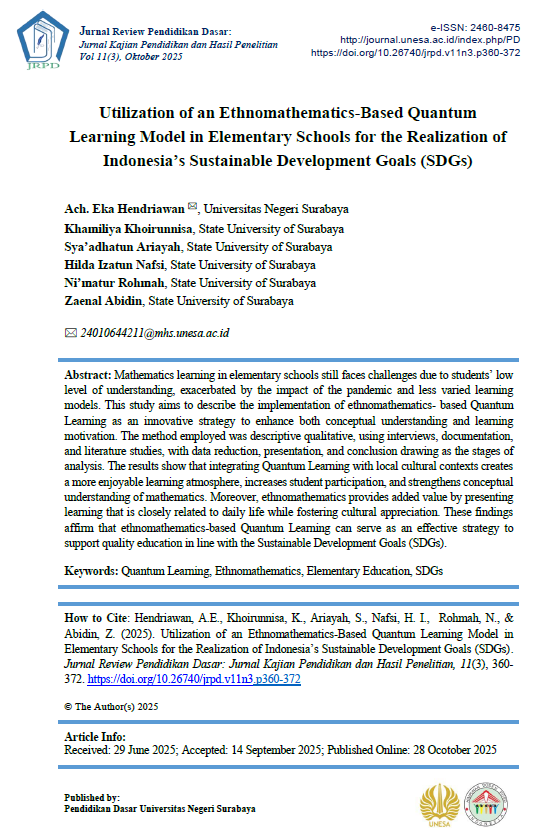
Integrating Ethnomathematics into the Quantum Learning Model to Support Mathematics Learning and Quality Education
DOI:
https://doi.org/10.26740/jrpd.v11n3.p360-372Keywords:
Ethnomathematics, Quantum Learning, Elementary Mathematics Education, Quality Education, Qualitative Descriptive StudyAbstract
This study aims to describe how the quantum learning model and ethnomathematics have been examined in recent research and to examine whether and how the two approaches can be combined to support elementary mathematics learning and quality education. The study extends previous research, which has largely examined each approach separately, by analysing quantum learning and ethnomathematics together within the context of elementary mathematics learning and by relating them explicitly to SDG 4. A qualitative descriptive design was used, combining a literature corpus (56 articles screened, 28 included), semi-structured teacher interviews, and documentation. Data were analysed through data reduction, data display, and conclusion drawing. Half of the included articles were published in 2024, and the articles were distributed across ethnomathematics (n = 15), quantum learning (n = 9), and SDG 4 (n = 4). The Scopus-indexed studies summarised here report positive outcomes of quantum learning for achievement, retention, critical thinking, and collaboration, and positive but variable outcomes of ethnomathematics for mathematical learning. A conceptual alignment between the six phases of quantum learning and ethnomathematics-based activities is proposed for empirical testing in elementary classrooms.
References
Aprinastuti, C., & Amelia, M. A. (2025). The relationship between mathematical thinking and resilience in number sequence lesson through ethnomathematics among pre-service primary school teachers. ITM Web of Conferences, 71, Article 01003. https://doi.org/10.1051/itmconf/20257101003
Astuti, E. P., Wijaya, A., & Hanum, F. (2024). Characteristics of junior high school teachers’ beliefs in developing students’ numeracy skills through ethnomathematics-based numeracy learning. Journal of Pedagogical Research, 8(1), 244–268. https://doi.org/10.33902/JPR.202423405
Betthäuser, B. A., Bach-Mortensen, A. M., & Engzell, P. (2023). A systematic review and meta-analysis of the evidence on learning during the COVID-19 pandemic. Nature Human Behaviour, 7(3), 375–385. https://doi.org/10.1038/s41562-022-01506-4
Braun, V., & Clarke, V. (2006). Using thematic analysis in psychology. Qualitative Research in Psychology, 3(2), 77–101. https://doi.org/10.1191/1478088706qp063oa
Dela Cruz, N. A., Adona, A. J., Molato-Gayares, R., & Park, A. (2025). Learning loss and recovery from the COVID-19 pandemic: A systematic review of evidence. International Journal of Educational Development, 115, Article 103271. https://doi.org/10.1016/j.ijedudev.2025.103271
Donnelly, R., & Patrinos, H. A. (2022). Learning loss during Covid-19: An early systematic review. Prospects, 51(4), 601–609. https://doi.org/10.1007/s11125-021-09582-6
Engzell, P., Frey, A., & Verhagen, M. D. (2021). Learning loss due to school closures during the COVID-19 pandemic. Proceedings of the National Academy of Sciences, 118(17), Article e2022376118. https://doi.org/10.1073/pnas.2022376118
Khan, F., Khan, M. A., & Rahman, H. U. (2024). Perusing sustainable development through education: Evidence from Malaysia, Indonesia and Pakistan. Environment, Development and Sustainability. https://doi.org/10.1007/s10668-024-05441-4
Khozaei, S. A., Zare, N. V., Moneghi, H. K., Sadeghi, T., & Taraghdar, M. M. (2022). Effects of quantum-learning and conventional teaching methods on learning achievement, motivation to learn, and retention among nursing students during critical care nursing education. Smart Learning Environments, 9, Article 18. https://doi.org/10.1186/s40561-022-00198-7
Meeran, S., Kodisang, S. M., Moila, M. M., Davids, M. N., & Makokotlela, M. V. (2024). Ethnomathematics in intermediate phase: Reflections on the Morabaraba game as indigenous mathematical knowledge. African Journal of Research in Mathematics, Science and Technology Education, 28(2), 171–184. https://doi.org/10.1080/18117295.2024.2340095
Nahar, S., Suhendri, Zailani, & Hardivizon. (2022). Improving students’ collaboration thinking skill under the implementation of the quantum teaching model. International Journal of Instruction, 15(3), 451–464. https://doi.org/10.29333/iji.2022.15325a
Näslund-Hadley, E., Hernández-Agramonte, J., Santos, H., Albertos, C., Grigera, A., Hobbs, C., & Álvarez, H. (2025). The effects of ethnomathematics education on student outcomes: The JADENKÄ program in the Ngäbe-Buglé comarca, Panama. International Journal of Bilingual Education and Bilingualism, 28(5), 579–595. https://doi.org/10.1080/13670050.2024.2446987
Nursyahidah, F., Wardono, Mariani, S., & Wijayanti, K. (2025). Integrating technology, Javanese ethnomathematics, and realistic mathematics education in supporting prospective mathematics teachers’ numeracy skills: A learning trajectory. Journal on Mathematics Education, 16(2), 671–688. https://doi.org/10.22342/jme.v16i2.pp671-688
Page, M. J., McKenzie, J. E., Bossuyt, P. M., Boutron, I., Hoffmann, T. C., Mulrow, C. D., Shamseer, L., Tetzlaff, J. M., Akl, E. A., Brennan, S. E., Chou, R., Glanville, J., Grimshaw, J. M., Hróbjartsson, A., Lalu, M. M., Li, T., Loder, E. W., Mayo-Wilson, E., McDonald, S., … Moher, D. (2021). The PRISMA 2020 statement: An updated guideline for reporting systematic reviews. BMJ, 372, Article n71. https://doi.org/10.1136/bmj.n71
Payadnya, I. P. A. A., Wulandari, I. G. A. P. A., Puspadewi, K. R., & Saelee, S. (2024). The significance of ethnomathematics learning: A cross-cultural perspectives between Indonesian and Thailand educators. Journal for Multicultural Education, 18(4), 508–522. https://doi.org/10.1108/JME-05-2024-0049
Pratama, R. A., & Yelken, T. Y. (2024). Effectiveness of ethnomathematics-based learning on students’ mathematical literacy: A meta-analysis study. Discover Education, 3, Article 202. https://doi.org/10.1007/s44217-024-00309-1
Rimba, A. B., Sato, I., & Endo, K. (2025). Localization and its impact on achieving SDGs and transitioning to post-SDGs in Indonesia. Environmental and Sustainability Indicators, 28, Article 100926. https://doi.org/10.1016/j.indic.2025.100926
Şahin, Ş., & Kılıç, A. (2024). Comparison of the effectiveness of project-based 6E learning and problem-based quantum learning: Solomon four-group design. Journal of Research in Innovative Teaching & Learning. https://doi.org/10.1108/JRIT-09-2023-0139
Supriyadi, E., Turmudi, T., Dahlan, J. A., & Juandi, D. (2024). Development of Sundanese gamelan ethnomathematics e-module for junior high school mathematics learning. Malaysian Journal of Learning and Instruction, 21(2), 147–186. https://doi.org/10.32890/mjli2024.21.2.6
Turmuzi, M., Suharta, I. G. P., & Suparta, I. N. (2023). Ethnomathematical research in mathematics education journals in Indonesia: A case study of data design and analysis. Eurasia Journal of Mathematics, Science and Technology Education, 19(1), Article em2220. https://doi.org/10.29333/ejmste/12836
Downloads
Published
How to Cite
Issue
Section
License
Copyright (c) 2025 Jurnal Review Pendidikan Dasar : Jurnal Kajian Pendidikan dan Hasil Penelitian

This work is licensed under a Creative Commons Attribution 4.0 International License.
 Abstract views: 84
,
 PDF Downloads: 91