Adapting Muhadharah as a Religious Activity-Based Strategy to Develop Students’ Speaking Confidence and Skills
DOI:
https://doi.org/10.26740/jrpd.v11n3.p313-330Keywords:
Religius Activities, Speaking skill, Muhadharah, Speaking Confidence, Qualitative Case StudyAbstract
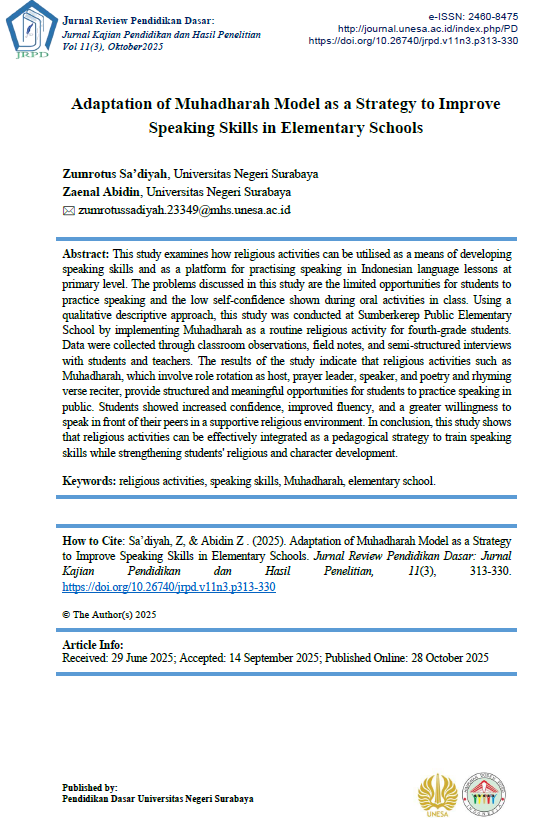
Limited opportunities for speaking practice and low self-confidence remain common concerns in elementary classrooms. This study examines the implementation of Muhadharah, a religious speaking activity adapted from an Islamic school program, and explores changes in students’ speaking confidence and behavior. A qualitative descriptive case study was conducted with fourth-grade students over two months. Data were collected through semi-structured interviews with four purposively selected students and teachers, participatory observation, field notes, and documentation. The data were analyzed thematically. Before Muhadharah, students reported nervousness, fear of ridicule, and limited experience with extended speaking. Observations revealed limited eye contact, stiff posture, and low voice volume. During implementation, students demonstrated gradual improvements in composure, voice projection, eye contact, and willingness to participate. Follow-up interviews indicated reduced fear of mistakes and greater readiness to speak voluntarily. Teachers considered the religious elements meaningful and familiar to students. These findings suggest that regular, structured speaking routines, role rotation, and a supportive setting may help develop speaking confidence. However, the findings are context-specific because the study involved one class and relied on interviews and observations.
References
Bowen, G. A. (2009). Document analysis as a qualitative research method. Qualitative Research Journal, 9(2), 27–40. https://doi.org/10.3316/QRJ0902027
Bradshaw, C., Atkinson, S., & Doody, O. (2017). Employing a qualitative description approach in health care research. Global Qualitative Nursing Research, 4, Article 2333393617742282. https://doi.org/10.1177/2333393617742282
Braun, V., & Clarke, V. (2006). Using thematic analysis in psychology. Qualitative Research in Psychology, 3(2), 77–101. https://doi.org/10.1191/1478088706qp063oa
Carter, N., Bryant-Lukosius, D., DiCenso, A., Blythe, J., & Neville, A. J. (2014). The use of triangulation in qualitative research. Oncology Nursing Forum, 41(5), 545–547. https://doi.org/10.1188/14.ONF.545-547
Dewaele, J.-M., & MacIntyre, P. D. (2014). The two faces of Janus? Anxiety and enjoyment in the foreign language classroom. Studies in Second Language Learning and Teaching, 4(2), 237–274. https://doi.org/10.14746/ssllt.2014.4.2.5
Dewaele, J.-M., Witney, J., Saito, K., & Dewaele, L. (2018). Foreign language enjoyment and anxiety: The effect of teacher and learner variables. Language Teaching Research, 22(6), 676–697. https://doi.org/10.1177/1362168817692161
Horwitz, E. K., Horwitz, M. B., & Cope, J. (1986). Foreign language classroom anxiety. The Modern Language Journal, 70(2), 125–132. https://doi.org/10.1111/j.1540-4781.1986.tb05256.x
Hyett, N., Kenny, A., & Dickson-Swift, V. (2014). Methodology or method? A critical review of qualitative case study reports. International Journal of Qualitative Studies on Health and Well-Being, 9, Article 23606. https://doi.org/10.3402/qhw.v9.23606
Lim, W. M. (2025). What is qualitative research? An overview and guidelines. Australasian Marketing Journal, 33(2), 199–229. https://doi.org/10.1177/14413582241264619
Liu, M., & Hong, M. (2021). English language classroom anxiety and enjoyment in Chinese young learners. SAGE Open, 11(4), Article 21582440211047550. https://doi.org/10.1177/21582440211047550
Malterud, K., Siersma, V. D., & Guassora, A. D. (2016). Sample size in qualitative interview studies: Guided by information power. Qualitative Health Research, 26(13), 1753–1760. https://doi.org/10.1177/1049732315617444
Morris, T. H. (2020). Experiential learning: A systematic review and revision of Kolb’s model. Interactive Learning Environments, 28(8), 1064–1077. https://doi.org/10.1080/10494820.2019.1570279
Moser, A., & Korstjens, I. (2018a). Series: Practical guidance to qualitative research. Part 3: Sampling, data collection and analysis. European Journal of General Practice, 24(1), 9–18. https://doi.org/10.1080/13814788.2017.1375091
Moser, A., & Korstjens, I. (2018b). Series: Practical guidance to qualitative research. Part 4: Trustworthiness and publishing. European Journal of General Practice, 24(1), 120–124. https://doi.org/10.1080/13814788.2017.1375092
Nowell, L. S., Norris, J. M., White, D. E., & Moules, N. J. (2017). Thematic analysis: Striving to meet the trustworthiness criteria. International Journal of Qualitative Methods, 16(1), Article 1609406917733847. https://doi.org/10.1177/1609406917733847
Palinkas, L. A., Horwitz, S. M., Green, C. A., Wisdom, J. P., Duan, N., & Hoagwood, K. (2015). Purposeful sampling for qualitative data collection and analysis in mixed method implementation research. Administration and Policy in Mental Health and Mental Health Services Research, 42(5), 533–544. https://doi.org/10.1007/s10488-013-0528-y
Peng, J.-E., & Woodrow, L. (2010). Willingness to communicate in English: A model in the Chinese EFL classroom context. Language Learning, 60(4), 834–876. https://doi.org/10.1111/j.1467-9922.2010.00576.x
Sandelowski, M. (2000). Whatever happened to qualitative description? Research in Nursing & Health, 23(4), 334–340. https://doi.org/10.1002/1098-240X(200008)23:4<334::AID-NUR9>3.0.CO;2-G
Santos, K. D. S., Ribeiro, M. C., Queiroga, D. E. U. D., Silva, I. A. P. D., & Ferreira, S. M. S. (2020). The use of multiple triangulations as a validation strategy in a qualitative study. Ciência & Saúde Coletiva, 25(2), 655–664. https://doi.org/10.1590/1413-81232020252.12302018
Teimouri, Y., Goetze, J., & Plonsky, L. (2019). Second language anxiety and achievement: A meta-analysis. Studies in Second Language Acquisition, 41(2), 363–387. https://doi.org/10.1017/S0272263118000311
Toyama, M., & Yamazaki, Y. (2021). Classroom interventions and foreign language anxiety: A systematic review with narrative approach. Frontiers in Psychology, 12, Article 614184. https://doi.org/10.3389/fpsyg.2021.614184
Valls-Ratés, I., Niebuhr, O., & Prieto, P. (2022). Unguided virtual-reality training can enhance the oral presentation skills of high-school students. Frontiers in Communication, 7, Article 910952. https://doi.org/10.3389/fcomm.2022.910952
Downloads
Published
How to Cite
Issue
Section
License
Copyright (c) 2025 Jurnal Review Pendidikan Dasar : Jurnal Kajian Pendidikan dan Hasil Penelitian

This work is licensed under a Creative Commons Attribution 4.0 International License.
 Abstract views: 101
,
 PDF Downloads: 83