The Bibliometrics Analysis of the Development of Research on Spatial Thinking in Elementary School: Global Trends 2015-2025
DOI:
https://doi.org/10.26740/jrpd.v11n3.p286-296Keywords:
Spatial thinking, Bibliometrics, Elemetary SchoolAbstract
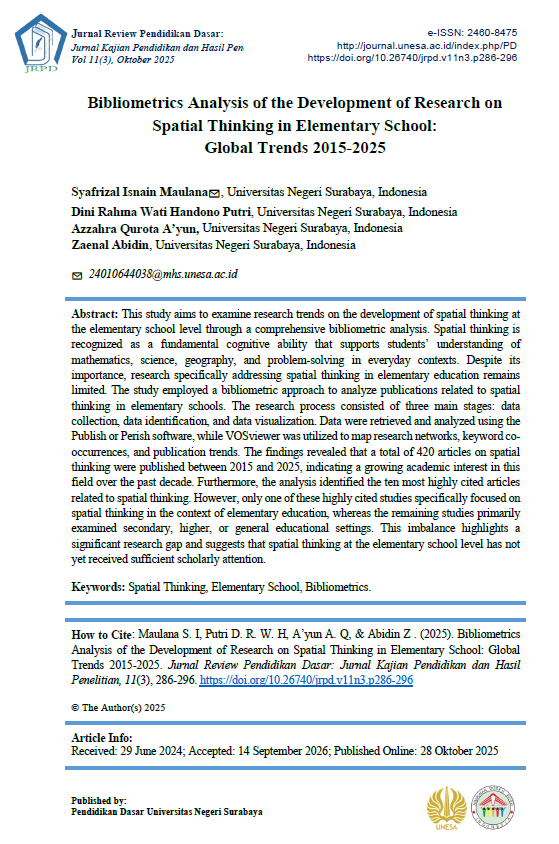
This study aims to examine research trends on the development of spatial thinking at the elementary school level through a comprehensive bibliometric analysis. Spatial thinking is recognized as a fundamental cognitive ability that supports students’ understanding of mathematics, science, geography, and problem-solving in everyday contexts. Despite its importance, research specifically addressing spatial thinking in elementary education remains limited. The study employed a bibliometric approach to analyze publications related to spatial thinking in elementary schools. The research process consisted of three main stages: data collection, data identification, and data visualization. Data were retrieved and analyzed using the Publish or Perish software, while VOSviewer was utilized to map research networks, keyword co-occurrences, and publication trends. The findings revealed that a total of 420 articles on spatial thinking were published between 2015 and 2025, indicating a growing academic interest in this field over the past decade. Furthermore, the analysis identified the ten most highly cited articles related to spatial thinking. However, only one of these highly cited studies specifically focused on spatial thinking in the context of elementary education, whereas the remaining studies primarily examined secondary, higher, or general educational settings. This imbalance highlights a significant research gap and suggests that spatial thinking at the elementary school level has not yet received sufficient scholarly attention.
References
Agni, R., Rahman, A. A., Rochman, S., Zainal, S., Pahriadi, P., & Isnawati, I. (2025). Dari teori ke praktik: Kreativitas, teknologi, dan evaluasi berbasis keberlanjutan. Penerbit Dharma Samakta Edukhatulistiwa.
Arisha, D. (2023). Pengembangan LKPD berbasis pendekatan STEM (Science, Technology, Engineering, And Mathematics) untuk meningkatkan kemampuan berpikir kritis [Doctoral dissertation, UNIMED].
Atit, K., Uttal, D. H., & Stieff, M. (2020). Situating space: Using a discipline-focused lens to examine spatial thinking skills. Cognitive Research: Principles and Implications, 5, Article 19. https://doi.org/10.1186/s41235-020-00210-z
Bazilova, A., Kaimuldinova, K., Shakirova, N., Abdimanapov, B., Aliaskarov, D., & Satybaldieva, A. (2025). Implementation of ESD in school geography: Bibliometric analysis of 2015-2024 publications in scientific databases. EURASIA Journal of Mathematics, Science and Technology Education, 21(4), em2614.
Bednarz, R., & Lee, J. (2019). What improves spatial thinking? Evidence from the spatial thinking abilities test. International Research in Geographical and Environmental Education, 28(4), 262-280.
Casey, B. M., Pezaris, E., Fineman, B., Pollock, A., Demers, L., & Dearing, E. (2015). A longitudinal analysis of early spatial skills compared to arithmetic and verbal skills as predictors of fifth-grade girls' math reasoning. Learning and Individual Differences, 40, 90-100.
Cholilah, M. (2023). Profil kemampuan spasial siswa SMP pada pembelajaran matematika yang berkaitan dengan geometri dalam implementasi Kurikulum Merdeka. SCIENCE: Jurnal Inovasi Pendidikan Matematika dan IPA, 3(3), 178-188.
De Queiroz, A. P. (2021). Spatial thinking: A bibliometric analysis (1970-2019). In Geographical reasoning and learning: Perspectives on curriculum and cartography from South America (pp. 111-122). Springer International Publishing.
Faridah, Z., & Muzakki, A. (2024). Strategi meningkatkan potensi kecerdasan visual-spasial peserta didik di tingkat sekolah dasar. Madrasah Ibtidaiyah Education Journal, 2(1), 22-31.
Fuad, N. M., Zubaidah, S., Mahanal, S., & Suarsini, E. (2017). Improving junior high schools' critical thinking skills based on test three different models of learning. International Journal of Instruction, 10(1), 101-116.
Hawes, Z., & Ansari, D. (2020). What explains the relationship between spatial and mathematical skills? A review of evidence from brain and behavior. Psychonomic Bulletin & Review, 27(3), 465–482. https://doi.org/10.3758/s13423-019-01694-7
Hawes, Z., Moss, J., Caswell, B., Naqvi, S., & MacKinnon, S. (2017). Enhancing children’s spatial and numerical skills through a dynamic spatial approach to early geometry instruction: Effects of a 32-week intervention. Cognition and Instruction, 35(3), 236–264. https://doi.org/10.1080/07370008.2017.1323902
Herman, T., Akbar, A., Farokhah, L., Febriandi, R., Zahrah, R. F., Febriani, W. D., ... & Abidin, Z. (2024). Kecakapan abad 21: Literasi matematis, berpikir matematis, dan berpikir komputasi. Indonesia Emas Group.
Irawan, E., & Purwasih, R. (2024). Tren dan arah baru penelitian pendidikan matematika: Analisis bibliometrik publikasi terindeks Scopus peneliti Indonesia. IMEJ: Indonesian Mathematics Education Journal, 1(2), 171-190.
Ketelhut, D. J., Mills, K., Hestness, E., Cabrera, L., Plane, J., & McGinnis, J. R. (2020). Teacher change following a professional development experience in integrating computational thinking into elementary science. Journal of Science Education and Technology, 29(1), 174-188.
Lamb, R., Akmal, T., & Petrie, K. (2015). Development of a cognition-priming model describing learning in a STEM classroom. Journal of Research in Science Teaching, 52(3), 410-437.
Lee, I., Grover, S., Martin, F., Pillai, S., & Malyn-Smith, J. (2020). Computational thinking from a disciplinary perspective: Integrating computational thinking in K-12 science, technology, engineering, and mathematics education. Journal of Science Education and Technology, 29(1), 1-8.
Leonard, J., Buss, A., Gamboa, R., Mitchell, M., Fashola, O. S., Hubert, T., & Almughyirah, S. (2016). Using robotics and game design to enhance children's self-efficacy, STEM attitudes, and computational thinking skills. Journal of Science Education and Technology, 25(6), 860-876.
Li, Y., Schoenfeld, A. H., Disessa, A. A., Graesser, A. C., Benson, L. C., English, L. D., & Duschl, R. A. (2019). Design and design thinking in STEM education. Journal for STEM Education Research, 2(2), 93-104.
Lokollo, L. J., Lasaiba, M., Arfa, A. M., & Lasaiba, D. (2024). Mengembangkan kemampuan berpikir spasial melalui pendidikan STEM di sekolah dasar. Scholaria: Jurnal Pendidikan dan Kebudayaan, 14(3), 293-308.
Lowrie, T., Logan, T., & Ramful, A. (2017). Visuospatial training improves elementary students' mathematics performance. British Journal of Educational Psychology, 87(2), 170-186.
Mathewson, J. H. (1999). Visual-spatial thinking: An aspect of science overlooked by educators. Science Education, 83(1), 33-54.
Newcombe, N. S. (2017). Harnessing spatial thinking to support STEM learning (OECD Education Working Paper No. 161). OECD Publishing. https://doi.org/10.1787/7d5dcae6-en
Oktavianto, D. A. (2022). Peningkatan keterampilan berpikir spasial melalui aktivitas geographic inquiry pada project based learning berdiferensiasi. Jurnal Teknodik, 145-156.
Prasmono, A., Purnomo, D., Ustadi, I., Hasan, I., Mayasari, I., Parasta, Y. D., ... & Al Khatami, S. H. (n.d.). Resonansi pemikiran ke-30: Kesadaran spasial guru dalam perspektif pendidikan dan lingkungan. Muhammadiyah University Press.
Ramful, A., Lowrie, T., & Logan, T. (2017). Measurement of spatial ability: Construction and validation of the spatial reasoning instrument for middle school students. Journal of Psychoeducational Assessment, 35(7), 709-727.
Tandjung, T. D. (2023). Pemodelan topik dengan Latent-Dirichlet Allocation untuk penemuan state-of-the-art dalam keilmuan [Doctoral dissertation, Universitas Islam Indonesia].
Verdine, B. N., Golinkoff, R. M., Hirsh-Pasek, K., & Newcombe, N. S. (2017). Spatial skills, their development, and their links to mathematics. Monographs of the Society for Research in Child Development, 82(1), 7–30. https://doi.org/10.1111/mono.12280
York, S., Lavi, R., Dori, Y. J., & Orgill, M. (2019). Applications of systems thinking in STEM education. Journal of Chemical Education, 96(12), 2742-2751.
Zalfa, R. A., Ayuning, R. P., & Rustini, T. (2023). Pengembangan spatial literacy untuk meningkatkan pembelajaran geografi di sekolah dasar. Dirasah: Jurnal Studi Ilmu dan Manajemen Pendidikan Islam, 6(1), 73-182.
Zubaidah, S., Fuad, N. M., Mahanal, S., & Suarsini, E. (2017). Improving creative thinking skills of students through differentiated science inquiry integrated with mind map. Journal of Turkish Science Education, 14(4), 77-91.
Downloads
Published
How to Cite
Issue
Section
License
Copyright (c) 2025 Jurnal Review Pendidikan Dasar : Jurnal Kajian Pendidikan dan Hasil Penelitian

This work is licensed under a Creative Commons Attribution 4.0 International License.
 Abstract views: 78
,
Abstract views: 78
, PDF Downloads: 78