A Bibliometric Review of Research Trends on Digital Modules for Literacy and Numeracy in Elementary Schools
DOI:
https://doi.org/10.26740/jrpd.v11n2.p241-259Keywords:
Digital modules, Bibliometrics, Literacy and Numeracy, Elementary SchoolAbstract
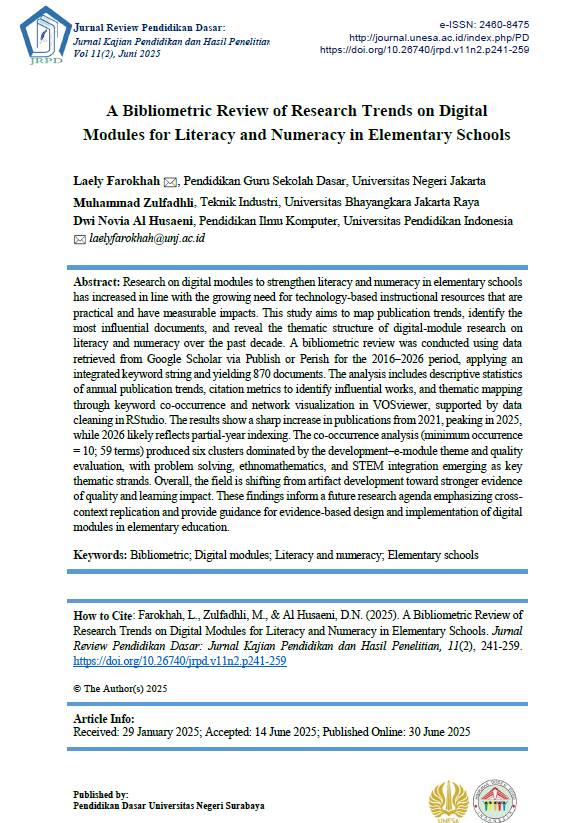
Research on digital modules to strengthen literacy and numeracy in elementary schools has increased in line with the growing need for technology-based instructional resources that are practical and have measurable impacts. This study aims to map publication trends, identify the most influential documents, and reveal the thematic structure of digital-module research on literacy and numeracy over the past decade. A bibliometric review was conducted using data retrieved from Google Scholar via Publish or Perish for the 2016–2026 period, applying an integrated keyword string and yielding 870 documents. The analysis includes descriptive statistics of annual publication trends, citation metrics to identify influential works, and thematic mapping through keyword co-occurrence and network visualization in VOSviewer, supported by data cleaning in RStudio. The results show a sharp increase in publications from 2021, peaking in 2025, while 2026 likely reflects partial-year indexing. The co-occurrence analysis (minimum occurrence = 10; 59 terms) produced six clusters dominated by the development–e-module theme and quality evaluation, with problem solving, ethnomathematics, and STEM integration emerging as key thematic strands. Overall, the field is shifting from artifact development toward stronger evidence of quality and learning impact. These findings inform a future research agenda emphasizing cross-context replication and provide guidance for evidence-based design and implementation of digital modules in elementary education.
References
Alyusfitri, R., Gistituati, N., & Fauzan, A. (2024). The effectiveness and relationship of student responses toward learning outcomes using interactive multimedia-based e-modules in elementary schools. International Electronic Journal of Elementary Education, 16(5), 573–584.
Anggun, M. S., Fakhruddin, F., Arbarini, M., Subali, B., & Widiarti, N. (2025). Implementing creative learning with technology to improve literacy and numeracy in primary schools. Journal of Innovation and Research in Primary Education, 4(3), 430–437. https://doi.org/10.56916/jirpe.v4i3.1299
AR, M. M., Asmoni, A., Aini, K., & Wardi, M. (2024). The relationship of the 5th batch campus teaching program to literacy and numeracy skills in elementary schools. Al-Ishlah: Jurnal Pendidikan, 16(2), 1999–2011. https://doi.org/10.35445/alishlah.v16i2.4958
Astiti, A. D., Murti, R. C., & Hakiki, M. (2023). Development of web-based digital libraries as learning resource facilities in elementary schools. Jurnal Kajian Informasi & Perpustakaan, 11(1), 147–160. https://doi.org/10.24198/jkip.v11i1.42192
Aulia, E. T., & Prahmana, R. C. I. (2022). Developing interactive e-module based on realistic mathematics education approach and mathematical literacy ability. Jurnal Elemen, 8(1), 231–249. https://doi.org/10.29408/jel.v8i1.4569
Dewi, C. A., Awaliyah, N., Fitriana, N., Darmayani, S., Setiawan, J., & Irwanto, I. (2022). Using Android-based e-module to improve students’ digital literacy on chemical bonding. International Journal of Interactive Mobile Technologies, 16(22). https://doi.org/10.3991/ijim.v16i22.34151
Hidayanthi, R., Siregar, N. H., Siregar, D. A., & Siregar, H. L. (2024). Implementation of STEAM-based digital learning for students’ numeracy literacy in elementary schools. Research and Development in Education (RaDEn), 4(1), 653–661. https://doi.org/10.22219/raden.v4i1.32663
Hidayat, R. A., Wijayanto, Z., & Sutama, S. (2024). Digital media innovation for enhancing numeracy literacy in elementary schools. Profesi Pendidikan Dasar, 11(3), 26–39. https://doi.org/10.23917/ppd.v11i3.5991
Nirmala, S. D., & Puspita, R. D. (2025). Innovative e-module design using the FIVES model: Strengthening literacy and numeracy in elementary schools. Al-Ishlah: Jurnal Pendidikan, 17(1), 1504–1518. https://doi.org/10.35445/alishlah.v17i1.6756
Nurani, D. C., Safitri, M. L. O., Pulungan, M., Fathia, N., & Adikara, F. S. (2024). Improving the competence of elementary school teachers through assistance in the preparation of numeracy-based literacy teaching modules. ABDIMAS: Jurnal Pengabdian Masyarakat, 7(3), 1138–1145. https://doi.org/10.35568/abdimas.v7i3.5024
Purwaningrum, J. P., Ahyani, L. N., & Utomo, A. P. (2022). The need for a digital module to improve the numerical literacy of dyscalculia students. Kalamatika: Jurnal Pendidikan Matematika, 7(1), 99–110. https://doi.org/10.22236/KALAMATIKA.vol7no1.2022pp99-110
Rakhmawati, Y., & Mustadi, A. (2021). Examining the necessity of reflective module: Literacy numeracy skill of students elementary school. Al-Ishlah: Jurnal Pendidikan, 13(1), 597–609. https://doi.org/10.35445/alishlah.v13i1.534
Sufianti, M. (2023). Calistung e-module innovation for strengthening basic literacy and numeracy student. Jurnal Ilmiah Sekolah Dasar, 7(2), 236–248. https://doi.org/10.23887/jisd.v7i2.55833
Sulasmi, E. (2022). Primary school teachers’ digital literacy: An analysis on teachers’ skills in using technological devices. Journal of Innovation in Educational and Cultural Research, 3(2), 140–145. https://doi.org/10.46843/jiecr.v3i2.81
Susanta, A., Susanto, E., Sumardi, H., & Ali, S. R. B. (2025). Literacy skills through the use of digital STEAM-inquiry learning modules: A comparative study of urban and rural elementary schools in Indonesia. Eurasia Journal of Mathematics, Science and Technology Education, 21(4), Article em2615. https://doi.org/10.29333/ejmste/16170
Suwarto, D. H., Setiawan, B., & Machmiyah, S. (2022). Developing digital literacy practices in Yogyakarta elementary schools. Electronic Journal of E-Learning, 20(2), 101–111. https://doi.org/10.34190/ejel.20.2.2602
Tarusu, D. T., Makawawa, J. C., & Gampu, G. G. (2025, November). Literacy and numeracy skills in primary education. In Proceedings of the 1st International Conference on Educational Science and Teacher Education (ICESTE 2025) (p. 176). Springer Nature.
Tuychiyevich, E. (2024, July). Development of numeracy literacy modules in the independent curriculum for VI grade elementary. In Proceedings of the 2nd International Conference on Advanced Research in Social and Economic Science (ICARSE), 842, 429.
Yuliana, Y., Usodo, B., & Riyadi, R. (2023). The new way improve mathematical literacy in elementary school: Ethnomathematics module with realistic mathematics education. Al-Ishlah: Jurnal Pendidikan, 15(1), 33–44. https://doi.org/10.35445/alishlah.v15i1.2591
Yustitia, V., & Kusmaharti, D. (2022). Problem-based learning digital module assistance of numeration of prospective elementary school teachers. Elementary School: Jurnal Pendidikan dan Pembelajaran ke-SD-an, 9(1), 24–27. https://doi.org/10.31316/esjurnal.v9i1.2029
Downloads
Published
How to Cite
Issue
Section
License
Copyright (c) 2025 Jurnal Review Pendidikan Dasar : Jurnal Kajian Pendidikan dan Hasil Penelitian

This work is licensed under a Creative Commons Attribution 4.0 International License.
 Abstract views: 48
,
Abstract views: 48
, PDF Downloads: 55