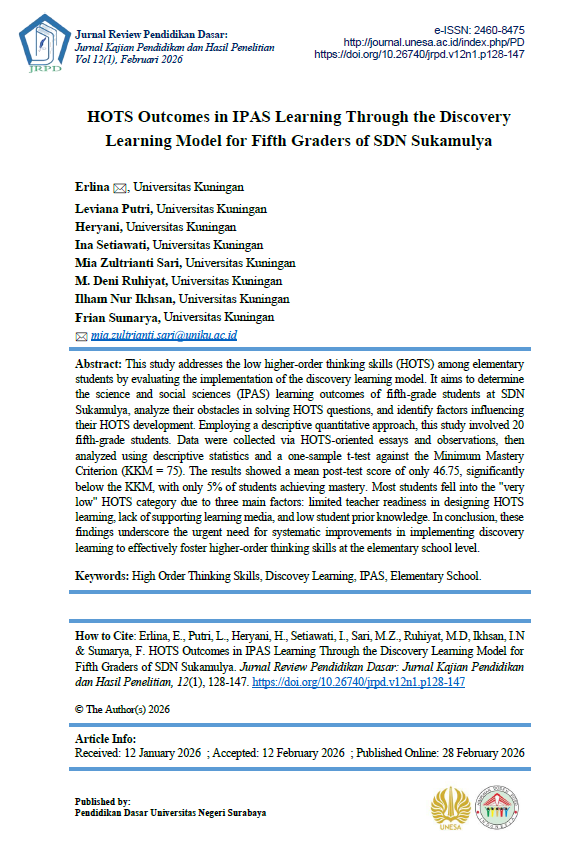
Higher-Order Thinking Skills Outcomes in Integrated Natural and Social Sciences Learning Following the Implementation of Discovery Learning among Fifth-Grade Students
DOI:
https://doi.org/10.26740/jrpd.v12n1.p128-147Keywords:
higher order thinking skills,, Discovery Learning, Elementary School, Natural and Social Sciences, scaffoldingAbstract
Discovery learning is widely promoted as a means of developing higher-order thinking skills (HOTS), and evidence on HOTS outcomes after its implementation in routine elementary classrooms remains limited, so this study aimed to describe the Natural and Social Sciences learning outcomes of fifth-grade students, their performance on essay items at the C2, C4, C5, and C6 levels, and the factors that the classroom teacher considered relevant. A descriptive quantitative design was applied to 20 fifth-grade students and complemented by a semi-structured teacher interview, and the data were analysed with descriptive statistics and a one-sample t-test against the Minimum Mastery Criterion (Kriteria Ketuntasan Minimal, KKM = 75). The mean score was 46.75 (SD = 18.73, very low category), one student (5%) reached mastery, the mean was reliably below the KKM (t(19) = -6.75, p < .001, d = -1.51), item-level correct response rates ranged from 7% (C6) to 28% (C4), and the teacher referred to limited literacy, unfamiliarity with essay questions, limited parental guidance, and heterogeneous learning needs. Because the design has no comparison group or pretest, the findings describe post-implementation outcomes and suggest that guided discovery, diagnostic attention to prior knowledge, and regular HOTS essay practice merit empirical testing in elementary IPAS classrooms.
References
Aldalur, I., & Perez, A. (2023). Gamification and discovery learning: Motivating and involving students in the learning process. Heliyon, 9(1), Article e13135. https://doi.org/10.1016/j.heliyon.2023.e13135
Anazifa, R. D., & Djukri. (2017). Project-based learning and problem-based learning: Are they effective to improve student’s thinking skills? Jurnal Pendidikan IPA Indonesia, 6(2), 346-355. https://doi.org/10.15294/jpii.v6i2.11100
Binder, T., Sandmann, A., Sures, B., Friege, G., Theyssen, H., & Schmiemann, P. (2019). Assessing prior knowledge types as predictors of academic achievement in the introductory phase of biology and physics study programmes using logistic regression. International Journal of STEM Education, 6, Article 33. https://doi.org/10.1186/s40594-019-0189-9
Dong, A., Jong, M. S.-Y., & King, R. B. (2020). How does prior knowledge influence learning engagement? The mediating roles of cognitive load and help-seeking. Frontiers in Psychology, 11, Article 591203. https://doi.org/10.3389/fpsyg.2020.591203
Fu, M., Bo, W. V., Xue, Y., & Yuan, T.-F. (2017). Parental absence accompanies worse academic achievements: Evidence based upon a sample of left-behind children in rural China. Frontiers in Education, 2, Article 38. https://doi.org/10.3389/feduc.2017.00038
Greving, S., & Richter, T. (2018). Examining the testing effect in university teaching: Retrievability and question format matter. Frontiers in Psychology, 9, Article 2412. https://doi.org/10.3389/fpsyg.2018.02412
Hadi, S., Retnawati, H., Munadi, S., Apino, E., & Wulandari, N. F. (2018). The difficulties of high school students in solving higher-order thinking skills problems. Problems of Education in the 21st Century, 76(4), 520-532. https://doi.org/10.33225/pec/18.76.520
Ichsan, I. Z., Sigit, D. V., Miarsyah, M., Ali, A., Arif, W. P., & Prayitno, T. A. (2019). HOTS-AEP: Higher order thinking skills from elementary to master students in environmental learning. European Journal of Educational Research, 8(4), 935-942. https://doi.org/10.12973/eu-jer.8.4.935
Kruit, P. M., Oostdam, R. J., van den Berg, E., & Schuitema, J. A. (2018). Effects of explicit instruction on the acquisition of students’ science inquiry skills in grades 5 and 6 of primary education. International Journal of Science Education, 40(4), 421-441. https://doi.org/10.1080/09500693.2018.1428777
Li, J., Xue, E., & You, H. (2024). Parental educational expectations and academic achievement of left-behind children in China: The mediating role of parental involvement. Behavioral Sciences, 14(5), Article 371. https://doi.org/10.3390/bs14050371
Lu, K., Yang, H. H., Shi, Y., & Wang, X. (2021). Examining the key influencing factors on college students’ higher-order thinking skills in the smart classroom environment. International Journal of Educational Technology in Higher Education, 18, Article 1. https://doi.org/10.1186/s41239-020-00238-7
Mahanal, S., Zubaidah, S., Sumiati, I. D., Sari, T. M., & Ismirawati, N. (2019). RICOSRE: A learning model to develop critical thinking skills for students with different academic abilities. International Journal of Instruction, 12(2), 417-434. https://doi.org/10.29333/iji.2019.12227a
Nancekivell, S. E., Shah, P., & Gelman, S. A. (2020). Maybe they’re born with it, or maybe it’s experience: Toward a deeper understanding of the learning style myth. Journal of Educational Psychology, 112(2), 221-235. https://doi.org/10.1037/edu0000366
Newton, P. M., & Miah, M. (2017). Evidence-based higher education: Is the learning styles “myth” important? Frontiers in Psychology, 8, Article 444. https://doi.org/10.3389/fpsyg.2017.00444
O’Reilly, T., Wang, Z., & Sabatini, J. (2019). How much knowledge is too little? When a lack of knowledge becomes a barrier to comprehension. Psychological Science, 30(9), 1344-1351. https://doi.org/10.1177/0956797619862276
Pozas, M., Letzel, V., & Schneider, C. (2020). Teachers and differentiated instruction: Exploring differentiation practices to address student diversity. Journal of Research in Special Educational Needs, 20(3), 217-230. https://doi.org/10.1111/1471-3802.12481
Ramdiah, S., Abidinsyah, Royani, M., Husamah, & Fauzi, A. (2019). Understanding, planning, and implementation of HOTS by senior high school biology teachers in Banjarmasin-Indonesia. International Journal of Instruction, 12(1), 425-440. https://doi.org/10.29333/iji.2019.12128a
Retnawati, H., Kartowagiran, B., Arlinwibowo, J., & Sulistyaningsih, E. (2017). Why are the mathematics national examination items difficult and what is teachers’ strategy to overcome it? International Journal of Instruction, 10(3), 257-276. https://doi.org/10.12973/iji.2017.10317a
Retnawati, H., Djidu, H., Kartianom, Apino, E., & Anazifa, R. D. (2018). Teachers’ knowledge about higher-order thinking skills and its learning strategy. Problems of Education in the 21st Century, 76(2), 215-230. https://doi.org/10.33225/pec/18.76.215
Rogowsky, B. A., Calhoun, B. M., & Tallal, P. (2020). Providing instruction based on students’ learning style preferences does not improve learning. Frontiers in Psychology, 11, Article 164. https://doi.org/10.3389/fpsyg.2020.00164
Shieh, C.-J., & Yu, L. (2016). A study on information technology integrated guided discovery instruction towards students’ learning achievement and learning retention. Eurasia Journal of Mathematics, Science and Technology Education, 12(4), 833-842. https://doi.org/10.12973/eurasia.2015.1554a
Sidiq, Y., Ishartono, N., Desstya, A., Prayitno, H. J., Anif, S., & Hidayat, M. L. (2021). Improving elementary school students’ critical thinking skill in science through HOTS-based science questions: A quasi-experimental study. Jurnal Pendidikan IPA Indonesia, 10(3), 378-386. https://doi.org/10.15294/jpii.v10i3.30891
Suprayogi, M. N., Valcke, M., & Godwin, R. (2017). Teachers and their implementation of differentiated instruction in the classroom. Teaching and Teacher Education, 67, 291-301. https://doi.org/10.1016/j.tate.2017.06.020
Tiruneh, D. T., De Cock, M., Weldeslassie, A. G., Elen, J., & Janssen, R. (2017). Measuring critical thinking in physics: Development and validation of a critical thinking test in electricity and magnetism. International Journal of Science and Mathematics Education, 15(4), 663-682. https://doi.org/10.1007/s10763-016-9723-0
van Riesen, S. A. N., Gijlers, H., Anjewierden, A., & de Jong, T. (2018). Supporting learners’ experiment design. Educational Technology Research and Development, 66(2), 475-491. https://doi.org/10.1007/s11423-017-9568-4
Vieira, R. M., & Tenreiro-Vieira, C. (2016). Fostering scientific literacy and critical thinking in elementary science education. International Journal of Science and Mathematics Education, 14(4), 659-680. https://doi.org/10.1007/s10763-014-9605-2
Weaver, J. P., Chastain, R. J., DeCaro, D. A., & DeCaro, M. S. (2018). Reverse the routine: Problem solving before instruction improves conceptual knowledge in undergraduate physics. Contemporary Educational Psychology, 52, 36-47. https://doi.org/10.1016/j.cedpsych.2017.12.003
Wijesekera, H. D., & Hameed, R. (2025). From rote learning to critical inquiry: Fostering higher order thinking skills through collaborative questioning in a rural secondary English-medium science classroom. Thinking Skills and Creativity, 60, Article 102093. https://doi.org/10.1016/j.tsc.2025.102093
Yang, K.-K., Lee, L., Hong, Z.-R., & Lin, H.-S. (2016). Investigation of effective strategies for developing creative science thinking. International Journal of Science Education, 38(13), 2133-2151. https://doi.org/10.1080/09500693.2016.1230685
Yerimadesi, Y., Warlinda, Y. A., Rosanna, D. L., Sakinah, M., Putri, E. J., Guspatni, G., & Andromeda, A. (2023). Guided discovery learning-based chemistry e-module and its effect on students’ higher-order thinking skills. Jurnal Pendidikan IPA Indonesia, 12(1), 168-177. https://doi.org/10.15294/jpii.v12i1.42130
Downloads
Published
How to Cite
Issue
Section
License
Copyright (c) 2026 Jurnal Review Pendidikan Dasar : Jurnal Kajian Pendidikan dan Hasil Penelitian

This work is licensed under a Creative Commons Attribution 4.0 International License.
 Abstract views: 116
,
 PDF Downloads: 99