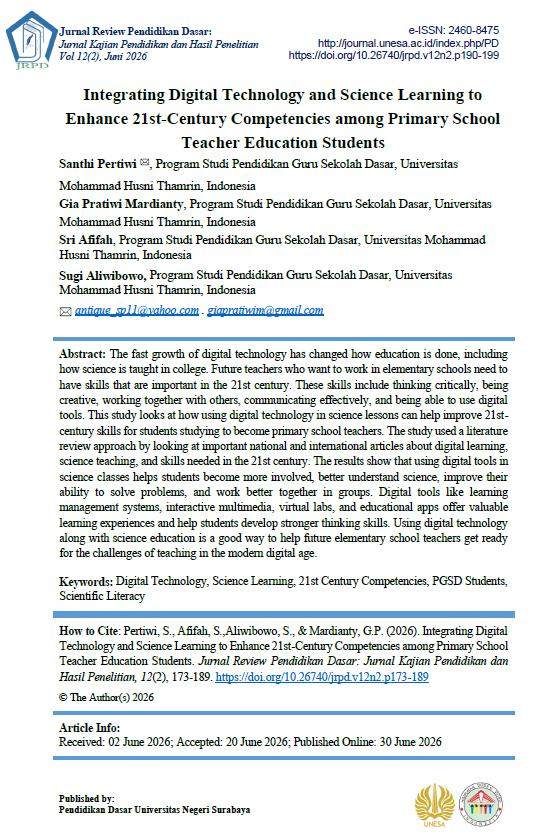
Integrating Digital Technology and Science Learning to Enhance 21st-Century Competencies among Primary School Teacher Education Students
DOI:
https://doi.org/10.26740/jrpd.v12n02.p190-199Keywords:
Digital technology, Science Learning, 21st Century Competnecies, Scientific LiteracyAbstract
The fast growth of digital technology has changed how education is done, including how science is taught in college. Future teachers who want to work in elementary schools need to have skills that are important in the 21st century. These skills include thinking critically, being creative, working together with others, communicating effectively, and being able to use digital tools. This study looks at how using digital technology in science lessons can help improve 21st-century skills for students studying to become primary school teachers. The study used a literature review approach by looking at important national and international articles about digital learning, science teaching, and skills needed in the 21st century. The results show that using digital tools in science classes helps students become more involved, better understand science, improve their ability to solve problems, and work better together in groups. Digital tools like learning management systems, interactive multimedia, virtual labs, and educational apps offer valuable learning experiences and help students develop stronger thinking skills. Using digital technology along with science education is a good way to help future elementary school teachers get ready for the challenges of teaching in the modern digital age.
References
Bond, M., Buntins, K., Bedenlier, S., Zawacki-Richter, O., & Kerres, M. (2020). Mapping research in student engagement and educational technology in higher education. International Journal of Educational Technology in Higher Education, 17(2), 1–30. https://doi.org/10.1186/s41239-019-0176-8
Bybee, R. W. (2018). Scientific literacy. In B. Akpan (Ed.), Science Education in Theory and Practice (pp. 15–28). Springer. https://doi.org/10.1007/978-3-319-73921-1_2
Chai, C. S., Koh, J. H. L., & Tsai, C. C. (2013). A review of technological pedagogical content knowledge. Educational Technology & Society, 16(2), 31–51.
Creswell, J. W., & Creswell, J. D. (2018). Research Design: Qualitative, Quantitative, and Mixed Methods Approaches (5th ed.). Sage Publications.
Darling-Hammond, L., Flook, L., Cook‐Harvey, C., Barron, B., & Osher, D. (2020). Implications for educational practice of the science of learning and development. Applied Developmental Science, 24(2), 97–140. https://doi.org/10.1080/10888691.2018.1537791
Ertmer, P. A., & Ottenbreit-Leftwich, A. T. (2019). Teacher technology change: How knowledge, confidence, beliefs, and culture intersect. Journal of Research on Technology in Education, 42(3), 255–284.
Fraillon, J., Ainley, J., Schulz, W., Friedman, T., & Duckworth, D. (2020). Preparing for Life in a Digital World: IEA International Computer and Information Literacy Study 2018 International Report. Springer. https://doi.org/10.1007/978-3-030-38781-5
Henderson, M., Selwyn, N., & Aston, R. (2017). What works and why? Student perceptions of useful digital technology in university teaching and learning. Studies in Higher Education, 42(8), 1567–1579.
Hsu, Y. C., Hung, J. L., & Ching, Y. H. (2013). Trends of educational technology research: More than a decade of international research in six SSCI-indexed journals. Educational Technology Research and Development, 61(4), 685–705.
Kimmons, R., Graham, C. R., & West, R. E. (2020). The PICRAT model for technology integration in teacher preparation. Contemporary Issues in Technology and Teacher Education, 20(1), 176–198.
Koehler, M. J., Mishra, P., Kereluik, K., Shin, T. S., & Graham, C. R. (2014). The technological pedagogical content knowledge framework. In J. M. Spector et al. (Eds.), Handbook of Research on Educational Communications and Technology (pp. 101–111). Springer.
Law, N., Woo, D., De La Torre, J., & Wong, G. (2018). A Global Framework of Reference on Digital Literacy Skills for Indicator 4.4.2. UNESCO Institute for Statistics.
Lederman, N. G., Lederman, J. S., & Antink, A. (2013). Nature of science and scientific inquiry as contexts for the learning of science and achievement of scientific literacy. International Journal of Education in Mathematics, Science and Technology, 1(3), 138–147.
Martin, F., Sun, T., & Westine, C. D. (2020). A systematic review of research on online teaching and learning from 2009 to 2018. Computers & Education, 159, 104009.
Mishra, P., & Koehler, M. J. (2006). Technological pedagogical content knowledge: A framework for teacher knowledge. Teachers College Record, 108(6), 1017–1054. https://doi.org/10.1111/j.1467-9620.2006.00684.x
Ng, W. (2012). Can we teach digital natives digital literacy? Computers & Education, 59(3), 1065–1078.
OECD. (2023). PISA 2022 Results (Volume I): The State of Learning and Equity in Education. OECD Publishing. https://doi.org/10.1787/53f23881-en
Redecker, C. (2017). European Framework for the Digital Competence of Educators: DigCompEdu. Publications Office of the European Union.
Sari, D. P., Nurhayati, S., & Widodo, A. (2023). Digital literacy and science learning in higher education: A systematic review. Journal of Science Learning, 6(2), 125–137.
Scherer, R., Siddiq, F., & Tondeur, J. (2019). The technology acceptance model (TAM): A meta-analytic structural equation modeling approach to explaining teachers’ adoption of digital technology. Computers & Education, 128, 13–35.
Siddiq, F., Gochyyev, P., & Wilson, M. (2017). Learning in digital networks: ICT literacy and educational outcomes. Computers & Education, 109, 11–25.
Snyder, H. (2019). Literature review as a research methodology: An overview and guidelines. Journal of Business Research, 104, 333–339. https://doi.org/10.1016/j.jbusres.2019.07.039
Teo, T. (2011). Factors influencing teachers’ intention to use technology: Model development and test. Computers & Education, 57(4), 2432–2440.
Tondeur, J., Scherer, R., Siddiq, F., & Baran, E. (2020). Enhancing pre-service teachers’ technological pedagogical content knowledge (TPACK): A mixed-method study. Educational Technology Research and Development, 68(1), 319–343.
Trust, T. (2018). Why do teachers use Twitter for professional development? Journal of Digital Learning in Teacher Education, 28(4), 133–145.
Uerz, D., Volman, M., & Kral, M. (2018). Teacher educators’ competencies in fostering student teachers’ proficiency in teaching and learning with technology. Teaching and Teacher Education, 73, 12–23.
UNESCO. (2023). Global Education Monitoring Report 2023: Technology in Education—A Tool on Whose Terms? UNESCO Publishing.
Valtonen, T., Sointu, E., Kukkonen, J., Kontkanen, S., Lambert, M., & Mäkitalo-Siegl, K. (2021). TPACK updated to measure pre-service teachers’ twenty-first century skills. Australasian Journal of Educational Technology, 37(3), 15–31.
Voogt, J., Fisser, P., Roblin, N. P., Tondeur, J., & Van Braak, J. (2013). Technological pedagogical content knowledge—A review of the literature. Journal of Computer Assisted Learning, 29(2), 109–121. https://doi.org/10.1111/j.1365-2729.2012.00487.x
Zawacki-Richter, O., Marín, V. I., Bond, M., & Gouverneur, F. (2019). Systematic review of research on artificial intelligence applications in higher education. International Journal of Educational Technology in Higher Education, 16(39), 1–27.
Zhao, Y., Pugh, K., Sheldon, S., & Byers, J. L. (2020). Conditions for classroom technology innovations. Teachers College Record, 104(3), 482–515.
Downloads
Published
How to Cite
Issue
Section
License
Copyright (c) 2026 Jurnal Review Pendidikan Dasar : Jurnal Kajian Pendidikan dan Hasil Penelitian

This work is licensed under a Creative Commons Attribution 4.0 International License.
 Abstract views: 201
,
Abstract views: 201
, PDF Downloads: 95