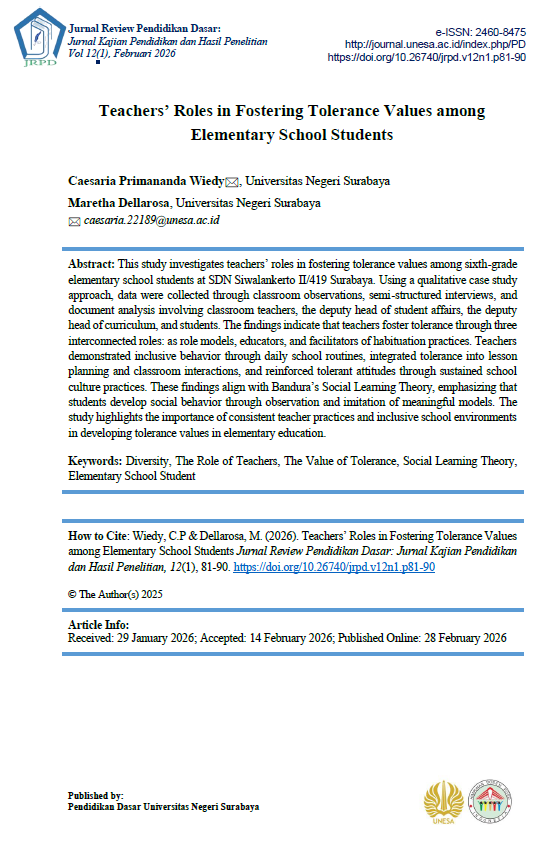
Teachers’ Roles in Fostering Tolerance Values among Elementary School Students
DOI:
https://doi.org/10.26740/jrpd.v12n1.p81-90Keywords:
Diversity, The role of teacher, the value of tolerance, social learning theory, elementary school studentAbstract
Elementary classrooms in Indonesia bring together students from diverse religious, ethnic, cultural, socioeconomic, and academic backgrounds, and this study aims to describe how teachers foster tolerance values among sixth-grade students at a public elementary school in Surabaya through the lens of Bandura’s Social Learning Theory. A qualitative case study was conducted using passive participatory observation, semi-structured interviews with classroom teachers, the deputy head of student affairs, the deputy head of curriculum, and students, and document analysis, with source triangulation, technique triangulation, and member checking supporting trustworthiness. The findings show three interconnected teacher roles: as role models through the daily Senyum, Salam, Sapa, Sopan, Santun (5S) routine, as educators through reflective lesson openings and weekly mixed-group seating rotation, and as mediators and facilitators through neutral handling of differing opinions. These patterns can be interpreted through the attention, retention, behavioral production, and motivation processes of Social Learning Theory, and they highlight the relevance of consistent teacher practices and inclusive school routines for tolerance education in elementary schools.
References
Afifuddin, A., Amri, M., Latif, A., Rosmini, R., & Bin Tahir, S. Z. (2025). Negotiating multicultural values within centralized education systems: A case study of Indonesia. Frontiers in Education, 10, Article 1620685. https://doi.org/10.3389/feduc.2025.1620685
Bandura, A. (2001b). Social cognitive theory of mass communication. Media Psychology, 3(3), 265-299. https://doi.org/10.1207/S1532785XMEP0303_03
Baysu, G., Hillekens, J., Phalet, K., & Deaux, K. (2021). How diversity approaches affect ethnic minority and majority adolescents: Teacher-student relationship trajectories and school outcomes. Child Development, 92, 367-387. https://doi.org/10.1111/cdev.13417
Birt, L., Scott, S., Cavers, D., Campbell, C., & Walter, F. (2016). Member checking: A tool to enhance trustworthiness or merely a nod to validation? Qualitative Health Research, 26(13), 1802-1811. https://doi.org/10.1177/1049732316654870
Carter, N., Bryant-Lukosius, D., DiCenso, A., Blythe, J., & Neville, A. J. (2014). The use of triangulation in qualitative research. Oncology Nursing Forum, 41(5), 545-547. https://doi.org/10.1188/14.ONF.545-547
Cassar, C., Oosterheert, I., & Meijer, P. (2021). The classroom in turmoil: Teachers’ perspective on unplanned controversial issues in the classroom. Teachers and Teaching. https://doi.org/10.1080/13540602.2021.1986694
Celeste, L., Baysu, G., Phalet, K., Meeussen, L., & Kende, J. (2019). Can school diversity policies reduce belonging and achievement gaps between minority and majority youth? Multiculturalism, colorblindness, and assimilationism assessed. Personality and Social Psychology Bulletin, 45, 1603-1618. https://doi.org/10.1177/0146167219838577
Cherng, H.-Y. S., & Davis, L. A. (2019). Multicultural matters: An investigation of key assumptions of multicultural education reform in teacher education. Journal of Teacher Education, 70, 219-236. https://doi.org/10.1177/0022487117742884
Civitillo, S., Schachner, M. K., Juang, L. P., van de Vijver, F. J. R., Handrick, A., & Noack, P. (2017). Towards a better understanding of cultural diversity approaches at school: A multi-informant and mixed-methods study. Learning, Culture and Social Interaction, 12, 1-14. https://doi.org/10.1016/j.lcsi.2016.09.002
Cook, C. R., Fiat, A., Larson, M., Daikos, C., Slemrod, T., Holland, E. A., Thayer, A. J., & Renshaw, T. (2018). Positive greetings at the door: Evaluation of a low-cost, high-yield proactive classroom management strategy. Journal of Positive Behavior Interventions, 20(3), 149-159. https://doi.org/10.1177/1098300717753831
Crowe, S., Cresswell, K., Robertson, A., Huby, G., Avery, A., & Sheikh, A. (2011). The case study approach. BMC Medical Research Methodology, 11, Article 100. https://doi.org/10.1186/1471-2288-11-100
Dubbeld, A., de Hoog, N., den Brok, P., & de Laat, M. (2019). Teachers’ multicultural attitudes and perceptions of school policy and school climate in relation to burnout. Intercultural Education, 30, 599-617. https://doi.org/10.1080/14675986.2018.1538042
Geerlings, J., Thijs, J., & Verkuyten, M. (2018). Teaching in ethnically diverse classrooms: Examining individual differences in teacher self-efficacy. Journal of School Psychology, 67, 134-147. https://doi.org/10.1016/j.jsp.2017.12.001
Gutentag, T., Horenczyk, G., & Tatar, M. (2018). Teachers’ approaches toward cultural diversity predict diversity-related burnout and self-efficacy. Journal of Teacher Education, 69, 408-419. https://doi.org/10.1177/0022487117714244
Hendrickx, M. M. H. G., Mainhard, M. T., Boor-Klip, H. J., Cillessen, A. H. N., & Brekelmans, M. (2016). Social dynamics in the classroom: Teacher support and conflict and the peer ecology. Teaching and Teacher Education, 53, 30-40. https://doi.org/10.1016/j.tate.2015.10.004
Hjerm, M., Eger, M. A., Bohman, A., & Fors Connolly, F. (2020). A new approach to the study of tolerance: Conceptualizing and measuring acceptance, respect, and appreciation of difference. Social Indicators Research, 147(3), 897-919. https://doi.org/10.1007/s11205-019-02176-y
Howe, C., Hennessy, S., Mercer, N., Vrikki, M., & Wheatley, L. (2019). Teacher-student dialogue during classroom teaching: Does it really impact on student outcomes? Journal of the Learning Sciences, 28(4-5), 462-512. https://doi.org/10.1080/10508406.2019.1573730
Kello, K. (2016). Sensitive and controversial issues in the classroom: Teaching history in a divided society. Teachers and Teaching, 22(1), 35-53. https://doi.org/10.1080/13540602.2015.1023027
Nowell, L. S., Norris, J. M., White, D. E., & Moules, N. J. (2017). Thematic analysis: Striving to meet the trustworthiness criteria. International Journal of Qualitative Methods, 16(1), Article 1609406917733847. https://doi.org/10.1177/1609406917733847
Ortega, L., Boda, Z., Treviño, E., Arriagada, V., Gelber, D., & Escribano, M. del R. (2020). The centrality of immigrant students within teacher-student interaction networks: A relational approach to educational inclusion. Teaching and Teacher Education, 95, Article 103126. https://doi.org/10.1016/j.tate.2020.103126
Raihani, R. (2018). Education for multicultural citizens in Indonesia: Policies and practices. Compare: A Journal of Comparative and International Education, 48, 992-1009. https://doi.org/10.1080/03057925.2017.1399250
Reimer, N. K., Hughes, J., Blaylock, D., Donnelly, C., Wölfer, R., & Hewstone, M. (2022). Shared education as a contact-based intervention to improve intergroup relations among adolescents in postconflict Northern Ireland. Developmental Psychology. https://doi.org/10.1037/dev0001274
Schachner, M. K., Noack, P., van de Vijver, F. J. R., & Eckstein, K. (2016). Cultural diversity climate and psychological adjustment at school: Equality and inclusion versus cultural pluralism. Child Development, 87(4), 1175-1191. https://doi.org/10.1111/cdev.12536
Schachner, M. K., Schwarzenthal, M., & van de Vijver, F. J. R. (2019). How all students can belong and achieve: Effects of the cultural diversity climate amongst students of immigrant and nonimmigrant background in Germany. Journal of Educational Psychology, 111(4), 703-716. https://doi.org/10.1037/edu0000303
Schachner, M. K., Schwarzenthal, M., Moffitt, U., Civitillo, S., & Juang, L. (2021). Capturing a nuanced picture of classroom cultural diversity climate: Multigroup and multilevel analyses among secondary school students in Germany. Contemporary Educational Psychology, 65, Article 101971. https://doi.org/10.1016/j.cedpsych.2021.101971
Schwarzenthal, M., Juang, L. P., Schachner, M. K., van de Vijver, F. J. R., & Handrick, A. (2017). From tolerance to understanding: Exploring the development of intercultural competence in multiethnic contexts from early to late adolescence. Journal of Community & Applied Social Psychology, 27, 388-399. https://doi.org/10.1002/casp.2317
Schwarzenthal, M., Schachner, M. K., van de Vijver, F. J. R., & Juang, L. P. (2018). Equal but different: Effects of equality/inclusion and cultural pluralism on intergroup outcomes in multiethnic classrooms. Cultural Diversity and Ethnic Minority Psychology, 24(2), 260-271. https://doi.org/10.1037/cdp0000173
Sirry, M., Suyanto, B., Sugihartati, R., Kartono, D. T., & Yani, M. T. (2024). Teachers’ perspectives on tolerance education in Indonesian high schools. British Journal of Religious Education. https://doi.org/10.1080/01416200.2024.2345213
Smith, L. V., Wang, M.-T., & Hill, D. J. (2020). Black youths’ perceptions of school cultural pluralism, school climate and the mediating role of racial identity. Journal of School Psychology, 83, 50-65. https://doi.org/10.1016/j.jsp.2020.09.002
Tracy, S. J. (2010). Qualitative quality: Eight “big-tent” criteria for excellent qualitative research. Qualitative Inquiry, 16(10), 837-851. https://doi.org/10.1177/1077800410383121
Ulbricht, J., Schachner, M. K., Civitillo, S., & Noack, P. (2022). Teachers’ acculturation in culturally diverse schools: How is the perceived diversity climate linked to intercultural self-efficacy? Frontiers in Psychology, 13, Article 953068. https://doi.org/10.3389/fpsyg.2022.953068
Van Praag, L., Stevens, P. A. J., & Van Houtte, M. (2016). “No more Turkish music!” The acculturation strategies of teachers and ethnic minority students in Flemish schools. Journal of Ethnic and Migration Studies, 42, 1353-1370. https://doi.org/10.1080/1369183X.2015.1103171
Veldman, M. A., Doolaard, S., Bosker, R. J., & Snijders, T. A. B. (2020). Young children working together: Cooperative learning effects on group work of children in Grade 1 of primary education. Learning and Instruction, 67, Article 101308. https://doi.org/10.1016/j.learninstruc.2020.101308
Wijaya Mulya, T., & Aditomo, A. (2019). Researching religious tolerance education using discourse analysis: A case study from Indonesia. British Journal of Religious Education, 41(4), 446-457. https://doi.org/10.1080/01416200.2018.1556602
Wijaya Mulya, T., Aditomo, A., & Suryani, A. (2022). On being a religiously tolerant Muslim: Discursive contestations among pre-service teachers in contemporary Indonesia. British Journal of Religious Education, 44(1), 66-79. https://doi.org/10.1080/01416200.2021.1917338
Wölfer, R., Schmid, K., Hewstone, M., & van Zalk, M. (2016). Developmental dynamics of intergroup contact and intergroup attitudes: Long-term effects in adolescence and early adulthood. Child Development, 87(5), 1466-1478. https://doi.org/10.1111/cdev.12598
Downloads
Published
How to Cite
Issue
Section
License
Copyright (c) 2026 Jurnal Review Pendidikan Dasar : Jurnal Kajian Pendidikan dan Hasil Penelitian

This work is licensed under a Creative Commons Attribution 4.0 International License.
 Abstract views: 117
,
 PDF Downloads: 116