Improving Environmental Literacy Through Ecobrick-Based Project-Based Learning in Second-Grade Elementary Students
DOI:
https://doi.org/10.26740/jrpd.v12n2.p210-228Keywords:
Environemntal literacy, Ecobrick, Project Based Learning, Classroom action research, normalized gainAbstract
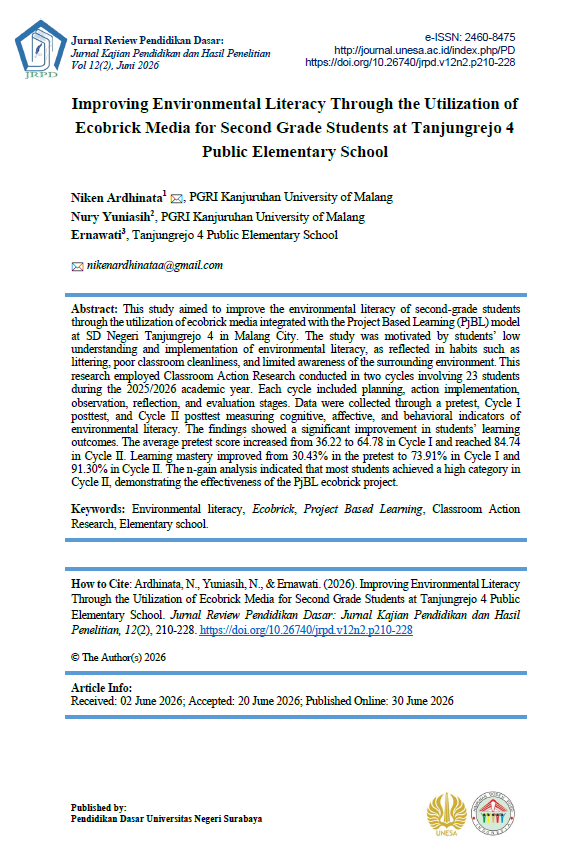
Limited research has examined how ecobrick projects can be organized within project-based learning to develop environmental literacy in the early primary grades. This study aimed to examine whether and how ecobrick-based Project Based Learning (PjBL) improved the environmental literacy of second-grade students at a public elementary school in Malang City, Indonesia. Classroom Action Research was conducted in two cycles with 23 students in the 2025/2026 academic year, and each cycle comprised planning, action, observation, reflection, and evaluation. Data were collected through a pretest, a Cycle I posttest, and a Cycle II posttest covering cognitive, affective, and behavioral indicators, together with teacher observations. Mean scores increased from 36.22 in the pretest to 64.78 in Cycle I and 84.74 in Cycle II, and learning mastery rose from 30.43% to 73.91% and then to 91.30%. In Cycle II, 69.57% of students were in the high normalized gain category, 30.43% were in the moderate category, and none were in the low category. The results indicate that ecobrick-based PjBL with small groups and direct observation was associated with improved environmental literacy in this class, and further studies with comparison groups and delayed posttests are needed.
References
Baierl, T.-M., Johnson, B., & Bogner, F. X. (2021). Assessing environmental attitudes and cognitive achievement within 9 years of informal earth education. Sustainability, 13(7), Article 3622. https://doi.org/10.3390/su13073622
Baierl, T.-M., Kaiser, F. G., & Bogner, F. X. (2024). The role of attitude toward nature in learning about environmental issues. Frontiers in Psychology, 15, Article 1471026. https://doi.org/10.3389/fpsyg.2024.1471026
Barrera-Hernández, L. F., Sotelo-Castillo, M. A., Echeverría-Castro, S. B., & Tapia-Fonllem, C. O. (2020). Connectedness to nature: Its impact on sustainable behaviors and happiness in children. Frontiers in Psychology, 11, Article 276. https://doi.org/10.3389/fpsyg.2020.00276
Bølling, M., Otte, C. R., Elsborg, P., Nielsen, G., & Bentsen, P. (2018). The association between education outside the classroom and students’ school motivation: Results from a one-school-year quasi-experiment. International Journal of Educational Research, 89, 22–35. https://doi.org/10.1016/j.ijer.2018.03.004
Bølling, M., Pfister, G. U., Mygind, E., & Nielsen, G. (2019). Education outside the classroom and pupils’ social relations? A one-year quasi-experiment. International Journal of Educational Research, 94, 29–41. https://doi.org/10.1016/j.ijer.2019.02.014
Borrelle, S. B., Ringma, J., Law, K. L., Monnahan, C. C., Lebreton, L., McGivern, A., Murphy, E., Jambeck, J., Leonard, G. H., Hilleary, M. A., Eriksen, M., Possingham, H. P., De Frond, H., Gerber, L. R., Polidoro, B., Tahir, A., Bernard, M., Mallos, N., Barnes, M., & Rochman, C. M. (2020). Predicted growth in plastic waste exceeds efforts to mitigate plastic pollution. Science, 369(6510), 1515–1518. https://doi.org/10.1126/science.aba3656
Braun, T., Cottrell, R., & Dierkes, P. (2018). Fostering changes in attitude, knowledge and behavior: Demographic variation in environmental education effects. Environmental Education Research, 24(6), 899–920. https://doi.org/10.1080/13504622.2017.1343279
Coletta, V. P., & Steinert, J. J. (2020). Why normalized gain should continue to be used in analyzing preinstruction and postinstruction scores on concept inventories. Physical Review Physics Education Research, 16(1), Article 010108. https://doi.org/10.1103/PhysRevPhysEducRes.16.010108
Dettweiler, U., Becker, C., Auestad, B. H., Simon, P., & Kirsch, P. (2017). Stress in school. Some empirical hints on the circadian cortisol rhythm of children in outdoor and indoor classes. International Journal of Environmental Research and Public Health, 14(5), Article 475. https://doi.org/10.3390/ijerph14050475
Djordjevic, I., Jovanovic, S., Markovic, M., Andjelkovic, S., Prnjat, Z., Matović, S., & Valjarević, A. (2026). Project-based learning in geography and its impact on developing students’ values, attitudes and pro-environmental behavior. Sustainability, 18(2), Article 725. https://doi.org/10.3390/su18020725
Dole, S., Bloom, L., & Kowalske, K. (2016). Transforming pedagogy: Changing perspectives from teacher-centered to learner-centered. Interdisciplinary Journal of Problem-Based Learning, 10(1). https://doi.org/10.7771/1541-5015.1538
Duke, N. K., Halvorsen, A.-L., Strachan, S. L., Kim, J., & Konstantopoulos, S. (2021). Putting PjBL to the test: The impact of project-based learning on second graders’ social studies and literacy learning and motivation in low-SES school settings. American Educational Research Journal, 58(1), 160–200. https://doi.org/10.3102/0002831220929638
Evans, G. W., Otto, S., & Kaiser, F. G. (2018). Childhood origins of young adult environmental behavior. Psychological Science, 29(5), 679–687. https://doi.org/10.1177/0956797617741894
Geyer, R., Jambeck, J. R., & Law, K. L. (2017). Production, use, and fate of all plastics ever made. Science Advances, 3(7), Article e1700782. https://doi.org/10.1126/sciadv.1700782
Hake, R. R. (1998). Interactive-engagement versus traditional methods: A six-thousand-student survey of mechanics test data for introductory physics courses. American Journal of Physics, 66(1), 64–74. https://doi.org/10.1119/1.18809
Kemmis, S. (2009). Action research as a practice-based practice. Educational Action Research, 17(3), 463–474. https://doi.org/10.1080/09650790903093284
Kuo, M., Browning, M. H. E. M., Sachdeva, S., Lee, K., & Westphal, L. (2018). Might school performance grow on trees? Examining the link between “greenness” and academic achievement in urban, high-poverty schools. Frontiers in Psychology, 9, Article 1669. https://doi.org/10.3389/fpsyg.2018.01669
Lau, W. W. Y., Shiran, Y., Bailey, R. M., Cook, E., Stuchtey, M. R., Koskella, J., Velis, C. A., Godfrey, L., Boucher, J., Murphy, M. B., Thompson, R. C., Jankowska, E., Castillo Castillo, A., Pilditch, T. D., Dixon, B., Koerselman, L., Kosior, E., Favoino, E., Gutberlet, J., ... Palardy, J. E. (2020). Evaluating scenarios toward zero plastic pollution. Science, 369(6510), 1455–1461. https://doi.org/10.1126/science.aba9475
Lebreton, L. C. M., van der Zwet, J., Damsteeg, J.-W., Slat, B., Andrady, A., & Reisser, J. (2017). River plastic emissions to the world’s oceans. Nature Communications, 8, Article 15611. https://doi.org/10.1038/ncomms15611
Liefländer, A. K., & Bogner, F. X. (2018). Educational impact on the relationship of environmental knowledge and attitudes. Environmental Education Research, 24(4), 611–624. https://doi.org/10.1080/13504622.2016.1188265
McBride, B. B., Brewer, C. A., Berkowitz, A. R., & Borrie, W. T. (2013). Environmental literacy, ecological literacy, ecoliteracy: What do we mean and how did we get here? Ecosphere, 4(5), Article 67. https://doi.org/10.1890/ES13-00075.1
Meijer, L. J. J., van Emmerik, T., van der Ent, R., Schmidt, C., & Lebreton, L. (2021). More than 1000 rivers account for 80% of global riverine plastic emissions into the ocean. Science Advances, 7(18), Article eaaz5803. https://doi.org/10.1126/sciadv.aaz5803
Meltzer, D. E. (2002). The relationship between mathematics preparation and conceptual learning gains in physics: A possible “hidden variable” in diagnostic pretest scores. American Journal of Physics, 70(12), 1259–1268. https://doi.org/10.1119/1.1514215
Otte, C. R., Bølling, M., Stevenson, M. P., Ejbye-Ernst, N., Nielsen, G., & Bentsen, P. (2019). Education outside the classroom increases children’s reading performance: Results from a one-year quasi-experimental study. International Journal of Educational Research, 94, 42–51. https://doi.org/10.1016/j.ijer.2019.01.009
Otto, S., Evans, G. W., Moon, M. J., & Kaiser, F. G. (2019). The development of children’s environmental attitude and behavior. Global Environmental Change, 58, Article 101947. https://doi.org/10.1016/j.gloenvcha.2019.101947
Otto, S., & Pensini, P. (2017). Nature-based environmental education of children: Environmental knowledge and connectedness to nature, together, are related to ecological behaviour. Global Environmental Change, 47, 88–94. https://doi.org/10.1016/j.gloenvcha.2017.09.009
Oyinlola, M., Whitehead, T., Abuzeinab, A., Adefila, A., Akinola, Y., Anafi, F., Farukh, F., Jegede, O., Kandan, K., Kim, B., & Mosugu, E. (2018). Bottle house: A case study of transdisciplinary research for tackling global challenges. Habitat International, 79, 18–29. https://doi.org/10.1016/j.habitatint.2018.07.007
Regmi, S., Johnson, B., & Dahal, B. M. (2020). Analysing the environmental values and attitudes of rural Nepalese children by validating the 2-MEV model. Sustainability, 12(1), Article 164. https://doi.org/10.3390/su12010164
Soga, M., Gaston, K. J., Yamaura, Y., Kurisu, K., & Hanaki, K. (2016). Both direct and vicarious experiences of nature affect children’s willingness to conserve biodiversity. International Journal of Environmental Research and Public Health, 13(6), Article 529. https://doi.org/10.3390/ijerph13060529
Sze, S. T. S., Ali, R. B., Marsi, N. B., Sunar, N. B. M., & Azni, M. B. B. (2026). Optimisation of ecobrick density and strength as a building material to reduce plastic waste. Journal of Tropical Resources and Sustainable Science, 14(1), 173–181. https://doi.org/10.47253/jtrss.v14i1.2150
Szczytko, R., Stevenson, K., Peterson, M. N., Nietfeld, J., & Strnad, R. L. (2019). Development and validation of the environmental literacy instrument for adolescents. Environmental Education Research, 25(2), 193–210. https://doi.org/10.1080/13504622.2018.1487035
Tallis, H., Bratman, G. N., Samhouri, J. F., & Fargione, J. (2018). Are California elementary school test scores more strongly associated with urban trees than poverty? Frontiers in Psychology, 9, Article 2074. https://doi.org/10.3389/fpsyg.2018.02074
Viñuela, Y., & de Caso Fuertes, A. M. (2022). Improving motivation in pre-school education through the use of project-based learning and cooperative learning. Frontiers in Education, 7, Article 1094004. https://doi.org/10.3389/feduc.2022.1094004
Wang, M., Jiang, L., & Luo, H. (2023). Dyads or quads? Impact of group size and learning context on collaborative learning. Frontiers in Psychology, 14, Article 1168208. https://doi.org/10.3389/fpsyg.2023.1168208
Yue, Z., & Chen, J. (2023). Direct, indirect, and vicarious nature experiences collectively predict preadolescents’ self-reported nature connectedness and conservation behaviors. PeerJ, 11, Article e15542. https://doi.org/10.7717/peerj.15542
Downloads
Published
How to Cite
Issue
Section
License
Copyright (c) 2026 Jurnal Review Pendidikan Dasar : Jurnal Kajian Pendidikan dan Hasil Penelitian

This work is licensed under a Creative Commons Attribution 4.0 International License.
 Abstract views: 240
,
 PDF Downloads: 245