Development of Augmented Reality Learning Media for Classifying Animals by Food Type in Elementary Science
DOI:
https://doi.org/10.26740/jrpd.v12n1.p1-17Keywords:
augmented reality, ADDIE model, Assemblr Edu, animal classification, elementary science educationAbstract
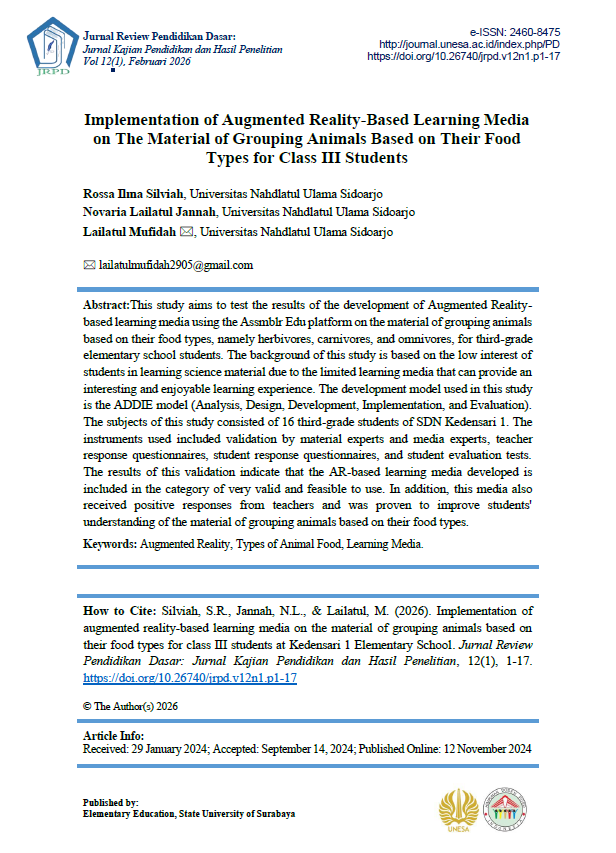
Elementary science lessons on classifying animals by food type often rely on static media that offer limited opportunities for interaction. This study aimed to describe the development of augmented reality (AR) learning media built on the Assemblr Edu platform using the ADDIE model, and to examine whether and how the media meets criteria of validity, practicality, and effectiveness among third-grade students. A research and development design was applied with 16 third-grade students, one material expert, one media expert, and one classroom teacher. The instruments were expert validation sheets, teacher and student response questionnaires, and an evaluation test, and the data were analyzed descriptively as percentages. The material expert and the media expert gave scores of 91.11% and 82.5%, respectively, both in the very valid category. The teacher response reached 91.11% (very practical) and the student response reached 85.63% (practical). A total of 13 of 16 students (81.25%) reached the minimum completion criterion, with a class mean of 83.6, which met the effectiveness criterion set in this study. These findings suggest that the media is feasible for classroom use as a supplement to science instruction, although the small sample, the absence of a comparison group and a pretest, and the delivery of the lesson by the researcher limit generalizability. Future studies should apply pretest-posttest designs with comparison groups, teacher-led implementation, and longer instructional periods.
References
Abdullah, N., Baskaran, V. L., Mustafa, Z., Ali, S. R., & Zaini, S. H. (2022). Augmented reality: The effect in students’ achievement, satisfaction and interest in science education. International Journal of Learning, Teaching and Educational Research, 21(5). https://doi.org/10.26803/ijlter.21.5.17
Afnan, Muhammad, K., Khan, N., Lee, M.-Y., Imran, A. S., & Sajjad, M. (2021). School of the future: A comprehensive study on the effectiveness of augmented reality as a tool for primary school children’s education. Applied Sciences, 11(11), Article 5277. https://doi.org/10.3390/app11115277
Akçayır, M., Akçayır, G., Pektaş, H. M., & Ocak, M. A. (2016). Augmented reality in science laboratories: The effects of augmented reality on university students’ laboratory skills and attitudes toward science laboratories. Computers in Human Behavior, 57, 334-342. https://doi.org/10.1016/j.chb.2015.12.054
Alalwan, N., Cheng, L., Al-Samarraie, H., Yousef, R., Alzahrani, A. I., & Sarsam, S. M. (2020). Challenges and prospects of virtual reality and augmented reality utilization among primary school teachers: A developing country perspective. Studies in Educational Evaluation, 66, Article 100876. https://doi.org/10.1016/j.stueduc.2020.100876
Altmeyer, K., Kapp, S., Thees, M., Malone, S., Kuhn, J., & Brünken, R. (2020). The use of augmented reality to foster conceptual knowledge acquisition in STEM laboratory courses: Theoretical background and empirical results. British Journal of Educational Technology, 51(3), 611-628. https://doi.org/10.1111/bjet.12900
Arici, F., & Yilmaz, R. M. (2025). Effects of augmented reality and video-based learning in inquiry-based science education on academic achievement and motivation to learn science. Journal of Computer Assisted Learning, 41(5), Article e70128. https://doi.org/10.1111/jcal.70128
Bursali, H., & Yilmaz, R. M. (2019). Effect of augmented reality applications on secondary school students’ reading comprehension and learning permanency. Computers in Human Behavior, 95, 126-135. https://doi.org/10.1016/j.chb.2019.01.035
Cai, S., Liu, C., Wang, T., Liu, E., & Liang, J.-C. (2021). Effects of learning physics using augmented reality on students’ self-efficacy and conceptions of learning. British Journal of Educational Technology, 52(1), 235-251. https://doi.org/10.1111/bjet.13020
Çetin, H., & Türkan, A. (2022). The effect of augmented reality based applications on achievement and attitude towards science course in distance education process. Education and Information Technologies, 27(2), 1397-1415. https://doi.org/10.1007/s10639-021-10625-w
Fidan, M., & Tuncel, M. (2019). Integrating augmented reality into problem based learning: The effects on learning achievement and attitude in physics education. Computers & Education, 142, Article 103635. https://doi.org/10.1016/j.compedu.2019.103635
Gnidovec, T., Žemlja, M., Dolenec, A., & Torkar, G. (2020). Using augmented reality and the structure-behavior-function model to teach lower secondary school students about the human circulatory system. Journal of Science Education and Technology, 29(6), 774-784. https://doi.org/10.1007/s10956-020-09850-8
Ibáñez, M.-B., Di-Serio, Á., Villarán-Molina, D., & Delgado-Kloos, C. (2016). Support for augmented reality simulation systems: The effects of scaffolding on learning outcomes and behavior patterns. IEEE Transactions on Learning Technologies, 9(1), 46-56. https://doi.org/10.1109/TLT.2015.2445761
Khan, T., Johnston, K., & Ophoff, J. (2019). The impact of an augmented reality application on learning motivation of students. Advances in Human-Computer Interaction, 2019, Article 7208494. https://doi.org/10.1155/2019/7208494
Kyza, E. A., & Georgiou, Y. (2018). Scaffolding augmented reality inquiry learning: The design and investigation of the TraceReaders location-based, augmented reality platform. Interactive Learning Environments, 27(2), 211-225. https://doi.org/10.1080/10494820.2018.1458039
Sahin, D., & Yilmaz, R. M. (2020). The effect of augmented reality technology on middle school students’ achievements and attitudes towards science education. Computers & Education, 144, Article 103710. https://doi.org/10.1016/j.compedu.2019.103710
Sökmen, Y., Sarıkaya, İ., & Nalçacı, A. (2024). The effect of augmented reality technology on primary school students’ achievement, attitudes towards the course, attitudes towards technology, and participation in classroom activities. International Journal of Human-Computer Interaction, 40(15), 3936-3951. https://doi.org/10.1080/10447318.2023.2204270
Spatioti, A. G., Kazanidis, I., & Pange, J. (2022). A comparative study of the ADDIE instructional design model in distance education. Information, 13(9), Article 402. https://doi.org/10.3390/info13090402
Thees, M., Altmeyer, K., Kapp, S., Rexigel, E., Beil, F., Klein, P., Malone, S., Brünken, R., & Kuhn, J. (2022). Augmented reality for presenting real-time data during students’ laboratory work: Comparing a head-mounted display with a separate display. Frontiers in Psychology, 13, Article 804742. https://doi.org/10.3389/fpsyg.2022.804742
Wen, Y., Wu, L., He, S., Ng, N. H.-E., Teo, B. C., Looi, C. K., & Cai, Y. (2023). Integrating augmented reality into inquiry-based learning approach in primary science classrooms. Educational Technology Research and Development, 71, 1631-1651. https://doi.org/10.1007/s11423-023-10235-y
Downloads
Published
How to Cite
Issue
Section
License
Copyright (c) 2026 Jurnal Review Pendidikan Dasar : Jurnal Kajian Pendidikan dan Hasil Penelitian

This work is licensed under a Creative Commons Attribution 4.0 International License.
 Abstract views: 275
,
 PDF Downloads: 264