Effects of Scratch-Based Learning Media on Elementary Students’ Creative Skills in Social Studies
DOI:
https://doi.org/10.26740/jrpd.v12n1.p107-115Keywords:
Scratch, Creative skills, social studies learning, quasi-experimental design, elementary educationAbstract
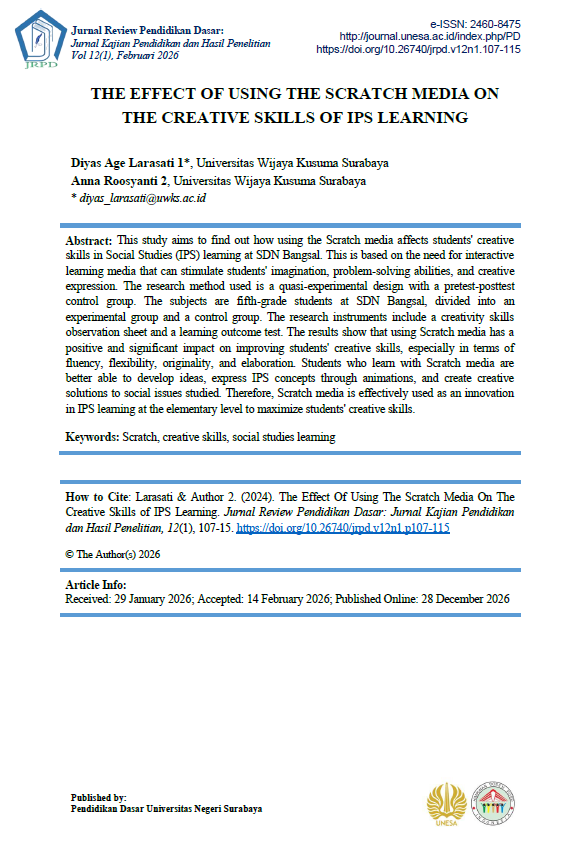
Creative skills are central to 21st-century learning, and limited research has examined how block-based programming media can support these skills within elementary Social Studies. This study aims to examine whether Scratch-based learning media is associated with a greater improvement in fifth-grade students’ creative skills in Social Studies than conventional digital presentation media, using a quasi-experimental pretest-posttest nonequivalent control group design with 60 students from one public elementary school (experimental class n = 30; control class n = 30) and a rubric-scored, project-based creativity task analyzed as normalized gain (N-Gain) with an independent-samples t-test. The experimental group showed a significantly higher N-Gain than the control group, t(58) = 6.559, p < .001, with a mean difference of 0.230, a 95% confidence interval from 0.160 to 0.300, and a large standardized effect (d = 1.69). Given the nonrandomized design and the single-site sample, the findings should be interpreted with caution, and they suggest that Scratch-based project activities are a feasible option for elementary Social Studies that warrants replication in randomized, multi-site, and longitudinal studies.
References
Bers, M. U., González-González, C., & Armas-Torres, M. B. (2019). Coding as a playground: Promoting positive learning experiences in childhood classrooms. Computers & Education, 138, 130-145. https://doi.org/10.1016/j.compedu.2019.04.013
Chevalier, M., Giang, C., El-Hamamsy, L., Bonnet, E., Papaspyros, V., Pellet, J.-P., Audrin, C., Romero, M., Baumberger, B., & Mondada, F. (2022). The role of feedback and guidance as intervention methods to foster computational thinking in educational robotics learning activities for primary school. Computers & Education, 180, Article 104431. https://doi.org/10.1016/j.compedu.2022.104431
Deng, W., Pi, Z., Lei, W., Zhou, Q., & Zhang, W. (2020). Pencil Code improves learners’ computational thinking and computer learning attitude. Computer Applications in Engineering Education, 28(1), 90-104. https://doi.org/10.1002/cae.22177
Falloon, G. (2016). An analysis of young students’ thinking when completing basic coding tasks using Scratch Jnr. on the iPad. Journal of Computer Assisted Learning, 32(6), 576-593. https://doi.org/10.1111/jcal.12155
Garneli, V., & Chorianopoulos, K. (2018). Programming video games and simulations in science education: Exploring computational thinking through code analysis. Interactive Learning Environments, 26(3), 386-401. https://doi.org/10.1080/10494820.2017.1337036
Hake, R. R. (1998). Interactive-engagement versus traditional methods: A six-thousand-student survey of mechanics test data for introductory physics courses. American Journal of Physics, 66(1), 64-74. https://doi.org/10.1119/1.18809
Hershkovitz, A., Sitman, R., Israel-Fishelson, R., Eguíluz, A., Garaizar, P., & Guenaga, M. (2019). Creativity in the acquisition of computational thinking. Interactive Learning Environments, 27(5-6), 628-644. https://doi.org/10.1080/10494820.2019.1610451
Israel-Fishelson, R., Hershkovitz, A., Eguíluz, A., Garaizar, P., & Guenaga, M. (2021). The associations between computational thinking and creativity: The role of personal characteristics. Journal of Educational Computing Research, 58(8), 1415-1447. https://doi.org/10.1177/0735633120940954
Kert, S. B., Erkoç, M. F., & Yeni, S. (2020). The effect of robotics on six graders’ academic achievement, computational thinking skills and conceptual knowledge levels. Thinking Skills and Creativity, 38, Article 100714. https://doi.org/10.1016/j.tsc.2020.100714
Kong, S.-C., Chiu, M. M., & Lai, M. (2018). A study of primary school students’ interest, collaboration attitude, and programming empowerment in computational thinking education. Computers & Education, 127, 178-189. https://doi.org/10.1016/j.compedu.2018.08.026
Li, W.-Y., & Lu, T.-C. (2024). Effect of an OwlSpace programming course on the computational thinking of elementary school students. Informatics in Education, 23(1), 145-178. https://doi.org/10.15388/infedu.2024.07
Ma, H., Zhao, M., Wang, H., Wan, X., Cavanaugh, T. W., & Liu, J. (2021). Promoting pupils’ computational thinking skills and self-efficacy: A problem-solving instructional approach. Educational Technology Research and Development, 69(3), 1599-1616. https://doi.org/10.1007/s11423-021-10016-5
Noh, J., & Lee, J. (2020). Effects of robotics programming on the computational thinking and creativity of elementary school students. Educational Technology Research and Development, 68(1), 463-484. https://doi.org/10.1007/s11423-019-09708-w
Nouri, J., Zhang, L., Mannila, L., & Norén, E. (2020). Development of computational thinking, digital competence and 21st century skills when learning programming in K-9. Education Inquiry, 11(1), 1-17. https://doi.org/10.1080/20004508.2019.1627844
Park, J.-Y., Im, H., & Kim, S.-A. (2024). The effects of preschool teachers’ professional development in computational thinking: Teachers’ self-efficacy and young children’s computational concepts. Educational Technology & Society, 27(4), 53-68. https://doi.org/10.30191/ETS.202410_27(4).RP04
Pérez-Marín, D., Hijón-Neira, R., Bacelo, A., & Pizarro, C. (2020). Can computational thinking be improved by using a methodology based on metaphors and Scratch to teach computer programming to children? Computers in Human Behavior, 105, Article 105849. https://doi.org/10.1016/j.chb.2018.12.027
Rodrigues, L., Pereira, F. D., Toda, A. M., Palomino, P. T., Pessoa, M., Carvalho, L. S. G., Fernandes, D., Oliveira, E. H. T., Cristea, A. I., & Isotani, S. (2022). Gamification suffers from the novelty effect but benefits from the familiarization effect: Findings from a longitudinal study. International Journal of Educational Technology in Higher Education, 19, Article 13. https://doi.org/10.1186/s41239-021-00314-6
Sáez-López, J.-M., & Cózar-Gutiérrez, R. (2017). Visual programming with blocks in primary education: Learning and creating content in social sciences. Revista Complutense de Educación, 28(2), 409-426. https://doi.org/10.5209/rev_RCED.2017.v28.n2.49381
Sáez-López, J.-M., Román-González, M., & Vázquez-Cano, E. (2016). Visual programming languages integrated across the curriculum in elementary school: A two year case study using “Scratch” in five schools. Computers & Education, 97, 129-141. https://doi.org/10.1016/j.compedu.2016.03.003
Sáez-López, J.-M., Sevillano-García, M.-L., & Vázquez-Cano, E. (2019). The effect of programming on primary school students’ mathematical and scientific understanding: Educational use of mBot. Educational Technology Research and Development, 67(6), 1405-1425. https://doi.org/10.1007/s11423-019-09648-5
Sentance, S., & Csizmadia, A. (2017). Computing in the curriculum: Challenges and strategies from a teacher’s perspective. Education and Information Technologies, 22(2), 469-495. https://doi.org/10.1007/s10639-016-9482-0
Strawhacker, A., & Bers, M. U. (2019). What they learn when they learn coding: Investigating cognitive domains and computer programming knowledge in young children. Educational Technology Research and Development, 67(3), 541-575. https://doi.org/10.1007/s11423-018-9622-x
Su, S.-W., Chen, L.-X., Yuan, S.-M., & Sun, C.-T. (2024). Cultivating creativity and improving coding skills in primary school students via domain-general and domain-specific learning scaffoldings. Education Sciences, 14(7), Article 695. https://doi.org/10.3390/educsci14070695
Su, Y.-S., Shao, M., & Zhao, L. (2022). Effect of mind mapping on creative thinking of children in Scratch visual programming education. Journal of Educational Computing Research, 60(4), 906-929. https://doi.org/10.1177/07356331211053383
Sullivan, G. M., & Feinn, R. (2012). Using effect size: Or why the p value is not enough. Journal of Graduate Medical Education, 4(3), 279-282. https://doi.org/10.4300/JGME-D-12-00156.1
Sun, L., Hu, L., Yang, W., Zhou, D., & Wang, X. (2021). STEM learning attitude predicts computational thinking skills among primary school students. Journal of Computer Assisted Learning, 37(2), 346-358. https://doi.org/10.1111/jcal.12493
Sun, L., Hu, L., & Zhou, D. (2021). Improving 7th-graders’ computational thinking skills through unplugged programming activities: A study on the influence of multiple factors. Thinking Skills and Creativity, 42, Article 100926. https://doi.org/10.1016/j.tsc.2021.100926
Wei, X., Lin, L., Meng, N., Tan, W., Kong, S.-C., & Kinshuk. (2021). The effectiveness of partial pair programming on elementary school students’ computational thinking skills and self-efficacy. Computers & Education, 160, Article 104023. https://doi.org/10.1016/j.compedu.2020.104023
Wong, G. K. W., & Cheung, H. Y. (2020). Exploring children’s perceptions of developing twenty-first century skills through computational thinking and programming. Interactive Learning Environments, 28(4), 438-450. https://doi.org/10.1080/10494820.2018.1534245
Wu, S.-Y., & Su, Y.-S. (2021). Visual programming environments and computational thinking performance of fifth- and sixth-grade students. Journal of Educational Computing Research, 59(6), 1075-1092. https://doi.org/10.1177/0735633120988807
Yang, W., Ng, D. T. K., & Gao, H. (2022). Robot programming versus block play in early childhood education: Effects on computational thinking, sequencing ability, and self-regulation. British Journal of Educational Technology, 53(6), 1817-1841. https://doi.org/10.1111/bjet.13215
Yolcu, V., & Demirer, V. (2023). The effects of educational robotics in programming education on students’ programming success, computational thinking, and transfer of learning. Computer Applications in Engineering Education, 31(6), 1633-1647. https://doi.org/10.1002/cae.22664
Downloads
Published
How to Cite
Issue
Section
License
Copyright (c) 2026 Jurnal Review Pendidikan Dasar : Jurnal Kajian Pendidikan dan Hasil Penelitian

This work is licensed under a Creative Commons Attribution 4.0 International License.
 Abstract views: 49
,
 PDF Downloads: 99