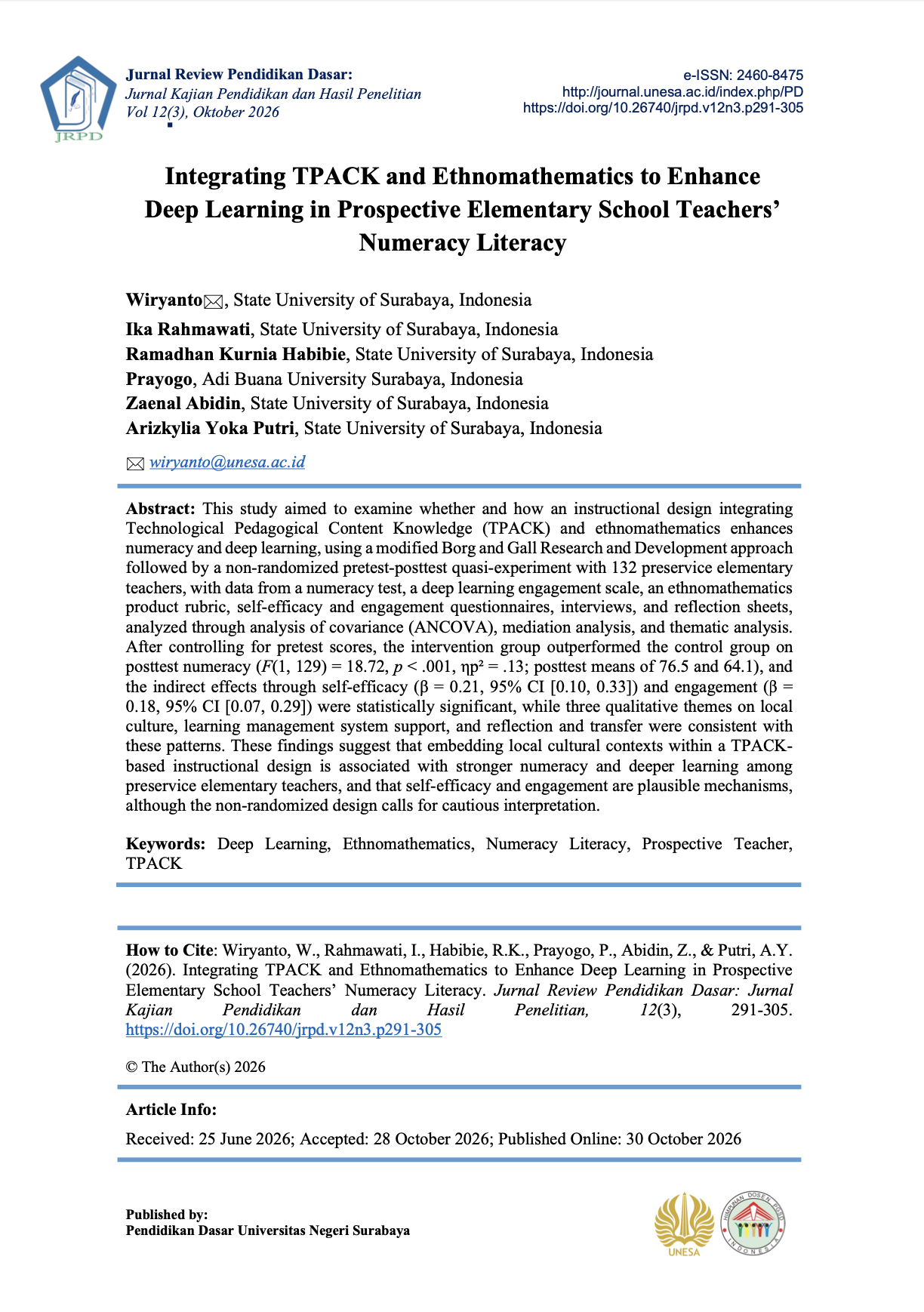
Integrating TPACK and Ethnomathematics to Enhance Deep Learning in Prospective Elementary School Teachers’ Numeracy Literacy
DOI:
https://doi.org/10.26740/jrpd.v12n3.p291-305Keywords:
Deep Learning, Ethnomathematics, Numeracy Literacy, Prospective Teacher, TPACKAbstract
This study aimed to examine whether and how an instructional design integrating Technological Pedagogical Content Knowledge (TPACK) and ethnomathematics enhances numeracy and deep learning, using a modified Borg and Gall Research and Development approach followed by a non-randomized pretest-posttest quasi-experiment with 132 preservice elementary teachers, with data from a numeracy test, a deep learning engagement scale, an ethnomathematics product rubric, self-efficacy and engagement questionnaires, interviews, and reflection sheets, analyzed through analysis of covariance (ANCOVA), mediation analysis, and thematic analysis. After controlling for pretest scores, the intervention group outperformed the control group on posttest numeracy (F(1, 129) = 18.72, p < .001, ηp² = .13; posttest means of 76.5 and 64.1), and the indirect effects through self-efficacy (β = 0.21, 95% CI [0.10, 0.33]) and engagement (β = 0.18, 95% CI [0.07, 0.29]) were statistically significant, while three qualitative themes on local culture, learning management system support, and reflection and transfer were consistent with these patterns. These findings suggest that embedding local cultural contexts within a TPACK-based instructional design is associated with stronger numeracy and deeper learning among preservice elementary teachers, and that self-efficacy and engagement are plausible mechanisms, although the non-randomized design calls for cautious interpretation.
References
Acharya, B. R., Kshetree, M. P., Khanal, B., Panthi, R. K., & Belbase, S. (2021). Mathematics educators’ perspectives on cultural relevance of basic level mathematics in Nepal. Journal on Mathematics Education, 12(1), 17–48. https://doi.org/10.22342/jme.12.1.12955.17-48
Albeshree, F., Al-Manasia, M., Lemckert, C., Liu, S., & Tran, D. (2022). Mathematics teaching pedagogies to tertiary engineering and information technology students: A literature review. International Journal of Mathematical Education in Science and Technology, 53(6), 1609–1628. https://doi.org/10.1080/0020739X.2020.1837399
Ali, S. S., & Hawk, N. A. (2024). Examining cultural background as context and in-service teachers’ perception of TPACK: A mixed-method study. Education and Information Technologies, 29(3), 3547–3570. https://doi.org/10.1007/s10639-023-11939-7
Averill, R., Anderson, D., Easton, H., Te Maro, P., Smith, D., & Hynds, A. (2009). Culturally responsive teaching of mathematics: Three models from linked studies. Journal for Research in Mathematics Education, 40(2), 157–186. https://doi.org/10.2307/40539330
Boadu, S. K., & Boateng, F. O. (2024). Enhancing students’ achievement in mathematics education in the 21st century through technology integration, collaborative learning, and student motivation: The mediating role of student interest. Eurasia Journal of Mathematics, Science and Technology Education, 20(11), Article em2534. https://doi.org/10.29333/ejmste/15622
Braun, V., & Clarke, V. (2006). Using thematic analysis in psychology. Qualitative Research in Psychology, 3(2), 77–101. https://doi.org/10.1191/1478088706qp063oa
Bueno, R. W. da S., & Niess, M. L. (2023). Redesigning mathematics preservice teachers’ preparation for teaching with technology: A qualitative cross-case analysis using TPACK lenses. Computers & Education, 205, Article 104895. https://doi.org/10.1016/j.compedu.2023.104895
Darling-Hammond, L., Schachner, A. C. W., Wojcikiewicz, S. K., & Flook, L. (2024). Educating teachers to enact the science of learning and development. Applied Developmental Science, 28(1), 1–21. https://doi.org/10.1080/10888691.2022.2130506
Díez-Palomar, J., Ramis-Salas, M., Močnik, I., Simonič, M., & Hoogland, K. (2023). Challenges for numeracy awareness in the 21st century: Making visible the invisible. Frontiers in Education, 8, Article 1295781. https://doi.org/10.3389/feduc.2023.1295781
Dolapcioglu, S., & Doğanay, A. (2022). Development of critical thinking in mathematics classes via authentic learning: An action research. International Journal of Mathematical Education in Science and Technology, 53(6), 1363–1386. https://doi.org/10.1080/0020739X.2020.1819573
Dolgopolovas, V., & Dagiene, V. (2024). Competency-based TPACK approaches to computational thinking and integrated STEM: A conceptual exploration. Computer Applications in Engineering Education, 32(6), Article e22788. https://doi.org/10.1002/cae.22788
Drijvers, P., & Sinclair, N. (2024). The role of digital technologies in mathematics education: Purposes and perspectives. ZDM – Mathematics Education, 56(2), 239–248. https://doi.org/10.1007/s11858-023-01535-x
Fredricks, J. A., Blumenfeld, P. C., & Paris, A. H. (2004). School engagement: Potential of the concept, state of the evidence. Review of Educational Research, 74(1), 59–109. https://doi.org/10.3102/00346543074001059
Geiger, V., Goos, M., & Forgasz, H. (2015). A rich interpretation of numeracy for the 21st century: A survey of the state of the field. ZDM – Mathematics Education, 47(4), 531–548. https://doi.org/10.1007/s11858-015-0708-1
Geiger, V., & Schmid, M. (2024). A critical turn in numeracy education and practice. Frontiers in Education, 9, Article 1363566. https://doi.org/10.3389/feduc.2024.1363566
Kadluba, A., Strohmaier, A., Schons, C., & Obersteiner, A. (2025). How much C is in TPACK? A systematic review on the assessment of TPACK in mathematics. Educational Studies in Mathematics, 118(2), 169–199. https://doi.org/10.1007/s10649-024-10357-x
Li, M., & Li, B. (2024). Unravelling the dynamics of technology integration in mathematics education: A structural equation modelling analysis of TPACK components. Education and Information Technologies, 29(17), 23687–23715. https://doi.org/10.1007/s10639-024-12805-w
Li, M., Vale, C., Tan, H., & Blannin, J. (2024). A systematic review of TPACK research in primary mathematics education. Mathematics Education Research Journal, 37(2), 281–311. https://doi.org/10.1007/s13394-024-00491-3
Li, M., Vale, C., Tan, H., & Blannin, J. (2025). Factors influencing the use of digital technologies in primary mathematics teaching: Voices from Chinese educators. Education and Information Technologies, 30(9), 12573–12608. https://doi.org/10.1007/s10639-024-13309-3
Li, W., Liu, C.-Y., & Tseng, J. C. R. (2023). Effects of the interaction between metacognition teaching and students’ learning achievement on students’ computational thinking, critical thinking, and metacognition in collaborative programming learning. Education and Information Technologies, 28(10), 12919–12943. https://doi.org/10.1007/s10639-023-11671-2
Mania, S., & Alam, S. (2021). Teachers’ perception toward the use of ethnomathematics approach in teaching math. International Journal of Education in Mathematics, Science and Technology, 9(2), 282–298. https://doi.org/10.46328/ijemst.1551
Mansour, N., Said, Z., & Abu-Tineh, A. (2024). Factors impacting science and mathematics teachers’ competencies and self-efficacy in TPACK for PBL and STEM. Eurasia Journal of Mathematics, Science and Technology Education, 20(5), Article em2442. https://doi.org/10.29333/ejmste/14467
Mishra, P., & Koehler, M. J. (2006). Technological pedagogical content knowledge: A framework for teacher knowledge. Teachers College Record, 108(6), 1017–1054. https://doi.org/10.1111/j.1467-9620.2006.00684.x
O’Keeffe, L., & Paige, K. (2021). Re-highlighting the potential of critical numeracy. Mathematics Education Research Journal, 33(2), 285–299. https://doi.org/10.1007/s13394-019-00297-8
Payadnya, I. P. A. A., Putri, G. A. M. A., Suwija, I. K., Saelee, S., & Jayantika, I. G. A. N. T. (2025). Cultural integration in AI-enhanced mathematics education: Insights from Southeast Asian educators. Journal for Multicultural Education, 19(1), 58–72. https://doi.org/10.1108/JME-09-2024-0119
Poçan, S., Altay, B., & Yaşaroğlu, C. (2023). The effects of mobile technology on learning performance and motivation in mathematics education. Education and Information Technologies, 28(1), 683–712. https://doi.org/10.1007/s10639-022-11166-6
Polly, D. (2024). Examining TPACK enactment in elementary mathematics with various learning technologies. Education Sciences, 14(10), Article 1091. https://doi.org/10.3390/educsci14101091
Priyanda, R., Herman, T., Amalia, R., & Ihsan, I. R. (2025). Exploring teachers’ pedagogical reasoning in mathematics education using the TPACK framework. Frontiers in Education, 10, Article 1552760. https://doi.org/10.3389/feduc.2025.1552760
Putra, Z. H., Hermita, N., Alim, J. A., Dahnilsyah, D., & Gunawan, Y. (2025). The role of project-based ethno-didactics of mathematics learning toward pre-service elementary teachers’ perspectives, mathematical, and didactic knowledge. Frontiers in Education, 10, Article 1568366. https://doi.org/10.3389/feduc.2025.1568366
Rakes, C. R., Stites, M. L., Ronau, R. N., Bush, S. B., Fisher, M. H., Safi, F., Desai, S., Schmidt, A., Andreasen, J. B., Saderholm, J., Amick, L., Mohr-Schroeder, M. J., & Viera, J. (2022). Teaching mathematics with technology: TPACK and effective teaching practices. Education Sciences, 12(2), Article 133. https://doi.org/10.3390/educsci12020133
Saralar-Aras, I., & Türker-Biber, B. (2024). Enhancing technological pedagogical content knowledge of prospective teachers through mathematics lesson plan development. Education and Information Technologies, 29(11), 14491–14512. https://doi.org/10.1007/s10639-023-12435-8
Sari, N., Saragih, S., Napitupulu, E. E., Rakiyah, S., Sari, D. N., Sirait, S., & Anim, A. (2023). Applying ethnomathematics in learning mathematics for middle school students. Acta Scientiae, 25(5), 250–274. https://doi.org/10.17648/acta.scientiae.7690
Smith, P. G., & Zelkowski, J. (2023). Validating a TPACK instrument for 7–12 mathematics in-service middle and high school teachers in the United States. Journal of Research on Technology in Education, 55(5), 858–876. https://doi.org/10.1080/15391523.2022.2048145
Sølvik, R. M., & Glenna, A. E. H. (2022). Teachers’ potential to promote students’ deeper learning in whole-class teaching: An observation study in Norwegian classrooms. Journal of Educational Change, 23(3), 343–369. https://doi.org/10.1007/s10833-021-09420-8
Suh, J., Matson, K., Seshaiyer, P., Jamieson, S., & Tate, H. (2021). Mathematical modeling as a catalyst for equitable mathematics instruction: Preparing teachers and young learners with 21st century skills. Mathematics, 9(2), Article 162. https://doi.org/10.3390/math9020162
Tanudjaya, C. P., & Doorman, M. (2020). Examining higher order thinking in Indonesian lower secondary mathematics classrooms. Journal on Mathematics Education, 11(2), 277–300. https://doi.org/10.22342/jme.11.2.11000.277-300
Tout, D. (2020). Evolution of adult numeracy from quantitative literacy to numeracy: Lessons learned from international assessments. International Review of Education, 66(2–3), 183–209. https://doi.org/10.1007/s11159-020-09831-4
Wang, Q., & Zhao, G. (2021). ICT self-efficacy mediates most effects of university ICT support on preservice teachers’ TPACK: Evidence from three normal universities in China. British Journal of Educational Technology, 52(6), 2319–2339. https://doi.org/10.1111/bjet.13141
Weng, C., Chen, C., & Ai, X. (2023). A pedagogical study on promoting students’ deep learning through design-based learning. International Journal of Technology and Design Education, 33(4), 1653–1674. https://doi.org/10.1007/s10798-022-09789-4
Zhao, J., Liu, E., & Sofeia, N. (2024). Whether perceived TPACK could improve deep learning? Through the lens of the mediating role of self-regulatory learning and the moderating role of technology self-efficacy in the online environment. Current Psychology, 43(37), 29848–29864. https://doi.org/10.1007/s12144-024-06455-x
Downloads
Published
How to Cite
Issue
Section
License
Copyright (c) 2026 Jurnal Review Pendidikan Dasar : Jurnal Kajian Pendidikan dan Hasil Penelitian

This work is licensed under a Creative Commons Attribution 4.0 International License.
 Abstract views: 0
,
 PDF Downloads: 0