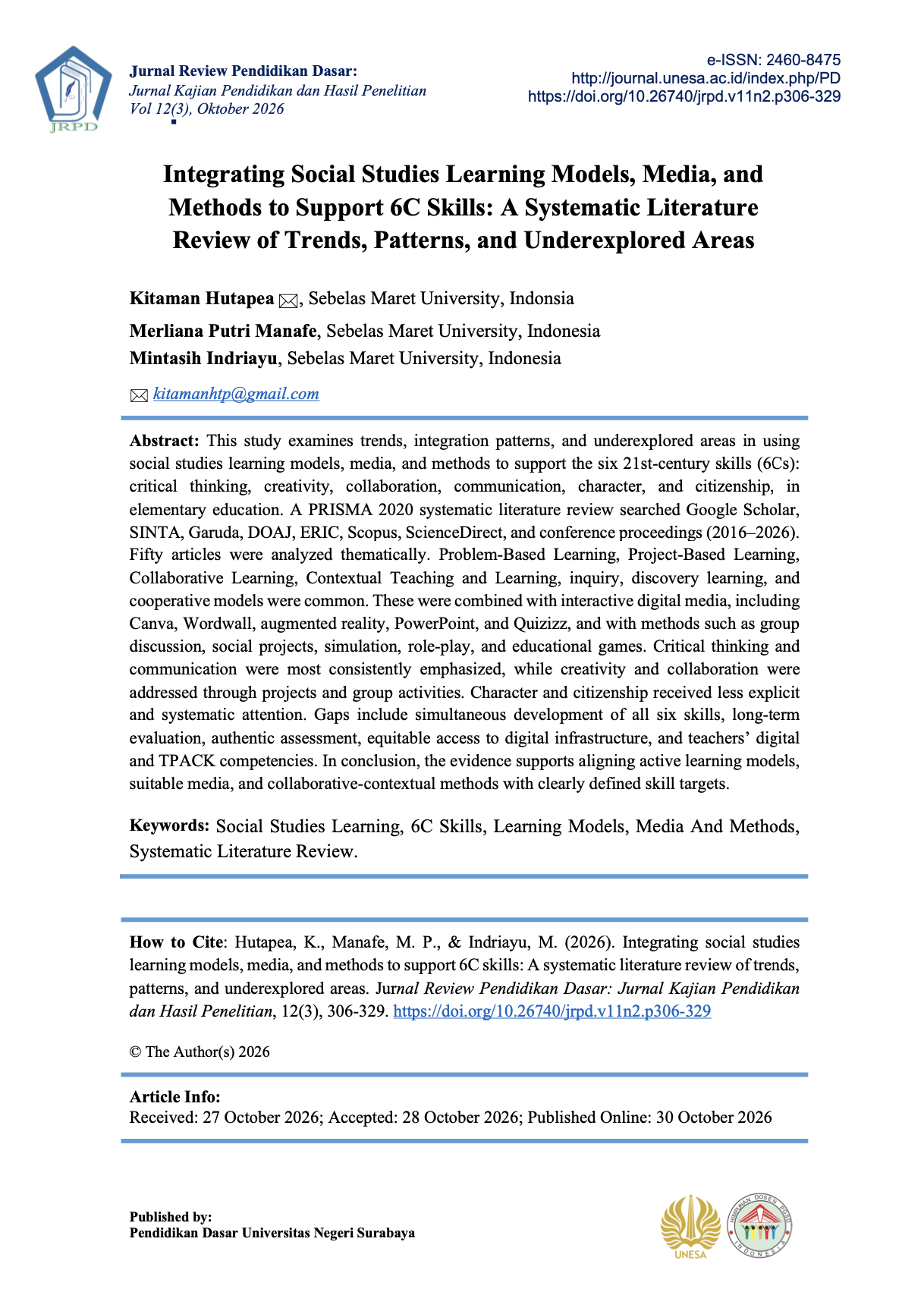
Integrating Social Studies Learning Models, Media, and Methods to Support 6C Skills
A Systematic Literature Review of Trends, Patterns, and Underexplored Areas
DOI:
https://doi.org/10.26740/jrpd.v12n3.p306-329Abstract
This study examines trends, integration patterns, and underexplored areas in using social studies learning models, media, and methods to support the six 21st-century skills (6Cs): critical thinking, creativity, collaboration, communication, character, and citizenship, in elementary education. A PRISMA 2020 systematic literature review searched Google Scholar, SINTA, Garuda, DOAJ, ERIC, Scopus, ScienceDirect, and conference proceedings (2016–2026). Fifty articles were analyzed thematically. Problem-Based Learning, Project-Based Learning, Collaborative Learning, Contextual Teaching and Learning, inquiry, discovery learning, and cooperative models were common. These were combined with interactive digital media, including Canva, Wordwall, augmented reality, PowerPoint, and Quizizz, and with methods such as group discussion, social projects, simulation, role-play, and educational games. Critical thinking and communication were most consistently emphasized, while creativity and collaboration were addressed through projects and group activities. Character and citizenship received less explicit and systematic attention. Gaps include simultaneous development of all six skills, long-term evaluation, authentic assessment, equitable access to digital infrastructure, and teachers’ digital and TPACK competencies. In conclusion, the evidence supports aligning active learning models, suitable media, and collaborative-contextual methods with clearly defined skill targets.
References
Amalia, Z., & Rafianti, W. R. (2024). Penerapan model pembelajaran PBL, role playing, dan small group work untuk meningkatkan aktivitas dan hasil belajar dalam pembelajaran IPS. Jurnal Teknologi Pendidikan dan Pembelajaran (JTPP), 01(04), 724-728. https://jurnal.kopusindo.com/index.php/jtpp/article/view/174/165
Anggriani, R., Hakim, A. R., & Hairunisa. (2024). Pengembangan LKPD berbasis literasi numerasi menggunakan model PjBL dalam meningkatkan kemampuan berpikir kritis siswa kelas V SDN Inpres Muku. Jurnal Pendidikan dan Pembelajaran Indonesia (JPPI), 4(1), 101-110. https://doi.org/10.53299/jppi.v4i1.438
Ani, N., Asyahidah, N. L., & Rustini, T. (2024). Analisis pembelajaran IPS di kelas tinggi menggunakan model problem based learning pada materi keberagaman di Indonesia. Jurnal Bintang Pendidikan Indonesia (JUBPI), 2(1), 98-103. https://doi.org/10.55606/jubpi.v2i1.2466
Antonio, R. P., & Prudente, M. S. (2023). Effects of inquiry-based approaches on students’ higher-order thinking skills in science: A meta-analysis. International Journal of Education in Mathematics, Science and Technology, 12(1), 251-281. https://doi.org/10.46328/ijemst.3216
Arianda, Y. D., Kamal, I., Supriadi, W., Mahdiyah, M., & Sarifah, I. (2024). Trends in project based learning models in increase 6C skills (character, citizenship, critical thinking, creative, collaborative, and communication). Jurnal Penelitian Pendidikan, 41(2), 143-152. https://doi.org/10.15294/jpp.v41i2.18711
Arifin, Z., Sukarmin, Saputro, S., & Kamari, A. (2025). The effect of inquiry-based learning on students’ critical thinking skills in science education: A systematic review and meta-analysis. Eurasia Journal of Mathematics, Science and Technology Education, 21(3), Article em2592. https://doi.org/10.29333/ejmste/15988
Astuti, M. L. (2024). The role of 6C skills in 21st century learning of elementary school students. DIDAKTIKA: Jurnal Pendidikan Sekolah Dasar, 7(2), 154-161. https://doi.org/10.21831/didaktika.v7i2.80220
Azizah, U., Ibrahim, & Hasni. (2026). Pemanfaatan media pembelajaran berbasis digital dalam mata pelajaran IPS di sekolah dasar. Pendas: Jurnal Ilmiah Pendidikan Dasar, 11(02), 248-258. https://doi.org/10.23969/jp.v11i02.44886
Backfisch, I., Lachner, A., Stürmer, K., & Scheiter, K. (2021). Variability of teachers’ technology integration in the classroom: A matter of utility! Computers & Education, 166, Article 104159. https://doi.org/10.1016/j.compedu.2021.104159
Baihaqi, M. R., Ristono, W., & Lidinillah, D. A. M. (2018). Pengembangan media Kartu Nusantara untuk pembelajaran IPS kelas IV SDN pada materi keanekaragaman suku bangsa dan budaya. Pedadidaktika: Jurnal Ilmiah Pendidikan Guru Sekolah Dasar, 5(2), 47-58. http://ejournal.upi.edu/index.php/pedadidaktika/index
Barokah, T., Sapriani, M., Cahyani, V. J., Astin, H., Negara, C. M., Melany, S. D., Sofwan, M., & Khoirunnisa. (2025). Kesulitan guru dalam mengoptimalkan media pembelajaran berbasis teknologi dalam pembelajaran IPS di sekolah dasar. Pendas: Jurnal Ilmiah Pendidikan Dasar, 10(02), 290-299. https://doi.org/10.23969/jp.v10i02.23819
Barta, A., Fodor, L. A., Tamas, B., & Szamoskozi, I. (2022). The development of students’ critical thinking abilities and dispositions through the concept mapping learning method: A meta-analysis. Educational Research Review, 37, Article 100481. https://doi.org/10.1016/j.edurev.2022.100481
Barz, N., Benick, M., Dörrenbächer-Ulrich, L., & Perels, F. (2024). The effect of digital game-based learning interventions on cognitive, metacognitive, and affective-motivational learning outcomes in school: A meta-analysis. Review of Educational Research, 94(2), 193-227. https://doi.org/10.3102/00346543231167795
Bauml, M. (2023). “Fitting it in”: Elementary teachers talk about social studies instruction in public school classrooms. The Journal of Social Studies Research, 47(3-4), 147-160. https://doi.org/10.1177/23522798231206188
Braun, V., & Clarke, V. (2021). One size fits all? What counts as quality practice in (reflexive) thematic analysis? Qualitative Research in Psychology, 18(3), 328-352. https://doi.org/10.1080/14780887.2020.1769238
Brown, M., McGrath, R. E., Bier, M. C., Johnson, K., & Berkowitz, M. W. (2023). A comprehensive meta-analysis of character education programs. Journal of Moral Education, 52(2), 119-138. https://doi.org/10.1080/03057240.2022.2060196
Bulkis, I., Tahir, M., & Sakkir, G. (2025). The EFL teachers’ implementation of 6C skills (critical thinking, creativity, collaboration, communication, citizenship, and character) of 21st century skills. EduLine: Journal of Education and Learning Innovation, 5(2), 262-273. https://doi.org/10.35877/454ri.eduline3927
Butler, H. A. (2024). Predicting everyday critical thinking: A review of critical thinking assessments. Journal of Intelligence, 12(2), Article 16. https://doi.org/10.3390/jintelligence12020016
Candra, Suardi, & Arifin, J. (2025). Pengembangan media pembelajaran Manarang AR pada mata pelajaran IPAS di sekolah dasar. Jurnal Pendidikan Ilmu Pengetahuan Sosial Indonesia, 10(3), 285-301. http://dx.doi.org/10.26737/jpipsi.v10i3.6950
Chang, H.-Y., Binali, T., Liang, J.-C., Chiou, G.-L., Cheng, K.-H., Lee, S. W.-Y., & Tsai, C.-C. (2022). Ten years of augmented reality in education: A meta-analysis of (quasi-) experimental studies to investigate the impact. Computers & Education, 191, Article 104641. https://doi.org/10.1016/j.compedu.2022.104641
Choirunnisa, M., & Arini, N. W. (2023). Pengembangan media pembelajaran Polysoc (Monopoly Social) untuk pembelajaran IPS kelas V sekolah dasar. Research and Development Journal of Education, 9(2), 788. https://doi.org/10.30998/rdje.v9i2.19232
Chumairah, L., & Nurmairina, N. (2024). Pengembangan media pembelajaran IPS berbasis multimedia interaktif sebagai inovasi pembelajaran bagi siswa SD. Cybernetics: Journal Educational Research and Social Studies, 5(1), 1-10. https://doi.org/10.51178/cjerss.v5i1.1844
Cochon Drouet, O., Lentillon-Kaestner, V., & Margas, N. (2023). Effects of the Jigsaw method on student educational outcomes: Systematic review and meta-analyses. Frontiers in Psychology, 14, Article 1216437. https://doi.org/10.3389/fpsyg.2023.1216437
Cromley, J. G., Chen, R., & Lawrence, L. (2023). Meta-analysis of STEM learning using virtual reality: Benefits across the board. Journal of Science Education and Technology, 32(3), 355-364. https://doi.org/10.1007/s10956-023-10032-5
Fernández-Sánchez, M. R., Garrido-Arroyo, M. d. C., & Porras-Masero, I. (2022). Curricular integration of digital technologies in teaching processes. Frontiers in Education, 7, Article 1005499. https://doi.org/10.3389/feduc.2022.1005499
Fitri, A. N., & Hadi, M. S. (2024). Pemanfaatan media pembelajaran digital pada pembelajaran IPS di sekolah dasar. Jurnal Tarbiyah dan Ilmu Keguruan Borneo, 5(2), 133-146. https://doi.org/10.21093/jtikborneo.v5i2.6995
Fütterer, T., Scherer, R., Scheiter, K., Stürmer, K., & Lachner, A. (2023). Will, skills, or conscientiousness: What predicts teachers’ intentions to participate in technology-related professional development? Computers & Education, 198, Article 104756. https://doi.org/10.1016/j.compedu.2023.104756
Godaert, E., Aesaert, K., Voogt, J., & van Braak, J. (2022). Assessment of students’ digital competences in primary school: A systematic review. Education and Information Technologies, 27(7), 9953-10011. https://doi.org/10.1007/s10639-022-11020-9
Hidayat, A. G., & Aulia, A. (2024). Elementary school social studies learning assessment instrument. Insights: Journal of Primary Education Research, 1(1), 25-31. https://doi.org/10.59923/insights.v1i1.73
Hutapea, K., Dewanti, A., Azzahra, A., & Indriayu, M. (2026). Analisis model pembelajaran IPS dalam penguatan keterampilan 6C pada kurikulum sekolah dasar: Kajian systematic literature review. Indo Green Journal, 4(2), 788-801. https://doi.org/10.31004/green.v4i2.298
Jiménez Sierra, Á. A., Ortega Iglesias, J. M., Cabero-Almenara, J., & Palacios-Rodríguez, A. (2023). Development of the teacher’s technological pedagogical content knowledge (TPACK) from the lesson study: A systematic review. Frontiers in Education, 8, Article 1078913. https://doi.org/10.3389/feduc.2023.1078913
Kaczkó, É., & Ostendorf, A. (2023). Critical thinking in the community of inquiry framework: An analysis of the theoretical model and cognitive presence coding schemes. Computers & Education, 193, Article 104662. https://doi.org/10.1016/j.compedu.2022.104662
Khatimah, H., Wati, N. J., Anggraini, S., Wahyuni, A. D., Afifah, R., Ananda, N., & Khoirunnisa. (2025). Pengembangan model pembelajaran IPS yang interaktif dan kontekstual untuk meningkatkan pemahaman siswa. Pendas: Jurnal Ilmiah Pendidikan Dasar, 10(01), 36-46. https://doi.org/10.23969/jp.v10i01.23653
Koçak, Ö., Çoban, M., Aydin, A., & Çakmak, N. (2021). The mediating role of critical thinking and cooperativity in the 21st century skills of higher education students. Thinking Skills and Creativity, 42, Article 100967. https://doi.org/10.1016/j.tsc.2021.100967
Kurniawati, L., Ganda, N., & Mulyadiprana, A. (2021). Pengembangan media pembelajaran berbasis permainan monopoli pada pelajaran IPS SD. Pedadidaktika: Jurnal Ilmiah Pendidikan Guru Sekolah Dasar, 8(4), 860-873. https://doi.org/10.17509/pedadidaktika.v8i4.41752
Lahamado, I., Lukman, & Zulnurain. (2025). Literature analysis: The development of interactive learning media using the Canva application in social studies learning in elementary school. Pedagogik Journal of Islamic Elementary School, 8(2), 585-596. https://doi.org/10.24256/pijies.v8i2.7628
Lee, K. M., Sturm, S., & Giacaman, N. (2022). A systematic review of primary school teachers’ experiences with digital technologies curricula. Education and Information Technologies, 27(5), 6357-6375. https://doi.org/10.1007/s10639-022-11127-z
Li, S., Liu, Y., & Su, Y.-S. (2022). Differential analysis of teachers’ technological pedagogical content knowledge (TPACK) abilities according to teaching stages and educational levels. Sustainability, 14(12), Article 7176. https://doi.org/10.3390/su14127176
Marifah, S., & Amaliyah, N. (2022). Pengembangan media pembelajaran interaktif berbasis Google Slide pada mata pelajaran IPS sekolah dasar. Jurnal Basicedu, 6(4), 7563-7572.
Mohebi, L. (2021). Theoretical models of integration of interactive learning technologies into teaching: A systematic literature review. International Journal of Learning, Teaching and Educational Research, 20(12), 232-254. https://doi.org/10.26803/ijlter.20.12.14
Muhammad, Wibowo, Z., & Wibowo, M. Z. (2023). Implementasi pendidikan karakter tanggung jawab mampu meningkatkan hasil belajar siswa. Jurnal Bintang Pendidikan Indonesia (JUBPI), 1(1).
Nafian, R. K., Widayanti, U. A., & Rahmawati, I. (2024). Penggunaan media Wordwall sebagai evaluasi pembelajaran IPAS kelas IV SD Negeri 1 Gumul. Jurnal Teknologi Pendidikan dan Pembelajaran, 01(04), 747-750.
Narmi, Y., Montessori, M., Fitria, Y., & Adnan, M. F. (2021). Pemanfaatan sarana dan sumber belajar pada pembelajaran IPS di sekolah dasar. Jurnal Basicedu, 5(6), 6144-6149. https://doi.org/10.31004/basicedu.v5i6.1774
Nasution, H. A. R., & Sitepu, M. S. (2025). Pembelajaran berbasis literasi dan numerasi untuk meningkatkan kemampuan berpikir kritis peserta didik pada mata pelajaran IPS kelas IV SD Muhammadiyah 18. Pendas: Jurnal Ilmiah Pendidikan Dasar, 10(03), 439-449.
Nawir, M., Sentya, M., Firdaus, A., & Faisal, S. Z. A. (2026). Pengembangan media pembelajaran IPS di sekolah dasar. DIKSI: Jurnal Kajian Pendidikan dan Sosial, 7(1), 181-189. https://doi.org/10.53299/diksi.v7i1.3867
Nduru, S. M., Manurung, E. R., & Ginting, S. (2022). Hubungan hasil belajar PKn dengan keterampilan kewarganegaraan (civic skill) siswa kelas XI SMA Etis Landia Medan tahun ajaran 2021/2022. Jurnal Pendidikan Pancasila dan Kewarganegaraan, 4, 22-32.
Ngatari, & Novianti, U. (2021). Studi pustaka penggunaan model pembelajaran IPS terpadu di sekolah dasar. Journal of Social Knowledge Education (JSKE), 2(1), 16-20. https://doi.org/10.37251/jske.v2i1.376
Nurdiansyah, Rahma, A. R., Trisnawati, P., Rofatunnuroh, & Maria, S. (2024). Pengembangan model pembelajaran kolaboratif untuk meningkatkan kemampuan problem solving siswa dalam pembelajaran IPS di SD. Jurnal Pendidikan Tambusai, 8(2), 21705-21718.
Nurfadhillah, S., Anggraeni, S., Rahmanda, F. P., Ristavania, F., & Kurniawan, W. (2021). Pengembangan media berbasis PowerPoint dalam pembelajaran IPS untuk siswa Sekolah Dasar Negeri Pinang 1. Jurnal Pendidikan dan Ilmu Sosial Nusantara, 3(1), 135-150. https://ejournal.stitpn.ac.id/index.php/nusantara/article/view/1283
Page, M. J., McKenzie, J. E., Bossuyt, P. M., Boutron, I., Hoffmann, T. C., Mulrow, C. D., Shamseer, L., Tetzlaff, J. M., Akl, E. A., Brennan, S. E., Chou, R., Glanville, J., Grimshaw, J. M., Hróbjartsson, A., Lalu, M. M., Li, T., Loder, E. W., Mayo-Wilson, E., McDonald, S., ... Moher, D. (2021). The PRISMA 2020 statement: An updated guideline for reporting systematic reviews. BMJ, 372, Article n71. https://doi.org/10.1136/bmj.n71
Pratiwi, E. A., Witono, A. H., & Jaelani, A. K. (2022). Keterampilan komunikasi siswa kelas V SDN 32 Cakranegara Kecamatan Sandubaya Kota Mataram tahun ajaran 2021/2022. Jurnal Ilmiah Profesi Pendidikan, 7(3b), 1639-1646. https://doi.org/10.29303/jipp.v7i3b.832
Prayitno, H. F., Aziz, R. A., & Turmudi, H. (2023). Pengembangan multimedia interaktif dalam pembelajaran IPS materi sumber daya alam kelas IV SD/MI. Jurnal Penelitian Sistem Informasi (JPSI), 1(4), 01-11. https://doi.org/10.54066/jpsi.v1i4.853
Qurrotaini, L., & Putri, D. A. (2024). Pengembangan media pembelajaran “MAPENA” mainan peta anak pada pembelajaran IPS SD. Jurnal Holistika, 7(2), 131. https://doi.org/10.24853/holistika.7.2.131-137
Rayhana, A. N. (2024). Analisis implementasi projek penguatan profil pelajar Pancasila sebagai upaya peningkatan keterampilan komunikasi interpersonal dan kolaborasi siswa. Jurnal Teknologi Pendidikan, 1(4), 10. https://doi.org/10.47134/jtp.v1i4.555
Richardson, J. W., Martin, F., & Sauers, N. (2021). Systematic review of 15 years of research on digital citizenship: 2004-2019. Learning, Media and Technology, 46(3), 267-283. https://doi.org/10.1080/17439884.2021.1941098
Rosalinda, & Kurnia, I. R. (2024). Pengembangan media pembelajaran berbasis aplikasi digital Prezi untuk meningkatkan minat belajar siswa pada mata pembelajaran IPS kelas V. Pendas: Jurnal Ilmiah Pendidikan Dasar, 09(04), 159-166. https://doi.org/10.23969/jp.v9i4.20291
Royani, R., Ahda, S., & Silalahi, S. (2024). Model pembelajaran deep learning untuk meningkatkan pemahaman IPS di sekolah dasar: Studi kasus di SD Global Garuda Nusantara. Jurnal Ilmiah Guru Madrasah, 3(2), 77-88. https://doi.org/10.69548/jigm.v3i2.27
Safira, M., & Veri, J. (2026). Systematic literatur review dengan metode PRISMA: Analisis penerapan konsep SDM terhadap efektivitas pengambilan keputusan di lingkungan organisasi. Journal of Science Education and Management Business (JOSEAMB), 5(1), 461-472.
Sahrina, A., & El-Yunusi, M. Y. M. (2024). Analisis kemampuan literasi numerasi melalui soal cerita dalam meningkatkan kemampuan berpikir kritis di SDN Candipari 2 Porong. Pendas: Jurnal Ilmiah Pendidikan Dasar, 9(4), 39-48.
Salsabila, N., Nadella, Nazhira, N., Andini, N., Nadia, N., & Yusnaldi, E. (2024). Pembelajaran IPS dalam pendidikan karakter anak SD/MI. Journal on Education, 06(04), 20460-20465. https://doi.org/10.31316/esjurnal.v12i2.4545
Setiawan, H., Nafiati, D. A., & Munadi. (2025). Validitas konstruk instrumen keterampilan abad 21 pada pembelajaran IPAS berbasis problem based learning berbantuan audiovisual. Pendas: Jurnal Ilmiah Pendidikan Dasar, 10(04), 1221-1229. https://doi.org/10.23969/jp.v10i4.37372
Setiawan, H., Nafiati, D. A., & Munadi. (2026). Confirmatory factor analysis of a 21st-century skills instrument in audiovisual-assisted problem-based learning. Jurnal Paedagogy: Jurnal Penelitian dan Pengembangan Pendidikan, 13(1), 43-51. https://doi.org/10.33394/jp.v13i1.18801
Setiawati, T., Haki Pranata, O., & Halimah, M. (2019). Pengembangan media permainan papan pada pembelajaran IPS untuk siswa kelas V sekolah dasar. Pedadidaktika: Jurnal Ilmiah Pendidikan Guru Sekolah Dasar, 6(1), 163-174. http://ejournal.upi.edu/index.php/pedadidaktika/index
Sudiarti, N. P., Lasmawan, I. W., & Kertih, I. W. (2025). Implementasi model pembelajaran berbasis TPACK dalam pembelajaran IPS di sekolah dasar. Journal of Education Action Research, 9(2), 250-258. https://doi.org/10.23887/jear.v9i2.87135
Sundari, A., Fauzia, F. I., & Rustini, T. (2023). Pengembangan media pembelajaran IPS pada buku tema 1 ASEAN untuk siswa kelas VI SD. Dirasah: Jurnal Studi Ilmu dan Manajemen Pendidikan Islam, 6(1), 104-111. https://doi.org/10.58401/dirasah.v6i1.782
Suryani, I., Permatasari, A., & Jayanti. (2024). Pengembangan multimedia interaktif berbasis Macromedia Flash pada mata pelajaran IPA kelas V sekolah dasar. Jurnal Inovasi, Evaluasi, dan Pengembangan Pembelajaran (JIEPP), 4(3), 499-508. https://doi.org/10.31980/caxra.v4i1.1040
Tadlaoui-Brahmi, A., Çuko, K., & Alvarez, L. (2022). Digital citizenship in primary education: A systematic literature review describing how it is implemented. Social Sciences & Humanities Open, 6(1), Article 100348. https://doi.org/10.1016/j.ssaho.2022.100348
Thornhill-Miller, B., Camarda, A., Mercier, M., Burkhardt, J.-M., Morisseau, T., Bourgeois-Bougrine, S., Vinchon, F., El Hayek, S., Augereau-Landais, M., Mourey, F., Feybesse, C., Sundquist, D., & Lubart, T. (2023). Creativity, critical thinking, communication, and collaboration: Assessment, certification, and promotion of 21st century skills for the future of work and education. Journal of Intelligence, 11(3), Article 54. https://doi.org/10.3390/jintelligence11030054
Ting, F. S. T., Shroff, R. H., Lam, W. H., Garcia, R. C. C., Chan, C. L., Tsang, W. K., & Ezeamuzie, N. O. (2023). A meta-analysis of studies on the effects of active learning on Asian students’ performance in science, technology, engineering and mathematics (STEM) subjects. The Asia-Pacific Education Researcher, 32(3), 379-400. https://doi.org/10.1007/s40299-022-00661-6
Utama, E. G., Hendriana, E. C., & Sukardi. (2023). Pengaruh model kooperatif Quiz-Quiz Trade berbantuan media audio visual terhadap hasil belajar IPS SD. Jurnal IKA: Ikatan Alumni PGSD UNARS, 13(1), 173-185. https://doi.org/10.36841/pgsdunars.v13i1.3091
Utami, S., & Giyartini, R. (2021). Pengembangan media puzzle berbasis Make A Match pada materi negara ASEAN dalam pembelajaran IPS kelas VI SD. Pedadidaktika: Jurnal Ilmiah Pendidikan Guru Sekolah Dasar, 8(4), 827-839. https://ejournal.upi.edu/index.php/pedadidaktika/article/view/41749
Vajen, B., Kenner, S., & Reichert, F. (2023). Digital citizenship education: Teachers’ perspectives and practices in Germany and Hong Kong. Teaching and Teacher Education, 125, Article 104038. https://doi.org/10.1016/j.tate.2023.104038
Wahida, F., Rahman, N., & Gonggo, T. (2015). Pengaruh model pembelajaran berbasis proyek terhadap keterampilan berpikir kreatif dan hasil belajar siswa kelas X SMA Negeri 1 Parigi. Sains dan Teknologi Tadulako, 4(3), 36-43.
Wahyuningtyas, E. J., Zulfiati, H. M., Nisa, A. F., & Barriyah, I. Q. (2025). Penguatan keterampilan 6C terintegrasi ajaran Tamansiswa Tri N pada proyek diorama bentang alam. Jurnal Manajemen Pendidikan dan Ilmu Sosial, 6(5), 4021-4027. https://doi.org/10.38035/jmpis.v6i5.5081
Wati, S. (2025). Strategi pembelajaran IPS yang efektif untuk siswa sekolah dasar. Intelektual: Jurnal Ilmiah Multidisiplin Mahasiswa dan Akademisi, 1(1), 95-105. https://doi.org/10.64690/intelektual.v1i1.152
Wattimena, H. S., Suhandi, A., & Setiawan, A. (2014). Profil penyelenggaraan praktikum fisika sekolah sebagai penyiapan mengembangkan kreativitas calon guru. Jurnal Pendidikan MIPA, 15(2), 71-80. https://doi.org/10.23960/jpmipa/v15i2.pp71-80
Wen, Y., Wu, L., He, S., Ng, N. H. E., Teo, B. C., Looi, C.-K., & Cai, Y. (2023). Integrating augmented reality into inquiry-based learning approach in primary science classrooms. Educational Technology Research and Development, 71(4), 1631-1651. https://doi.org/10.1007/s11423-023-10235-y
Wijaya, S., Inayah, L., Sapuroh, A., Awaliah, A., & Patmawati. (2024). Meningkatkan kemampuan berpikir kritis pada siswa sekolah dasar melalui pembelajaran IPS. Jurnal Penelitian Ilmiah Multidisiplin, 8(1), 288-292. https://sejurnal.com/pub/index.php/jpim/article/download/525/601/1906
Wulandari, I., Ningsih, S., & Aziz, S. (2025). Pengembangan model pembelajaran IPS yang berbasis masalah dan proyek di sekolah dasar. Arini: Jurnal Ilmiah dan Karya Inovasi Guru, 2(1), 16-32. https://doi.org/10.71153/arini.v2i1.300
Yanti, M., Rahayu, D. P., & Rabbani, A. (2024). Analysis of the implementation of science learning based on teachers’ technological pedagogical and content knowledge (TPACK) capabilities. Journal of Science Education Research, 8(2), 42-55. https://doi.org/10.21831/jser.v8i1.70762
Yun, M., & Crippen, K. J. (2024). The use of educational technology in inquiry-based elementary science education: A systematic review. International Journal of Science Education, 46(12), 1256-1279. https://doi.org/10.1080/09500693.2023.2284689
Zahro, L. (2022). Model pembelajaran inkuiri sosial dalam pembelajaran IPS SD/MI. Jurnal Tarbiyah Darussalam, 10(1), 54-63. https://jurnal.iaidarussalam.ac.id/index.php/tarbiyah/article/view/45/33
Zhang, L., & Ma, Y. (2023). A study of the impact of project-based learning on student learning effects: A meta-analysis study. Frontiers in Psychology, 14, Article 1202728. https://doi.org/10.3389/fpsyg.2023.1202728
Zhang, W., Guan, Y., & Hu, Z. (2024). The efficacy of project-based learning in enhancing computational thinking among students: A meta-analysis of 31 experiments and quasi-experiments. Education and Information Technologies, 29, 14513-14545. https://doi.org/10.1007/s10639-023-12392-2
Downloads
Published
How to Cite
Issue
Section
License
Copyright (c) 2026 Jurnal Review Pendidikan Dasar : Jurnal Kajian Pendidikan dan Hasil Penelitian

This work is licensed under a Creative Commons Attribution 4.0 International License.
 Abstract views: 0
,
 PDF Downloads: 0