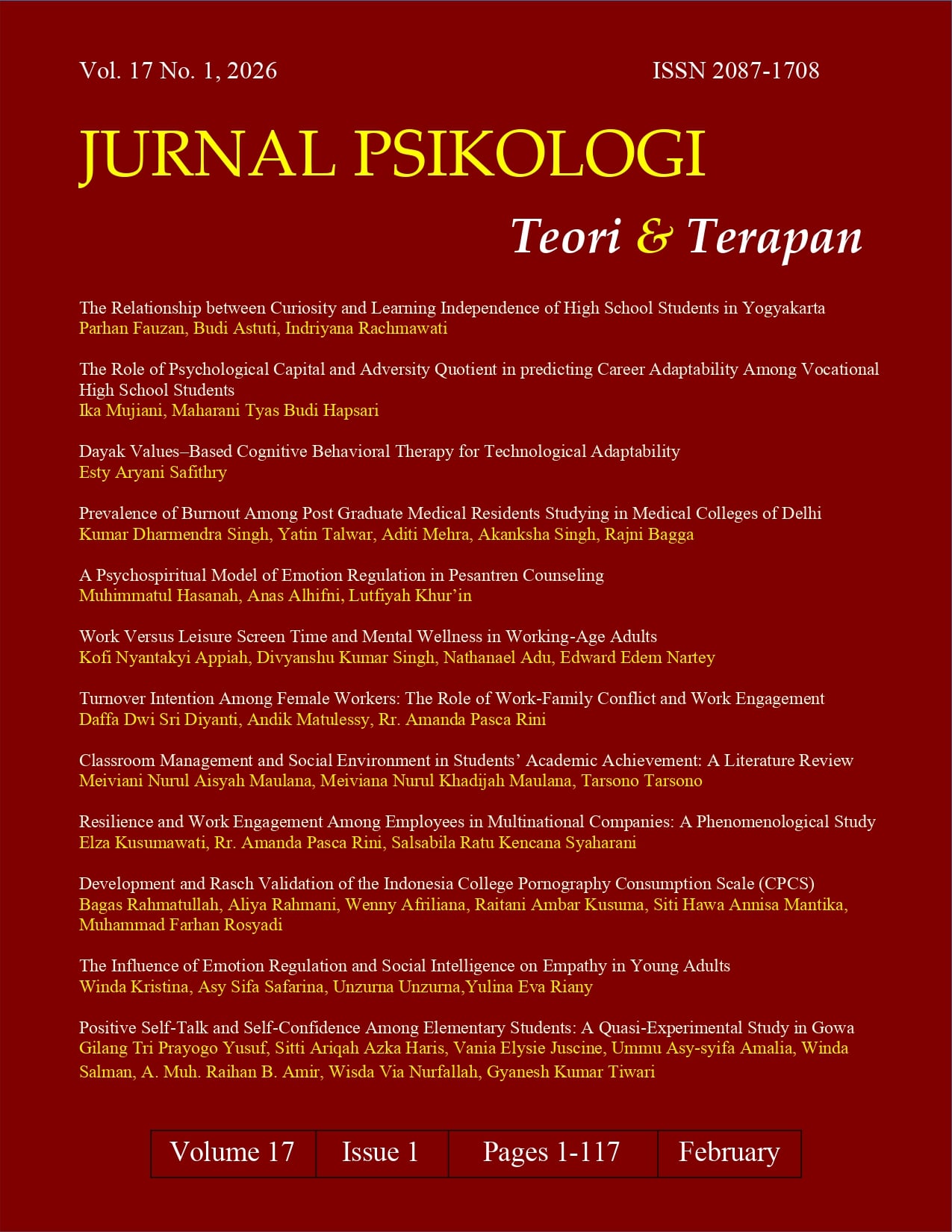
Turnover Intention in Female Workers: The Role of Work-Family Conflict and Work Engagement
DOI:
https://doi.org/10.26740/jptt.v17n01.p61-69Keywords:
Turnover intention, work engagement, work-family conflictAbstract
Background: The increasingly advanced industrial development increases the need for labor, but the intention to quit remains a significant challenge because it can harm companies through recruitment costs and the loss of high-quality human resources. This issue is particularly relevant for female workers who often face challenges balancing professional roles with family responsibilities. Objective: This study aims to determine the relationship between work-family conflict and work engagement with intention to quit among working women in East Java. Method: This study used a quantitative correlational design with a sample of 149 female workers obtained through simple random sampling. Data were collected using scales adapted from the Work-Family Conflict scale, the Utrecht Work Engagement Scale (UWES), and the Intention to Quit Scale, then analyzed using multiple regression analysis. Results: The results showed that work-family conflict and work engagement together were significantly correlated with intention to quit (F = 7.758; p < 0.01). However, individually, work-family conflict did not correlate with intention to quit (p = 0.290), while work engagement showed a significant correlation with intention to quit (p = 0.001). Conclusion: It is concluded that work engagement is a more dominant factor influencing the intention to quit among female workers compared to work-family conflict, providing an effective contribution of 11.89%.
Abstrak
Latar Belakang: Perkembangan industri yang semakin maju meningkatkan kebutuhan tenaga kerja, namun niat berhenti kerja tetap menjadi tantangan signifikan karena dapat merugikan perusahaan melalui biaya perekrutan dan hilangnya sumber daya manusia berkualitas tinggi. Masalah ini sangat relevan bagi pekerja perempuan yang sering menghadapi tantangan menyeimbangkan peran profesional dengan tanggung jawab keluarga. Tujuan: Studi ini bertujuan untuk mengetahui hubungan antara konflik kerja-keluarga dan keterlibatan kerja dengan niat berhenti kerja di kalangan perempuan yang bekerja di Jawa Timur. Metode: Penelitian ini menggunakan desain kuantitatif korelasional dengan sampel 149 pekerja perempuan yang diperoleh melalui pengambilan sampel acak sederhana. Data dikumpulkan menggunakan skala yang diadaptasi dari skala Konflik Kerja-Keluarga, Skala Keterlibatan Kerja Utrecht (UWES), dan Skala Niat Berhenti Kerja, kemudian dianalisis menggunakan analisis regresi berganda. Hasil: Hasil menunjukkan bahwa konflik kerja-keluarga dan keterlibatan kerja bersama-sama berkorelasi signifikan dengan niat berhenti kerja (F = 7,758; p < 0,01). Namun, secara individual, konflik kerja-keluarga tidak berkorelasi dengan niat berhenti kerja (p = 0,290), sedangkan keterlibatan kerja menunjukkan korelasi yang signifikan dengan niat berhenti kerja (p = 0,001). Kesimpulan: Disimpulkan bahwa keterlibatan kerja merupakan faktor yang lebih dominan yang memengaruhi niat berhenti kerja pada pekerja perempuan dibandingkan dengan konflik kerja-keluarga. Keterikatan kerja memberikan kontribusi efektif sebesar 11,89% terhadap intention turnover pada perempuan yang bekerja.
References
Albrecht, S. L., Bakker, A. B., Gruman, J. A., Macey, W. H., & Saks, A. M. (2015). Employee engagement, human resource management practices and competitive advantage. Journal of Organizational Effectiveness: People and Performance, 2(1), 7-35. https://doi.org/10.1108/JOEPP-08-2014-0042
Anshori, M. Y. (2019). Analisis niat berhenti kerja karyawan Primebiz Hotel Surabaya. Jurnal Ekonomi dan Pariwisata, 14(1).
Ardan, M., & Jaelani, A. (2021). Manajemen sumber daya manusia: Niat berhenti kerja dapat mempengaruhi kualitas kinerja perusahaan. CV Persada Pen.
Bailey, C., dkk. (2017). The meaning, antecedents and outcomes of employee engagement: A narrative synthesis. International Journal of Management Reviews, 19(1), 31-53. https://doi.org/10.1111/ijmr.12077
Bakker, A. B., Schaufeli, W. B., Leiter, M. P., & Taris, T. W. (2008). Work engagement: An emerging concept in occupational health psychology. Work & Stress, 22(3), 187-200. https://doi.org/10.1080/02678370802393649
Bhatnagar, J. (2012). Management of innovation: Role of psychological empowerment, work engagement and turnover intention in the Indian context. The International Journal of Human Resource Management, 23(5), 928-951. https://doi.org/10.1080/09585192.2012.651313
Cahyana, K. S., & Prahara, S. A. (2021). Keterlibatan kerja dan niat berhenti kerja pada karyawan. Intuisi: Jurnal Psikologi Ilmiah, 12(3), 285-294.
Chou, S. Y., & Rodriguez, M. (2013). An indirect relationship between social media and turnover intention. Journal of Management Development, 32(4), 385-399. https://doi.org/10.1108/02621711311318303
French, K. A., Allen, T. D., Miller, M. H., Kim, E. S., & Centeno, G. (2020). Faculty time allocation in relation to work-family balance, job satisfaction, commitment, and turnover intention. Journal of Vocational Behavior, 120, 103443. https://doi.org/10.1016/j.jvb.2020.103443
Frone, M. R., Russell, M., & Barnes, G. M. (1996). Work-family conflict, gender, and health-related outcomes: A study of employed parents in two community samples. Journal of Occupational Health Psychology, 1(1), 57-69. https://doi.org/10.1037/1076-8998.1.1.57
Fukui, S., dkk. (2019). The impact of management support on turnover intention. Journal of Vocational Behavior, 115, 103324. https://doi.org/10.1016/j.jvb.2019.103324
Gallup. (2024). State of the global workplace: 2024 report. Gallup Press.
Ghozali, I. (2018). Aplikasi analisis multivariate dengan program IBM SPSS 25 (Edisi 9). Badan Penerbit Universitas Diponegoro.
Gutek, B. A., Searle, S., & Klepa, L. (1991). Rational versus gender role explanations for work-family conflict. Journal of Applied Psychology, 76(4), 560-568. https://doi.org/10.1037/0021-9010.76.4.560
Hallberg, U. E., & Schaufeli, W. B. (2006). "Same same" but different? Can work engagement be discriminated from job involvement and organizational commitment? European Psychologist, 11(2), 119-127. https://doi.org/10.1027/1016-9040.11.2.119
Hammer, L. B., Bauer, T. N., & Grandey, A. A. (2003). Work-family conflict and work-related withdrawal behaviors. Journal of Business and Psychology, 17(3), 419-436.
Hermawan, H., dkk. (2017). Pengaruh work-family conflict dan stres kerja terhadap niat keluar karyawan. Jurnal Ilmu Manajemen, 5(3), 1-11.
Jaharuddin, & Zainol, N. N. (2019). The impact of work-life balance on job satisfaction and turnover intention. Journal of Human Resources Management and Operations, 1(1), 10-16.
Juhdi, N., Pa'wan, F., & Hansaram, R. M. (2013). HR practices and turnover intention: The mediating roles of organizational commitment and internal employability. International Journal of Business and Management, 8(13), 154-166. https://doi.org/10.1080/09585192.2013.763841
Karatepe, O. M., & Tekinkus, M. (2006). The effects of work-family conflict, emotional exhaustion, and intrinsic motivation on job outcomes of front-line employees. International Journal of Bank Marketing, 24(3), 173-193. https://doi.org/10.1108/02652320610659021
Memon, M. A., dkk. (2021). Person-job fit and turnover intention: The mediating role of employee engagement. Journal of Management Development, 40(3), 205-219. https://doi.org/10.1108/JMD-12-2020-0388
Merissa. (2018). Analisis pengaruh kepuasan kerja dan komitmen organisasional terhadap niat berhenti kerja. Jurnal Ilmiah Manajemen Bisnis, 18(2), 120-135.
Netemeyer, R. G., Boles, J. S., & McMurrian, R. (1996). Development and validation of work-family conflict and family-work conflict scales. Journal of Applied Psychology, 81(4), 400-410. https://doi.org/10.1037/0021-9010.81.4.400
Ridlo, I. A. (2012). Turnover karyawan: Kajian literatur. Surabaya: PH Press.
Sager, J. K., Griffeth, R. W., & Hom, P. W. (1998). A Comparison Of Structural Models Representing Turnover Cognitions. Journal Of Vocational Behavior, 53(2), 254-273. https://doi.org/10.1006/jvbe.1997.1617
Saks, A. M. (2006). Antecedents and consequences of employee engagement. Journal of Managerial Psychology, 21(7), 600-619. https://doi.org/10.1108/02632770610703960
Schaufeli, W. B., & Bakker, A. B. (2004). Utrecht Work Engagement Scale: Preliminary Manual. Occupational Health Psychology Unit, Utrecht University.
Schaufeli, W. B., Bakker, A. B., & Salanova, M. (2003). The measurement of work engagement with a short questionnaire: A multi-sample study. Educational and Psychological Measurement, 66(4), 701-716. https://doi.org/10.1177/0013164405281920
Soomro, A. A., Breitenecker, R. J., & Moshadi, S. A. (2018). Relation of work-life balance, work-family conflict, and family-work conflict with employee performance: Moderating role of job satisfaction. South Asian Journal of Business Studies, 7(1), 129-146. https://doi.org/10.1108/SAJBS-02-2017-0015
Tett, R. P., & Meyer, J. P. (1993). Job satisfaction, organizational commitment, turnover intention, and turnover: Path analyses based on meta-analytic findings. Personnel Psychology, 46(2), 259-293. https://doi.org/10.1111/j.1744-6570.1993.tb00874.x
Yi, X., dkk. (2011). The impact of work-family conflict on turnover intention: A study of Chinese hotels. International Journal of Hospitality Management, 30(4), 923-933. https://doi.org/10.1016/j.ijhm.2011.02.004
Zhang, J., dkk. (2020). Work-family conflict and turnover intention: The moderating role of gender. Frontiers in Psychology, 11, 1-12. https://doi.org/10.3389/fpsyg.2020.00448
Downloads
Published
How to Cite
Issue
Section
License
Copyright (c) 2026 Daffa Dwi Sri Diyanti, Andik Matulessy Matulessy, Rr Amanda Pasca Rini

This work is licensed under a Creative Commons Attribution 4.0 International License.
Authors who publish in this journal agree to the following terms:
Copyright in any article is held by the author.
The author grants the journal, publication rights with the work simultaneously licensed under a Creative Commons Attribution License that allows others to share the work with an acknowledgment of the work's authorship and initial publication in this journal.
Authors may enter into separate, additional contractual arrangements for the non-exclusive distribution of the journal's published version of the work (e.g., posting it to an institutional repository or publishing it in a book), with an acknowledgment of its initial publication in this journal.
Authors are permitted and encouraged to post their work online (e.g., in an institutional repository or on their website) prior to and during the submission process, as this can lead to productive exchanges, as well as earlier and greater citation of published work.
 Abstract views: 494
,
Abstract views: 494
, PDF Downloads: 592