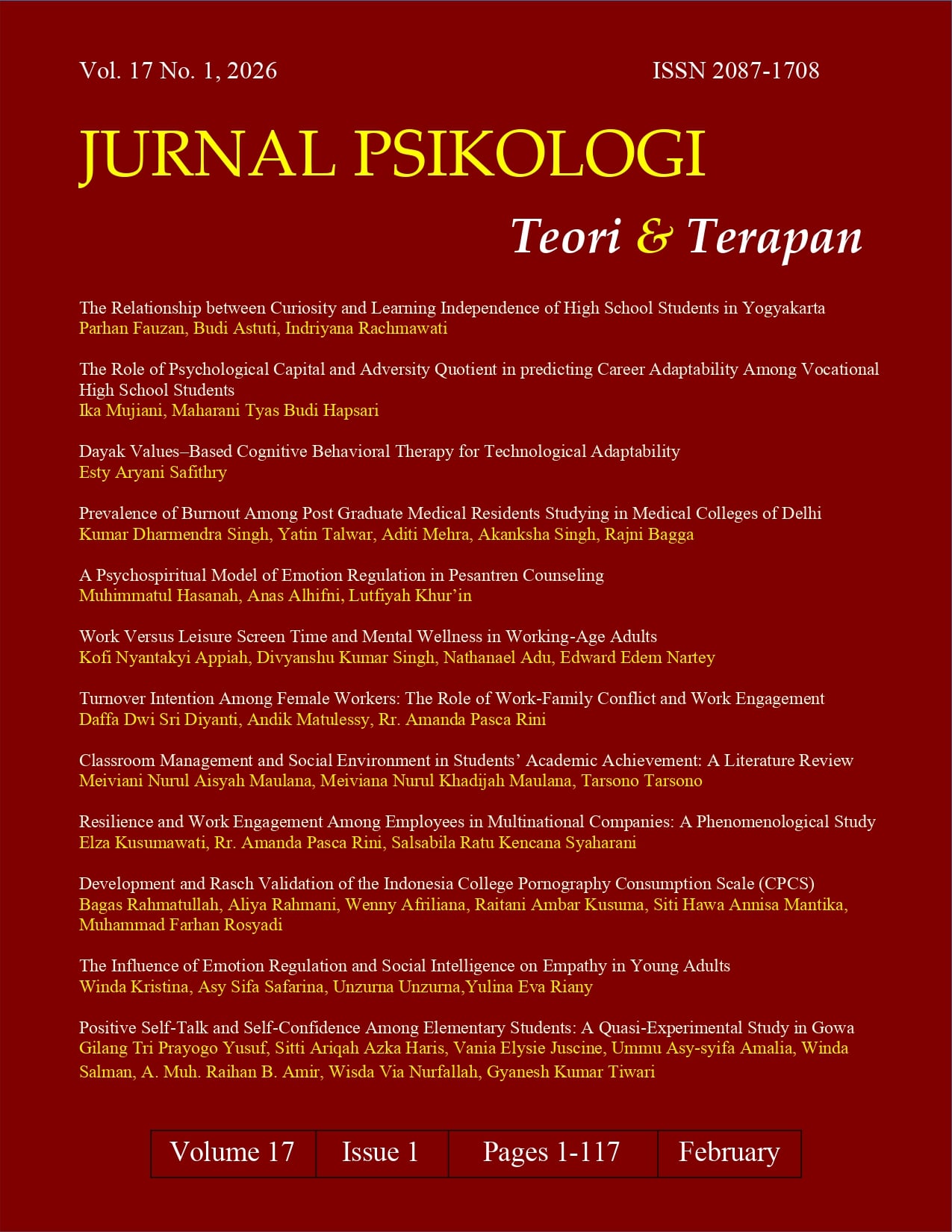
Positive Self-Talk and Self-Confidence Among Elementary Students: A Quasi-Experimental Study in Gowa
DOI:
https://doi.org/10.26740/jptt.v17n01.p106-117Keywords:
Cognitive restructuring, elementary students, positive self-talk, self-confidence, school-based interventionAbstract
Background: Low self-confidence in upper elementary school can undermine academic engagement and socio-emotional adjustment, highlighting the need for school-based interventions. Objective: This study examined the effectiveness of a positive self-talk intervention to enhance self-confidence among fifth-grade students. Method: Using a one-group pretest–posttest design, seven students with low-to-moderate self-confidence were identified through classroom observations and teacher interviews. Four structured sessions employed play-based activities, storytelling, and guided practice to foster cognitive reinterpretation. Self-confidence was measured using the Self-Confidence Assessment Instrument before and after the intervention. Results: All seven participants showed improvement, with group-level analysis indicating statistically significant change (Sign Test, p = .016, Cohen's d = 2.61), though the large effect size should be interpreted cautiously given the small sample (n = 7) and absence of a control group. Conclusion: The intervention appears practical and potentially promising for enhancing self-confidence in similar school contexts. Findings provide preliminary support for brief cognitive interventions in schools, while underscoring the need for replication through controlled studies with larger samples.
Abstrak
Latar Belakang: Rendahnya self-confidence pada siswa sekolah dasar kelas tinggi dapat mengganggu keterlibatan akademik dan penyesuaian sosial-emosional, sehingga diperlukan intervensi berbasis sekolah. Tujuan: Penelitian ini menguji efektivitas intervensi self-talk positif untuk meningkatkan self-confidence pada siswa kelas lima. Metode: Menggunakan desain pretest–posttest satu kelompok, tujuh siswa ber-self-confidence rendah hingga sedang diidentifikasi melalui observasi kelas dan wawancara guru. Empat sesi terstruktur menggunakan aktivitas berbasis bermain, bercerita, dan latihan terpandu untuk memfasilitasi reinterpretasi kognitif. Self-confidence diukur menggunakan Self-Confidence Assessment Instrument sebelum dan sesudah intervensi. Hasil: Ketujuh partisipan menunjukkan peningkatan, dengan analisis tingkat kelompok mengindikasikan perubahan yang signifikan secara statistik (Sign Test, p = 0,016, Cohen's d = 2,61), meskipun effect size yang besar ini perlu diinterpretasikan secara hati-hati mengingat sampel yang kecil (n = 7) dan ketiadaan kelompok kontrol. Kesimpulan: Intervensi ini tampak praktis dan berpotensi menjanjikan untuk meningkatkan self-confidence dalam konteks sekolah serupa. Temuan ini memberikan dukungan awal bagi intervensi kognitif singkat di sekolah, serta menegaskan perlunya replikasi melalui studi terkontrol dengan sampel lebih besar.
References
Arum, A., Khumaedi, M., & Susilaningsih, E. (2022). Validity and reliability of development of self-confidence assessment instruments for students on chemistry subject. Journal of Research and Educational Research Evaluation, 11(1), 62–69. https://doi.org/10.15294/jere.v11i1.55048
Barnett, A. G. (2005). Regression to the mean: What it is and how to deal with it. International Journal of Epidemiology, 34(1), 215–220. https://doi.org/10.1093/ije/dyh299
Berg, M., Klemetz, H., Lindegaard, T., & Andersson, G. (2023). Self-esteem in new light: A qualitative study of experiences of internet-based cognitive behaviour therapy for low self-esteem in adolescents. BMC Psychiatry, 23(1), 810. https://doi.org/10.1186/s12888-023-05328-0
Bertie, L.-A., & Hudson, J. L. (2021). CBT for childhood anxiety: Reviewing the state of personalised intervention research. Frontiers in Psychology, 12, 722546. https://doi.org/10.3389/fpsyg.2021.722546
Borrelli, B. (2011). The assessment, monitoring, and enhancement of treatment fidelity in public health clinical trials. Journal of Public Health Dentistry, 71(s1), S52–S63. https://doi.org/10.1111/j.1752-7325.2011.00233.x
Bruns, E. J., Lee, K., Davis, C., Pullmann, M. D., Ludwig, K., Sander, M., Holm-Hansen, C., Hoover, S., & McCauley, E. M. (2023). Effectiveness of a brief engagement, problem-solving, and triage strategy for high school students: Results of a randomized study. Prevention Science, 24(4), 701–714. https://doi.org/10.1007/s11121-022-01463-4
Campbell, D. T., & Stanley, J. C. (1963). Experimental and quasi-experimental designs for research. Wadsworth.
Chen, Y.-Y., Hong, L., & Wang, M. (2025). Integrating career development with socio-emotional learning for rural primary school children: A school-based program and evaluation. Applied Research in Quality of Life, Advanced Online Publication. https://doi.org/10.1007/s11482-025-10507-0
Cohen, J. (1988). Statistical power analysis for the behavioral sciences (2nd ed.). Lawrence Erlbaum Associates.
Cunha, J., Guimarães, A., Martins, J., & Rosário, P. (2023). A self-regulation intervention conducted by teachers in a disadvantaged school neighborhood: Implementers’ and observers’ perceptions of its impact on elementary students. Children, 10(11), 1795. https://doi.org/10.3390/children10111795
David, O. A., & Fodor, L. A. (2023). Preventing mental illness in children that experienced maltreatment: The efficacy of Rethink Online Therapeutic Game. Npj Digital Medicine, 6(1), 106. https://doi.org/10.1038/s41746-023-00849-0
De Silva, S., Peris, R., Senaviratne, S., & Samaranayake, D. (2024). Effectiveness of a cognitive behavioural therapy (CBT)-based intervention for reducing anxiety among adolescents in the Colombo District, Sri Lanka: Cluster randomized controlled trial. Child and Adolescent Psychiatry and Mental Health, 18(1), 108. https://doi.org/10.1186/s13034-024-00799-9
Eccles, J. S., & Wigfield, A. (2020). From expectancy-value theory to situated expectancy-value theory: A developmental, social cognitive, and sociocultural perspective on motivation. Contemporary Educational Psychology, 61, 101859. https://doi.org/10.1016/j.cedpsych.2020.101859
Ede, M. O., Okeke, C. I., & Oneli, J. O. (2023). Raising the self-esteem and reducing irrational beliefs of schoolchildren: The moderating and main effect study. Medicine, 102(27), e34168. https://doi.org/10.1097/md.0000000000034168
Eiraldi, R., Comly, R., Goldstein, J., Khanna, M. S., McCurdy, B. L., Rutherford, L. E., Henson, K., Bevenour, P., Francisco, J., & Jawad, A. F. (2023). Development of an online training platform and implementation strategy for school-based mental health professionals in rural elementary schools: A mixed-methods study. School Mental Health, 15(3), 692–709. https://doi.org/10.1007/s12310-023-09582-1
Epel, N., Zohar, A. A., Artom, A., Novak, A. M., & Lev-Ari, S. (2021). The effect of cognitive behavioral group therapy on children’s self-esteem. Children, 8(11), 958. https://doi.org/10.3390/children8110958
Fernández-Sogorb, A., Sanmartín, R., Vicent, M., & Gonzálvez, C. (2021). Identifying profiles of anxiety in late childhood and exploring their relationship with school-based distress. International Journal of Environmental Research and Public Health, 18(3), 948. https://doi.org/10.3390/ijerph18030948
Fishstrom, S., Wang, H.-H., Bhat, B. H., Daniel, J., Dille, J., Capin, P., & Vaughn, S. (2022). A meta-analysis of the effects of academic interventions on academic achievement and academic anxiety outcomes in elementary school children. Journal of School Psychology, 92, 265–284. https://doi.org/10.1016/j.jsp.2022.03.011
Handley, M. A., Lyles, C. R., McCulloch, C., & Cattamanchi, A. (2018). Selecting and improving quasi-experimental designs in effectiveness and implementation research. Annual Review of Public Health, 39(1), 5–25. https://doi.org/10.1146/annurev-publhealth-040617-014128
Hedges, L. V. (1981). Distribution theory for Glass's estimator of effect size and related estimators. Journal of Educational Statistics, 6(2), 107–128. https://doi.org/10.2307/1164588
Hudson, J. L., Minihan, S., Chen, W., Carl, T., Fu, M., Tully, L., Kangas, M., Rosewell, L., McDermott, E. A., Wang, Y., Stubbs, T., & Martiniuk, A. (2023). Interventions for young children’s mental health: A review of reviews. Clinical Child and Family Psychology Review, 26(3), 593–641. https://doi.org/10.1007/s10567-023-00443-6
Karlen, Y., Hirt, C. N., Liska, A., & Stebner, F. (2021). Mindsets and self-concepts about self-regulated learning: Their relationships with emotions, strategy knowledge, and academic achievement. Frontiers in Psychology, 12, 661142. https://doi.org/10.3389/fpsyg.2021.661142
Kilbourne, A. M., Smith, S. N., Choi, S. Y., Koschmann, E., Liebrecht, C., Rusch, A., Abelson, J. L., Eisenberg, D., Himle, J. A., Fitzgerald, K., & Almirall, D. (2018). Adaptive school-based implementation of CBT (ASIC): Clustered-SMART for building an optimized adaptive implementation intervention to improve uptake of mental health interventions in schools. Implementation Science, 13(1), 119. https://doi.org/10.1186/s13012-018-0808-8
Krumpal, I. (2013). Determinants of social desirability bias in sensitive surveys. Quality & Quantity, 47(4), 2025–2047. https://doi.org/10.1007/s11135-011-9640-9
Lau, J. Y., Watkins-Muleba, R., Lee, I., Pile, V., & Hirsch, C. R. (2021). Promoting helpful attention and interpretation patterns to reduce anxiety and depression in young people: Weaving scientific data with young peoples’ lived experiences. BMC Psychiatry, 21(1), 403. https://doi.org/10.1186/s12888-021-03320-0
Laursen, B., Richmond, A., Kiuru, N., Lerkkanen, M.-K., & Poikkeus, A.-M. (2021). Off on the wrong foot: Task avoidance at the outset of primary school anticipates academic difficulties and declining peer acceptance. European Journal of Developmental Psychology, 19(4), 601–615. https://doi.org/10.1080/17405629.2021.1936491
Long, Z., Wang, K., Wang, H., Yao, W., & Liu, C. (2023). Effect of a mental health education intervention on children’s life satisfaction and self-confidence in rural China. Frontiers in Psychology, 14, 1277139. https://doi.org/10.3389/fpsyg.2023.1277139
March, S., Spence, S. H., Myers, L., Ford, M., Smith, G., & Donovan, C. L. (2023). Stepped-care versus therapist-guided, internet-based cognitive behaviour therapy for childhood and adolescent anxiety: A non-inferiority trial. Internet Interventions, 34, 100675. https://doi.org/10.1016/j.invent.2023.100675
Marsh, H. W., & Craven, R. G. (2006). Reciprocal effects of self-concept and performance from a multidimensional perspective: Beyond seductive pleasure and unidimensional perspectives. Perspectives on Psychological Science, 1(2), 133–163. https://doi.org/10.1111/j.1745-6916.2006.00010.x
McCambridge, J., Witton, J., & Elbourne, D. R. (2014). Systematic review of the Hawthorne effect: New concepts are needed to study research participation effects. Journal of Clinical Epidemiology, 67(3), 267–277. https://doi.org/10.1016/j.jclinepi.2013.08.015
McCartan, C. J., Roberts, J., & Jordan, J. (2023). Centre‐based early education interventions for improving school readiness: A systematic review. Campbell Systematic Reviews, 19(4), e1363. https://doi.org/10.1002/cl2.1363
Morello, K., Schäfer, S. K., Kunzler, A. M., Priesterroth, L.-S., Tüscher, O., & Kubiak, T. (2023). Cognitive reappraisal in mHealth interventions to foster mental health in adults: A systematic review and meta-analysis. Frontiers in Digital Health, 5, 1253390. https://doi.org/10.3389/fdgth.2023.1253390
Morris, S. B., & DeShon, R. P. (2002). Combining effect size estimates in meta-analysis with repeated measures and independent-groups designs. Psychological Methods, 7(1), 105–125. https://doi.org/10.1037/1082-989x.7.1.105
Naegeli, A. N., Hanlon, J., Gries, K. S., Safikhani, S., Ryden, A., Patel, M., Crescioni, M., & Vernon, M. (2018). Literature review to characterize the empirical basis for response scale selection in pediatric populations. Journal of Patient-Reported Outcomes, 2, 39. https://doi.org/10.1186/s41687-018-0051-8
Noble, H., & Heale, R. (2019). Triangulation in research, with examples. Evidence Based Nursing, 22(3), 67–68. https://doi.org/10.1136/ebnurs-2019-103145
Norbury, A., Hauser, T. U., Fleming, S. M., Dolan, R. J., & Huys, Q. J. (2024). Different components of cognitive-behavioral therapy affect specific cognitive mechanisms. Science Advances, 10(13), eadk3222. https://doi.org/10.1126/sciadv.adk3222
Palinkas, L., Horwitz, S., Green, C., Wisdom, J., Duan, N., & Hoagwood, K. (2015). Purposeful sampling for qualitative data collection and analysis in mixed method implementation research. Administration and Policy in Mental Health and Mental Health Services Research, 42(5), 533–544. https://doi.org/10.1007/s10488-013-0528-y
Postigo, Á., Fernández-Alonso, R., Fonseca-Pedrero, E., González-Nuevo, C., & Muñiz, J. (2022). Academic self-concept dramatically declines in secondary school: Personal and contextual determinants. International Journal of Environmental Research and Public Health, 19(5), 3010. https://doi.org/10.3390/ijerph19053010
Raoof, K., Shokri, O., Fathabadi, J., & Panaghi, L. (2024). Unpacking the underachievement of gifted students: A systematic review of internal and external factors. Heliyon, 10(17), e36908. https://doi.org/10.1016/j.heliyon.2024.e36908
Rookes, T. A., Schrag, A., Walters, K., & Armstrong, M. (2022). Measures of fidelity of delivery and engagement in self-management interventions: A systematic review of measures. Clinical Trials, 19(6), 665–672. https://doi.org/10.1177/17407745221118555
Rosenberg, M. (1965). Society and the adolescent self-image. Princeton University Press.
Rost, D. H., & Feng, X. (2024). Academic self-concept wins the race: The prediction of achievements in three major school subjects by five subject-specific self-related variables. Behavioral Sciences, 14(1), 40. https://doi.org/10.3390/bs14010040
Salkovskis, P. M., Sighvatsson, M. B., & Sigurdsson, J. F. (2023). How effective psychological treatments work: Mechanisms of change in cognitive behavioural therapy and beyond. Behavioural and Cognitive Psychotherapy, 51(6), 595–615. https://doi.org/10.1017/s1352465823000590
Shadish, W. R., Cook, T. D., & Campbell, D. T. (2002). Experimental and quasi-experimental designs for generalized causal inference. Wadsworth Cengage Learning.
Stankov, L., Lee, J., Luo, W., & Hogan, D. J. (2012). Confidence: A better predictor of academic achievement than self-efficacy, self-concept and anxiety? Learning and Individual Differences, 22(6), 747–758. https://doi.org/10.1016/j.lindif.2012.05.013
Stiede, J. T., Trent, E. S., Viana, A. G., Guzick, A. G., Storch, E. A., & Hershfield, J. (2023). Cognitive behavioral therapy for children and adolescents with anxiety disorders. Child and Adolescent Psychiatric Clinics of North America, 32(3), 543–558. https://doi.org/10.1016/j.chc.2022.12.001
Tavakol, M., & Dennick, R. (2011). Making sense of Cronbach's alpha. International Journal of Medical Education, 2(2), 53–55. https://doi.org/10.5116/ijme.4dfb.8dfd
Thomaes, S., Tjaarda, I. C., Brummelman, E., & Sedikides, C. (2020). Effort self‐talk benefits the mathematics performance of children with negative competence beliefs. Child Development, 91(6), 2211–2220. https://doi.org/10.1111/cdev.13347
Tolan, P. H., Harris, A. R., Burchinal, M., & Jennings, P. A. (2024). Promoting 21st century health and wellness skills in elementary school children: A group randomized trial. Prevention Science, 25(6), 919–933. https://doi.org/10.1007/s11121-024-01717-3
Wikman, C., Allodi, M. W., & Ferrer-Wreder, L. A. (2022). Self-concept, prosocial school behaviors, well-being, and academic skills in elementary school students: A whole-child perspective. Education Sciences, 12(5), 298. https://doi.org/10.3390/educsci12050298
Zabek, F., Lyons, M. D., Alwani, N., Taylor, J. V., Brown-Meredith, E., Cruz, M. A., & Southall, V. H. (2023). Roles and functions of school mental health professionals within comprehensive school mental health systems. School Mental Health, 15(1), 1–18. https://doi.org/10.1007/s12310-022-09535-0
Downloads
Published
How to Cite
Issue
Section
License
Copyright (c) 2026 Gilang Tri Prayogo Yusuf, Sitti Ariqah Azka Haris, Vania Elysie Juscine, Ummu Asy-syifa Amalia, Winda Salman, A. Muh. Raihan B. Amir, Wisda Via Nurfallah, Gyanesh Kumar Tiwari

This work is licensed under a Creative Commons Attribution 4.0 International License.
Authors who publish in this journal agree to the following terms:
Copyright in any article is held by the author.
The author grants the journal, publication rights with the work simultaneously licensed under a Creative Commons Attribution License that allows others to share the work with an acknowledgment of the work's authorship and initial publication in this journal.
Authors may enter into separate, additional contractual arrangements for the non-exclusive distribution of the journal's published version of the work (e.g., posting it to an institutional repository or publishing it in a book), with an acknowledgment of its initial publication in this journal.
Authors are permitted and encouraged to post their work online (e.g., in an institutional repository or on their website) prior to and during the submission process, as this can lead to productive exchanges, as well as earlier and greater citation of published work.
 Abstract views: 905
,
Abstract views: 905
, PDF Downloads: 728