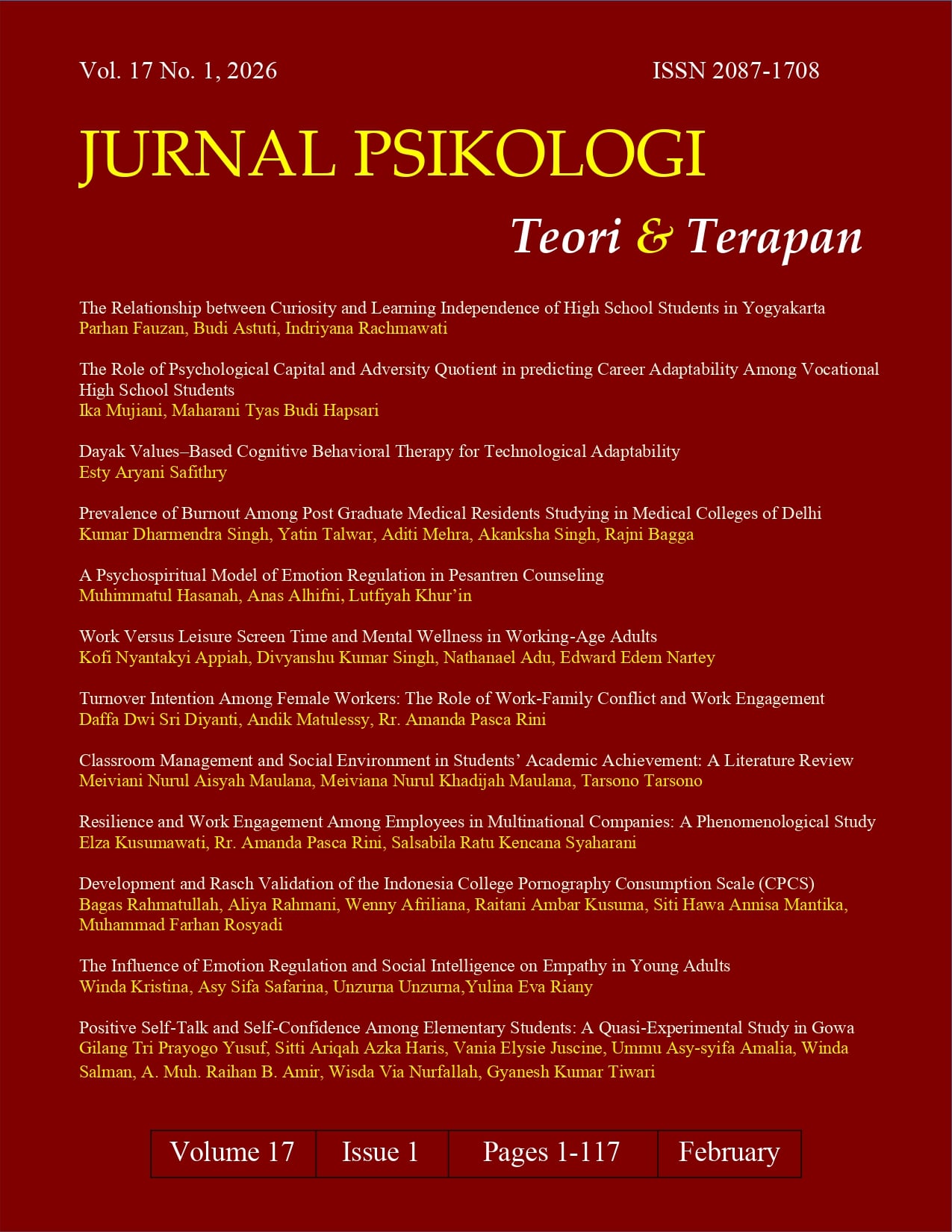
Resilience and Work Engagement Among Employees in Multinational Companies: A Phenomenological Study
DOI:
https://doi.org/10.26740/jptt.v17n01.p79-85Keywords:
Manufacturing company, multinational companies, phenomenology, resilience, work engagementAbstract
Background: The work environment becomes more complex due to globalization and cross-cultural performance demands. A multinational manufacturing company in East Java faces significant challenges in sustaining employee work engagement. Objective: This study aims to understand how employees in a multinational company experience and construe resilience in sustaining their work engagement. The research adopts Coulson’s (2006) resilience framework. Method: This qualitative study employed an Interpretative Phenomenological Analysis (IPA), involving 4 participants. Data were analyzed using IPA, with credibility ensured through triangulation, member checking, and peer debriefing. Results: Employees’ resilience in sustaining work engagement within a multinational company context is dynamic, from yielding to thriving. Engagement is initially minimal due to emotional strain, becomes more stable during recovery, and ultimately strengthens when work-related pressure is reinterpreted as a catalyst for continuous growth. Conclusion: Employee resilience is a dynamic and gradual process that shapes the sustainability of work engagement through adaptation to global pressures. This study highlights resilience as a regulatory mechanism and recommends emotional regulation training, coaching interventions, and the development of organizational psychological safety.
Abstrak
Latar Belakang: Lingkungan kerja semakin kompleks akibat globalisasi, teknologi, restrukturisasi, dan tuntutan kinerja lintas budaya. Perusahaan manufaktur multinasional di Jawa Timur menghadapi tantangan menjaga keterlibatan kerja karyawan akibat tekanan global, restrukturisasi, dan tuntutan kinerja. Tujuan: Penelitian ini bertujuan untuk memahami bagaimana karyawan di perusahaan multinasional mengalami dan memaknai resiliensi dalam mempertahankan keterlibatan kerja mereka. Penelitian ini mengadopsi teori resiliensi Coulson (2006). Metode: Penelitian kualitatif dengan pendekatan Interpretative Phenomenological Analysis (IPA) melibatkan 4 partisipan yang dipilih melalui purposive sampling. Analisis menggunakan IPA keabsahan melalui triangulasi, member checking, dan diskusi sejawat Hasil: Resiliensi karyawan dalam work engagement di perusahaan multinasional bersifat dinamis dan bertahap, dari mengalah hingga berkembang pesat. Keterlibatan awalnya minimal akibat tekanan emosional, kemudian stabil saat pemulihan, dan akhirnya kuat ketika tekanan dimaknai sebagai tantangan pertumbuhan berkelanjutan. Kesimpulan: Resiliensi karyawan bersifat dinamis dan bertahap, membentuk keberlanjutan work engagement melalui adaptasi terhadap tekanan global. Studi ini menegaskan peran resiliensi sebagai mekanisme regulatif, serta merekomendasikan pelatihan emosi, coaching, dan psychological safety organisasi.
References
Aditya, E., Haikal, M., & Putra, R. D. (2024). Strategi peningkatan kualitas sumber daya manusia melalui manajemen SDM di era global. Economics Learning Experience & Social Thinking Education Journal, 4(2), 151-159. https://doi.org/10.58890/eleste.v4i2.229
Aisha, N., Mahilan, A., & Saefullah, A. (2025). Transformasi budaya organisasi dan dampaknya terhadap kinerja bisnis: Strategi adaptasi di era ekonomi digital. RIGGS: Journal of Artificial Intelligence and Digital Business, 4(3), 6196-6204. https://doi.org/10.31004/riggs.v4i3.2911
Anggawa, D., & Wartini, S. (2026). Self-Efficacy Job Performance: Peran Mediasi Work Engagement pada Lingkungan Kerja Berbasis Proyek. Bookchapter Manajemen SDM, 2, 1-38. https://bookchapter.unnes.ac.id/index.php/msdm/article/view/376
Apriawal, J. (2022). Resiliensi pada karyawan yang mengalami pemutusan hubungan kerja (PHK). Jurnal Ilmu Psikologi Dan Kesehatan (SIKONTAN), 1(1), 27-38. https://doi.org/10.47353/sikontan.v1i1.330
Creswell, J. W., & Creswell, J. D. (2017). Research design: Qualitative, quantitative, and mixed methods
Eatough, V., & Smith, J. A. (2017). Interpretative phenomenological analysis. The Sage handbook of qualitative research in psychology, 2, 193-209.
Edwards, T., Marginson, P., & Ferner, A. (2013). Multinational Companies in Cross-National Context: Integration, Differentiation, and the Interactions between MNCS and Nation States: Introduction to a Special Issue of the ILRReview. ILR Review, 66(3), 547-587.
Firdaus, R. R. (2019). Pengaruh Stress Kerja dan Work Engagement terhadap kinerja karyawan dengan komitmen Organisasi sebagai variabel intervening. https://dspace.uii.ac.id/handle/123456789/13948
Guarte, J. M., & Barrios, E. B. (2006). Estimation under purposive sampling. Communications in Statistics-Simulation and Computation, 35(2), 277-284. https://doi.org/10.1080/03610910600591610
Mariska, N., Yanti, L., Rafi, I. A., Ibrohim, M. H. D., & Hadiati, E. (2024). Manajemen Sumber Daya Manusia Global: Tujuan, Ruang Lingkup, Dan Tantangan. Jurnal Media Akademik (JMA), 2(12). https://doi.org/10.62281/v2i12.1302
Nurlaila, C. D. (2023). Studi Fenomenologis tentang Resiliensi Pada Karyawan PHK Perusahaan X Di Jawa Tengah Universitas Walisongo
Nuswantoro, A., Sahrah, A., Fitriana, N., & Widiastuti, N. (2024). Benarkah Dukungan Sosial dan Resiliensi Berpengaruh Pada Keterikatan Kerja Karyawan?. Dinamika Psikologis: Jurnal Ilmiah Psikologis, 1(2), 42-55. https://doi.org/10.26486/jdp.v1i2.4259
Perraton, J. (2000). Book Reviews.
Ramadhani, F., Situmorang, N. Z., & Prabawanti, C. (2021). Resiliensi Pada Pekerja Perempua. Psyche 165 Journal, 22-26. https://doi.org/10.35134/jpsy165.v14i1.24
Setiawan, K. C., Prayuda, F., Putri, D. D. A., Hanifah, R. P., Egissa, S. A., & Trisna, M. (2025). Frustasi Kerja Sebagai Bentuk Stress Psikologis: Analisis Literatur Tentang Regulasi Emosi dan Resiliensi Karyawan. Journal of Health and Medical Science, 1(2), 36-42. https://jurnal.dokicti.org/index.php/jhms/article/view/1501
Siregar, H. N. S., Paksi, A. K., & Jatmika, S. (2023). Leveraging Indonesia's G20 Presidency for Post-Pandemic Economic Resurgence and Global Diplomatic Leadership. Innovative: Journal Of Social Science Research, 3(6), 10323-10335. https://doi.org/10.31004/innovative.v3i6.7875
Wicaksana, S. A. (2025). Business Psychology in The Human Side of Strategy: Menemukan Keputusan yang Adaptif, Etis, dan Berkelanjutan.
Zaman, I. B. (2025). Meningkatkan Readiness for Change pada Karyawan: Peran Resiliensi, Kepemimpinan Transformasional, dan Modal Psikologis. Jurnal Locus Penelitian Dan Pengabdian, 4(8), 8217-8229. https://doi.org/10.58344/locus.v4i8.4276
Zeirliana, E. D. (2025). Tuntutan Kerja Dan Dukungan Sosial Sebagai Faktor Penentu Stres Kerja: Studi Pada Karyawan Cv. Zeirliana Bersatu. http://etheses.uin-malang.ac.id/id/eprint/73912
Downloads
Published
How to Cite
Issue
Section
License
Copyright (c) 2026 Elza Kusumawati, Rr. Amanda Pasca Rini; Salsabila Ratu Kencana Syaharani

This work is licensed under a Creative Commons Attribution 4.0 International License.
Authors who publish in this journal agree to the following terms:
Copyright in any article is held by the author.
The author grants the journal, publication rights with the work simultaneously licensed under a Creative Commons Attribution License that allows others to share the work with an acknowledgment of the work's authorship and initial publication in this journal.
Authors may enter into separate, additional contractual arrangements for the non-exclusive distribution of the journal's published version of the work (e.g., posting it to an institutional repository or publishing it in a book), with an acknowledgment of its initial publication in this journal.
Authors are permitted and encouraged to post their work online (e.g., in an institutional repository or on their website) prior to and during the submission process, as this can lead to productive exchanges, as well as earlier and greater citation of published work.
 Abstract views: 948
,
Abstract views: 948
, PDF Downloads: 491