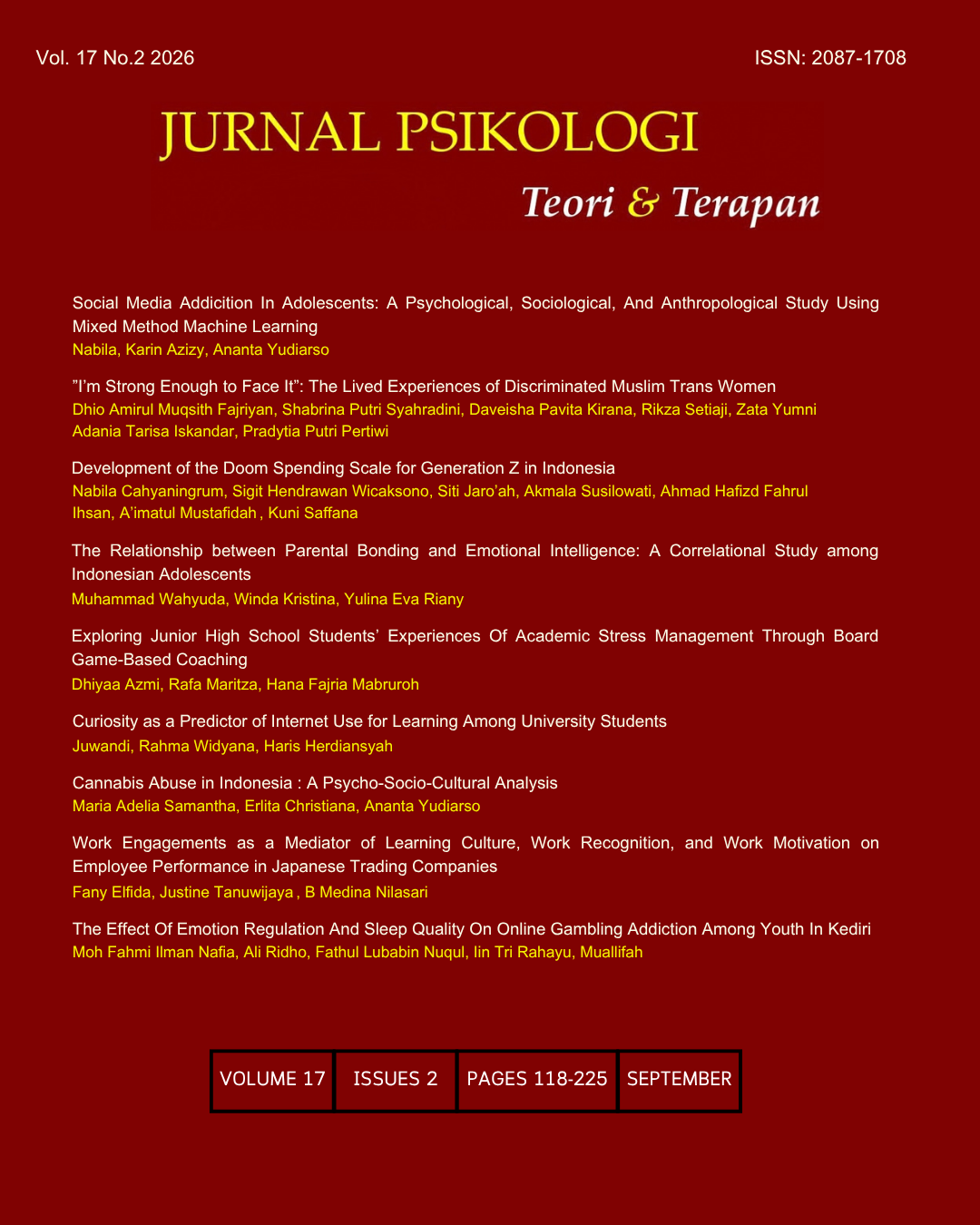
Exploring Junior High School Students’ Experiences Of Academic Stress Management Through Board Game-Based Coaching
DOI:
https://doi.org/10.26740/jptt.v17n02.p163-178Keywords:
Academic stress, fear of failure, coaching, board game, hope, self-regulationAbstract
Background: Academic stress and fear of failure are common among junior high school students due to high academic demands and evaluation pressure, which can reduce motivation and disrupt psychological well-being. Participatory learning media, such as board games, may support stress management and character development. Objective: This study explored students’ experiences in managing academic stress and fear of failure through coaching based on the board game Perjalanan Menuju Ketenangan. Method: Thirty eighth-grade students were purposively selected for an exploratory qualitative study. Data were collected via observation, reflection, and testimony, then analyzed thematically using hope and self-regulation indicators. The board game is the researcher’s original product, registered with the Indonesian Intellectual Property Agency. Results: Students showed improvement in managing emotions, setting realistic learning goals, applying adaptive coping strategies, and reflecting on their learning through the board game. Conclusion: Board game-based coaching effectively fosters psychological resilience and supports the development of academic stress management strategies among junior high school students.
References
Baratta, M. V., Seligman, M. E. P., & Maier, S. F. (2023). From helplessness to controllability: toward a neuroscience of resilience. Frontiers in Psychiatry, 14(May). https://doi.org/10.3389/fpsyt.2023.1170417
Braun, V., & Clarke, V. (2006). Using thematic analysis in psychology. Qualitative Research in Psychology, 3(2), 77–101. https://doi.org/10.1191/1478088706qp063oa
Brown, D. M. Y., Cairney, J., Azimi, S., Vandenborn, E., Bruner, M. W., Tamminen, K. A., & Kwan, M. Y. W. (2023). Towards the development of a quality youth sport experience measure: Understanding participant and stakeholder perspectives. PLoS ONE, 18(7 July), 1–17. https://doi.org/10.1371/journal.pone.0287387
Brown, J. K., Hohman, Z. P., Niedbala, E. M., & Stinnett, A. J. (2020). Sweating the big stuff Arousal and stress as functions of self‐uncertainty and.pdf (pp. 1–13). Wiley Psychipahsiology.
Çınar-Tanrıverdi, E., & Karabacak-Çelik, A. (2023). Psychological need satisfaction and academic stress in college students: mediator role of grit and academic self-efficacy. European Journal of Psychology of Education, 38(1), 131–160. https://doi.org/10.1007/s10212-022-00658-1
Creswell, J. W., & Creswell, J. D. (2018). Research Design Qualitative, Quantitative, and Mixed Methods Approaches (14th ed.). SAGE Publications, Inc.
Echeverria, I., Peraire, M., Penadés, D., & Quintero, V. (2022). Purpose in Life and Character Strengths as Predictors of Health Sciences Students ’ Psychopathology During the COVID-19 Pandemic. 13(July), 1–8. https://doi.org/10.3389/fpsyt.2022.932249
Gibbons, C. (2022). Understanding the role of stress, personality and coping on learning motivation and mental health in university students during a pandemic. BMC Psychology, 10(1), 1–13. https://doi.org/10.1186/s40359-022-00971-w
Gong, Z., Wang, H., Zhong, M., & Shao, Y. (2023). College students’ learning stress, psychological resilience and learning burnout: status quo and coping strategies. BMC Psychiatry, 23(1), 1–7. https://doi.org/10.1186/s12888-023-04783-z
González-Hernández, J., Gómez-López, M., Manzano-Sánchez, D., & Valero-Valenzuela, A. (2023). Motivated and without Fear of Failure: The Strength of Basic Psychological Needs in Youth Spanish Athletes in Team Sports. Journal of Human Kinetics, 87(April), 235–245. https://doi.org/10.5114/jhk/162449
Guo, S., Li, T., Xue, B., & Yang, X. (2023). Horticultural Activities Participation and College Students’ Positive Mental Characters: Mediating Role of Academic Self-Efficacy. Horticulturae, 9(3). https://doi.org/10.3390/horticulturae9030334
Holmes, S. E., & Nikiforidou, Z. (2023). ‘They don’t realise how hard it is’. Investigating the lived experiences of higher education students with parental responsibilities during the Covid-19 pandemic. Higher Education Quarterly, 77(4), 638–654. https://doi.org/10.1111/hequ.12423
Imani, P. K., & Rozi, F. (2024). Pengaruh Self-Regulated Learning dan Prokrastinasi Akademik terhadap Kecemasan Akademik pada Mahasiswa. 10(2), 231–239. https://doi.org/10.31289/diversita.v10i2.12971
Jiang, Z., Jia, X., Tao, R., & Dördüncü, H. (2022). COVID-19: A Source of Stress and Depression Among University Students and Poor Academic Performance. Frontiers in Public Health, 10(April), 1–7. https://doi.org/10.3389/fpubh.2022.898556
Kennes, A., Lataster, J., Janssens, M., Simons, M., Reijnders, J., Jacobs, N., & Peeters, S. (2023). Efficacy of a School ‑ Based Mental Health Intervention Based on Mindfulness and Character Strengths Use Among Adolescents : a Pilot Study of Think Happy ‑ Be Happy. Journal of Happiness Studies, 24(2), 677–697. https://doi.org/10.1007/s10902-022-00611-5
Kristensen, S. M., Larsen, T. M. B., Urke, H. B., & Danielsen, A. G. (2023). Academic Stress, Academic Self-efficacy, and Psychological Distress: A Moderated Mediation of Within-person Effects. Journal of Youth and Adolescence, 52(7), 1512–1529. https://doi.org/10.1007/s10964-023-01770-1
Lapierre, S., Chauvette, S., Bolduc, L., Adams-Lemieux, M., Boller, B., & Desjardins, S. (2023). Character Strengths and Resilience in Older Adults during the COVID-19 Pandemic. Canadian Journal on Aging, 42(3), 455–465. https://doi.org/10.1017/S0714980823000089
Maryatmi, A. S., Sovitriana, R., Profesi, M. P., Persada, U., & Yai, I. (2024). Pengaruh Regulasi Emosi dan Kontrol Diri Terhadap Kecenderungan Perilaku Cyberbullying Dengan Konformitas Sebagai Mediator. 8(3), 174–184.
Morshidi, M. I., Chew, P. K. H., & Suárez, L. (2024). The higher education expectation scale: development and testing. Higher Education Research and Development, 43(2), 377–391. https://doi.org/10.1080/07294360.2023.2228222
O’Daffer, A., Comiskey, L., Scott, S. R., Zhou, C., Bradford, M. C., Yi-Frazier, J. P., & Rosenberg, A. R. (2023). Protocol for the promoting resilience in stress management (PRISM) intervention: a multi-site randomized controlled trial for adolescents and young adults with advanced cancer. BMC Palliative Care, 22(1), 1–9. https://doi.org/10.1186/s12904-023-01179-4
Putwain, D. W., Jansen in de Wal, J., & van Alphen, T. (2023). Academic Buoyancy: Overcoming Test Anxiety and Setbacks. Journal of Intelligence, 11(3), 1–16. https://doi.org/10.3390/jintelligence11030042
Raine, K. E., Zimmer-Gembeck, M. J., & Skinner, E. A. (2023). The role of coping in processes of resilience: The sample case of academic coping during late childhood and early adolescence. Development and Psychopathology, 35(5), 2499–2515. https://doi.org/10.1017/S095457942300072X
Reynish, T., Hoang, H., Bridgman, H., & Nic Giolla Easpaig, B. (2023). Psychological Distress, Resilience, and Help-Seeking Experiences of LGBTIQA+ People in Rural Australia. International Journal of Environmental Research and Public Health, 20(4). https://doi.org/10.3390/ijerph20042842
Sirois, F. M., Stride, C. B., & Pychyl, T. A. (2023). Procrastination and health: A longitudinal test of the roles of stress and health behaviours. British Journal of Health Psychology, 28(3), 860–875. https://doi.org/10.1111/bjhp.12658
Sugiyono, P. D. (2023). Metode Penelitian Kuantitatif Kualitatif, dan R&D (M. Dr. Ir. Sutopo, S.Pd. (ed.); 5th ed.). ALFABETA BANDUNG.
Veronica X. Yan, Oyserman, D., Kiper, G., & Atari, M. (2019). Difficulty-as-Improvement: The Courage to Keep Going in the Face of Life’s Difficulties. Sustainability (Switzerland), 11(1), 1–14. http://scioteca.caf.com/bitstream/handle/123456789/1091/RED2017-Eng-8ene.pdf?sequence=12&isAllowed=y%0Ahttp://dx.doi.org/10.1016/j.regsciurbeco.2008.06.005%0Ahttps://www.researchgate.net/publication/305320484_SISTEM_PEMBETUNGAN_TERPUSAT_STRATEGI_MELESTARI
Wang, D., Chen, X. Y., Ma, Z., Liu, X., & Fan, F. (2022). Has the “Double Reduction” policy relieved stress? A follow-up study on Chinese adolescents. Child and Adolescent Psychiatry and Mental Health, 16(1), 1–10. https://doi.org/10.1186/s13034-022-00530-6
Yu, M., Wen, J., Smith, S., & Stokes, P. (2022). Building-up Resilience and Being Effective Leaders in the Workplace: A Systematic Review and Synthesis Model.
Zhai, X., Zhu, C. J., & Zhang, M. M. (2023). Mapping promoting factors and mechanisms of resilience for performance improvement: The role of strategic human resource management systems and psychological empowerment. Applied Psychology, 72(3), 915–936. https://doi.org/10.1111/apps.12411
Zhang, C., Shi, L., Tian, T., Zhou, Z., Peng, X., Shen, Y., Li, Y., & Ou, J. (2022). Associations Between Academic Stress and Depressive Symptoms Mediated by Anxiety Symptoms and Hopelessness Among Chinese College Students. Psychology Research and Behavior Management, 15(February), 547–556. https://doi.org/10.2147/PRBM.S353778
Zogmaister, C., & Maricutoiu, L. P. (2022). Mirror, mirror on the wall, tell me that I have succeeded at it all: Self-esteem and the defensive mechanisms against failure. Social Psychology of Education, 25(5), 1221–1248. https://doi.org/10.1007/s11218-022-09723-5
Downloads
Published
How to Cite
Issue
Section
License
Copyright (c) 2026 Dhiyaa Azmi, Rafa Maritza, Hana Fajria Mabruroh

This work is licensed under a Creative Commons Attribution 4.0 International License.
Authors who publish in this journal agree to the following terms:
Copyright in any article is held by the author.
The author grants the journal, publication rights with the work simultaneously licensed under a Creative Commons Attribution License that allows others to share the work with an acknowledgment of the work's authorship and initial publication in this journal.
Authors may enter into separate, additional contractual arrangements for the non-exclusive distribution of the journal's published version of the work (e.g., posting it to an institutional repository or publishing it in a book), with an acknowledgment of its initial publication in this journal.
Authors are permitted and encouraged to post their work online (e.g., in an institutional repository or on their website) prior to and during the submission process, as this can lead to productive exchanges, as well as earlier and greater citation of published work.
 Abstract views: 151
,
Abstract views: 151
, PDF Downloads: 68