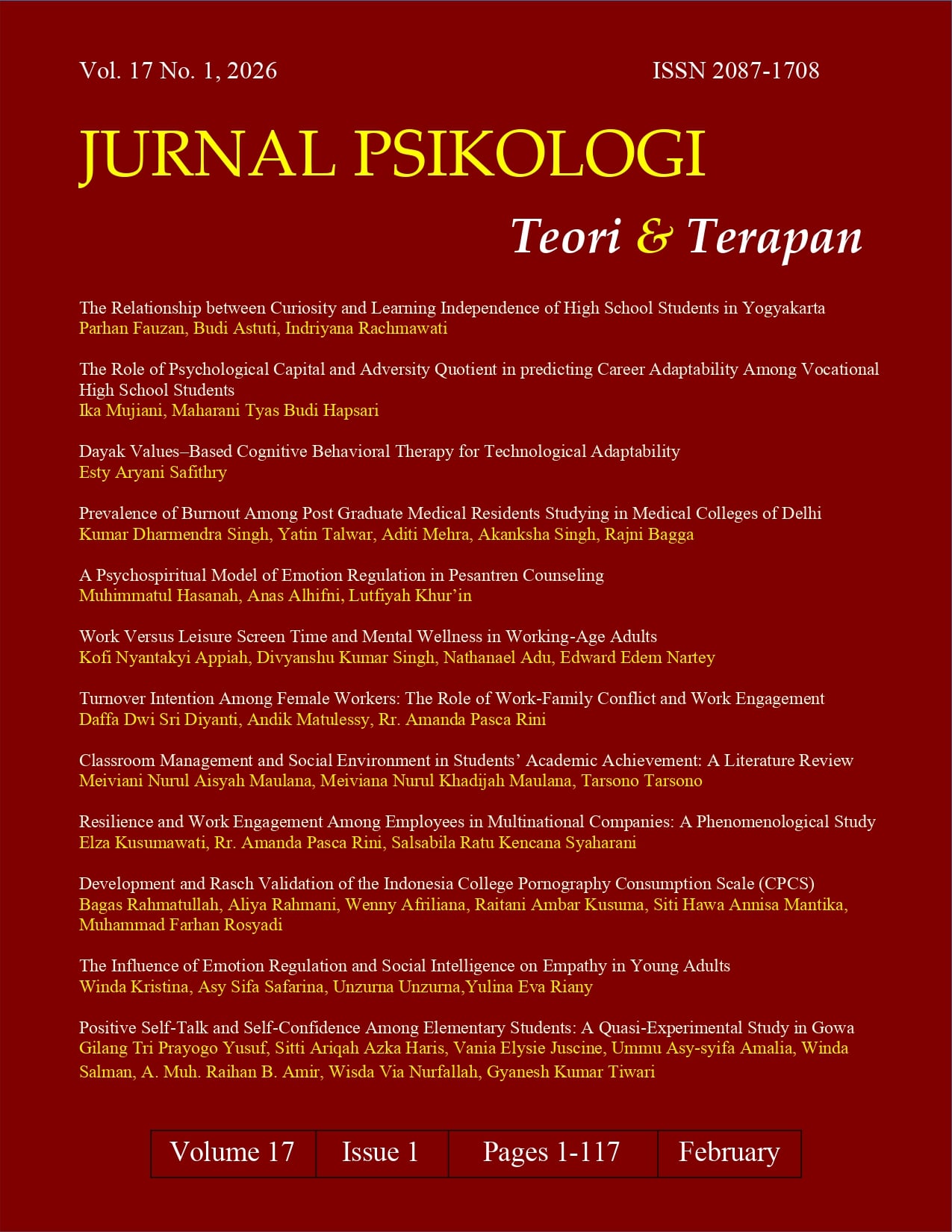
The Influence of Emotion Regulation and Social Intelligence on Empathy in Young Adults
DOI:
https://doi.org/10.26740/jptt.v17n01.p96-105Keywords:
Emotion regulation, empathy, social intelligence, young adultsAbstract
Background: The massive digital environment challenges empathy development due to reduced face-to-face interactions and nonverbal cues. Objective: This study aims to analyze the influence of emotion regulation and social intelligence on empathy in young adults and to examine the potential mediating role of social intelligence. Method: Using a quantitative cross-sectional design, data were collected from 341 Indonesian young adults using the DERS-SF, TSIS, and IRI scales. Data analysis was performed using multiple linear regression and path analysis with bootstrapping. Result: Simultaneous test results showed that emotion regulation and social intelligence significantly influence empathy (F = 18.452, p < 0.001), although their effective contribution was 9,8%. Social intelligence (t = 6.075, p < 0.001) and emotion regulation (t = 2.351, p = 0.019) were significant predictors of empathy. Conclusion: These findings confirm that effective emotional management and socio-cognitive skills are key developmental tasks for young adults. The low R-square value (9,8%) indicates that emotion regulation and social intelligence explain a small proportion of empathy's variance, while the remaining 90.2% being attributable to other external factors.
Abstrak
Latar Belakang: Lingkungan digital yang masif menghadirkan tantangan bagi perkembangan empati akibat berkurangnya interaksi tatap muka dan isyarat nonverbal. Tujuan: Penelitian ini bertujuan untuk menganalisis pengaruh regulasi emosi dan kecerdasan sosial terhadap empati pada usia dewasa muda serta menguji potensi peran mediasi kecerdasan sosial. Metode: Menggunakan desain kuantitatif cross-sectional, data dikumpulkan dari 341 dewasa muda Indonesia menggunakan skala DERS-SF, TSIS, dan IRI. Hasil: Analisis data dilakukan dengan regresi linier berganda dan path analysis dengan bootstrapping. Hasil uji simultan menunjukkan bahwa regulasi emosi dan kecerdasan sosial secara signifikan mempengaruhi empati (F = 18,452, p < 0,001), meskipun kontribusi efektif total sebesar 9,8%. Baik kecerdasan sosial (t = 6,075, p < 0,001) maupun regulasi emosi (t = 2,351, p = 0,019) merupakan prediktor empati yang signifikan. Kesimpulan: Temuan ini menegaskan bahwa manajemen emosi yang efektif dan keterampilan sosio-kognitif penting untuk tugas perkembangan kunci bagi dewasa muda Indonesia. Nilai R-square yang sangat rendah (9,8%) secara eksplisit menunjukkan bahwa regulasi emosi dan kecerdasan sosial hanya menjelaskan sebagian kecil varians empati, dengan sebagian besar (90,2%) disebabkan oleh faktor eksternal lainnya.
References
Aberth, W. A. V. P. (2024). Indonesia jadi negara dengan penduduk terbanyak ke-4 di dunia. GoodStats. https://data.goodstats.id/statistic/indonesia-jadi-negara-dengan-penduduk-terbanyak-ke-4-di-dunia-DfGK7
Afifah, A. F., & Setiawati, D. (2021). Studi tentang regulasi emosi serta peran bimbingan dan konseling pada siswa disabilitas SMP Negeri 39 Surabaya. Jurnal BK UNESA, 12(1), 662-673.
Azis, A. S., & Wulandari, P. Y. (2025). Peran Empati Terhadap Depresi Pada Emerging Adulthood. Repository Universitas Airlangga.
Badan Pusat Statistik (BPS). (2024). Statistik Pemuda Indonesia 2023/2024. Jakarta: BPS
Bozzola, E., Spina, G., Agostiniani, R., Barni, S., Russo, R., Scarpato, E., Di Mauro, A., Di Stefano, A. V., Caruso, C., Corsello, G., & Staiano, A. (2022). The use of social media in children and adolescents: Scoping review on the potential risks. International Journal of Environmental Research and Public Health, 19(16), 9960. DOI: 10.3390/ijerph19169960
Brandão, T., Alfacinha, L., Brites, R., & Diniz, E. (2025). Burnout in Teachers: The Role of Emotion Regulation, Empathy, and Educational Level Taught. School Mental Health, 17(3), 1014-1025.
Decety, J., & Holvoet, C. (2021). The emergence of empathy: A developmental neuroscience perspective. Developmental Review, 62, 100999. https://doi.org/10.1016/j.dr.2021.100999
Databoks. (2024). Mayoritas anak muda RI pakai internet untuk hiburan. Katadata. https://databoks.katadata.co.id/teknologi-telekomunikasi/statistik/68255edc646bf/mayoritas-anak-muda-ri-pakai-internet-untuk-hiburan
Data Reportal. (2024). Digital 2024: Indonesia. https://datareportal.com/reports/digital-2024-indonesia
Dewi, H. S., & Huwae, A. (2025). Emotional Intelligence and Suicidal Ideation in Indonesian Adolescents: Dynamics, Contributing Factors, and Pathways to Resilience. Journal of Psychological Perspective, 7(3), 227-238.
Erikson, E. H. (1982). The Life Cycle Completed: A Review. W. W. Norton & Company.
Fiandra, K., & Utami, R. H. (2025). Adaptation of the Digital Communication Empathy Scale (DCES) in Indonesian version on adolescence to early adulthood. Jurnal RAP (Riset Aktual Psikologi Universitas Negeri Padang), 16(2), 23-50.
Giyati, A. N., & Whibowo, C. (2023). Hubungan antara Self-Compassion dan Regulasi Emosi dengan Stres Pada Dewasa Awal. Psikodimensia: Kajian Ilmiah Psikologi, 22(1), 83-95.
Goleman, D. (2006). Emotional intelligence. Bantam Books.
Gross, J. J. (1998). The emerging field of emotion regulation: An integrative review. Review of General Psychology, 2(3), 271-299. https://doi.org/10.1037/1089-2680.2.3.271
Henschel, S., Nandrino, J. L., & Doba, K. (2020). Emotion regulation and empathic abilities in young adults: The role of attachment styles. Personality and Individual Differences, 156, 109763. https://doi.org/10.1016/j.paid.2019.109763
Hetemi, B., Abazi, K., Kryeziu, B., Hoxha, A., Hajrullahu, V., Gallopeni, F., & Taganoviq, B. (2023). Impact of empathic skills to social intelligence, Environment and Social Psychology, 8(3). DOI:10.54517/esp.v8i3.2176
Julliyaningtyas, A. B., & Khasan, M. (2025). Pemaafan Pada Dewasa Awal Korban Bullying Ditinjau dari Kecerdasan Emosi dan Empati. JIIP-Jurnal Ilmiah Ilmu Pendidikan, 8(3), 3475-3480.
Khalillah, Y. A., Damayanti, R., Agustriyani, F., & Susanto, A. (2025). Hubungan kecerdasan emosional dengan interaksi sosial pada remaja di SMP Negeri 15 Bandar Lampung. Health Research Journal of Indonesia (HRJI), 3(13), 165-173. DOI: https://doi.org/10.63004/hrji.v3i3.547
Konrath, S. (2024). Empathy Among Young Americans on the Rise? Lilly Family School of Philanthropy. https://philanthropy.indianapolis.iu.edu/news-events/news/_news/2024/empathy-among-young-americans.html
Li, M. N., Ren, Y. L., Liu, L. J., Cheng, M. H., Di, Q., Chang, H. J., ... & Ma, A. (2024). The effect of emotion regulation on empathic ability in Chinese nursing students: The parallel mediating role of emotional intelligence and self-consistency congruence. Nurse Education in Practice, 75, 103882. DOI: 10.1016/j.nepr.2024.103882
Merlin J, I., & Soubramanian, P. (2024). From self-awareness to social savvy: how intrapersonal skills shape interpersonal competence in university students. Frontiers in Psychology, 15, 1469746. doi: 10.3389/fpsyg.2024.1469746
Nauvan, M. Z., Zamzami, R., Nafais, M., Azmi, Z., & Afwan, M. (2024). Dampak teknologi digital terhadap perilaku sosial generasi muda. TECHSI, 15(2), 87-95. DOI: https://doi.org/10.29103/techsi.v15i2.19443
Pairi, A. K. (2024). Gambaran Regulasi Emosi pada Dewasa Awal dengan Gangguan Kepribadian Ambang.
Rahmah, F., Sutami, Nasywa., & Amanda, M.D. (2025). Ledakan Informasi dan Kesehatan Mental: Peran Kecerdasan Emosional di Era Digital. Journal of Information System and Management Vol. 04 No. 02 (2025) https://jisma.org e-ISSN: 2829-6591 19 https://doi.org/10.4444/jisma.v4i2.1170
Salovey, P., & Mayer, J. D. (1990). Emotional intelligence. Imagination, Cognition and Personality, 9(3), 185-211. https://doi.org/10.2190/DUGG-P24E-52WK-6CDG
Semaraputri, S. A. K. T., & Rustika, I. M. (2018). Peran problem focused coping dan konsep diri terhadap penyesuaian diri pada remaja akhir yang menjadi pengurus organisasi kemahasiswaan di Fakultas Kedokteran Universitas Udayana. Jurnal Psikologi Udayana, 5(1), 35-47. DOI: https://doi.org/10.24843/JPU.2018.v05.i01.p04
Smith, C., & Stamoulis, C. (2023). Effects of multidomain environmental and mental health factors on the development of empathetic behaviors and emotions in adolescence. Plos one, 18(11), e0293473. https://doi.org/10.1371/journal.pone.0293473
Starynska, O., & Melnyk, Z. (2025). The Relationship between Social Intelligence and Empathy in Students of Ukrainian Universities during Martial Law. Revista Romaneasca pentru Educatie Multidimensionala, 17(3), 786-797. DOI: https://doi.org/10.18662/rrem/17.3/1043
Salazar Kämpf, M., Adam, L., Rohr, M. K., Exner, C., & Wieck, C. (2023). A Meta-Analysis of the Relationship Between Emotion Regulation and Social Affect and Cognition. Clinical Psychological Science, 11(6), 1159-1189. https://doi.org/10.1177/21677026221149953
Sulistio, H., Assa, A. F., & Herdiansyah, M. I. (2016). Pengaruh Kecerdasan Emosional Dan Kepribadian Terhadap Kinerja Karyawan Pada PT Bank Danamon Indonesia, Tbk. Manajemen Bisnis Kompetensi.
Zainab, A., & Khan, N. (2025). Exploring How Social Intelligence, Empathy, and Aggression are Interconnected in Adults. Pakistan Journal of Social and Clinical Psychology, 23(1), 40-48.
Zaki, J. (2020). Integrating empathy and interpersonal emotion regulation. Annual review of psychology, 71(1), 517-540. DOI: 10.1146/annurev-psych-010419-050830
Downloads
Published
How to Cite
Issue
Section
License
Copyright (c) 2026 Winda Kristina, Asy Sifa Safarina, Unzurna, Yulina Eva Riany

This work is licensed under a Creative Commons Attribution 4.0 International License.
Authors who publish in this journal agree to the following terms:
Copyright in any article is held by the author.
The author grants the journal, publication rights with the work simultaneously licensed under a Creative Commons Attribution License that allows others to share the work with an acknowledgment of the work's authorship and initial publication in this journal.
Authors may enter into separate, additional contractual arrangements for the non-exclusive distribution of the journal's published version of the work (e.g., posting it to an institutional repository or publishing it in a book), with an acknowledgment of its initial publication in this journal.
Authors are permitted and encouraged to post their work online (e.g., in an institutional repository or on their website) prior to and during the submission process, as this can lead to productive exchanges, as well as earlier and greater citation of published work.
 Abstract views: 919
,
Abstract views: 919
, PDF Downloads: 651