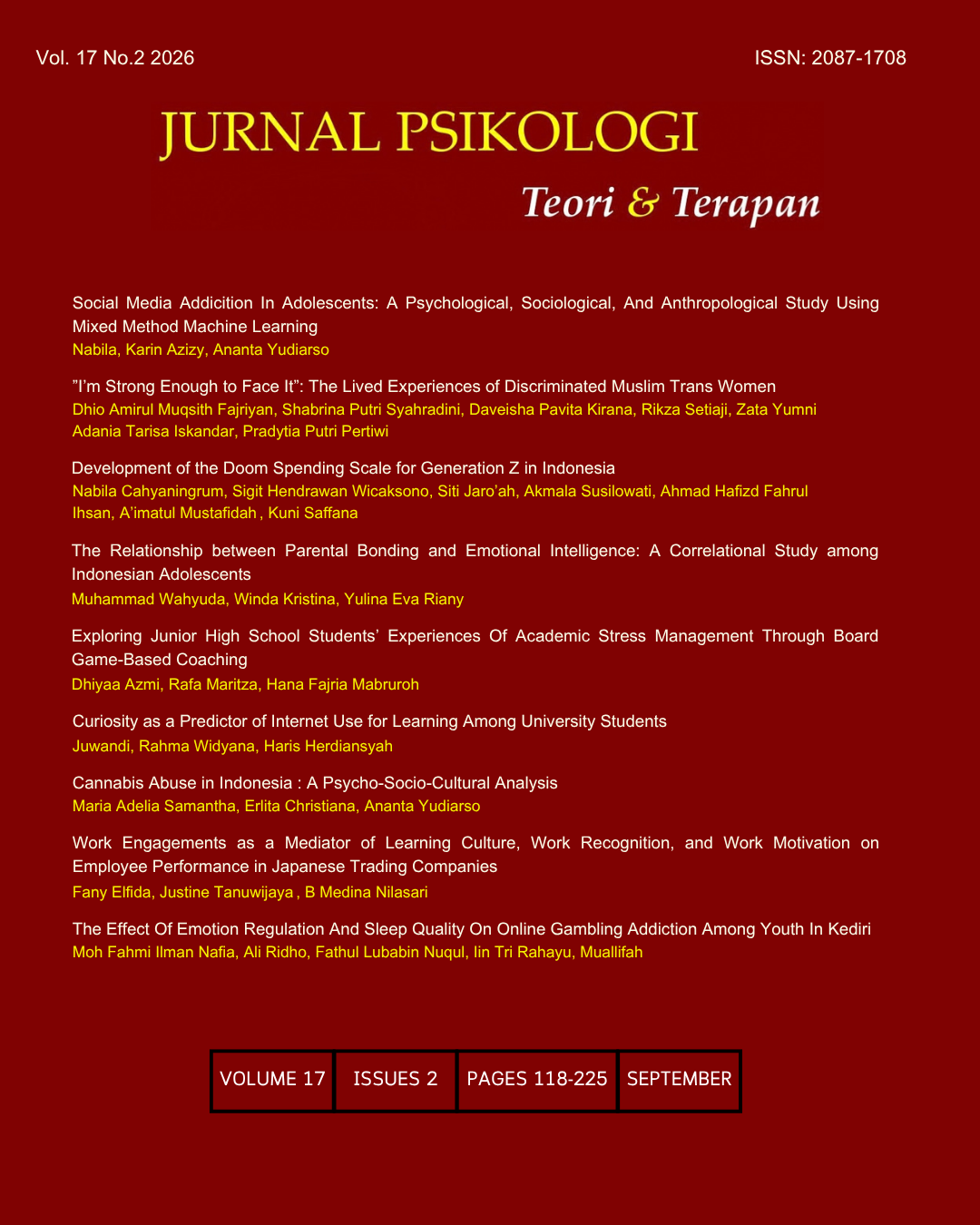
Development of the Doom Spending Scale for Generation Z in Indonesia
DOI:
https://doi.org/10.26740/jptt.v17n02.p143-155Keywords:
Consumber behavior, doom spending, EFA, future anxietyAbstract
Background: The phenomenon of doom spending has become increasingly
prevalent among Generation Z as a response to emotional stress and uncertainty
about the future, characterized by excessive consumer behavior and impulsive
use of digital financial services. Objective: This study aims to develop and
examine the validity and reliability of the doom spending scale based on the
conceptual framework of financial behavior and consumer psychology. Method:
This research employed a quantitative approach with an accidental sampling
technique involving 220 Generation Z participants in Indonesia. Data were
analyzed using exploratory factor analysis (EFA) and Cronbach’s Alpha
reliability test. Results: The EFA results revealed that the doom spending scale
consists of three main dimensions self-control, future anxiety, and lack of
financial consideration with a total of 18 valid items. The Cronbach’s Alpha
coefficient of 0.889 indicates a high level of internal consistency. Conclusion:
The developed doom spending scale is valid and reliable for measuring the
tendency toward excessive spending behavior driven by emotional distress
among Generation Z and can be applied in future financial psychology research
and intervention programs.
References
Badan Pusat Statistik (BPS). (2025). Jumlah Perceraian Menurut Provinsi dan Faktor Penyebab Perceraian (perkara), 2024 - Tabel Statistik - Badan Pusat Statistik Indonesia. In BPS. https://www.bps.go.id/id/statistics-table/3/YVdoU1IwVmlTM2h4YzFoV1psWkViRXhqTlZwRFVUMDkjMw==/jumlah-perceraian-menurut-provinsi-dan-faktor-penyebab-perceraian--perkara---2024.html?year=2023
Otoritas Jasa Keuangan (OJK). (2024). Statistik P2P Lending Periode Desember 2024. In OJK. https://www.ojk.go.id/id/kanal/iknb/data-dan-statistik/fintech/Pages/Statistik-P2P-Lending-Periode-Desember-2024.aspx
Anditasari, P., Sabillah, E., & Budiman, A. (2025). When shopping becomes solace: An analysis of doom spending in the context of mental health and Islamic ethics. Philanthropy Journal of Psychology, 9(1), 42–59. https://doi.org/10.26623/philanthropy.v9i1.11510
Anggraheni, D. R. (2025). Peran literasi keuangan digital dalam memitigasi perilaku doom spending: A narrative literature review. Transgenera, 2(1), 87–105. https://doi.org/10.35457/transgenera.v2i1.4150
Apriadi, D., Adelin, D., Mutumanikam, P. R., & Lanjarsih, L. (2025). Personal Finance Transformation in the Digital Era: The Impact of Financial Technology on People’s Economic Behavior. Oikonomia : Journal of Management Economics and Accounting, 2(3), 89–100. https://doi.org/10.61942/oikonomia.v2i3.356
Balleyer, A. H., & Fennis, B. M. (2022). Hedonic Consumption in Times of Stress: Reaping the Emotional Benefits Without the Self-Regulatory Cost. Frontiers in Psychology, 13, 685552. https://doi.org/10.3389/fpsyg.2022.685552
Cachón-Rodríguez, G., Blanco-González, A., Prado-Román, C., & Fernández-Portillo, A. (2024). How compulsive and impulsive buying affect consumer emotional regulation: Is anxiety a differential element? European Journal of Management and Business Economics. https://doi.org/10.1108/ejmbe-06-2023-0172
Clark, L. A., & Watson, D. (2019). Constructing validity: New developments in creating objective measuring instruments. Psychological Assessment, 31(12), 1412–1427. https://doi.org/10.1037/pas0000626
Comrey, A. L., & Lee, H. B. (1992). A first course in factor analysis (2nd ed.). Lawrence Erlbaum Associates.
DeVellis, R. F. (2017). Scale development: Theory and applications (4th ed.). SAGE Publications Inc.
Fan, L., & Henager, R. (2021). A structural determinants framework for financial well-being. Journal of Family and Economic, Issues, 43, 415–428. https://doi.org/10.1007/s10834-021-09798-w
Ferreira, M. B., Almeida, F. D., Soro, J. C., Herter, M. M., Pinto, D. C., & Silva, C. S. (2021). On the relation between over-indebtedness and well-being: An analysis of the mechanisms influencing health, sleep, life satisfaction, and emotional well-being. Frontiers in Psychology, 12, 591875. https://doi.org/10.3389/fpsyg.2021.591875
Fu, Y., Wen, Z., & Wang, Y. (2022). A Comparison of Reliability Estimation Based on Confirmatory Factor Analysis and Exploratory Structural Equation Models. Educational and Psychological Measurement, 82(2), 205–224. https://doi.org/10.1177/00131644211008953
Hair, J. ., Black, W. ., Babin, B. ., & Anderson, R. E. (2009). Multivariate Data Analysis, (7th ed.). Prentice Hall International: Upper Saddle River.
Hu, L., & Bentler, P. M. (1999). Cutoff criteria for fit indexes in covariance structure analysis: Conventional criteria versus new alternatives. Struct. Equ. Model., 6, 1–55. https://doi.org/https://doi.org/10.1080/10705519909540118
Husnayetti, Novida, I., Junarti, & Yudiman, A. T. (2025). Doom spending behaviour among the digital generation: The role of financial literacy and social media interaction. Journal of Economics Finance and Management Studies, 8(6). https://doi.org/10.47191/jefms/v8-i6-44
Iannello, P., Sorgente, A., Lanz, M., & Antonietti, A. (2020). Financial well-being and its relationship with subjective and psychological well-being among emerging adults: Testing the moderating effect of individual differences. Journal of Happiness Studies, 22, 1385–1411. https://doi.org/10.1007/s10902-020-00277
Idris, N. H., Muhammad, N. S., Taib, N., Rafien, N. S. M., & Noor, N. H. M. (2024). The consequences of over-indebtedness and its effect on individual well-being. International Journal of Research and Innovation in Social Science, 8(10), 2841–2849. https://doi.org/10.47772/IJRISS.2024.8100239
Jakpat. (2024). Discovering Financial Literacy in Indonesia. In Jakpat. https://insight.jakpat.net/discovering-financial-literacy-in-indonesia/
Kaiser, H. ., & Rice, J. (1974). Little Jiffy, Mark IV. Educ. Psychol. Meas., 34(1), 111–117. https://doi.org/https://doi.org/10.1177/001316447403400115
Kredivo. (2024). 2024 Indonesian PayLater User Behavior Report. In Kredivo. https://kredivocorp.com/
Krosnick, J. A., & Fabrigar, L. R. (1997). Designing Rating Scales for Effective Measurement in Surveys (D. Lyberg, Lars Biemer, Paul Collins, Martin Edith De Leeuw Dippo, Cathryn Schwarz, Norbert Trewin (ed.)). Wiley.
Kusuma, N. T. D., Wany, E., & Prayitno, B. P. (2025). Pengaruh perilaku doom spending dan kecerdasan emosional terhadap kemampuan berinvestasi dengan kecerdasan intelektual sebagai variabel moderating di kalangan mahasiswa generasi Z di Jawa Timur. Equilibrium, 21(1), 63–71. https://doi.org/10.30742/equilibrium.v21i1.4314
Marsh, H. W., Hau, K. T., & Wen, Z. (2004). In Search of Golden Rules: Comment on Hypothesis-Testing Approaches to Setting Cutoff Values for Fit Indexes and Dangers in Overgeneralizing Hu and Bentler’s (1999) Findings. Structural Equation Modeling: A Multidisciplinary Journal, 11(3), 320–341. https://doi.org/https://doi.org/10.1207/s15328007sem1103_2
Mu’awiyah, S., & Jurana, J. (2025). Financial behavior patterns of Generation Z: Netnographic analysis of the fear of missing out (FoMO) phenomenon. Journal of Theoretical and Empirical Policy, 5(1), 23–34. https://doi.org/10.38142/jtep.v5i1.1215
Muthén, L. K., & Muthén, B. O. (2017). Mplus: Statistical Analysis with Latent Variables: User’s Guide (Version 8). Muthén & Muthén.
Netemeyer, R. G., Warmath, D., Fernandes, D., & Lynch, J. G. (2017). How am I doing? Perceived financial well-being, its potential antecedents and its relation to overall well-being. Journal of Consumer Research, 45(1), 68–89. https://doi.org/10.1093/jcr/ucx109
Ngo, T. T. A., Nguyen, H. L. T., Nguyen, H. P., Mai, H. T. A., Mai, T. H. T., & Hoang, P. L. (2024). A comprehensive study on factors influencing online impulse buying behavior: Evidence from Shopee video platform. Heliyon, 10(15), e35743. https://doi.org/10.1016/j.heliyon.2024.e35743
Putri, M. C., & Melati, I. S. (2025). Generasi Z dan doom spending: Pengaruh pendapatan, media sosial, dan gaya hidup di Kota Tegal. Journal of Management and Business Research. https://doi.org/10.33557/mcwywk20
Qothrunnada, K. (2024). Mengenal Doom Spending, Istilah Populer di Kalangan Gen Z dan Milenial. In Detikedu. https://www.detik.com/edu/detikpedia/d-7574414/mengenal-doom-spending-istilah-populer-di-kalangan-gen-z-dan-milenial
Ranganathan, P., & Caduff, C. (2023). Designing and validating a research questionnaire - Part 1. Perspectives in Clinical Research, 14(3), 152–155. https://doi.org/10.4103/picr.picr_140_23
Rasiman, P. A., Masruri, A., & Asvariwangi, V. (2024). Doom spending among Gen Z and millennials in a financial planning webinar in the digital era. UIKA Community Service Journal, 1(1), 50–54. https://doi.org/10.32832/Introduction
Rosadi, D. S., & Andriani, I. (2023). Hubungan impulsive buying dengan perilaku berhutang pada pengguna pinjaman online. JIMPS, 8(4), 3655–3664. https://doi.org/10.24815/jimps.v8i4.26214
Sabri, M. F., Anthony, M., Law, S. H., Rahim, H. A., Burhan, N. A. S., & Ithnin, M. (2023). Impact of financial behaviour on financial well-being: evidence among young adults in Malaysia. Journal of Financial Services Marketing, 29(3), 1. https://doi.org/10.1057/s41264-023-00234-8
Sahabuddin, R., Azhari, A., Asriani, S., Qaisyarah, A., Ikhsan, A., & Saputri, L. (2025). Analisis statistik pengaruh flash sale, impulsivity, dan fear of missing out (FoMO) terhadap perilaku doom spending pada mahasiswa. Journal of Research in Management and Economics, 2(3), 208–319. https://doi.org/10.61722/jrme.v2i3.4511
Sahri, D. R., Poyo, M. D., & Waskito, B. (2025). Pengaruh live Shopee terhadap doom spending anggota Karang Taruna Kelurahan Gunung Terang Bandar Lampung. Professional: Jurnal Bisnis Dan Akuntansi, 12(1). https://doi.org/10.37676/professional.v12i1.8565
Sapsuha, M. U., Parmitasari, R. D. A., & Parakkasi, I. (2025). Implications of the Use of Fintech Payment on Consumptive Behavior. ULIL ALBAB : Jurnal Ilmiah Multidisiplin, 4(3), 965–979. https://doi.org/10.56799/jim.v4i3.7673
Supriadi, S. (2025). Doom spending among economics education students: A psychological and socioeconomic perspective. Journal of Economic Education, 10(1). https://doi.org/10.22437/jeec.v4i1.46409
Syaugie, A., & Nurhajati, L. (2025). Online media framing pada fenomena pemberitaan doom spending di kalangan milenial dan Gen Z. Jurnal PIKMA: Publikasi Ilmu Komunikasi, Media, Dan Cinema, 7(2), 303–320. https://doi.org/10.24076/4vy3nq43
Thomas, T. A., Laskowski, N. M., Lesener, T., Gusy, B., Zwaan, M. De, & Müller, A. (2024). Prevention approaches for compulsive buying-shopping disorder. Sucht, 70(6), 347–356. https://doi.org/10.1024/0939-5911/a000897
Tudu, B., Tudu, A., Khatua, P., & Panda, L. (2025). Economic Crisis and Financial Behaviour: Ripple Effect of Uncertainty and Risk. IJSAT - International Journal on Science and Technology, 16(3). https://doi.org/10.71097/ijsat.v16.i3.7612
Wahono, H. K., & Pertiwi, D. (2020). Pengaruh financial literacy, materialism, compulsive buying terhadap propensity to indebtedness. International Journal of Financial and Investment Studies, 1(1), 1–14. https://doi.org/10.9744/ijfis.1.1.1-14
Watkins, M. W. (2018). Exploratory Factor Analysis: A Guide to Best Practice. Journal of Black Psychology, 44(3), 219–246. https://doi.org/10.1177/0095798418771807
Zim, S. K., Hridoy, M. M. D., Hossain, M. S., Soiti, S. A., & Riadi, A. (2025). Adapting under pressure: Consumer decision-making in times of economic uncertainty and digital transformation. Finance & Accounting Research Journal, 7(7), 305–322. https://doi.org/10.51594/farj.v7i7.1992
Downloads
Published
How to Cite
Issue
Section
License
Copyright (c) 2026 Nabila Cahyaningrum

This work is licensed under a Creative Commons Attribution 4.0 International License.
Authors who publish in this journal agree to the following terms:
Copyright in any article is held by the author.
The author grants the journal, publication rights with the work simultaneously licensed under a Creative Commons Attribution License that allows others to share the work with an acknowledgment of the work's authorship and initial publication in this journal.
Authors may enter into separate, additional contractual arrangements for the non-exclusive distribution of the journal's published version of the work (e.g., posting it to an institutional repository or publishing it in a book), with an acknowledgment of its initial publication in this journal.
Authors are permitted and encouraged to post their work online (e.g., in an institutional repository or on their website) prior to and during the submission process, as this can lead to productive exchanges, as well as earlier and greater citation of published work.
 Abstract views: 0
,
Abstract views: 0
, PDF Downloads: 0