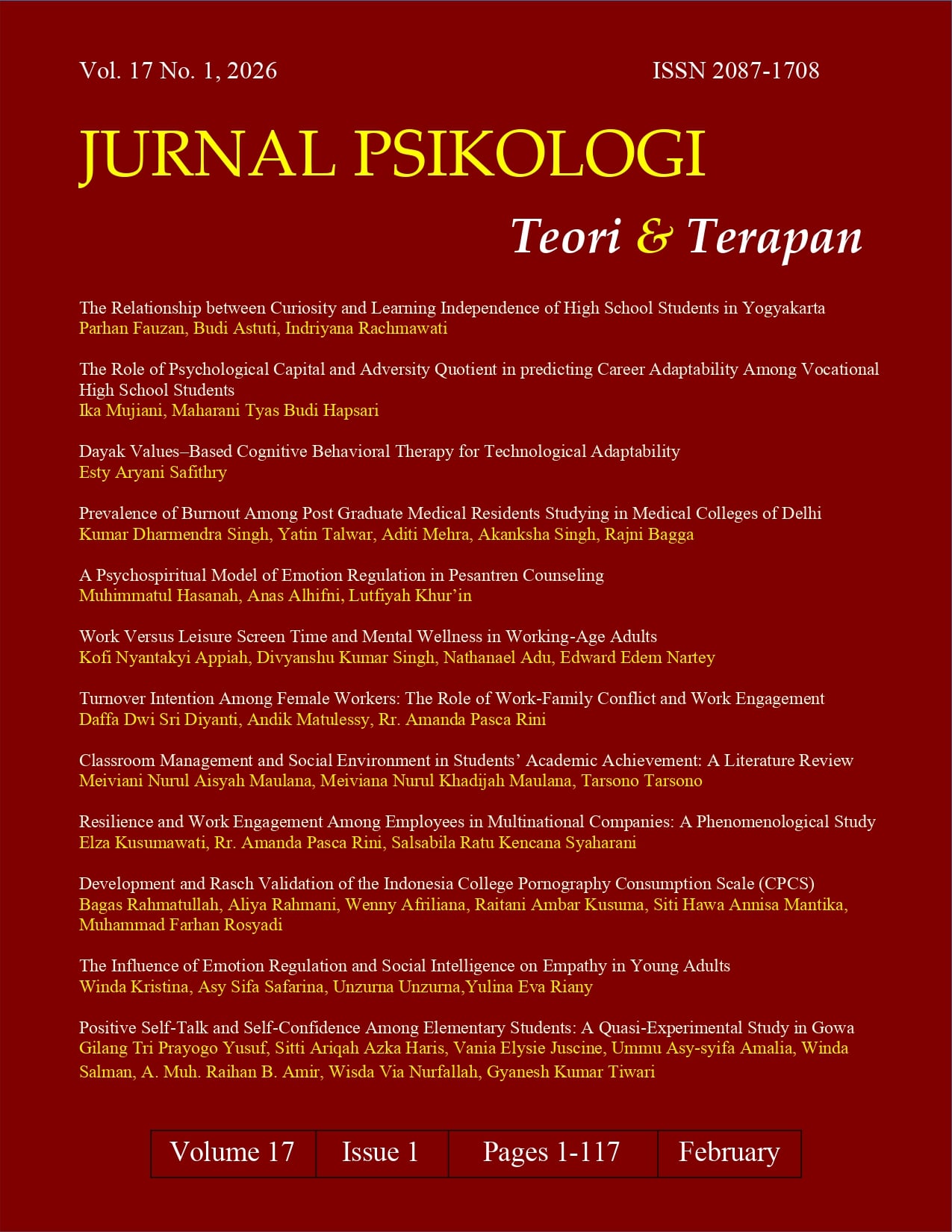
Development and Rasch Validation of the Indonesia College Pornography Consumption Scale (CPCS)
DOI:
https://doi.org/10.26740/jptt.v17n01.p86-95Keywords:
Indonesian students, problematic pornography use, psychometric validation, rasch analysis, scale developmentAbstract
Background: Online pornography raises concerns about problematic use among university students. Existing measures lack validation for Indonesian populations. Objective: To develop and validate the College Pornography Consumption Scale (CPCS) for Indonesian students. Method: Guided by Griffiths’(2005) biopsychosocial addiction model, an item pool covering six dimensions was generated and reviewed by expert judges. Psychometric evaluation used Rasch analysis on data from 383 Indonesian undergraduates recruited via purposive sampling. Results: Rasch analysis supported unidimensionality (variance explained = 66.20%). Reliability indices were high (person separation reliability = .95; Cronbach’s α = .98). Most items demonstrated acceptable model fit; however, eight misfitting items require refinement. The Wright map indicated effective targeting across levels of addictive behaviors, with greater sensitivity at higher levels of problematic use. Conclusion: Initial findings provide support for the validity of the CPCS, though the eight misfitting items indicates that the scale's performance is still being optimized. CPCS offers a useful starting point for clinical screening in Indonesia population, provided that future iterations re-evaluate the problematic items to improve overall model fit.
Abstrak
Latar Belakang: Akses ke pornografi daring semakin mudah, menimbulkan kekhawatiran tentang penggunaan problematik di kalangan mahasiswa. Instrumen yang ada belum tervalidasi khusus untuk populasi Indonesia. Tujuan: Mengembangkan dan memvalidasi College Pornography Consumption Scale (CPCS) bagi mahasiswa Indonesia. Metode: Berpedoman pada model adiksi biopsikososial Griffiths (2005), disusun himpunan butir yang mencakup enam dimensi (saliensi, toleransi, modifikasi suasana hati, gejala putus, konflik, kekambuhan) dan ditinjau oleh pakar. Evaluasi psikometrik menggunakan analisis Rasch pada data 383 mahasiswa sarjana Indonesia yang direkrut melalui sampling purposif. Hasil: Analisis Rasch mendukung unidimensionalitas (66,20%). Indeks reliabilitas tergolong tinggi (person separation reliability = .95; α = .98). Sebagian besar item menunjukkan kesesuaian model yang dapat diterima; namun, delapan item yang misfit memerlukan penyempurnaan. Wright Map menunjukkan penargetan yang efektif di berbagai tingkat perilaku adiktif, dengan sensitivitas yang lebih besar pada tingkat penggunaan bermasalah yang lebih tinggi. Kesimpulan: Temuan awal mendukung validitas CPCS, meskipun beberapa item masih perlu disempurnakan. Skala ini berpotensi menjadi instrumen awal untuk menilai penggunaan pornografi bermasalah pada mahasiswa Indonesia, dengan kebutuhan pengembangan lanjutan guna meningkatkan kesesuaian model.
References
Ballester-Arnal, R., García-Barba, M., Castro-Calvo, J., Giménez-García, C., & Gil-Llario, M. D. (2022). Pornography Consumption in People of Different Age Groups: an Analysis Based on Gender, Contents, and Consequences. Sexuality Research and Social Policy. https://doi.org/10.1007/s13178-022-00720-z
Bond, T. G., & Fox, C. M. (2015). Applying the Rasch model: fundamental measurement in the human sciences. Journal of Educational Measurement, 40(2), 185–187. https://doi.org/10.1111/j.1745-3984.2003.tb01103.x
Boone, W. J. (2016). Rasch Analysis for Instrument Development: Why, when, and how? CBE—Life Sciences Education, 15(4), rm4. https://doi.org/10.1187/cbe.16-04-0148
Bőthe, B., Tóth-Király, I., Zsila, Á., Griffiths, M. D., Demetrovics, Z., & Orosz, G. (2018). Problematic Pornography Consumption Scale. PsycTESTS Dataset. https://doi.org/10.1037/t66347-000
Brand, M., Young, K. S., Laier, C., Wölfling, K., & Potenza, M. N. (2016). Integrating psychological and neurobiological considerations regarding the development and maintenance of specific Internet-use disorders: An Interaction of Person-Affect-Cognition-Execution (I-PACE) model. Neuroscience & Biobehavioral Reviews, 71, 252–266. https://doi.org/10.1016/j.neubiorev.2016.08.033
Burtăverde, V., Jonason, P. K., Giosan, C., & Ene, C. G. (2021). Why Do People Watch Porn? An Evolutionary Perspective on the Reasons for Pornography Consumption. Evolutionary Psychology, 19(2), 147470492110287. https://doi.org/10.1177/14747049211028798
Cacioppo, M., Gori, A., Schimmenti, A., Baiocco, R., Laghi, F., & Caretti, V. (2018). Cyber Pornography Addiction Test. PsycTESTS Dataset. https://doi.org/10.1037/t66951-000
Fernandez, D., & Griffiths, M. D. (2021). Psychometric Instruments for Problematic Pornography Use: A Systematic Review. Evaluation & the Health Professions, 44(2), 111–141. https://doi.org/10.1177/0163278719861688
Griffiths, M. D. (2005). A ‘components’ model of addiction within a biopsychosocial framework. Journal of Substance Use, 10(4), 191–197. https://doi.org/10.1080/14659890500114359
Kor, A., Zilcha-Mano, S., Fogel, Y. A., Mikulincer, M., Reid, R. C., & Potenza, M. N. (2014). Psychometric development of the Problematic Pornography Use Scale. Addictive Behaviors, 39(5), 861–868. https://doi.org/10.1016/j.addbeh.2014.01.027
Kraus, S. W., Gola, M., Grubbs, J. B., Kowalewska, E., Hoff, R. A., Lew-Starowicz, M., Martino, S., Shirk, S. D., & Potenza, M. N. (2020). Validation of a Brief Pornography Screen across multiple samples. Journal of Behavioral Addictions, 9(2), 259–271. https://doi.org/10.1556/2006.2020.00038
Kumar, P., Patel, V. M., Bhatt, R. B., Vasavada, D. A., Sangma, R. D., & Tiwari, D. (2021). Prevalence of Problematic Pornography Use and Attitude Toward Pornography Among the Undergraduate Medical Students. Journal of Psychosexual Health, 3(1), 29–36. https://doi.org/10.1177/2631831821989677
Malki, K., Rahm, C., Öberg, K., & Ueda, P. (2021). Frequency of Pornography Use and Sexual Health Outcomes in Sweden: Analysis of a National Probability Survey. The Journal of Sexual Medicine, 18(10), 1735–1751. https://doi.org/10.1016/j.jsxm.2021.08.003
Reise, S. P. (1990). A Comparison of Item- and Person-Fit Methods of Assessing Model-Data Fit in IRT. Applied Psychological Measurement, 14(2), 127–137. https://doi.org/10.1177/014662169001400202
Setyawati, R., Hartini, N., & Suryanto, S. (2020). The Psychological Impacts of Internet Pornography Addiction on Adolescents. Humaniora, 11(3), 235–244. https://doi.org/10.21512/humaniora.v11i3.6682
Wéry, A., Burnay, J., Karila, L., & Billieux, J. (2016). The Short French Internet Addiction Test Adapted to Online Sexual Activities: Validation and Links With Online Sexual Preferences and Addiction Symptoms. Journal of Sex Research, 53(6), 701–710. https://doi.org/10.1080/00224499.2015.1051213
Downloads
Published
How to Cite
Issue
Section
License
Copyright (c) 2026 Bagas Rahmatullah, Aliya Rahmani, Wenny Afriliana, Raitani Ambar Kusuma, Siti Hawa Annisa Mantika, Muhammad Farhan Rosyadi

This work is licensed under a Creative Commons Attribution 4.0 International License.
Authors who publish in this journal agree to the following terms:
Copyright in any article is held by the author.
The author grants the journal, publication rights with the work simultaneously licensed under a Creative Commons Attribution License that allows others to share the work with an acknowledgment of the work's authorship and initial publication in this journal.
Authors may enter into separate, additional contractual arrangements for the non-exclusive distribution of the journal's published version of the work (e.g., posting it to an institutional repository or publishing it in a book), with an acknowledgment of its initial publication in this journal.
Authors are permitted and encouraged to post their work online (e.g., in an institutional repository or on their website) prior to and during the submission process, as this can lead to productive exchanges, as well as earlier and greater citation of published work.
 Abstract views: 578
,
Abstract views: 578
, PDF Downloads: 409