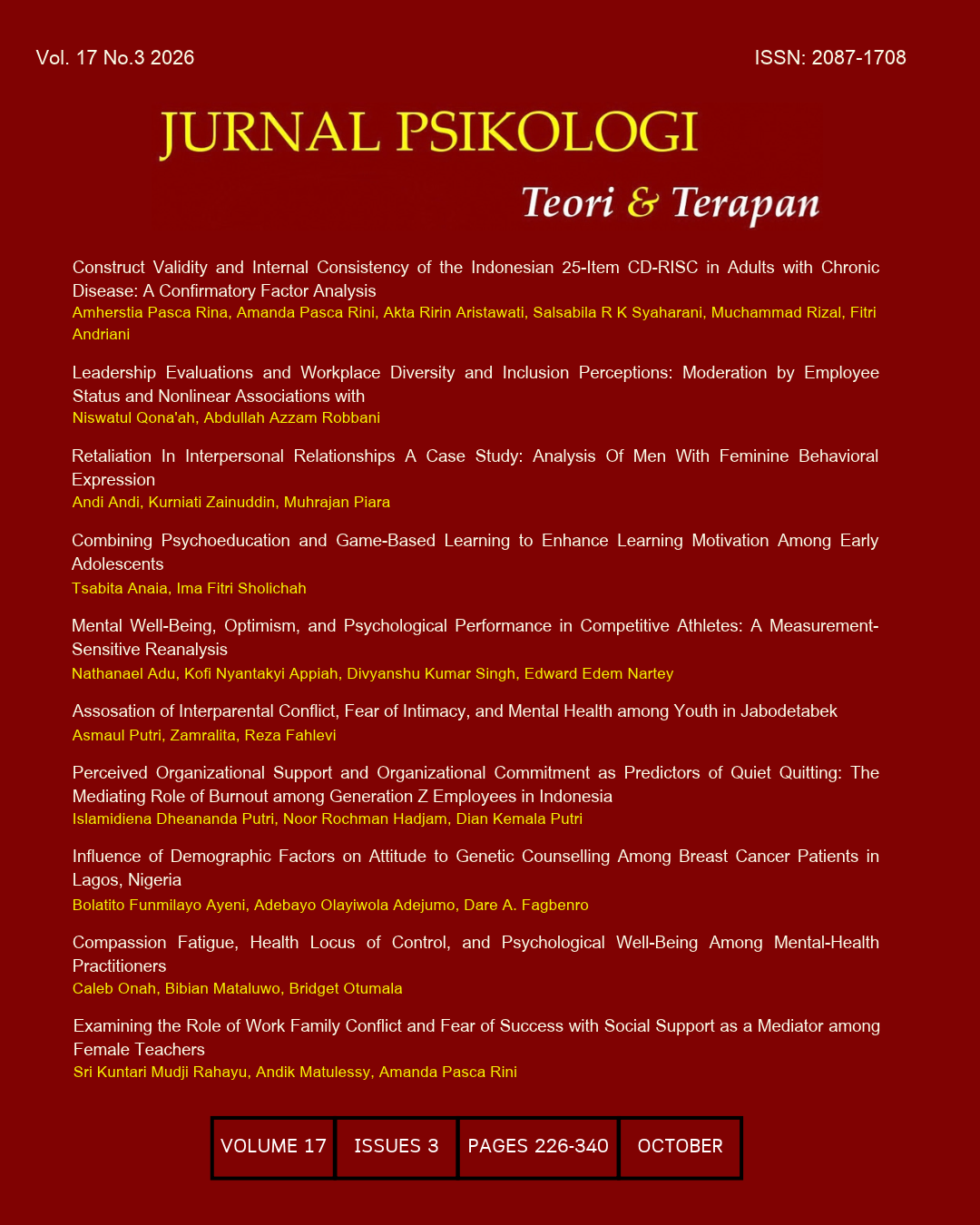
Leadership Evaluations and Workplace Diversity and Inclusion Perceptions: Moderation by Employee Status and Nonlinear Associations with
DOI:
https://doi.org/10.26740/jptt.v17n03.p236-250Keywords:
Diversity and inclusion, employee status, glassdoor, leadership evaluations, tenureAbstract
ackground: Leadership evaluations may signal organizational priorities, but their association with workplace diversity and inclusion (D&I) may vary by employees’ organizational position and experience. Objective: This study examined associations of CEO approval and senior leadership evaluations with D&I, employee status as a moderator, and the nonlinear association of tenure with D&I. Method: We analyzed 100,000 Glassdoor reviews from 9,017 organizations using multilevel linear models with organization-level random intercepts. Tenure was modeled using natural cubic splines, with multiple robustness analyses. Results: More favorable leadership evaluations were associated with higher D&I ratings. These associations were modestly stronger among former employees, although CEO-approval moderation was evident mainly for the Approve–Disapprove contrast. Tenure showed a nonlinear cross-sectional association, with larger differences at shorter tenure and a flatter pattern thereafter. Conclusion: Leadership evaluations were strongly associated with D&I perceptions, while employee status modestly conditioned these relationships. The findings support a receiver-dependent perspective on organizational signaling and highlight the value of distinguishing current and former employee feedback.
References
Bates, D., Mächler, M., Bolker, B., & Walker, S. (2015). Fitting Linear Mixed-Effects Models Using lme4. Journal of Statistical Software, 67(1), 1–48. https://doi.org/10.18637/jss.v067.i01
Bauer, T. N., Bodner, T., Erdogan, B., Truxillo, D. M., & Tucker, J. S. (2007). Newcomer adjustment during organizational socialization: A meta-analytic review of antecedents, outcomes, and methods. Journal of Applied Psychology, 92(3), 707–721. https://doi.org/10.1037/0021-9010.92.3.707
Carmeli, A., Reiter-Palmon, R., & Ziv, E. (2010). Inclusive leadership and employee involvement in creative tasks in the workplace: The mediating role of psychological safety. Creativity Research Journal, 22(3), 250–260. https://doi.org/10.1080/10400419.2010.504654
Chi, Nai-Wen, Huang, Yin-Mei, & Lin, Shu-Chi. (2009). A Double-Edged Sword? Exploring the Curvilinear Relationship Between Organizational Tenure Diversity and Team Innovation: The Moderating Role of Team-Oriented HR Practices. Group & Organization Management, 34(6), 698–726. https://doi.org/10.1177/1059601109350985
Connelly, B. L., Certo, S. T., Ireland, R. D., & Reutzel, C. R. (2011). Signaling theory: A review and assessment. Journal of Management, 37(1), 39–67. https://doi.org/10.1177/0149206310388419
Edmondson, A. (1999). Psychological safety and learning behavior in work teams. Administrative Science Quarterly, 44(2), 350–383. https://doi.org/10.2307/2666999
Eisenberger, R., Karagonlar, G., Stinglhamber, F., Neves, P., Becker, T. E., Gonzalez-Morales, M. G., & Steiger-Mueller, M. (2010). Leader-Member Exchange and Affective Organizational Commitment: The Contribution of Supervisor’s Organizational Embodiment. Journal of Applied Psychology, 95(6), 1085–1103. https://doi.org/10.1037/a0020858
Gauthier, D. (2024). Glassdoor Job Reviews 2. https://www.kaggle.com/datasets/davidgauthier/glassdoor-job-reviews-2
Guest, D. E., Sanders, K., Rodrigues, R., & Oliveira, T. (2021). Signalling theory as a framework for analysing human resource management processes and integrating human resource attribution theories: A conceptual analysis and empirical exploration. Human Resource Management Journal, 31(3), 796–818. https://doi.org/https://doi.org/10.1111/1748-8583.12326
Hofhuis, J., van der Rijt, P. G. A., & Vlug, M. (2016). Diversity climate enhances work outcomes through trust and openness in workgroup communication. SpringerPlus 2016 5:1, 5(1), 714-. https://doi.org/10.1186/s40064-016-2499-4
Jones, G. R. (2017). Socialization Tactics, Self-Efficacy, and Newcomers’ Adjustments to Organizations. Https://Doi.Org/10.5465/256188, 29(2), 262–279. https://doi.org/10.5465/256188
Kim, J. M., Mariani, M., & Hwang, K. (2026). Beyond the words: how reviewer status and review features jointly affect helpfulness in online employee reviews. Journal of Business Research, 207, 116008. https://doi.org/https://doi.org/10.1016/j.jbusres.2026.116008
Lee, J. H., & Shin, H. C. (2024). Effects of Inclusive Leadership on the Diversity Climate and Change-Oriented Organizational Citizenship Behavior. Behavioral Sciences 2024, Vol. 14, 14(6). https://doi.org/10.3390/bs14060491
Maitlis, S., & Christianson, M. (2014). Sensemaking in Organizations: Taking Stock and Moving Forward. Https://Doi.Org/10.5465/19416520.2014.873177, 8(1), 57–125. https://doi.org/10.5465/19416520.2014.873177
Nault, E., Sabat, I. E., He, Y., Zhou, Y., Jaramillo, K. N., & Liu, S.-N. C. (2026). The antecedents, outcomes, and moderators of diversity climate in the workplace: A meta-analytic review. Human Resource Management Review, 36(2), 101134. https://doi.org/https://doi.org/10.1016/j.hrmr.2026.101134
Nishii, L. H. (2013). The benefits of climate for inclusion for gender-diverse groups. Academy of Management Journal, 56(6), 1754–1774. https://doi.org/10.5465/amj.2009.0823
Nishii, L. H., & Mayer, D. M. (2009). Do Inclusive Leaders Help to Reduce Turnover in Diverse Groups? The Moderating Role of Leader-Member Exchange in the Diversity to Turnover Relationship. Journal of Applied Psychology, 94(6), 1412–1426. https://doi.org/10.1037/a0017190
Park, K. K., & Kim, J. M. (2025). Role of employee tenure in shaping the generation and consumption of online employee reviews. Marketing Intelligence & Planning, 44(4), 705–722. https://doi.org/https://doi.org/10.1108/MIP-07-2024-0501
Piercy, C. W., & Carr, C. T. (2020). Employer reviews may say as much about the employee as they do the employer: online disclosures, organizational attachments, and unethical behavior. Journal of Applied Communication Research, 48(5), 577–597. https://doi.org/10.1080/00909882.2020.1812692
Shore, L. M., Randel, A. E., Chung, B. G., Dean, M. A., Ehrhart, K. H., & Singh, G. (2011). Inclusion and diversity in work groups: A review and model for future research. Journal of Management, 37(4), 1262–1289. https://doi.org/10.1177/0149206310385943
Spence, M. (1973). Job Market Signaling. The Quarterly Journal of Economics, 87(3), 355–374. https://doi.org/10.2307/1882010
Symitsi, E., Stamolampros, P., Daskalakis, G., & Korfiatis, N. (2021). The informational value of employee online reviews. European Journal of Operational Research, 288(2), 605–619. https://doi.org/10.1016/J.EJOR.2020.06.001
van Maanen, J., & Schein, E. H. (1977). Toward a theory of organizational socialization. Research in Organizational Behavior, 1, 209–264. https://api.semanticscholar.org/CorpusID:11868398
Weick, K. E. (1995). Sensemaking in organizations (Vol. 3, Issue 10.1002). Sage publications Thousand Oaks, CA.
Downloads
Published
How to Cite
Issue
Section
License
Copyright (c) 2026 Niswatul Qona'ah, Abdullah Azzam Robbani

This work is licensed under a Creative Commons Attribution 4.0 International License.
Authors who publish in this journal agree to the following terms:
Copyright in any article is held by the author.
The author grants the journal, publication rights with the work simultaneously licensed under a Creative Commons Attribution License that allows others to share the work with an acknowledgment of the work's authorship and initial publication in this journal.
Authors may enter into separate, additional contractual arrangements for the non-exclusive distribution of the journal's published version of the work (e.g., posting it to an institutional repository or publishing it in a book), with an acknowledgment of its initial publication in this journal.
Authors are permitted and encouraged to post their work online (e.g., in an institutional repository or on their website) prior to and during the submission process, as this can lead to productive exchanges, as well as earlier and greater citation of published work.
 Abstract views: 0
,
 PDF Downloads: 1