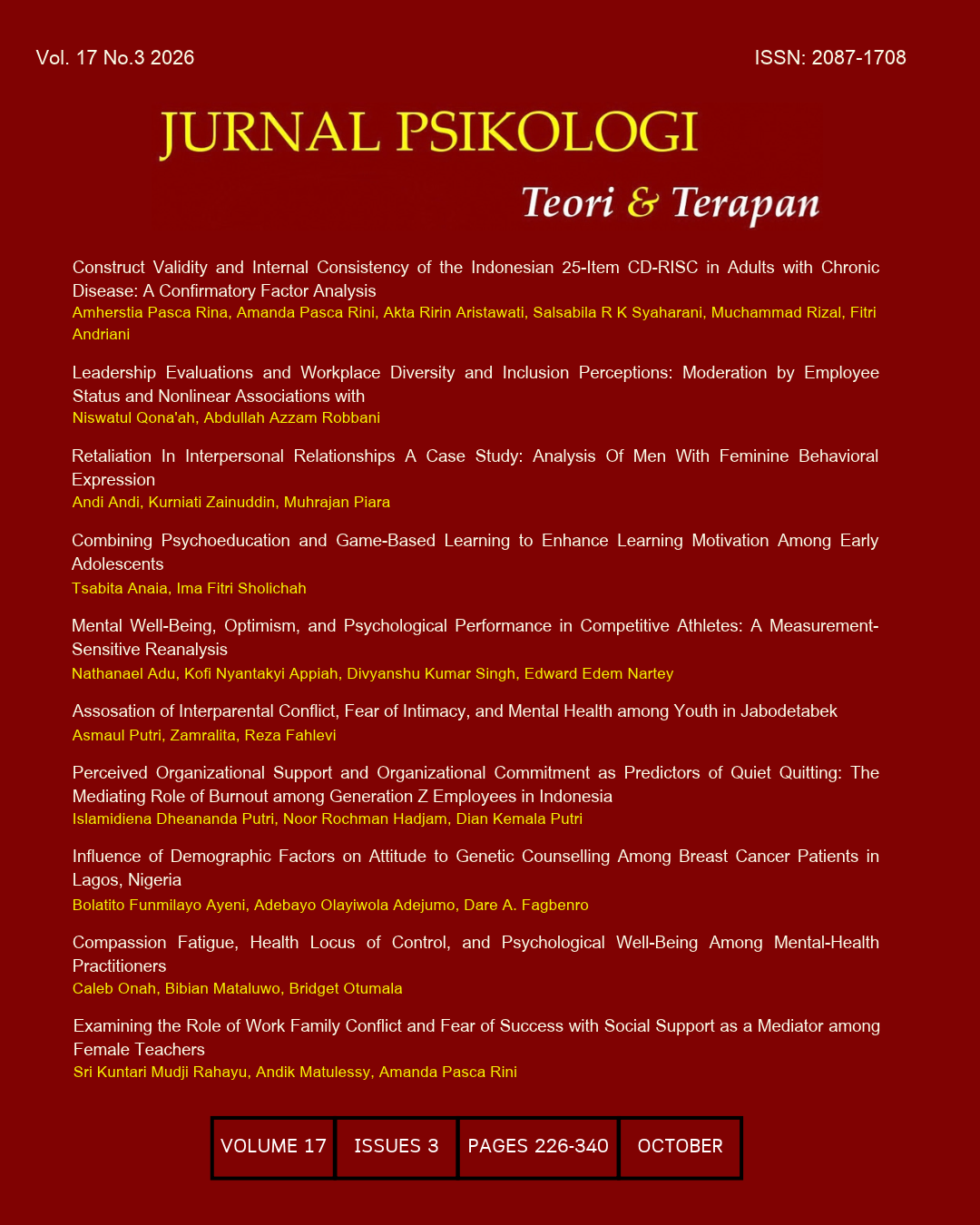
Compassion Fatigue, Health Locus of Control, and Psychological Well-Being Among Mental-Health Practitioners
DOI:
https://doi.org/10.26740/jptt.v17n03.p314-330Keywords:
Compassion fatigue, Health locus of control, Psychological well-being, Psychotherapists, Structural equation modelling, PsychologistsAbstract
Background: Mental-health practitioners supporting people in distress may experience compassion fatigue, especially where staffing and supervision are limited. Objective: This study examined associations among compassion fatigue, health locus of control and psychological well-being among mental-health practitioners in Makurdi, Benue State, Nigeria. Method: A cross-sectional survey recruited 780 practitioners by convenience sampling from public, private and mission-based facilities. Participants completed measures of compassion fatigue, the internal, chance and powerful-others dimensions of health locus of control, and mental well-being. Analyses comprised multiple regression and a structural equation model with a bootstrapped indirect-effect estimate. Results: Internal health locus of control was associated with lower compassion fatigue and higher well-being; chance and powerful-others orientations showed opposite associations. Compassion fatigue was negatively associated with well-being (β = −.62, p < .001). The structural model showed an indirect association through an overall health-locus-of-control factor but did not identify dimension-specific indirect effects. Conclusion: Findings highlight practitioner well-being and workplace support. The cross-sectional design establishes neither temporal order nor causation.
References
Adiukwu, F. N., Adedapo, O. O., Ojeahere, M. I., Musami, U. B., Mahmood, M. Y., Saidu Kakangi, A., Salihu, M. O., & Pinto da Costa, M. (2024). Psychotherapy training in postgraduate psychiatry training in Nigeria – Are we doing enough? Cambridge Prisms: Global Mental Health, 11, e41. https://doi.org/10.1017/gmh.2024.32
Aikpitanyi, J., Okonofua, F., Ntoimo, L., & Tubeuf, S. (2022). Locus of control and self esteem as predictors of maternal and child healthcare services utilisation in Nigeria. Frontiers in Health Services, 2, (847721), 1-17. https://doi.org/10.3389/frhs.2022.847721
Akanni, O. O., & Edozien, L. C. (2023). The new Nigerian mental health act: A huge leap before looking closely? Nigerian Medical Journal, 64(6), 838–845. https://pmc.ncbi.nlm.nih.gov/articles/PMC11227633/
Alaydi, B., Siew Imm, N. G., Mahomed, A., & Cheah, J. H. (2022). The effects of personal resources in the job demands and resources model: A systematic literature review. Studies of Applied Economics, 40(1). https://doi.org/10.25115/eea.v40i1.6624
Ayinde, T. O., & Olanrewaju, A. A. (2023). Emotional labor, compassion fatigue and psychological well-being among counsellors in Nigeria. African Journal of Counselling Psychology, 9(2), 34–49.
Bakker, A. B., Demerouti, E., & Sanz-Vergel, A. I. (2014). Burnout and work engagement: The JD-R approach. Annual Review of Organisational Psychology and Organisational Behaviour, 1, 389–411. https://doi.org/10.1146/annurev-orgpsych-031413-091235
Bakker, A. B., Demerouti, E., & Sanz-Vergel, A. I. (2023). Job demands–resources theory: Ten years later. Annual Review of Organisational Psychology and Organisational Behaviour, 10, 25–53. https://doi.org/10.1146/annurev-orgpsych-120920-053933
Demerouti, E., Bakker, A. B., Nachreiner, F., & Schaufeli, W. B. (2001). The job demands-resources model of burnout. Journal of Applied Psychology, 86(3), 499–512. https://doi.org/10.1037/0021-9010.86.3.499
Dogonchi, M., Mohammadzadeh, F., & Moshki, M. (2022). Investigating the relationship between health locus of control and health behaviours: A systematic review. The Open Public Health Journal, 15, e187494452208010. https://doi.org/10.2174/18749445-v15-e2208010
Donatus, O. (2024). Clinical psychology and psychotherapy in Nigeria: Challenges and prospects. International Journal for Psychotherapy in Africa, 9(2), 96–101. https://journals.ezenwaohaetorc.org/index.php/IJPA/article/view/2894
Dubale, B. W., Friedman, L. E., Chemali, Z., Denninger, J. W., Mehta, D. H., Alem, A., Fricchione, G. L., Dossett, M. L., & Gelaye, B. (2019). Systematic review of burnout among healthcare providers in sub Saharan Africa. BMC Public Health, 19(1), 1247. https://doi.org/10.1186/s12889-019-7566-7
Fadele, K. P., Igwe, S. C., Toluwalogo, N.-O., Udokang, E. I., Ogaya, J. B., & Lucero Prisno III, D. E. (2024). Mental health challenges in Nigeria: Bridging the gap between demand and resources. Cambridge Prisms: Global Mental Health, 11, e29. https://doi.org/10.1017/gmh.2024.19
Federal Ministry of Health. (2024). National mental health policy implementation framework. [White paper]. Abuja. Retrieved from https://cheld.org/wp-content/uploads/2026/08/National-Mental-Health-Policy.pdf
Figley, C. R. (1995). Compassion fatigue as secondary traumatic stress disorder: An overview. In C. R. Figley (Ed.), Compassion fatigue: Coping with secondary traumatic stress disorder in those who treat the traumatized (pp. 1–20). Brunner-Routledge. https://www.researchgate.net/publication/245720535_Compassion_fatigue_as_secondary_traumatic_stress_disorder_An_overview
Garnett, A., Hui, L., Oleynikov, C., & Boamah, S. (2023). Compassion fatigue in healthcare providers: A scoping review. BMC Health Services Research, 23, 1336. https://doi.org/10.1186/s12913-023-10356-3
Ghawadra, S. F., Abdullah, K. L., Choo, W. Y., & Phang, C. K. (2019). Mindfulness based stress reduction for psychological distress among nurses: A systematic review. Journal of Clinical Nursing, 28(21–22), 3747–3758. https://doi.org/10.1111/jocn.14987
Henderson, A., Jewell, T., Huang, X., & Simpson, A. (2025). Personal trauma history and secondary traumatic stress in mental health professionals: A systematic review. Journal of Psychiatric and Mental Health Nursing, 32(1), 13–30. https://doi.org/10.1111/jpm.13082
Johari, F. S. (2019). Occupational stress and psychological well being: The role of psychological capital. International Journal of Business and Management, 3(1), 13–17. https://doi.org/10.26666/rmp.ijbm.2019.1.3
Kabunga, A., Kigongo, E., Tumwesigye, R., Udho, S., Musinguzi, M., Acup, W., Auma, A. G., Akello, A. R., Okalo, P., Nabaziwa, J., & Shikanga, E. M. (2024). A systematic review and meta-analysis of compassion fatigue among healthcare professionals before and during COVID-19 in Sub-Saharan Africa. PLOS Global Public Health, 4(6), e0003388. https://doi.org/10.1371/journal.pgph.0003388
Kwaghgbah, A. T., Terwase, J. M., & Anhange, S. T. (2024). Secondary traumatic stress and psychosocial wellbeing among humanitarian health workers in Northwestern Nigeria: The moderating role of hardiness. Journal of Public Administration and Social Welfare Research, 9(4), 149–176. https://iiardjournals.org/abstract.php?j=JPASWR&pn=Secondary+Traumatic+Stress+and+Psychosocial+Wellbeing+Among+Humanitarian+Health+Workers+in+Northwestern+Nigeria%3A+The+Moderating+Role+of+Hardiness&id=57223
Labinjo, T. O. (2022). Exploring the experiences of mental health among internal migrants in Nigeria (Doctoral thesis). Sheffield Hallam University. https://shura.shu.ac.uk/30479/
Lipsa, J. M., Rajkumar, E., Gopi, A., & Romate, J. (2024). Effectiveness of psychological interventions for compassion fatigue: A systematic review and meta-analysis. Journal of Occupational Health, 66(1), Article uiae061. https://doi.org/10.1093/joccuh/uiae061
Maxwell, S. E., & Cole, D. A. (2007). Bias in cross-sectional analyses of longitudinal mediation. Psychological Methods, 12(1), 23–44. https://doi.org/10.1037/1082-989X.12.1.23
Mozafari, S., Yang, A., & Talaei-Khoei, J. (2024). Health locus of control and medical behavioural interventions: Systematic review and recommendations. Interactive Journal of Medical Research, 13, e52287. https://doi.org/10.2196/52287
Noor, A. M., Suryana, D., Kamarudin, E. M. E., Mahadir Naidu, N. B., Kamsani, S. R., & Govindasamy, P. (2025). Compassion fatigue in helping professions: A scoping literature review. BMC Psychology, 13, 349. https://doi.org/10.1186/s40359-024-01869-5
Nwobodo, E. P., Strukcinskiene, B., Razbadauskas, A., Grigoliene, R., & Agostinis-Sobrinho, C. (2023). Stress management in healthcare Organisations: The Nigerian context. Healthcare (Basel), 11(21), 2815. https://pmc.ncbi.nlm.nih.gov/articles/PMC10650396/
Nwosu, A. D. G., Ossai, E., Onwuasoigwe, O., Ezeigweneme, M., & Okpamen, J. (2021). Burnout and presenteeism among healthcare workers in Nigeria: Implications for patient care, occupational health and workforce productivity. Journal of Public Health Research, 10(1), 1900. https://doi.org/10.4081/jphr.2021.1900
Ogwuche, C. H., & Onah, C. (2023). Religious affiliation, subjective wellbeing and adherence to medication among diabetic patients in Nigeria. i-Manager’s Journal on Nursing, 13(3), 9–17. https://doi.org/10.26634/jnur.13.3.20115
Okoro, T., & Nwankwo, E. (2025). Stress, locus of control, and depressive symptoms among adults in Ebonyi State: Predictors of psychological outcomes. Nigerian Journal of Social Psychology, 3(1), 15–28. https://nigerianjsp.com/index.php/NJSP/article/download/216/209/
Onah, C., & Otumala, B. (2026). Psychotherapeutic and reintegration determinants of mental health among conflict-affected adolescents: The roles of stigma, social support, and trauma exposure. Psikoislamika: Journal of Psychology and Islamic Psychology, 23(1), 14—29. https://doi.org/10.18860/psikoislamika.v23i1.40975
Oyedijo, D. A. (2025). A critical review of Nigeria’s mental health policy and its impact on the younger demographic. Manuscript submitted for publication, University of Ibadan, Nigeria. Retrieved from https://www.researchgate.net/publication/397205370_A_Critical_Review_of_Nigeria%27s_Mental_Health_Policy_and_Its_Impact_on_the_Younger_Demographic.pdf
Patole, S., Pawale, D., & Rath, C. (2024). Interventions for compassion fatigue in healthcare providers—A systematic review of randomised controlled trials. Healthcare, 12(2), 171. https://doi.org/10.3390/healthcare12020171
Saeed, J., Khawaja, S. M., Naz, Q., & Zahid, Q. V. (2024). Emotional labor and compassion fatigue: A correlational analysis on mental health practitioners. Academic Journal of Psychology and Counseling, 6(1), 89–114. https://doi.org/10.22515/ajpc.v6i1.9656
Shindi, J., Onah, C., Okwoli, M. J., & Tewase, M. J. (2019). Resilience, personality traits, hope and compassion fatigue among caregivers of herdsmen victims in Nigeria. Journal of Counselling and Family Therapy, 2(1), 1-10. https://doi.org/10.5281/zenodo.3415053
Stamm, B. H. (2009). Professional quality of life: Compassion satisfaction and fatigue (ProQOL) version 5. Professional Quality of Life Organisation. Retrieved from https://socialwork.buffalo.edu/content/dam/socialwork/home/self-care-kit/compassion-satisfaction-and-fatigue-stamm-2009.pdf
Tennant, R., Hiller, L., Fishwick, R., Platt, S., Joseph, S., Weich, S., Parkinson, J., Secker, J., & Stewart-Brown, S. (2007). The Warwick-Edinburgh Mental Well-being Scale (WEMWBS): Development and UK validation. Health and Quality of Life Outcomes, 5, 63. https://doi.org/10.1186/1477-7525-5-63
Ulaş, S., & Seçer, İ. (2025). Secondary traumatic stress and burnout in healthcare professional: Systematic review and a meta-analysis based on correlation coefficient. Scientific Reports, 15, Article 34680. https://doi.org/10.1038/s41598-025-06950-6
Vancampfort, D., & Mugisha, J. (2022). Associations between compassion fatigue, burnout and secondary traumatic stress with lifestyle factors in mental health nurses: A multicenter study from Uganda. Archives of Psychiatric Nursing, 41, 221–226. https://doi.org/10.1016/j.apnu.2022.08.009
Wallston, K. A., Wallston, B. S., & DeVellis, R. (1978). Development of the Multidimensional Health Locus of Control (MHLC) scales. Health Education Monographs, 6(1), 160–170. https://doi.org/10.1177/109019817800600107
Wilski, M., Chmielewski, B., & Tomczak, M. (2015). Work locus of control and burnout in Polish physiotherapists: The mediating effect of coping styles. International Journal of Occupational Medicine and Environmental Health, 28(5), 875–889. https://doi.org/10.13075/ijomeh.1896.00287
Zacharias, B. S., & Upendra, S. (2024). Healing the healers: A systematic review on the burden of secondary traumatic stress among healthcare providers. Journal of Education and Health Promotion, 13, 466. https://doi.org/10.4103/jehp.jehp_218_24
Downloads
Published
How to Cite
Issue
Section
License
Copyright (c) 2026 Caleb Onah, Bibian Mataluwo, Bridget Otumala

This work is licensed under a Creative Commons Attribution 4.0 International License.
Authors who publish in this journal agree to the following terms:
Copyright in any article is held by the author.
The author grants the journal, publication rights with the work simultaneously licensed under a Creative Commons Attribution License that allows others to share the work with an acknowledgment of the work's authorship and initial publication in this journal.
Authors may enter into separate, additional contractual arrangements for the non-exclusive distribution of the journal's published version of the work (e.g., posting it to an institutional repository or publishing it in a book), with an acknowledgment of its initial publication in this journal.
Authors are permitted and encouraged to post their work online (e.g., in an institutional repository or on their website) prior to and during the submission process, as this can lead to productive exchanges, as well as earlier and greater citation of published work.
 Abstract views: 0
,
 PDF Downloads: 0