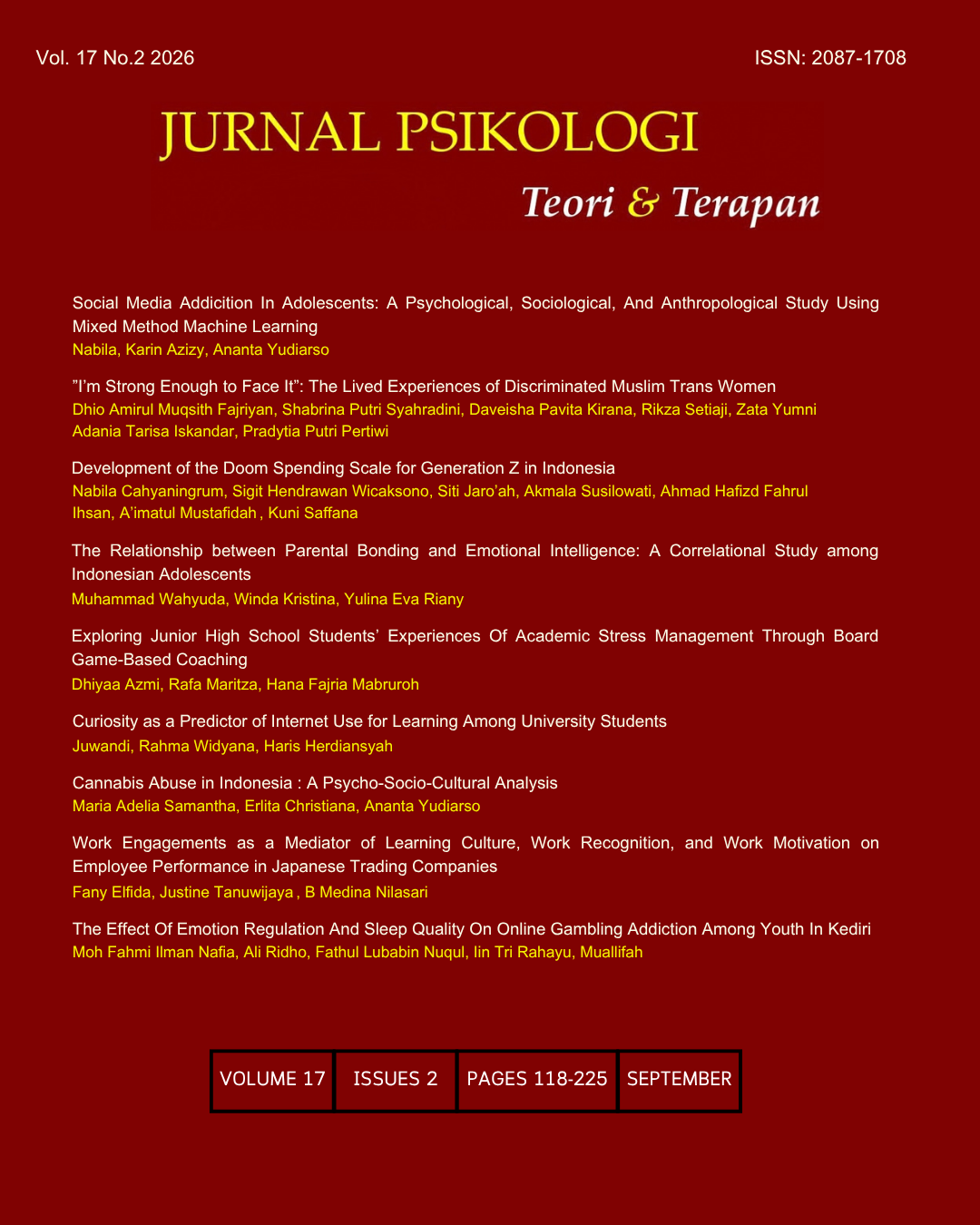
Curiosity as a Predictor of Internet Utilization as a Learning Resource Among University Students
DOI:
https://doi.org/10.26740/jptt.v17n02.p179-189Keywords:
Curiosity, internet utilization, learning resources, university studentsAbstract
Background: The internet is playing an increasingly important role as a learning resource. However, widespread access does not guarantee its effective use for learning. Previous studies have highlighted the role of curiosity in information seeking and the adoption of learning technologies, but empirical evidence that explicitly models curiosity as a predictor of internet use as a learning resource is still limited. Objective: This study aims to examine the effect of curiosity on internet utilization as a learning resource. Method: This study uses a quantitative cross-sectional design and involves 96 students selected through random sampling techniques. Curiosity scales and an internet utilization as a learning resource scale were analyzed using linear regression. Data were collected using a curiosity scale and an internet utilization as a learning resource scale, and analyzed using linear regression. Results: The findings show that curiosity influences the use of the internet as a learning resource (R² = 0.171). The regression model is statistically significant and suitable for predicting the use of the internet as a learning resource based on curiosity, with an F value of 19.382 and significance of 0.000 (p < 0.005). The findings confirm that curiosity is a contextual predictor and emphasize the importance of learning designs that encourage epistemic curiosity to support optimal, reflective, and responsible internet use.
Latar Belakang: Internet semakin berperan penting sebagai sumber belajar. Namun, akses yang luas tidak menjamin pemanfaatannya secara efektif untuk pembelajaran. Penelitian sebelumnya telah menyoroti peran rasa ingin tahu dalam pencarian informasi dan adopsi teknologi pembelajaran, tetapi bukti empiris yang secara eksplisit memodelkan rasa ingin tahu sebagai prediktor pemanfaatan internet sebagai sumber belajar masih terbatas. Tujuan: Penelitian ini bertujuan untuk menguji pengaruh rasa ingin tahu terhadap pemanfaatan internet sebagai sumber belajar. Metode: Penelitian ini menggunakan metode kuantitatif cross-sectional design dan melibatkan 96 mahasiswa yang dipilih melalui teknik pengambilan sampel acak. Skala rasa ingin tahu dan skala pemanfaatan internet sebagai sumber belajar digunakan, kemudian dianalisis menggunakan regresi linear. Hasil: Temuan menunjukkan bahwa rasa ingin tahu berpengaruh terhadap pemanfatan internet sebagai sumber belajar (R² = 0,171). Model regresi secara statistik juga signifikan dan cocok untuk memprediksi pemanfaatan internet sebagai sumber belajar berdasarkan rasa ingin tahu, dengan nilai F 19,382, signifikansi 0,000 (p < 0,005). Temuan penelitian ini menegaskan bahwa rasa ingin tahu merupakan prediktor yang bersifat kontekstual, serta menekankan pentingnya pembelajaran yang mendorong rasa ingin tahu epistemik guna mendukung pemanfaatan internet secara optimal, reflektif, dan bertanggung jawab.
References
Aditia, A. M., Latianingsih, N., & Wijiyanti, M. (2017). Pengaruh penggunaan internet sebagai media belajar terhadap prestasi belajar. Epigram, 14(1). https://doi.org/10.32722/epi.v14i1.953
Agina-Obu, R., & Okwu, E. (2023a). Impact of digital literacy on university students’ use of digital resources in Nigeria. Asian Journal of Information Science and Technology, 13(2), 60–65. https://doi.org/10.51983/ajist-2023.13.2.3587
Agina-Obu, R., & Okwu, E. (2023b). Impact of digital literacy on university students’ use of digital resources in Nigeria. Asian Journal of Information Science and Technology, 13(2), 60–65. https://doi.org/10.51983/ajist-2023.13.2.3587
Priyambodo, A.J., Andriani, F., & Paramita, P.P. (2025). Self-efficacy and self-regulated learning among college students in digital learning: A meta-analytic study. Journal of Educational, Health and Community Psychology, 1232–1254. https://doi.org/10.12928/jehcp.vi.31416
Almakaty, S. (2025). A comprehensive and critical literature review on uses and gratification theory in the digital media age. https://doi.org/10.20944/preprints202503.2033.v1
Almasi, M., Machumu, H., & Zhu, C. (2017). Internet use among secondary school students and its effects on their learning. International Technology, Education and Development Conference, 4(1), 221–230.
Apuke, O. D., & Iyendo, T. O. (2018). University students’ usage of the internet resources for research and learning: forms of access and perceptions of utility. Heliyon, 4(12), e01052. https://doi.org/10.1016/j.heliyon.2018.e01052
Arisukwu, O., Mkperedem, A. A., Etta-Oyong, S. O., Afolabi, A. O., Erondu, U. I., Abang, C., & Adedayo, R. A. (2022). Access, usage, and influence of mass media on students’ academic performance: A private university experience. Cogent Education, 9(1). https://doi.org/10.1080/2331186X.2022.2102117
Arlia, S., & Sumiati, A. (2015). Hubungan antara pemanfaatan media internet sebagai sumber belajar terhadap motivasi belajar siswa kelas X akuntansi SMK negeri 46 Jakarta. Jurnal Ilmiah Econosains, 13(1), 15–27.
Arneklev, B. J. (2023). Self-control and curiosity: Has curiosity been an overlooked concept in the crime/deviance decision-Making process? Deviant Behavior, 44(8), 1194–1218. https://doi.org/10.1080/01639625.2022.2164753
Artuti, E., Pandiangan, P., & Suparman, S. (2022). Pengaruh pemanfaatan internet sebagai sumber belajar dan kreativitas terhadap hasil belajar matematika siswa kelas VIII SMPN 4 Palangka Raya. Anterior Jurnal, 21(2), 1–7. https://doi.org/10.33084/anterior.v21i2.2906
Bayuningrum, W. A. (2021a). Curiosity dalam kehidupan sehari-hari. Psychological Journal: Science and Practice, 1(1), 32–36. https://doi.org/10.22219/pjsp.v1i1.15706
Bayuningrum, W. A. (2021b). Curiosity dalam kehidupan sehari-hari. Psychological Journal: Science and Practice, 1(1), 32–36. https://doi.org/10.22219/pjsp.v1i1.15706
Bhatiasevi, V. (2024). The uses and gratifications of social media and their impact on social relationships and psychological well-being. Frontiers in Psychiatry, 15. https://doi.org/10.3389/fpsyt.2024.1260565
Bond, C. S., Fevyer, D., & Pitt, C. (2006). Learning to use the internet as a study tool: a review of available resources and exploration of students’ priorities. Health Information & Libraries Journal, 23(3), 189–196. https://doi.org/10.1111/j.1471-1842.2006.00656.x
Dahabiyeh, L., Najjar, M. S., & Agrawal, D. (2021). When ignorance is bliss: The role of curiosity in online games adoption. Entertainment Computing, 37, 100398. https://doi.org/10.1016/j.entcom.2020.100398
Derksen, L., Michaud-Leclerc, C., & Souza, P. C. L. (2022). Restricted access: How the internet can be used to promote reading and learning. Journal of Development Economics, 155, 102810. https://doi.org/10.1016/j.jdeveco.2021.102810
Du, S. (2024). Digital and social interaction: A systematic literature review of TikTok’s appeal via uses and gratifications theory. Pakistan Journal of Life and Social Sciences (PJLSS), 22(2). https://doi.org/10.57239/PJLSS-2024-22.2.00614
Herawan, E., Febianti, Y. N., & Safitri, A.L. (2023). Digital literacy and student creativity through e-resources on the quality of learning in college. Journal of Education Technology, 7(1), 25–33. https://doi.org/10.23887/jet.v7i1.43622
Erdemli, A., Audrin, C., & Sander, D. (2025). An integrative appraisal model of epistemic curiosity. Affective Science. https://doi.org/10.1007/s42761-025-00328-7
Eschmann, K. C. J., Pereira, D. F. M. M., Valji, A., Dehmelt, V., & Gruber, M. J. (2023). Curiosity and mesolimbic functional connectivity drive information seeking in real life. Social Cognitive and Affective Neuroscience, 18(1). https://doi.org/10.1093/scan/nsac050
Field, A. (2009). Discovering Statistics Using SPSS. Sage Publications Inc.
Ginting, F. B. (2019). The Internet as a resource for learning in increasingstudents's learning outcomes on social studies subject. International Journal Pedagogy of Social Studies, 4(1), 57–63.
Green, S. B. (1991). How many subjects does it take to do a regression analysis?s. Multivariate Behavioral Research, 26(3), 499–510. https://doi.org/10.1207/s15327906mbr2603_7
Gruber, M. J., & Ranganath, C. (2019). How curiosity enhances hippocampus-dependent memory: The prediction, appraisal, curiosity, and exploration (PACE) framework. Trends in cognitive sciences, 23(12), 1014-1025. https://doi.org/10.1016/j.tics.2019.10.003
Guo, Z., Nadila, Y., & Yilizhati, M. (2025). The impact of time-limited context and feedback methods on epistemic curiosity. Frontiers in Psychology, 16. https://doi.org/10.3389/fpsyg.2025.1717846
Halim, A., Yani, E., Mahzum, E., Farhan, A., & Irwandi, I. (2021). Relationship between the use of the internet as a learning resource and physics learning outcomes. Journal of Physics: Conference Series, 1882(2).
Haryanto, Fridayanthie, E.W., & Nisaa, N.M.H. (2021). Dampak penggunaan internet sebagai media sumber belajar terhadap hasil belajar siswa dengan metode slovin. Akrab Juara : Jurnal Ilmu-Ilmu Sosial, 6(3), 152. https://doi.org/10.58487/akrabjuara.v6i3.1534
Hendriyani, Y., Anwar, M., Hidayat, H., Sabrina, E., Pardjono, P., & Saari, E. M. (2023). Factor analysis of the relationship between curiosity and device addiction through motivation to digital literacy in the context of smart learning. Jurnal Pendidikan Vokasi, 13(3), 320–333. https://doi.org/10.21831/jpv.v13i3.62720
Iba, Z., & Wardhana, A. (2024). Analisis regresi dan analisis jalur untuk riset bisnis menggunakan spss 29.0 & smart-pls 4.0. Eureka Media Aksara.
Kashdan, T. B., Gallagher, M. W., Silvia, P. J., Winterstein, B. P., Breen, W. E., Terhar, D., & Steger, M. F. (2009). The curiosity and exploration inventory-II: Development, factor structure, and psychometrics. Journal of Research in Personality, 43(6), 987–998. https://doi.org/10.1016/j.jrp.2009.04.011
Kashdan, T. B., Kaufman, J. C., & McKnight, P. E. (2024). The costs of curiosity and creativity: Minimizing the downsides while maximizing the upsides. Behavioral and Brain Sciences, 47, e105. https://doi.org/10.1017/S0140525X23003539
Kashdan, T. B., & Roberts, J. E. (2004). Trait and state curiosity in the genesis of intimacy: Differentiation from related constructs. Journal of Social and Clinical Psychology, 23(6), 792–816. https://doi.org/10.1521/jscp.23.6.792.54800
Kashdan, T. B., Stiksma, M. C., Disabato, D. J., McKnight, P. E., Bekier, J., Kaji, J., & Lazarus, R. (2018). The five-dimensional curiosity scale: Capturing the bandwidth of curiosity and identifying four unique subgroups of curious people. Journal of Research in Personality, 73, 130–149. https://doi.org/10.1016/j.jrp.2017.11.011
Keshavarz, H. (2021). Evaluating trustworthiness and expertise of information on websites among the undergraduate students: The role of curiosity. International Information & Library Review, 53(3), 199–213. https://doi.org/10.1080/10572317.2020.1827216
K.g., B., V.s., V., M.m., A., C.v., A., Bhat, S., & D’Souza, R. (2020). Influence of epistemic curiosity on the study approaches of first-year engineering students. Procedia Computer Science, 172, 443–451. https://doi.org/10.1016/j.procs.2020.05.097
Kidd, C., & Hayden, B. Y. (2015). The psychology and neuroscience of curiosity. Neuron, 88(3), 449–460. https://doi.org/10.1016/j.neuron.2015.09.010
Lin, X., Liang, Q., Shen, J., Yuan, Y., Zhou, C., & Yu, L. (2026). The impact of creative dance curriculum on epistemic curiosity in young children: A practice-based examination from the perspective of intrinsic needs. Thinking Skills and Creativity, 60, 102074. https://doi.org/10.1016/j.tsc.2025.102074
Liu, D., & Luo, J. (2022). College learning from classrooms to the internet: Adoption of YouTube as a supplementary tool in the COVID-19 pandemic environment. Education and Urban Society, 54(7), 848–870. https://doi.org/10.1177/00131245211062516
Ma, S., Jin, X., Li, X., Dong, H., Dong, X., & Tang, B. (2025a). How epistemic curiosity influences digital literacy: Evidence from international students in China. Behavioral Sciences, 15(3), 286. https://doi.org/10.3390/bs15030286
Ma, S., Jin, X., Li, X., Dong, H., Dong, X., & Tang, B. (2025b). How epistemic curiosity influences digital literacy: Evidence from international students in China. Behavioral Sciences, 15(3), 286. https://doi.org/10.3390/bs15030286
Mahama, I., Edoh-Torgah, N. A., Miezah, D., Ammah, C., & Amponsah, M. O. (2024). The predictive relationship between curiosity and internet addiction among tertiary students in Ghana. Discover Psychology, 4(1), 114–120.
Mallya, J., & Lakshminarayanan, S. (2017). Factors influencing the usage of the internet for academic purposes using the technology acceptance model. DESIDOC Journal of Library & Information Technology, 37(2), 119–127.
Martin, Y., Montessori, M., & Nora, D. (2022). Pemanfaatan internet sebagai sumber belajar. Ranah Research : Journal of Multidisciplinary Research and Development, 4(3), 242–246. https://doi.org/10.38035/rrj.v4i3.494
Mayone, M., & Arneklev, B. (2015). Curiosity, low self-control, and deviance: An exploratory study. FAU Undergraduate Research Journal, 4, 1-1, 4, 1–11.
Nurhayati, S., & Musa, S. (2020). Analysis of Students’ Internet utilization to improve public information literacy in theIndustrial Revolution Era 4.0. Society, 8(2), 557–566. https://doi.org/10.33019/society.v8i2.231
Pratama, T. G., Yuliarto, H., Rinaldy, M., Arianto, A. C., & Nurdin, U. (2023). Utilization of the internet as a learning resource: A case study of students at State Senior High School 1, Tanjungpandan, Belitung Regency. International Journal of Multidisciplinary Research and Analysis, 06(05). https://doi.org/10.47191/ijmra/v6-i5-25
Pratiwi, G., Sutarjo, A., & Hanif, M. (2024). Hubungan pemanfaatan internet sebagai sumber belajar dengan ,otivasi belajar siswa. Didaktika, 4(1), 88–99. https://doi.org/10.17509/didaktika.v4i1.43697
Schumacher, A., Kammerer, Y., Scharinger, C., Gottschling, S., Hübner, N., Tibus, M., Kasneci, E., Appel, T., Gerjets, P., & Bardach, L. (2026). How do intellectually curious people learn and attain knowledge? A focus on behavioral traces of information seeking. European Journal of Personality, 40(1), 87–110. https://doi.org/10.1177/08902070241309124
Schutte, N. S., & Li, H. (2025). The role of self-efficacy and curiosity in student use of artificial intelligence (AI). International Journal of Educational Technology in Higher Education, 22(1), 73. https://doi.org/10.1186/s41239-025-00574-6
Simanjuntak, E., Nawangsari, N. A. F., & Ardi, R. (2019). Do students really use internet access for learning in the classroom?: Exploring students’ cyberslacking in an Indonesian university. Behavioral Sciences, 9(12), 123. https://doi.org/10.3390/bs9120123
Song, D., & Bonk, C. J. (2016). Motivational factors in self-directed informal learning from online learning resources. Cogent Education, 3(1), 1205838. https://doi.org/10.1080/2331186X.2016.1205838
Sucipto, S., Ihsan, M. I., & Wiyono, B. B. (2019). Fostering curiosity to form self-directed learning traditions. SAR Journal-Science and Research, 2(2), 61–67.
Sutherland, S., & Jalali, A. (2017). Social media as an open-learning resource in medical education: current perspectives. Advances in Medical Education and Practice, Volume 8, 369–375. https://doi.org/10.2147/AMEP.S112594
Tasya, K. A., & Armayanti, N. (2025). Pengaruh penggunaan internet sebagai sumber belajar dan motivasi belajar terhadap prestasi belajar kelas XI MPLB di SMK swasta PAB 2 Helvitea. Pendas: Jurnal Ilmiah Pendidikan Dasar, 10(4), 200–209.
Udoh, I. U., Ekpenyong, G. E., & Olowookere. (2020). Digital literacy skills of undergraduate students of library and information science on the utilization of electronic information resources in two federal universities in Nigeria. Library Philosophy and Practice, 4(2), 68–76.
van Lieshout, L. L., de Lange, F. P., & Cools, R. (2020). Why so curious? Quantifying mechanisms of information seeking. Current Opinion in Behavioral Sciences, 35, 112–117. https://doi.org/10.1016/j.cobeha.2020.08.005
Walia, C. K. (2025). Uses and gratifications theory and media consumption patterns. International Journal of Advanced Mass Communication and Journalism, 6(1), 201–203. https://doi.org/10.22271/27084450.2025.v6.i1c.138
Whitecross, W. M., & Smithson, M. (2023). Curiously different: Interest-curiosity and deprivation-curiosity may have distinct benefits and drawbacks. Personality and Individual Differences, 213, 112310. https://doi.org/10.1016/j.paid.2023.112310
Yot-Domínguez, C., & Marcelo, C. (2017). University students’ self-regulated learning using digital technologies. International Journal of Educational Technology in Higher Education, 14(1), 38–49.
Zhou, D., Patankar, S., Lydon-Staley, D. M., Zurn, P., Gerlach, M., & Bassett, D. S. (2024). Architectural styles of curiosity in the global Wikipedia mobile app readership. Science Advances, 10(43). https://doi.org/10.1126/sciadv.adn3268
Downloads
Published
How to Cite
Issue
Section
License
Copyright (c) 2026 Juwandi, Rahma Widyana, Haris Herdiansyah

This work is licensed under a Creative Commons Attribution 4.0 International License.
Authors who publish in this journal agree to the following terms:
Copyright in any article is held by the author.
The author grants the journal, publication rights with the work simultaneously licensed under a Creative Commons Attribution License that allows others to share the work with an acknowledgment of the work's authorship and initial publication in this journal.
Authors may enter into separate, additional contractual arrangements for the non-exclusive distribution of the journal's published version of the work (e.g., posting it to an institutional repository or publishing it in a book), with an acknowledgment of its initial publication in this journal.
Authors are permitted and encouraged to post their work online (e.g., in an institutional repository or on their website) prior to and during the submission process, as this can lead to productive exchanges, as well as earlier and greater citation of published work.
 Abstract views: 0
,
Abstract views: 0
, PDF Downloads: 0