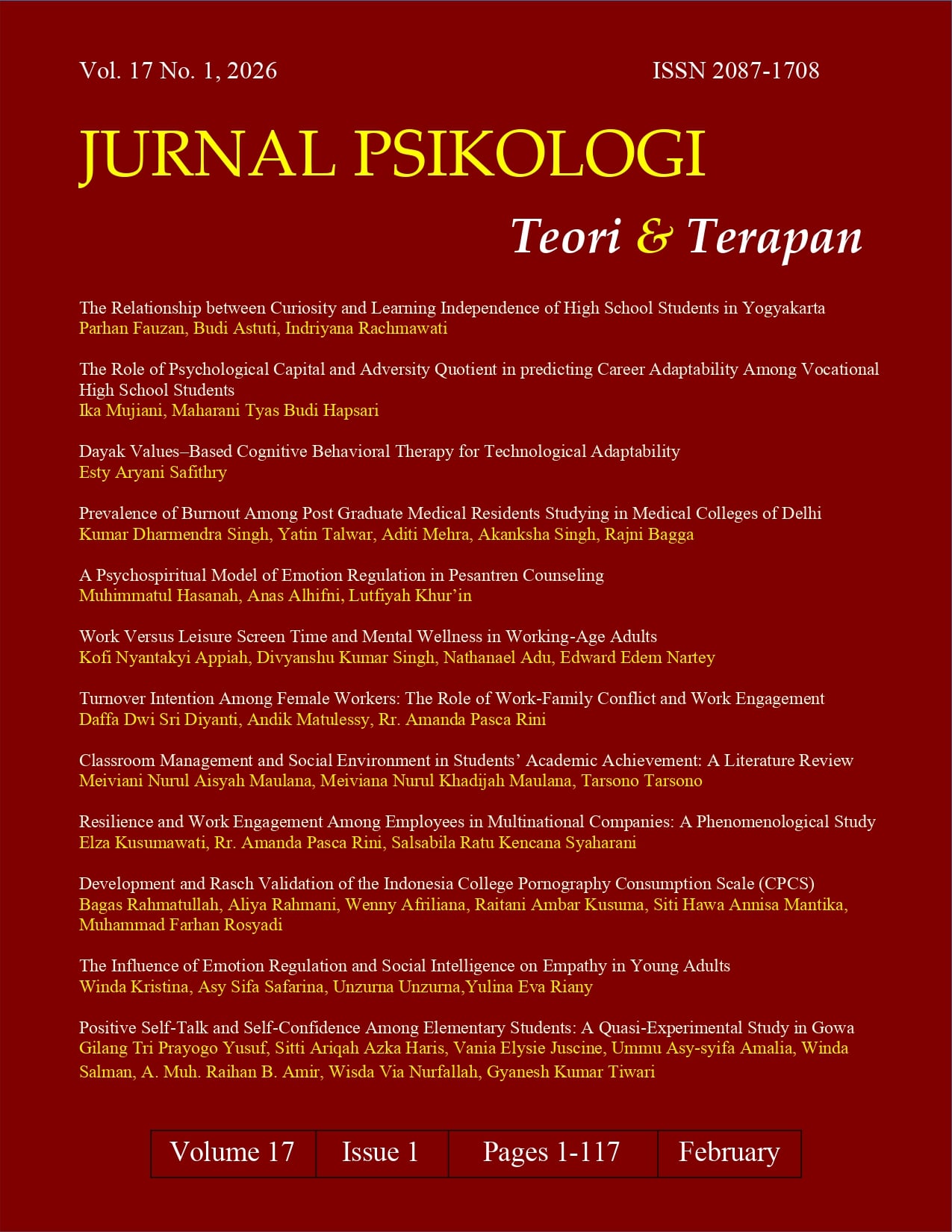
Prevalence of Burnout Among Post Graduate Medical Residents Studying in Medical Colleges of Delhi
DOI:
https://doi.org/10.26740/jptt.v17n01.p29-36Keywords:
Burnout, emotional exhaustion, mental health, occupational stress, postgraduate medical residentsAbstract
Background: Burnout is a significant psychological concern among postgraduate medical residents owing to high workload demands, long working hours, and emotional strain associated with clinical responsibilities. Persistent burnout may negatively affect residents’ well-being and their professional performance. Objective: This study aimed to examine the level of burnout among postgraduate medical residents and explore differences based on selected demographic characteristics. Method: A quantitative cross-sectional design was employed involving postgraduate medical residents from a teaching hospital. Data were collected using the Maslach Burnout Inventory–Human Services Survey (MBI- HSS). Statistical analysis was conducted using descriptive statistics and independent samples t-tests to examine the differences in burnout dimensions across groups. Results: The findings indicated that residents experienced moderate to high burnout levels, particularly in emotional exhaustion and depersonalization. Significant differences were observed across the selected demographic variables. Conclusion: Burnout remains a prevalent issue among postgraduate medical residents, highlighting the need for institutional and psychological interventions to promote mental well-being and sustainable professional functioning of residents.
Abstrak
Latar Belakang: Burnout merupakan permasalahan psikologis yang signifikan pada residen kedokteran pascasarjana akibat tuntutan beban kerja yang tinggi, jam kerja panjang, serta tekanan emosional dalam praktik klinis. Kondisi burnout yang berkepanjangan dapat berdampak negatif pada kesejahteraan dan kinerja profesional residen. Tujuan: Penelitian ini bertujuan untuk mengkaji tingkat burnout pada residen kedokteran pascasarjana serta menelaah perbedaan burnout berdasarkan karakteristik demografis tertentu. Metode: Penelitian ini menggunakan desain kuantitatif potong lintang dengan melibatkan residen kedokteran pascasarjana dari rumah sakit pendidikan. Pengumpulan data dilakukan menggunakan Maslach Burnout Inventory–Human Services Survey (MBI-HSS). Analisis data meliputi statistik deskriptif dan uji t independen untuk menguji perbedaan dimensi burnout antar kelompok. Hasil: Hasil penelitian menunjukkan bahwa residen mengalami tingkat burnout sedang hingga tinggi, terutama pada dimensi kelelahan emosional dan depersonalisasi, dengan perbedaan yang signifikan pada beberapa variabel demografis. Kesimpulan: Burnout pada residen kedokteran pascasarjana masih menjadi isu penting yang memerlukan perhatian melalui intervensi institusional dan psikologis.
References
Bakker, A. B., & Demerouti, E. (2017). Job demands–resources theory: Taking stock and looking forward. Journal of Occupational Health Psychology, 22(3), 273–285. https://doi.org/10.1037/ocp0000056
Dyrbye, L. N., West, C. P., Satele, D., Boone, S., Tan, L., Sloan, J., & Shanafelt, T. D. (2014). Burnout among U.S. medical students, residents, and early career physicians relative to the general U.S. population. Academic Medicine, 89(3), 443–451. https://doi.org/10.1097/ACM.0000000000000134
Halbesleben, J. R. B., & Rathert, C. (2008). Linking physician burnout and patient outcomes: exploring the dyadic relationship between physicians and patiens. Health Care Management Review, 33(1), 29–39. https://doi.org/10.1097/01.HMR.0000304493.87898.72
Kassam, A., Horton, J., Shoimer, I., & Patten, S. (2015). Predictors of well-being in resident physicians: A descriptive and psychometric study. Journal of Graduate Medical Education, 7(1), 70–74. https://doi.org/10.4300/JGME-D-14-00022.1
Maslach, C., & Goldberg, J. (1998). Prevention of burnout: New perspectives. Applied and Preventive Psychology, 7(1), 63–74. https://doi.org/10.1016/S0962-1849(98)80022-X
Maslach, C., Jackson, S. E., & Leiter, M. P. (1996). Maslach Burnout Inventory manual (3rd ed.). Consulting Psychologists Press.
Pastore, F. R., Gambert, S. R., Plutchik, A., & Plutchik, R. (1995). Empathy training for medical students (Unpublished manuscript). New York Medical College.
Prins, J. T., Hoekstra-Weebers, J. E. H. M., van de Wiel, H. B. M., Gazendam-Donofrio, S. M., Sprangers, F., Jaspers, F. C. A., & van der Heijden, F. M. M. A. (2007). Burnout among Dutch medical residents. International Journal of Behavioral Medicine, 14(3), 119–125. https://doi.org/10.1007/BF03000182
Ramirez, A. J., Graham, J., Richards, M. A., Cull, A., & Gregory, W. M. (1996). Mental health of hospital consultants: The effects of stress and satisfaction at work. The Lancet, 347(9003), 724–728. https://doi.org/10.1016/S0140-6736(96)90077-X
Ratnakaran, B., Prabhakaran, A., & Karunakaran, V. (2016). Prevalence of burnout and its correlates among residents in a tertiary medical center in Kerala, India: A cross-sectional study. Journal of Postgraduate Medicine, 62(3), 157–161. https://doi.org/10.4103/0022-3859.184274
Rodrigues, H., Cobucci, R., Oliveira, A., Cabral, J. V., Medeiros, L., Gurgel, K., Souza, T., Gonçalves,A. K., & Costa, L. R. (2018). Burnout syndrome among medical residents: A systematic review and meta- analysis. PLoS ONE, 13(11), e0206840. https://doi.org/10.1371/journal.pone.0206840
Sahasrabuddhe, A. G., Suryawanshi, S. R., & Bhandari, S. R. (2015). Stress among doctors doing residency: A cross-sectional study at a tertiary care hospital in the city of Mumbai. National Journal of Community Medicine, 6(1), 21–24. https://doi.org/10.18203/2394-6040.ijcmph20220720
Shanafelt, T. D., Bradley, K. A., Wipf, J. E., & Back, A. L. (2002). Burnout and self-reported patient care in an internal medicine residency program. Annals of Internal Medicine, 136(5), 358–367. 10.7326/0003-4819-136-5-200203050-00008
Shanafelt, T. D., Hasan, O., Dyrbye, L. N., et al. (2017). Changes in burnout and satisfaction with work-life integration. Mayo Clinic Proceedings, 92(9), 1293–1315. https://doi.org/10.1016/j.mayocp.2017.07.012
Downloads
Published
How to Cite
Issue
Section
License
Copyright (c) 2026 Kumar Dharmendra Singh, Yatin Talwar, Aditi Mehra, Akanksha singh, Rajni Bagga

This work is licensed under a Creative Commons Attribution 4.0 International License.
Authors who publish in this journal agree to the following terms:
Copyright in any article is held by the author.
The author grants the journal, publication rights with the work simultaneously licensed under a Creative Commons Attribution License that allows others to share the work with an acknowledgment of the work's authorship and initial publication in this journal.
Authors may enter into separate, additional contractual arrangements for the non-exclusive distribution of the journal's published version of the work (e.g., posting it to an institutional repository or publishing it in a book), with an acknowledgment of its initial publication in this journal.
Authors are permitted and encouraged to post their work online (e.g., in an institutional repository or on their website) prior to and during the submission process, as this can lead to productive exchanges, as well as earlier and greater citation of published work.
 Abstract views: 421
,
Abstract views: 421
, PDF Downloads: 331