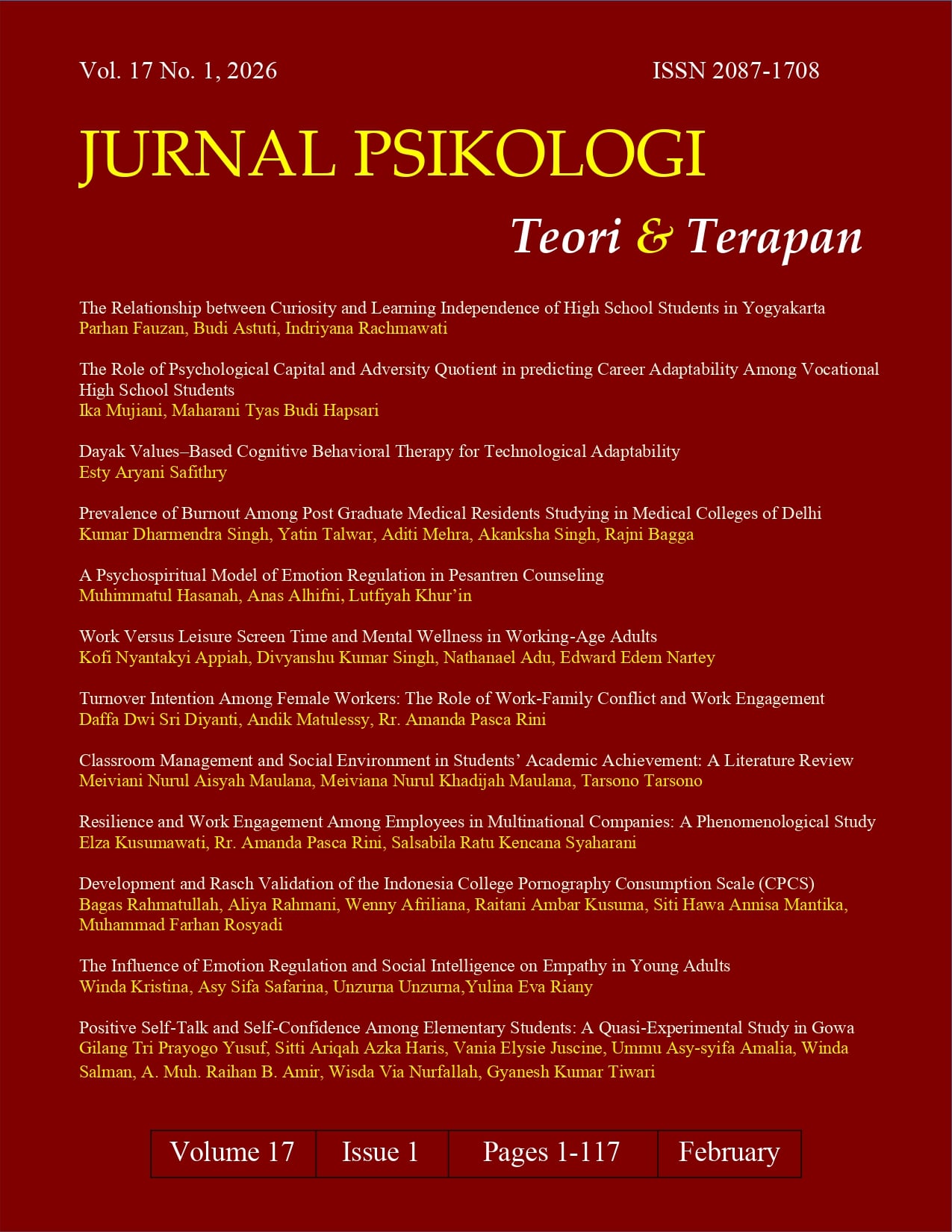
Classroom Management and Social Environment in Students’ Academic Achievement: A Literature Review
DOI:
https://doi.org/10.26740/jptt.v17n01.p70-78Keywords:
Academic achievement, classroom management, literature review, elementary education, social environmentAbstract
Background: Low academic achievement among elementary school students often linked to ineffective classroom management and unfavorable social environments. These factors are frequently examined in isolation, resulting in a fragmented understanding of their combined influence on learning outcomes. Objective: This study aims to synthesize existing literature to examine the integrated role of classroom management and social environment dynamics in shaping students’ academic achievement. Method: This research employed a qualitative literature review method by analyzing peer-reviewed journal articles, academic books, and scholarly reports related to classroom management, peer interactions, bullying, and academic achievement in elementary education. Data were analyzed to identify recurring concepts and relationships across studies. Results: The findings indicate effective classroom management with structured instruction, positive teacher student relationships, and clear routines enhances academic engagement, while supportive social environments foster emotional well-being and learning motivation. In contrast, negative peer interactions consistently undermine students’ academic outcomes. Conclusion: Classroom management and social environment function as an interconnected system influencing academic achievement, underscoring the importance of integrating instructional and social strategies in elementary education practice and policy.
Abstrak
Latar Belakang: Rendahnya prestasi akademik pada siswa sekolah dasar sering dikaitkan dengan pengelolaan kelas yang kurang efektif serta lingkungan sosial yang tidak kondusif. Faktor-faktor tersebut kerap dikaji secara terpisah sehingga menghasilkan pemahaman yang terfragmentasi mengenai pengaruh gabungannya. Tujuan: Penelitian ini bertujuan untuk mensintesis literatur guna mengkaji peran terpadu pengelolaan kelas dan dinamika lingkungan sosial dalam membentuk prestasi akademik siswa. Metode: Penelitian ini menggunakan metode kajian pustaka kualitatif dengan menganalisis artikel jurnal bereputasi, buku akademik, dan laporan ilmiah yang berkaitan dengan pengelolaan kelas, interaksi teman sebaya, perundungan, serta prestasi akademik pada pendidikan dasar. Data dianalisis menggunakan sintesis tematik untuk mengidentifikasi konsep dan hubungan yang berulang antar penelitian. Hasil: Temuan menunjukkan pengelolaan kelas yang efektif dengan pembelajaran yang terstruktur, hubungan guru–siswa yang positif, dan rutinitas yang jelas, mampu meningkatkan keterlibatan akademik, serta lingkungan sosial yang suportif mendukung kesejahteraan emosional dan motivasi belajar. Sebaliknya, interaksi negatif antar teman sebaya menurunkan capaian akademik siswa. Kesimpulan: Pengelolaan kelas dan lingkungan sosial memengaruhi prestasi akademik, sehingga menegaskan pentingnya integrasi strategi instruksional dan sosial dalam praktik serta kebijakan pendidikan dasar.
References
Berkowitz, R., Moore, H., Astor, R. A., & Benbenishty, R. (2017). A research synthesis of the associations between socioeconomic background, inequality, school climate, and academic achievement. Review of Educational Research, 87(2), 425–469. https://doi.org/10.3102/0034654316669821
Campbell, M., McKenzie, J. E., Sowden, A., Katikireddi, S. V., Brennan, S. E., Ellis, S., Hartmann-Boyce, J., Ryan, R., Shepperd, S., Thomas, J., Welch, V., & Thomson, H. (2020). Synthesis without meta-analysis (SWiM) in systematic reviews: Reporting guideline. BMJ, 368, l6890. https://doi.org/10.1136/bmj.l6890
Chavers, D. J., Baker, L. A., Bouillon, L. M., & Graham, S. (2024). Peer victimization in childhood and adolescence and literacy development: A systematic literature review. Frontiers in Education, 9, 1390271. https://doi.org/10.3389/feduc.2024.1390271
Chicote-Beato, J., Martín-Moya, R., & García-Fernández, C. (2024). Cyberbullying educational programmes in primary education: A systematic review and meta-analysis. Aggression and Violent Behavior, 76, 101938. https://doi.org/10.1016/j.avb.2024.101938
Corcoran, R. P., Cheung, A. C. K., Kim, E., & Xie, C. (2018). Effective universal school-based social and emotional learning programs for improving academic achievement: A systematic review and meta-analysis of 50 years of research. Educational Research Review, 25, 56–72. https://doi.org/10.1016/j.edurev.2017.12.001
Cornell, D., Shukla, K., & Konold, T. (2016). Authoritative school climate and student academic engagement, grades, and aspirations in middle and high schools. AERA Open, 2(2), 1–18. https://doi.org/10.1177/2332858416633184
Daily, S. M., Mann, M. J., Lilly, C. L., Dyer, A. M., Smith, M. L., & Kristjansson, A. L. (2019). School climate and academic achievement in middle and high school students. Journal of School Health, 89(3), 173–180. https://doi.org/10.1111/josh.12726
Demirtaş-Zorbaz, S., Akın-Arıkan, Ç., & Terzi, R. (2021). Does school climate that includes students’ views deliver academic achievement? A multilevel meta-analysis. School Effectiveness and School Improvement, 32(4), 548–570. https://doi.org/10.1080/09243453.2021.1920432
Duan, X., Hu, S., & Guan, Y. (2024). Classroom management self-efficacy: A meta-analysis. Educational Psychology Review. Advance online publication. https://doi.org/10.1007/s10648-024-09881-2
Endedijk, M. D., Brekelmans, M., Sleegers, P., & Vermunt, J. D. (2022). The role of teacher–student and peer relationships in students’ academic and emotional adjustment: A meta-analysis. Review of Educational Research. Advance online publication. https://doi.org/10.3102/00346543211051428
Erdem, C. (2024). The relationship between school and classroom climate and academic achievement: A meta-analysis. Educational and Psychological Measurement. Advance online publication. https://doi.org/10.1177/01430343231202923
Febriansyah, D. R., & Yuningsih, Y. (2024). Fenomena perilaku bullying sebagai bentuk kenakalan remaja di SMK-TI Pembangunan Cimahi. Jurnal Ilmiah Perlindungan dan Pemberdayaan Sosial, 6(1), 26–33.
Gaffney, H., Farrington, D. P., & Ttofi, M. M. (2019). Examining the effectiveness of school-bullying intervention programs globally: A meta-analysis. International Journal of Bullying Prevention, 1, 14–31. https://doi.org/10.1007/s42380-019-0007-4
Gaffney, H., Ttofi, M. M., & Farrington, D. P. (2019). Evaluating the effectiveness of school-bullying prevention programs: An updated meta-analytical review. Aggression and Violent Behavior, 45, 111–133. https://doi.org/10.1016/j.avb.2018.07.001
Gaffney, H., Farrington, D. P., Espelage, D. L., & Ttofi, M. M. (2019). Are cyberbullying intervention and prevention programs effective? A systematic and meta-analytical review. Aggression and Violent Behavior, 45, 134–153. https://doi.org/10.1016/j.avb.2018.07.002
Gaffney, H., Ttofi, M. M., & Farrington, D. P. (2021). What works in anti-bullying programs? Analysis of effective intervention components. Journal of School Psychology, 85, 37–56. https://doi.org/10.1016/j.jsp.2020.12.002
Gaffney, H., Farrington, D. P., & Ttofi, M. M. (2021). School-based programs to reduce bullying perpetration and victimization: A systematic review and meta-analysis. Campbell Systematic Reviews, 17(2), e1143. https://doi.org/10.1002/cl2.1143
Gage, N. A., Larson, A., Sugai, G., & Chafouleas, S. M. (2016). Student perceptions of school climate as predictors of office discipline referrals. American Educational Research Journal, 53(3), 492–515. https://doi.org/10.3102/0002831216637349
Grazia, V., & Molinari, L. (2021). School climate multidimensionality and measurement: A systematic literature review. Research Papers in Education, 36(5), 561–587. https://doi.org/10.1080/02671522.2019.1697735
Jiménez-Barbero, J. A., Ruiz-Hernández, J. A., Llor-Zaragoza, L., Pérez-García, M., & Llor-Esteban, B. (2016). Effectiveness of anti-bullying school programs: A meta-analysis. Children and Youth Services Review, 61, 165–175. https://doi.org/10.1016/j.childyouth.2015.12.015
Kamaruddin, N. N., Sharma, S., & Ahmad, N. (2023). Cyberbullying and mental health among adolescents: A systematic review and meta-analysis. Frontiers in Psychiatry, 14, 1014258. https://doi.org/10.3389/fpsyt.2023.1014258
Konold, T., Cornell, D., Shukla, K., & Huang, F. (2017). Racial/ethnic differences in perceptions of school climate and its association with student engagement and achievement. Journal of Youth and Adolescence, 46(6), 1289–1303. https://doi.org/10.1007/s10964-016-0576-1
Konold, T., Cornell, D., Jia, Y., & Malone, M. (2018). School climate, student engagement, and academic achievement: A latent variable multilevel multi-informant examination. AERA Open, 4(4), 1–17. https://doi.org/10.1177/2332858418815661
Korpershoek, H., Harms, T., de Boer, H., van Kuijk, M., & Doolaard, S. (2016). A meta-analysis of the effects of classroom management strategies and classroom management programs on students’ academic, behavioral, emotional, and motivational outcomes. Review of Educational Research, 86(3), 643–680. https://doi.org/10.3102/0034654315626799
Korpershoek, H., Harms, T., de Boer, H., van Kuijk, M., & Doolaard, S. (2025). Classroom management and student outcomes: A meta-analysis update. Review of Educational Research. Advance online publication. https://doi.org/10.3102/00346543251361903
Lan, C. M., Law, N., & Pan, Q. (2022). Effectiveness of anti-cyberbullying educational programs: A meta-analysis. Computers in Human Behavior, 131, 107200. https://doi.org/10.1016/j.chb.2022.107200
Larson, K. E., Pas, E. T., Bottiani, J. H., Debnam, K. J., & Bradshaw, C. P. (2021). Classroom management practices, student engagement, and disruptive behavior in high school classrooms. Journal of Positive Behavior Interventions, 23(4), 237–251. https://doi.org/10.1177/1098300720929352
Laslett, R., & Smith, C. (1984). Effective classroom management: A teacher’s guide. Croom Helm.
Lei, H., Cui, Y., & Zhou, W. (2018). Relationships between student engagement and academic achievement: A meta-analysis. Social Behavior and Personality: An International Journal, 46(3), 517–528. https://doi.org/10.2224/sbp.7054
Li, J., & Xue, E. (2023). Meta-analysis of student engagement and its influencing factors. Behavioral Sciences, 13(1), 59. https://doi.org/10.3390/bs13010059
Mammadov, S., & Schroeder, S. (2023). Perceived autonomy support and positive learning outcomes: A meta-analytic review. Contemporary Educational Psychology, 75, 102235. https://doi.org/10.1016/j.cedpsych.2023.102235
Maryati, S. (2018). Pengaruh pengelolaan kelas terhadap prestasi belajar siswa mata pelajaran Pendidikan Agama Islam kelas VI di Sekolah Dasar Muhammadiyah Seri Kembang 1 Kecamatan Payaraman Kabupaten Ogan Ilir (Undergraduate thesis). Universitas Raden Fatah Palembang.
Murano, D., Sawyer, J. E., & Lipnevich, A. A. (2020). A meta-analytic review of preschool social and emotional learning interventions. Review of Educational Research, 90(2), 227–263. https://doi.org/10.3102/0034654320914743
Musyayanah, E., Djamal, M., & Nafi’ah, S. A. (2021). Dampak pengelolaan kelas terhadap hasil belajar siswa di MI Ma’arif NU Brunosari. Jurnal As-Sibyan, 4(2), 149–162. https://doi.org/10.52484/as_sibyan.v4i2.243
Ningrum, W. W., & Purnomo, H. (2024). Strategi guru dalam mengatasi perilaku bullying pada siswa sekolah dasar. Jurnal Gentala Pendidikan Dasar, 9(1), 11–21.
Page, M. J., McKenzie, J. E., Bossuyt, P. M., Boutron, I., Hoffmann, T. C., Mulrow, C. D., Shamseer, L., Tetzlaff, J. M., Akl, E. A., Brennan, S. E., Chou, R., Glanville, J., Grimshaw, J. M., Hróbjartsson, A., Lalu, M. M., Li, T., Loder, E. W., Mayo-Wilson, E., McDonald, S., & Moher, D. (2021). The PRISMA 2020 statement: An updated guideline for reporting systematic reviews. BMJ, 372, n71. https://doi.org/10.1136/bmj.n71
Page, M. J., McKenzie, J. E., Bossuyt, P. M., Boutron, I., Hoffmann, T. C., Mulrow, C. D., Shamseer, L., Tetzlaff, J. M., Akl, E. A., Brennan, S. E., Chou, R., Glanville, J., Grimshaw, J. M., Hróbjartsson, A., Lalu, M. M., Li, T., Loder, E. W., Mayo-Wilson, E., McDonald, S., & Moher, D. (2021). PRISMA 2020 explanation and elaboration: Updated guidance and exemplars for reporting systematic reviews. BMJ, 372, n160. https://doi.org/10.1136/bmj.n160
Patall, E. A., Yates, N., Schwartz, A. E., et al. (2023). Teachers’ provision of structure in the classroom: A meta-analysis. Educational Psychologist. Advance online publication. https://doi.org/10.1080/00461520.2023.2274104
Patzak, A., et al. (2025). Blending autonomy support and structure: How teachers can optimize students’ basic need satisfaction, engagement, and achievement. Educational Psychology Review. Advance online publication. https://doi.org/10.1007/s10648-025-09994-2
Rahmawati, Y. N. (2018). Identifikasi penyebab prestasi belajar rendah siswa kelas IV SDN. Basic Education, 7(5), 2479–2488.
Reaves, S., McMahon, S. D., Duffy, S. N., & Ruiz, L. (2018). The test of time: A meta-analytic review of the relation between school climate and student problem behavior. Aggression and Violent Behavior, 39, 100–108. https://doi.org/10.1016/j.avb.2018.01.006
Rethlefsen, M. L., Kirtley, S., Waffenschmidt, S., et al. (2021). PRISMA-S: An extension to the PRISMA statement for reporting literature searches in systematic reviews. Systematic Reviews, 10, 39. https://doi.org/10.1186/s13643-020-01542-z
Ryan, R. M., & Deci, E. L. (2020). Intrinsic and extrinsic motivations: Classic definitions and new directions. Routledge.
Samara, M., Da Silva Nascimento, B., El-Asam, A., Hammuda, S., & Khattab, N. (2021). How can bullying victimisation lead to lower academic achievement? A systematic review and meta-analysis of the mediating role of cognitive-motivational factors. International Journal of Environmental Research and Public Health, 18(5), 2209. https://doi.org/10.3390/ijerph18052209
Shea, B. J., Reeves, B. C., Wells, G., et al. (2017). AMSTAR 2: A critical appraisal tool for systematic reviews that include randomised or non-randomised studies of healthcare interventions, or both. BMJ, 358, j4008. https://doi.org/10.1136/bmj.j4008
Shinta, M., & Yudiarso, A. (2021). Meta-Analysis antara Hubungan Self-Concept dengan Academic Achievement. Edukatif: Jurnal Ilmu Pendidikan, 3(5), 2065–2075. https://doi.org/10.31004/edukatif.v3i5.798
Sohrabi, C., Mathew, G., Franchi, T., Kerwan, A., & Griffin, M. (2021). PRISMA 2020 statement: What is new and the importance of reporting guidelines. International Journal of Surgery, 88, 105918. https://doi.org/10.1016/j.ijsu.2021.105918
Sterne, J. A. C., Hernán, M. A., Reeves, B. C., et al. (2016). ROBINS-I: A tool for assessing risk of bias in non-randomised studies of interventions. BMJ, 355, i4919. https://doi.org/10.1136/bmj.i4919
Sterne, J. A. C., Savović, J., Page, M. J., et al. (2019). RoB 2: A revised tool for assessing risk of bias in randomised trials. BMJ, 366, l4898. https://doi.org/10.1136/bmj.l4898
Tao, J., Meng, Y., Gao, Z., & Yang, X. (2022). Perceived teacher support, student engagement, and academic achievement: A meta-analysis. Educational Psychology. Advance online publication. https://doi.org/10.1080/01443410.2022.2033168
Tarsono, T., Hilmi, H., & Muhamad, I. (2024). Dinamika interaksi sosial di kelas: Implikasi terhadap prestasi siswa dalam psikologi pendidikan. Al-Hasanah: Jurnal Pendidikan Agama Islam, 9(1), 184–197
Taylor, R. D., Oberle, E., Durlak, J. A., & Weissberg, R. P. (2017). Promoting positive youth development through school-based social and emotional learning interventions: A meta-analysis of follow-up effects. Child Development, 88(4), 1156–1171. https://doi.org/10.1111/cdev.12864
Thornberg, R., Wänström, L., & Pozzoli, T. (2022). Teacher–student relationship quality and student engagement: A systematic review. Educational Research, 64(3), 241–260. https://doi.org/10.1080/00131881.2022.2062854
Torres, A. R., et al. (2020). Bullying victimization and academic achievement: A meta-analysis. Journal of School Violence. Advance online publication. https://doi.org/10.1080/15564886.2019.1681571
Tricco, A. C., Lillie, E., Zarin, W., et al. (2018). PRISMA extension for scoping reviews (PRISMA-ScR): Checklist and explanation. Annals of Internal Medicine, 169(7), 467–473. https://doi.org/10.7326/M18-0850
Vansteenkiste, M., Ryan, R. M., & Soenens, B. (2020). Basic psychological need theory: Advancements, critical themes, and future directions. Motivation and Emotion, 44, 1–31. https://doi.org/10.1007/s11031-019-09818-1
Vargas-Madriz, L. F., Konishi, C., & Wong, T. K. (2024). A meta-analysis of the association between teacher support and school engagement. Social Development, 33, e12745. https://doi.org/10.1111/sode.12745
Virtanen, T. E., Vasalampi, K., Kiuru, N., Lerkkanen, M.-K., & Poikkeus, A.-M. (2020). The role of perceived social support as a contributor to the successful transition from primary to lower secondary school. School Psychology International, 41(4), 384–405. https://doi.org/10.1080/00313831.2019.1639816
Wang, M.-T., & Degol, J. L. (2016). School climate: A review of the construct, measurement, and impact on student outcomes. Educational Psychology Review, 28, 315–352. https://doi.org/10.1007/s10648-015-9319-1
Wang, M.-T., Degol, J. L., Amemiya, J., Parr, A., & Guo, J. (2020). Classroom climate and children’s academic and psychological wellbeing: A systematic review and meta-analysis. Developmental Review, 57, 100912. https://doi.org/10.1016/j.dr.2020.100912
Whiting, P., Savović, J., Higgins, J. P. T., Caldwell, D. M., Reeves, B. C., Shea, B., Davies, P., Kleijnen, J., Churchill, R., & ROBIS group. (2016). ROBIS: A new tool to assess risk of bias in systematic reviews was developed. Journal of Clinical Epidemiology, 69, 225–234. https://doi.org/10.1016/j.jclinepi.2015.06.005
Wirnawati, Asiah, S., & Otaya, L. G. (2023). Pengelolaan kelas terhadap hasil belajar siswa. Journal of Islamic Education Management Research, 2(1), 69–75.
Woolfolk, A. (2021). Educational Psychology (14th ed). Pearson Education.
Wu, L., & Guo, X. (2021). The relationship between academic self-concept and academic achievement: A meta-analysis. Educational Psychology Review, 33, 1273–1304. https://doi.org/10.1007/s10648-021-09600-1
Xu, X., Zhang, M., & Ardasheva, Y. (2022). The effects of self-regulated learning interventions in online and blended learning environments: A meta-analysis. Behaviour & Information Technology. Advance online publication. https://doi.org/10.1080/0144929X.2022.2151935
Yang, X., Wang, M., & Cheng, H. (2022). Teachers’ autonomy support and student engagement: A systematic literature review. Frontiers in Psychology, 13, 925955. https://doi.org/10.3389/fpsyg.2022.925955
Downloads
Published
How to Cite
Issue
Section
License
Copyright (c) 2026 Meiviani Nurul Aisyah Maulana, Meiviana Nurul Khadijah Maulana, Tarsono Tarsono

This work is licensed under a Creative Commons Attribution 4.0 International License.
Authors who publish in this journal agree to the following terms:
Copyright in any article is held by the author.
The author grants the journal, publication rights with the work simultaneously licensed under a Creative Commons Attribution License that allows others to share the work with an acknowledgment of the work's authorship and initial publication in this journal.
Authors may enter into separate, additional contractual arrangements for the non-exclusive distribution of the journal's published version of the work (e.g., posting it to an institutional repository or publishing it in a book), with an acknowledgment of its initial publication in this journal.
Authors are permitted and encouraged to post their work online (e.g., in an institutional repository or on their website) prior to and during the submission process, as this can lead to productive exchanges, as well as earlier and greater citation of published work.
 Abstract views: 821
,
Abstract views: 821
, PDF Downloads: 598