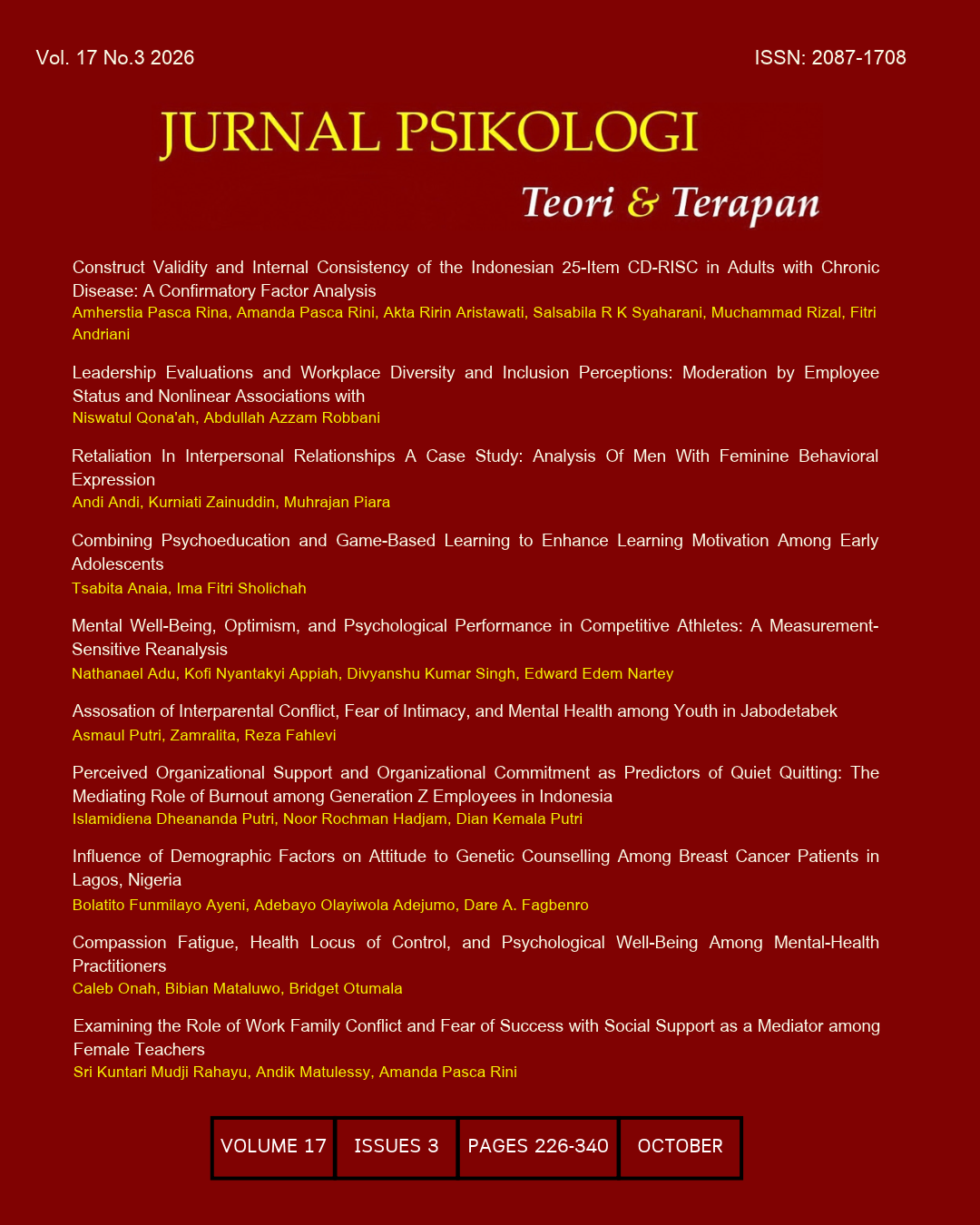
Mental Well-Being, Optimism, and Psychological Performance in Competitive Athletes: A Measurement-Sensitive Reanalysis
DOI:
https://doi.org/10.26740/jptt.v17n03.p270-280Keywords:
athlete psychological performance, construct overlap, mental well-being, optimism, secondary data analysisAbstract
Background: Apparent statistical suppression may reflect mistaken construct identification. Objective: To reassess optimism in associations between mental well-being and self-reported psychological functioning among athletes. Methods: We reanalysed cross-sectional responses from 739 athletes in Türkiye. One record with age below the stated eligibility threshold and two records with invalid optimism items were excluded (N = 736). We verified instrument definitions and applied the official transformed scoring for the seven-item Short Warwick–Edinburgh Mental Well-being Scale (SWEMWBS). Regression and 5,000-sample bootstrap analyses assessed statistical indirect associations. Results: A previously labelled well-being variable was mathematically derived from optimism and pessimism, rather than measuring well-being. Scored SWEMWBS was negligibly correlated with the unweighted 32-item psychological-performance composite (r = −.010). The covariate-adjusted indirect estimate through optimism was positive (B = .0085, 95% bootstrap CI [.0044, .0131]), whereas the direct estimate was nonsignificant (B = −.0041, p = .439). Anxiety, motivation, and confidence showed different associations with well-being. Conclusions: The original negative suppression claim was not replicated after measurement correction. The cross-sectional associations do not establish causal mediation or actual sporting performance.
References
Arındı, E., Adiloğulları, İ., & Özgider, C. (2025a). Factors affecting how well athletes perform mentally: The impact of optimism, pessimism, and mental well-being [Data set]. OpenICPSR. https://doi.org/10.3886/E231941V1
Arındı, E., Adiloğulları, İ., & Özgider, C. (2025b). Factors affecting how well athletes perform mentally: The impact of optimism, pessimism, and mental well-being [Preprint]. Research Square. https://doi.org/10.21203/rs.3.rs-6865136/v1
Aydoğan, H., & Konaş, Y. (2022). Sporda Psikolojik Performans Değerlendirme Ölçeği geliştirme çalışması [Development of the Psychological Performance Evaluation Scale in Sports]. Spor Eğitim Dergisi, 6(1), 74–87. https://doi.org/10.55238/seder.1096524
Carver, C. S., Scheier, M. F., & Segerstrom, S. C. (2010). Optimism. Clinical Psychology Review, 30(7), 879–889. https://doi.org/10.1016/j.cpr.2010.01.006
Cole, D. A., & Maxwell, S. E. (2003). Testing mediational models with longitudinal data: Questions and tips in the use of structural equation modeling. Journal of Abnormal Psychology, 112(4), 558–577. https://doi.org/10.1037/0021-843X.112.4.558
Craft, L. L., Magyar, T. M., Becker, B. J., & Feltz, D. L. (2003). The relationship between the Competitive State Anxiety Inventory-2 and sport performance: A meta-analysis. Journal of Sport & Exercise Psychology, 25(1), 44–65. https://doi.org/10.1123/jsep.25.1.44
Demirtaş, A. S., & Baytemir, K. (2019). Warwick-Edinburgh Mental İyi Oluş Ölçeği Kısa Formu’nun Türkçe’ye uyarlanması: Geçerlik ve güvenirlik çalışması. Elektronik Sosyal Bilimler Dergisi, 18(70), 689–701. https://doi.org/10.17755/esosder.432708
Fletcher, D., & Sarkar, M. (2012). A grounded theory of psychological resilience in Olympic champions. Psychology of Sport and Exercise, 13(5), 669–678. https://doi.org/10.1016/j.psychsport.2012.04.007
Gouttebarge, V., Castaldelli-Maia, J. M., Gorczynski, P., Hainline, B., Hitchcock, M. E., Kerkhoffs, G. M., Rice, S. M., & Reardon, C. L. (2019). Occurrence of mental health symptoms and disorders in current and former elite athletes: A systematic review and meta-analysis. British Journal of Sports Medicine, 53(11), 700–706. https://doi.org/10.1136/bjsports-2019-100671
Hayes, A. F., & Rockwood, N. J. (2017). Regression-based statistical mediation and moderation analysis in clinical research: Observations, recommendations, and implementation. Behaviour Research and Therapy, 98, 39–57. https://doi.org/10.1016/j.brat.2016.11.001
Hayes, A. F., & Scharkow, M. (2013). The relative trustworthiness of inferential tests of the indirect effect in statistical mediation analysis: Does method really matter? Psychological Science, 24(10), 1918–1927. https://doi.org/10.1177/0956797613480187
Imai, K., Keele, L., & Tingley, D. (2010). A general approach to causal mediation analysis. Psychological Methods, 15(4), 309–334. https://doi.org/10.1037/a0020761
Keyes, C. L. M. (2002). The mental health continuum: From languishing to flourishing in life. Journal of Health and Social Behavior, 43(2), 207–222. https://doi.org/10.2307/3090197
Keyes, C. L. M. (2005). Mental illness and/or mental health? Investigating axioms of the complete state model of health. Journal of Consulting and Clinical Psychology, 73(3), 539–548. https://doi.org/10.1037/0022-006X.73.3.539
Küttel, A., & Larsen, C. H. (2020). Risk and protective factors for mental health in elite athletes: A scoping review. International Review of Sport and Exercise Psychology, 13(1), 231–265. https://doi.org/10.1080/1750984X.2019.1689574
Lochbaum, M., & Sisneros, C. (2024). Situational and dispositional achievement goals and measures of sport performance: A systematic review with a meta-analysis. Sports, 12(11), 299. https://doi.org/10.3390/sports12110299
Lundqvist, C. (2011). Well-being in competitive sports: The feel-good factor? A review of conceptual considerations of well-being. International Review of Sport and Exercise Psychology, 4(2), 109–127. https://doi.org/10.1080/1750984X.2011.584067
Lundqvist, C., & Andersson, G. (2021). Let’s talk about mental health and mental disorders in elite sports: A narrative review of theoretical perspectives. Frontiers in Psychology, 12, Article 700829. https://doi.org/10.3389/fpsyg.2021.700829
MacKinnon, D. P., Fairchild, A. J., & Fritz, M. S. (2007). Mediation analysis. Annual Review of Psychology, 58, 593–614. https://doi.org/10.1146/annurev.psych.58.110405.085542
Maxwell, S. E., & Cole, D. A. (2007). Bias in cross-sectional analyses of longitudinal mediation. Psychological Methods, 12(1), 23–44. https://doi.org/10.1037/1082-989X.12.1.23
McNeish, D. (2018). Thanks coefficient alpha, we’ll take it from here. Psychological Methods, 23(3), 412–433. https://doi.org/10.1037/met0000144
Moesch, K., Kenttä, G., Kleinert, J., Quignon-Fleuret, C., Cecil, S., & Bertollo, M. (2018). FEPSAC position statement: Mental health disorders in elite athletes and models of service provision. Psychology of Sport and Exercise, 38, 61–71. https://doi.org/10.1016/j.psychsport.2018.05.013
Ng Fat, L., Scholes, S., Boniface, S., Mindell, J., & Stewart-Brown, S. (2017). Evaluating and establishing national norms for mental wellbeing using the short Warwick–Edinburgh Mental Well-being Scale (SWEMWBS): Findings from the Health Survey for England. Quality of Life Research, 26(5), 1129–1144. https://doi.org/10.1007/s11136-016-1454-8
Niering, M., Monsberger, T., Seifert, J., & Muehlbauer, T. (2023). Effects of psychological interventions on performance anxiety in performing artists and athletes: A systematic review with meta-analysis. Behavioral Sciences, 13(11), 910. https://doi.org/10.3390/bs13110910
Paulhus, D. L., Robins, R. W., Trzesniewski, K. H., & Tracy, J. L. (2004). Two replicable suppressor situations in personality research. Multivariate Behavioral Research, 39(2), 303–328. https://doi.org/10.1207/s15327906mbr3902_7
Peris-Delcampo, D., Núñez, A., Ortiz-Marholz, P., Olmedilla, A., Cantón, E., Ponseti, J., & Garcia-Mas, A. (2024). The bright side of sports: A systematic review on well-being, positive emotions and performance. BMC Psychology, 12, Article 284. https://doi.org/10.1186/s40359-024-01769-8
Preacher, K. J., & Hayes, A. F. (2008). Asymptotic and resampling strategies for assessing and comparing indirect effects in multiple mediator models. Behavior Research Methods, 40(3), 879–891. https://doi.org/10.3758/BRM.40.3.879
Purcell, R., Gwyther, K., & Rice, S. M. (2019). Mental health in elite athletes: Increased awareness requires an early intervention framework to respond to athlete needs. Sports Medicine - Open, 5, Article 46. https://doi.org/10.1186/s40798-019-0220-1
Reardon, C. L., Hainline, B., Aron, C. M., Baron, D., Baum, A. L., Bindra, A., Budgett, R., Campriani, N., Castaldelli-Maia, J. M., Currie, A., Derevensky, J. L., Glick, I. D., Gorczynski, P., Gouttebarge, V., Grandner, M. A., Han, D. H., McDuff, D., Mountjoy, M., Purcell, R., . . . Engebretsen, L. (2019). Mental health in elite athletes: International Olympic Committee consensus statement (2019). British Journal of Sports Medicine, 53(11), 667–699. https://doi.org/10.1136/bjsports-2019-100715
Reinebo, G., Alfonsson, S., Jansson-Fröjmark, M., Rozental, A., & Lundgren, T. (2024). Effects of psychological interventions to enhance athletic performance: A systematic review and meta-analysis. Sports Medicine, 54(2), 347–373. https://doi.org/10.1007/s40279-023-01931-z
Rice, S. M., Gwyther, K., Santesteban-Echarri, O., Baron, D., Gorczynski, P., Gouttebarge, V., Reardon, C. L., Hitchcock, M. E., Hainline, B., & Purcell, R. (2019). Determinants of anxiety in elite athletes: A systematic review and meta-analysis. British Journal of Sports Medicine, 53(11), 722–730. https://doi.org/10.1136/bjsports-2019-100620
Rice, S. M., Purcell, R., De Silva, S., Mawren, D., McGorry, P. D., & Parker, A. G. (2016). The mental health of elite athletes: A narrative systematic review. Sports Medicine, 46(9), 1333–1353. https://doi.org/10.1007/s40279-016-0492-2
Rohrer, J. M. (2018). Thinking clearly about correlations and causation: Graphical causal models for observational data. Advances in Methods and Practices in Psychological Science, 1(1), 27–42. https://doi.org/10.1177/2515245917745629
Scheier, M. F., & Carver, C. S. (1985). Optimism, coping, and health: Assessment and implications of generalized outcome expectancies. Health Psychology, 4(3), 219–247. https://doi.org/10.1037/0278-6133.4.3.219
Stewart-Brown, S., Tennant, A., Tennant, R., Platt, S., Parkinson, J., & Weich, S. (2009). Internal construct validity of the Warwick-Edinburgh Mental Well-being Scale (WEMWBS): A Rasch analysis using data from the Scottish Health Education Population Survey. Health and Quality of Life Outcomes, 7, 15. https://doi.org/10.1186/1477-7525-7-15
Tekkurşun Demir, G. (2022). Developing the Athlete Optimism and Pessimism Scale (AOPS): A validity and reliability study. International Journal of Eurasia Social Sciences, 13(49), 875–887. https://doi.org/10.35826/ijoess.3124
Tennant, R., Hiller, L., Fishwick, R., Platt, S., Joseph, S., Weich, S., Parkinson, J., Secker, J., & Stewart-Brown, S. (2007). The Warwick–Edinburgh Mental Well-being Scale (WEMWBS): Development and UK validation. Health and Quality of Life Outcomes, 5, Article 63. https://doi.org/10.1186/1477-7525-5-63
Wang, W., Schweickle, M. J., Arnold, E. R., & Vella, S. A. (2025). Psychological interventions to improve elite athlete mental wellbeing: A systematic review and meta-analysis. Sports Medicine, 55(4), 877–897. https://doi.org/10.1007/s40279-024-02173-3
Woodman, T., & Hardy, L. (2003). The relative impact of cognitive anxiety and self-confidence upon sport performance: A meta-analysis. Journal of Sports Sciences, 21(6), 443–457. https://doi.org/10.1080/0264041031000101809
Downloads
Published
How to Cite
Issue
Section
License
Copyright (c) 2026 Nathanael Adu, Kofi Nyantakyi Appiah, Divyanshu Kumar Singh, Edward Edem Nartey

This work is licensed under a Creative Commons Attribution 4.0 International License.
Authors who publish in this journal agree to the following terms:
Copyright in any article is held by the author.
The author grants the journal, publication rights with the work simultaneously licensed under a Creative Commons Attribution License that allows others to share the work with an acknowledgment of the work's authorship and initial publication in this journal.
Authors may enter into separate, additional contractual arrangements for the non-exclusive distribution of the journal's published version of the work (e.g., posting it to an institutional repository or publishing it in a book), with an acknowledgment of its initial publication in this journal.
Authors are permitted and encouraged to post their work online (e.g., in an institutional repository or on their website) prior to and during the submission process, as this can lead to productive exchanges, as well as earlier and greater citation of published work.
 Abstract views: 0
,
 PDF Downloads: 1