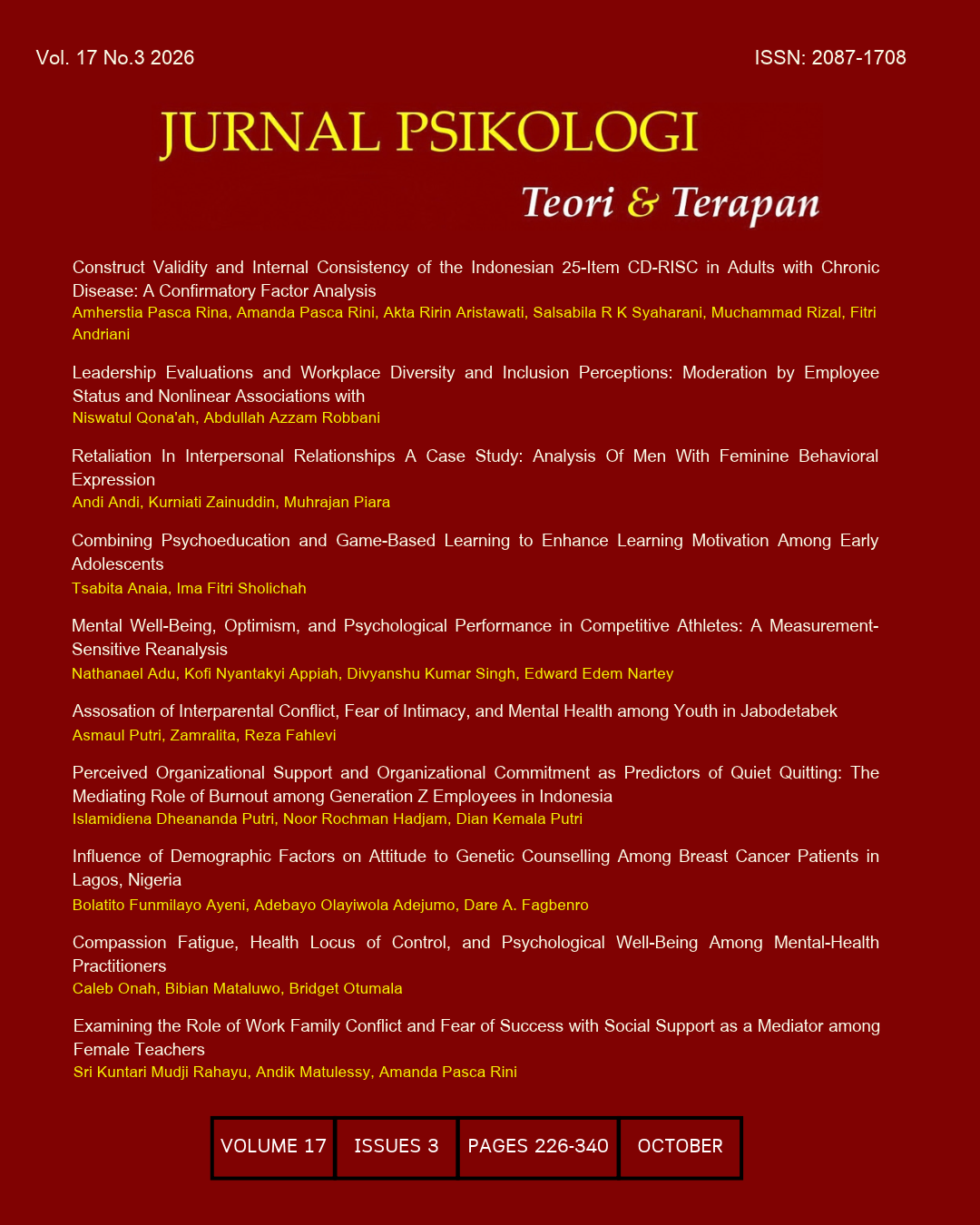
Retaliation In Interpersonal Relationships A Case Study: Analysis Of Men With Feminine Behavioral Expression
DOI:
https://doi.org/10.26740/jptt.v17n03.p251-260Keywords:
Retaliation, interpersonal relationships, men with feminine behavioral expressionAbstract
Background: Men with feminine behavioral expression may experience social pressure and discrimination in interpersonal relationships, potentially affecting their psychological responses. Objective: This study aimed to analyze the forms, triggers, impacts, and expectations associated with retaliation in the interpersonal relationships of men with feminine behavioral expression. Method: A qualitative case study approach was employed involving three male participants aged 19–21 who had experienced interpersonal conflict. Data were collected through semi-structured interviews and participant observation, then analyzed using thematic analysis. Results: Retaliation emerged as a response to perceived injustice and an attempt to preserve self-esteem. Its forms included passive, active non-destructive, and active destructive behaviors. Key triggers included emotional distress caused by bullying, peer pressure, discrimination, and social rejection. Although retaliation provided temporary relief, it also resulted in guilt, regret, restricted social relationships, and a risk of isolation. Conclusion: The findings highlight the need for psychological support that strengthens emotion regulation skills and promotes inclusive social environments to reduce conflict escalation and foster healthier interpersonal relationships.
References
Aisha, S., & Natasha, M. B. (2024). Analisis perlindungan hukum terhadap korban diskriminasi di Indonesia. MOTEKAR: Jurnal Multidisiplin Teknologi dan Arsitektur, 2(1), 45-58. https://doi.org/10.57235/motekar.v2i1.2334
Bastian, B., Jetten, J., & Radke, H. R. (2020). The interpersonal and psychological costs of interpersonal retaliation. Journal of Experimental Social Psychology, 88, Article 103963. https://doi.org/10.1016/j.jesp.2020.103963
Baumeister, R. F., & Leary, M. R. (1995). The need to belong: Desire for interpersonal attachments as a fundamental human motivation. Psychological Bulletin, 117(3), 497–529. https://doi.org/10.1037/0033-2909.117.3.497
Bosson, J. K., Jurek, P., Vandello, J. A., Kosakowska-Berezecka, N., Olech, M., Besta, T., ... & Žukauskienė, R. (2021). Psychometric properties and correlates of precarious manhood beliefs in 62 nations. Journal of Cross-Cultural Psychology, 52(3), 231–258. https://doi.org/10.1177/0022022121997997
Braun, V., & Clarke, V. (2006). Using thematic analysis in psychology. Qualitative Research in Psychology, 3(2), 77–101. https://doi.org/10.1191/1478088706qp063oa
Chen, S., Szepsenwol, O., Cheng, Y., Simpson, J. A., & Griskevicius, V. (2025). Emotion regulation and mental health across cultures: A systematic review and meta-analysis. Nature Human Behaviour, 9(6), 1176–1200. https://doi.org/10.1038/s41562-025-02168-8
Chester, D. S. (2023). The role of retaliatory aggression in social rejection and emotional regulation. Current Opinion in Behavioral Sciences, 49, Article 101243. https://doi.org/10.1016/j.cobeha.2022.101243
Creswell, J. W., & Poth, C. N. (2018). Qualitative inquiry and research design: Choosing among five approaches (4th ed.). SAGE Publications.
Dalimunthe, A. Q., Sinulingga, N. N., Koto, T. I., & Ananda, D. (2024). Toxic friendship communication behavior: Studi mahasiswa BPI Universitas Islam Negeri Sumatera Utara. Community Development Journal: Jurnal Pengabdian Masyarakat, 5(1), 1826–1831. https://doi.org/10.31004/cdj.v5i1.27530
Eder, A. B., Mitschke, V., & Gollwitzer, M. (2020). What stops revenge taking? Effects of observed emotional reactions on revenge seeking. Aggressive Behavior, 46(4), 305–316. https://doi.org/10.1002/ab.21890
Elliott, K. (2020). Caring masculinities: Conceptualizing an emergent category of masculine practices. Men and Masculinities, 23(2), 255–276. https://doi.org/10.1177/1097184X19830508
Gough, B., & Novikova, I. (2020). Mental health, masculinities, and culture: Student perspectives from the UK and Latvia. Psychology of Men & Masculinities, 21(4), 585–595. https://doi.org/10.1037/men0000259
King, T. L., Shields, M., Sojo, V., Daraganova, G., & Currier, D. (2020). Expressions of masculinity and associations with suicidal ideation among young Australian men. Social Science & Medicine, 249, Article 112858. https://doi.org/10.1016/j.socscimed.2020.112858
Levant, R. F., McDermott, R. C., Parent, M. C., & Alshabani, N. (2020). Development and initial validation of the Normative Male Restrictive Emotionality Scale (NMRES). Psychology of Men & Masculinities, 21(3), 443–456. https://doi.org/10.1037/men0000244
Liao, J., Sun, X., Fang, X., Li, F., & Lei, L. (2025). The relationships between motivations and different forms of online trolling among early adolescents: Gender differences in network analysis. Journal of Interpersonal Violence, 40(3–4), 1234–1256. https://doi.org/10.1177/08862605251360035
Moieni, M., & Eisenberger, N. I. (2020). Effects of social disconnection on neural and physical health. Current Opinion in Psychology, 34, 118–123. https://doi.org/10.1016/j.copsyc.2020.02.007
Molho, C., Balliet, D., & Wu, J. (2020). Direct and indirect punishment among strangers in the field. Nature Human Behaviour, 4(10), 1024–1031. https://doi.org/10.1038/s41562-020-0914-5
Murray, S. L., Gabriel, S., Lamarche, V. M., Seery, M. D., McNulty, J. K., Ward, D. E., & Naidu, E. (2025). When do real-world rejections motivate people to seek out symbolic social bonds? Insights from the risk-regulation model. Personality and Social Psychology Bulletin, 51(2), 384–699. https://doi.org/10.1177/01461672251384699
Mwilambwe-Tshilobo, L., & Spreng, R. N. (2021). Social exclusion engages the default and salience networks: A meta-analysis of Cyberball studies. NeuroImage, 230, Article 117796. https://doi.org/10.1016/j.neuroimage.2021.117796
Nevid, J. S., & Chozim, M. (2021). Gender dan seksualitas: Konsepsi dan aplikasi psikologi. Nusamedia.
Pachankis, J. E., Mahon, C. P., Jackson, S. D., Fetzner, B. K., & Bränström, R. (2020). Sexual orientation concealment and mental health: A conceptual framework and research agenda. Psychology of Sexual Orientation and Gender Diversity, 7(2), 127–140. https://doi.org/10.1037/sgd0000371
Puckett, J. A., Surace, F. I., Levitt, H. M., & Mogensen, B. (2021). The effects of identity concealment and social support on depression and anxiety in gender diverse individuals. Journal of Contextual Behavioral Science, 20, 195–204. https://doi.org/10.1016/j.jcbs.2021.04.004
Sarno, E. L., Mohr, J. J., Jackson, S. D., & Fassinger, R. E. (2020). When concealment matters: Examining the associations between concealment motivation, disclosure, and well-being. Journal of Counseling Psychology, 67(4), 488–498. https://doi.org/10.1037/cou0000411
Scheepers, D., & Ellemers, N. (2019). Social identity theory. In K. Sassenberg & M. L. W. Vliek (Eds.), Social psychology in action: Evidence-based interventions from theory to practice (pp. 41–54). Springer. https://doi.org/10.1007/978-3-030-13788-5_4
Seidler, Z. E., Rice, S. M., River, J., Oliffe, J. L., & Dhillon, H. M. (2021). Men’s mental health services: The case for a masculinities-based approach. Psychiatric Services, 72(4), 486–488. https://doi.org/10.1176/appi.ps.202000222
Stanaland, A., Gaither, S., & Gassman-Pines, A. (2023). When is masculinity “fragile”? An expectancy-discrepancy-threat model of masculine identity. Personality and Social Psychology Review, 27(4), 401–427. https://doi.org/10.1177/10888683221141176
Strimling, P., De Barra, M., & Eriksson, K. (2021). The evolution of moral norms against harm and unfairness. Evolution and Human Behavior, 42(3), 227–236. https://doi.org/10.1016/j.evolhumbehav.2020.10.005
Vescio, T. K., & Schermerhorn, N. E. C. (2021). Prioritizing hegemonic masculinity: An overarching framework for understanding gender differences in dominance, support for traditional gender roles, and systemic inequality. Current Opinion in Behavioral Sciences, 39, 137–142. https://doi.org/10.1016/j.cobeha.2021.03.011
Downloads
Published
How to Cite
Issue
Section
License
Copyright (c) 2026 Andi Andi, Kurniati Zainuddin, Muhrajan Piara

This work is licensed under a Creative Commons Attribution 4.0 International License.
Authors who publish in this journal agree to the following terms:
Copyright in any article is held by the author.
The author grants the journal, publication rights with the work simultaneously licensed under a Creative Commons Attribution License that allows others to share the work with an acknowledgment of the work's authorship and initial publication in this journal.
Authors may enter into separate, additional contractual arrangements for the non-exclusive distribution of the journal's published version of the work (e.g., posting it to an institutional repository or publishing it in a book), with an acknowledgment of its initial publication in this journal.
Authors are permitted and encouraged to post their work online (e.g., in an institutional repository or on their website) prior to and during the submission process, as this can lead to productive exchanges, as well as earlier and greater citation of published work.
 Abstract views: 0
,
 PDF Downloads: 1