
The Decolonizing the Papuan Body: Hybridity and Identity Politics in Jecko Siompo’s Animal Pop Choreographic Practice Dekolonisasi Tubuh Papua: Hibriditas dan Politik Identitas dalam Praktik Koreografi Pop Hewan Jecko Siompo
Article Sidebar
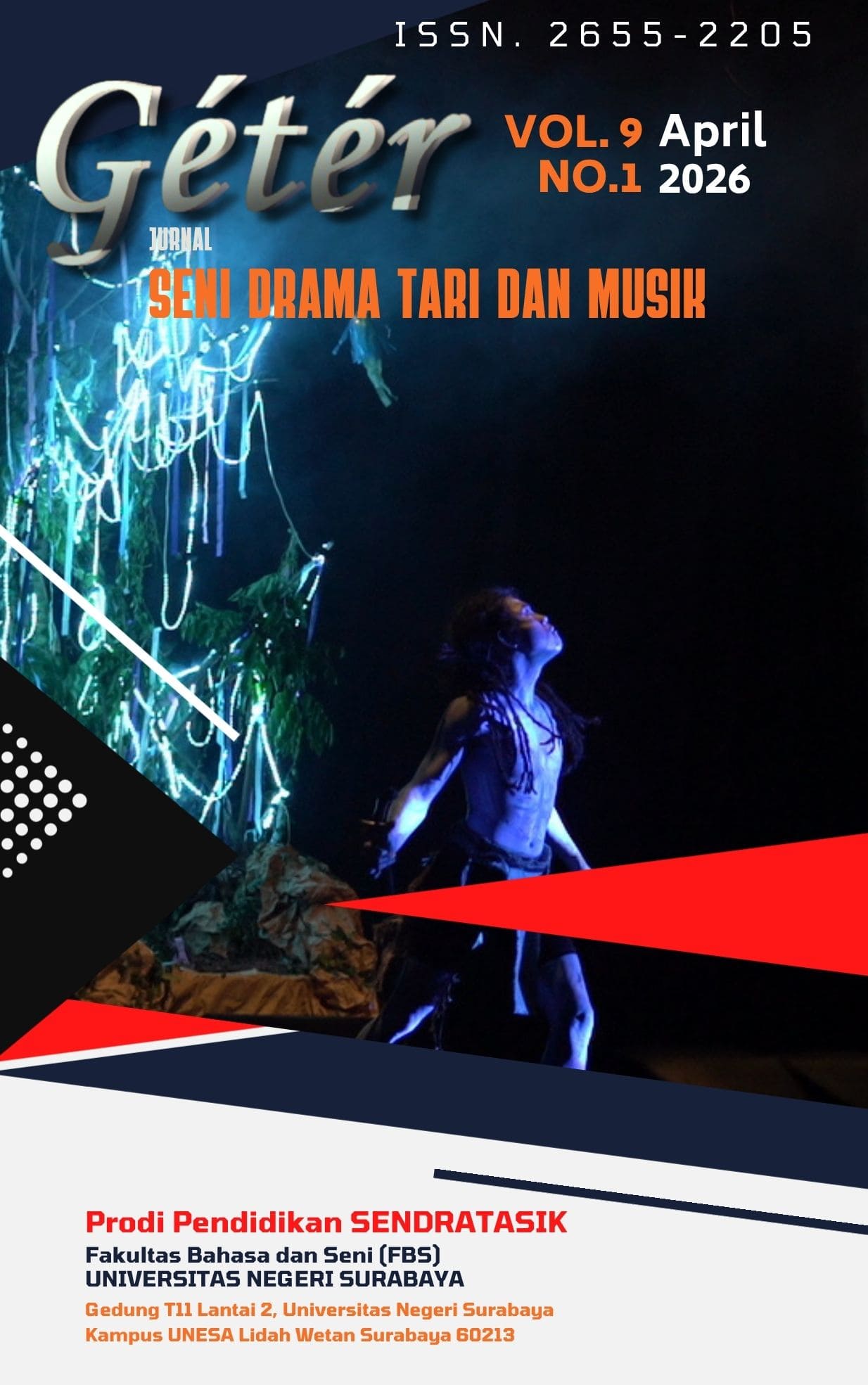
Main Article Content
Abstract
In Indonesia's contemporary dance landscape, the Papuan body is often caught in the tug-of-war between the legacy of colonial representation and the dynamics of urban modernity. This article aims to analyze how Jecko Siompo's Animal Pop rearticulates Papuan identity through choreographic practices in Jakarta. The research uses a qualitative approach with a case study design, through visual observation of the work, archival review, and continuous engagement with the choreographer's artistic environment.
The findings show that Animal Pop does not simply combine Papuan movements and global hip-hop, but rather presents a body practice that simultaneously negotiates ecological memory, references to fauna movements, and urban rhythms. The dancer's body serves as a living archive that maintains the tendency of environment-based movement while responding to the demands of metropolitan life. Movement patterns such as grounded postures, asymmetrical articulation, and rhythmic transitions indicate the existence of repeated embodied negotiation processes .
This article concludes that Jakarta is not only a production space, but also an important site in the transmission and reformulation of Papuan identity, especially through Jecko Siompo's artistic and pedagogical practice. Through the perspective of decolonial aesthetics, Animal Pop shows that decolonization does not take place as an abstract discourse, but as a living, situational, and continuously negotiated practice of movement. These findings contribute to the development of the study of contemporary dance, particularly in understanding the body as a medium of articulation of cultural identity and memory in urban spaces.
Article Details

This work is licensed under a Creative Commons Attribution-ShareAlike 4.0 International License.
kepemilikan artikel milik AutorReferences
Al-Fayyadl, M. (2022). The decolonization of the Indonesian body: Postcolonial philosophy, aesthetics, and subjects. Journal of Southeast Asian Cultural Studies, 14(2), 112–128.
Amin, M. (2023). Street dance as spatial reclamation: Youth subculture in metropolitan Jakarta. Review of Urban Sociology, 41(3), 305–321.
Barker, T. (2021). Media technology and Southeast Asian performance archiving. Asian Theatre Journal, 38(1), 89–110.
Bayuaji, R. (2025). Ecological memory in contemporary Indonesian dance: A sensory anthropological approach. Journal of Art Anthropology, 19(1), 45–62.
Buttingsrud, C. (2021). Embodied memory and archival practices in performance. Dance Research Journal, 53(2), 45–62. https://doi.org/10.1017/S014976772100005X
Carr, D., & Baddoo, N. (2020). Digital archiving and performance preservation: Challenges and strategies. International Journal of Performance Arts and Digital Media, 16(3), 245–260. https://doi.org/10.1080/14794713.2020.1816805
Chang, L., & Hogans, K. (2021). Pedagogical shifts in 21st-century arts education: Multimodal learning and cultural transmission. International Journal of Education & the Arts, 22(8), 1–21.
Conti, A. (2020). Youth agency and popular culture in metropolitan space: Negotiating identity under urban pressure. Sociological Compass, 14(6), e12790.
Dibia, I. W. (2020). Kinetic intersections in modern choreographic practices across Indonesia. Jurnal Seni Tari, 11(2), 150–165.
Fajrie, M., Santosa, P., & Haryono, S. (2024). A transformative ecosystem of contemporary choreographic practices in Eastern Indonesia. VIBRATION: Journal of Dance Arts, 7(1), 22–39. https://doi.org/10.26740/geter.v7n1.22-39
Febrianty, D., Nugroho, A., & Purba, S. (2024). Deconstructing cultural narratives through the body: Identity politics in modern Indonesian performance. Asian Cultural Studies, 29(4), 411–428.
Fukuoka, Y. (2020). Performing bodies and cultural memory in Southeast Asian dance. Asian Theatre Journal, 37(2), 389–405. https://doi.org/10.1353/atj.2020.0021
Garrett, M. (2024). Influence and embodiment in dance pedagogy: Teaching beyond verbal paradigms. Research in Dance Education, 25(2), 198–215.
Giese, M., & Keightley, E. (2024). Memory, embodiment, and cultural transmission in performance. Memory Studies, 17(2), 233–249. https://doi.org/10.1177/17506980221100000
Haryono, S. (2023). Urban pressures and cultural resilience in Papuan diaspora. Journal of Ethnic and Migration Studies, 49(5), 1140–1158.
Kiptiyah, M., & Santosa, P. (2022). Visual sociology of contemporary Indonesian art: Hybridity and cultural representation. Visual Studies, 37(3), 250–267.
Kurt, S. (2020). Identity, dynamic agency, and the dancing subject: A socio-political perspective. European Journal of Cultural Studies, 23(4), 589–606.
Metcalfe, R., & Llewellyn, S. (2020). Multimodal digital cognition in adolescent identity negotiation. New Media & Society, 22(9), 1621–1640.
Murgiyanto, S. (2021). Indonesian dance traditions and innovations: Tracing the trail of hybridity. IKJ Postgraduate Publisher.
Nugroho, A. (2023). Political economy of creative industries in Eastern Indonesia. Journal of Creative Industries, 16(2), 134–152.
Olsen, T. (2024). Techno-embodiment and media in contemporary cultural sustainability. Journal of Media Practice and Education, 25(1), 33–50.
Patiño Rabines, J. (2023). Decolonial aesthetics and performative recognition. Cultural Studies, 37(5), 780–801.
Payne, H. (2024). Reclaiming marginalized identities through global hip-hop. Popular Music and Society, 47(2), 180–199.
Pratama, A., & Widiastuti, R. (2025). Embodied code-switching in bilingual and multicultural contexts. Bulletin of Language and Literature Studies, 12(1), 45–63.
Purba, S. (2022). Animal Pop: Kinetic syntax and cultural hybridity in Jecko Siompo's choreography. Journal of the Study and Creation of Art, 18(2), 88–104.
Rifai, M., & Hutabarat, E. (2025). Managing hybrid identity in the global creative economy. Arts Education Policy Review, 126(1), 12–29.
Saidah, N., Wibowo, A., & Lestari, P. (2025). Spatial contestation in Eastern Indonesian cultural landscapes. Postcolonial Writing, 61(1), 77–95.
Semmalar, P., Kumar, R., & Devi, S. (2022). Decolonial aesthesis and embodied resistance. Interventions, 24(6), 845–863.
Smith, L. T. (2021). Decolonizing methodologies: Research and Indigenous peoples (3rd ed.). Zed Books.
Sustiawati, N. L., Arini, A., & Putra, K. (2021). Navigating urban subcultures and local wisdom in Indonesian dance. Asian Ethnology, 80(1), 115–136.
Whatley, S. (2022). Cultural property and embodied dance transmission in the 21st century. Dance Research, 40(1), 22–39.
Wijaya, H. (2024). Multimodal cognition and survival of traditional arts in the digital era. Journal of Digital Culture and Electronic Scholarship, 10(2), 210–228.
Zefanya, C., & Isa Ansari, M. (2025). Rearticulating cultural sovereignty in Papuan choreography. Asia Pacific Journal of Anthropology, 26(1), 50–68.