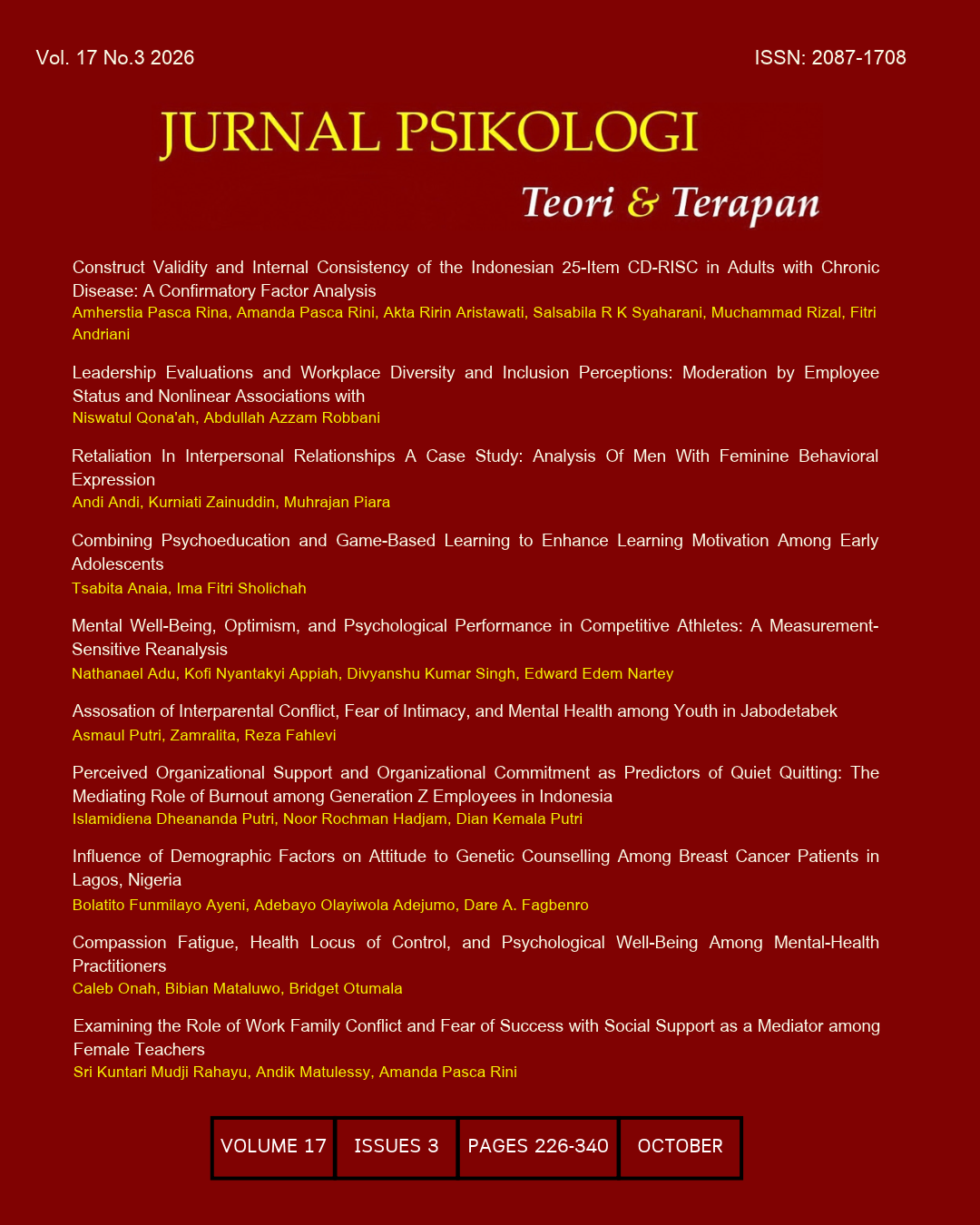
Influence of Demographic Factors on Attitude to Genetic Counselling Among Breast Cancer Patients in Lagos, Nigeria
DOI:
https://doi.org/10.26740/jptt.v17n03.p304-313Keywords:
Attitude toward genetic counselling, gender, marital status, educational qualificationAbstract
Background: Many factors have been investigated on attitude to genetic counselling among cancer patients but the role demographic factors can play on attitude to genetic counselling is still scarce in the extant literature. Objective: The study examined the influence of demographic factors (marital status and educational qualification) on attitude toward genetic counselling among breast cancer patients in Lagos, Nigeria. Method: The study adopted an ex post facto cross-sectional study design to purposively selected 187 respondents (mean age = 49.9years, σ = 14.04) who responded to a completed measures of socio demographic factors and attitude toward genetic counselling scale. Results: The results revealed that there was statistically significant main influence of marital status on attitude toward genetic counselling (F4,182 = 3.32, p<.05), with widowed patients having favourable attitude toward genetic counselling. There was also no statistically significant influence of educational qualification on attitude toward genetic counselling (F4,182 = 1.96, p>.05). Conclusion: The study concluded that marital status specifically divorced cancer patients have favourable attitude toward genetic counselling.
References
Adejumo, A., & Olaoye, M. (2018). Moderating role of gender on genetics knowledge, perceived need for genetic testing and attitude to genetic counseling among people living with SCD. Gender and behaviour, 16(1), https://hdl.handle.net/10520/EJC-fe228ba2a
Ajzen, I., & Fishbein, M. (1980). Understanding attitudes and predicting social behavior Prentice-Hall Inc. Englewood Cliffs, NJ.
Al shawish, E., & Yaseen, F. (2018). Knowledge and attitude toward genetic counseling and testing among parents of children with genetic disorder in the West Bank/ Palestine. Palestinian Medical and Pharmaceutical Journal (PMPJ), 3(1), 24-30. https://journals.najah.edu/journal/pmpj/issue/pmpj-v3-i1/article/1502/
Al-Enezi, K., & Mitra, A.K. (2017). Knowledge, Attitude, and Satisfaction of University Students Regarding Premarital Screening Programs in Kuwait. European Journal of Environment and Public Health, 1(2), 07. https://doi.org/10.20897/ejeph/78075
Arnold, M., Morgan E., Rumgay H., Mafra A., Singh D., & Laversanne M. (2022). Current and future burden of breast cancer: Global statistics for 2020 and 2040. The Breast, 66, 15-23. https://doi: 10.1016/j.breast.2022.08.010
Bener, A., Al-Mulla, M., & Clarke, A. (2019). Premarital Screening and Genetic Counseling Program: Studies from an Endogamous Population. International Journal Applied Basic Medcal Research, 9(1):20-26. https://doi.org/10.4103/ijabmr.IJABMR_42_18.
Bhatia, D., Lega, I.C., Wu, W., & Lipscombe, L.L. (2020) Breast, Cervical and Colorectal Cancer Screening in Adults with Diabetes: A Systematic Review and Meta-Analysis. Diabetologia 63, 34–48. https://doi: 10.1007/s00125-019-04995-7.
Botoseneanu, A., Alexander, J. A., & Banaszak-Holl, J. (2011). To test or not to test? The role of attitudes, knowledge, and religious involvement among US adults on intent-to-obtain adult genetic testing. Health Education & Behaviour, 38(6), 617–628. https://doi: 10.1177/1090198110389711
Calsbeek, H., Morren M., Bensing J., & Rijken M. (2007). Knowledge and Attitudes Towards Genetic Testing: A TwoYear Follow‐Up Study in Patients with Asthma, Diabetes Mellitus and Cardiovascular Disease. Journal of Genetic Counseling, 6(4), 493–504. https://doi: 10.1007/s10897-006-9085-9.
Čargonja, P., Mavrinac, M., Ostojić, S., & Pereza, N. (2021). The impact of needs-based education on the change of knowledge and attitudes towards medical genetics in medical students. European Journal of Human Genetics, 29:726–735. https://doi.org/10.1038/s41431-020-00791-9
Cuthrell, KM., & Tzenios N.(2023). Breast Cancer: Updated and Deep Insights. International Research Journal of Oncology, 6(1), 104-118. https://journalirjo.com/index.php/IRJO/article/view/129.
Ghanim, M., Rabayaa, M., Alqub, M., Hanani, A., Abuawad, M., Rahhal, B., Qadous, S., Barahmeh, M., Atout, S., Al-Lahham, S., Aref, A., Dwikat, M., Alkhaldi, S., & Makhamreh, A. (2025). Investigating knowledge and attitudes toward genetic testing and counseling among Palestinians Science Representation, 15(1):4446. https://doi.org/10.1038/s41598-024-84733-1.
Global cancer observatory [homepage on the Internet]. [cited 2021 Dec 3]. Available from: https://gco.iarc.fr/today/data/factsheets/populations/426-lesotho-fact-sheets.pdf
Hair, J. F., Black, W. C., Babin, B. J., & Anderson, R. E. (2010). Multivariate data analysis (7th ed.). Pearson.
Henneman L., Timmermans D., & Wal, G. (2006). Public Attitudes Toward Genetic Testing: Perceived Benefits and Objections. Genetic Testing, 10(2), 139–145. https://doi: 10.1089/gte.2006.10.139.
Huang J., Chan, PS., Lok, V., Chen, X., Ding, H., & Jin Y. (2021). Global incidence and mortality of breast cancer: a trend analysis. Aging (Albany NY). 13(4), 5748–5803. https://doi: 10.18632/aging.202502
Khalil, K., Hasan, M., & Injamul, M. (2026). Knowledge, attitudes, and perceptions towards premarital screening among undergraduate university students in Chattogram district, Bangladesh: a cross sectional study. BMC Public Health, 26:720. https://doi.org/10.1186/s12889-026-26464-8
Leach, V. (2010). Gender differences in attitudes towards genetic testing, risk interpretation and genetic testing. The Journal of Young Investigators, 19(20), 1-9.
Likhanov, M, Zakharov, I., Awofala, A., Ogundele O., Selita, F., & Kovas, Y. (2023). Attitudes towards genetic testing: The role of genetic literacy, motivated cognition, and socio-demographic characteristics. PLoS ONE 18(11), e0293187. https://doi.org/10.1371/journal.pone.0293187
Martei, Y.M., Dauda, B., & Vanderpuye, V. (2022). Breast Cancer Screening in Sub-Saharan Africa: A Systematic Review and Ethical Appraisal. BMC Cancer, 22, 203. https://doi.org/ 10.1186/s12885-022-09299-5.
Mochiki, I., Okugawa, Y., Hashizume, R., Imai, H., Ikejiri, M., Ogura, T., Nakatani, K., & Hori, H. (2022). Psychological characteristics of Japanese patients and their family members receiving genetic counseling: A single-institute exploratory study. Journal of Genetic Counselling, 32(1),128-139. https://doi.org/ 10.1002/jgc4.1629.
Morren M, Rijken M, Baanders A., & Bensing J. (2007). Perceived genetic knowledge, attitudes towards genetic testing, and the relationship between these among patients with a chronic disease. Patient Education and Counseling, 65(2), 197–204. https://doi.org/ 10.1016/j.pec.2006.07.005
Muhammed , A., & Ojo, M. (2026). Relationship between knowledge attitude and practice of pre-marital genetic counseling and testing for sickle cell disease among undergraduate students. Research Journal of Health, Medicine and Nursing, 14(2), 1–10. https://doi.org/10.5281/zenodo.19483180
Muzata K., Walubita, G., Muzatab D., Sefotho, M., Monaheng, M., & Chakulimba, O. (2020). Journal of Educational Research on Children, Parents and Teacher, 1(2), 90-103.
Muzata, K.K. (2019). Terminological abuse versus inclusion: An analysis of selected terms used to describe persons with disabilities in Luvale. Journal of Lexicography and Terminology, 3(1), 1-32. https://journals.unza.zm/index.php/jlt/article/view/103/108
Myint, N., Martawinarti, R., Nasution, R., Irwanti, P., Sari, L., Oktaria, R., & Mutmainnah, M. (2025). Psychological Impact of Breast Cancer Diagnosis and Patient Coping Strategies: a Literature Review. Jurnal Ilmiah Ners Indonesia, 6(1), 62-71 https://doi.org/10.22437/jini.v6i1.43945 e-ISSN: 2722-9211
Ngene, S., Adedokun, B., Adejumo, P., & Olopade, O. (2018). Breast Cancer Genetics Knowledge and Testing Intentions among Nigerian Professional Women. Journal of Genetic Counseling, 27:863–873. https://doi.org/10.1007/s10897-017-0194-4
Nja, G., Okaliwe, G., Ibor, G.O., Ogunkola, I.O., Okoroiwu, H.U., Ejemot-Nwadiaro, R.I., & Lucero-Prisno, D.E. III. (2022). Socio-Demographic Determinants of Mammography Uptake among Women of 40 Years and above in Calabar, South-South, Nigeria: A Cross-Sectional Study. Pan African Medical Journal, 43, 76. https://www.scirp.org/reference/referencespapers?referenceid=3340597
Ogunniyi, T., Fatokun, B., Isah, K., Abdulbaki, A., Emiola, R., & Batisani, K. (2025).Current Status of Cancer Diagnosis and Treatment in Nigeria. Health Science Reports, 8:e70877. https://doi.org/10.1002/hsr2.70877
Olanrewaju, F., & Adejumo, A. (2021). Role of SMS-Based Psycho-Education on Attitude to Genetic Counselling And Cancer-Risk Perception Among Relative of Persons Living With Cancer in Ibadan, Nigeria. International Journal of Emergency Mental Health and Human Resilience, 23(5), 65-77. https://doi.org/10.4172/1522-4821.1000472
Olubiyi, S. K., Umar, J. N., Ajiboye, O., Olubiyi, V. M., & Abioye, T. (2013). Knowledge and attitude of undergraduates of Ekiti State University towards sickle cell disease and genetic. Texila International Journal of Public Health, 4(3), https://doi.org/10.21522/TIJPH.2013.04.03.Art002
Ramathebane MM., Sooro MA., Kabuya, RM., & Sayed, A-R. (2022). Knowledge and attitudes relating to cervical and breast cancer among women in Maseru, Lesotho. African Journal Primary Health Care Family Medicine, 14(1), a3459. https://doi.org/10.4102/phcfm.v14i1.3459
Reddy, K., & Salve, P. (2024). Biogenic Synthesis of Silver Nanoparticles from Hylocereus Undatus Peel Waste: Exploring EGFR Inhibition for Targeted Therapy of Cervical and Breast Carcinomas. Future Journal Pharmacy Science, 10, 160. Future Journal of Pharmaceutical Sciences, 10:160. https://doi.org/10.1186/s43094-024-00737-8
Rosenstock, I. M. (1974). Historical origins of the health belief model. Health education monographs, 2(4), 328-335.
Sanderson, SC., Wardle, J., Jarvis, MJ., & Humphries, SE. (2004) Public interest in genetic testing for susceptibility to heart disease and cancer: a population-based survey in the UK. Preventive Medicine, 39(3), 458–64. https://doi.org/ 10.1016/j.ypmed.2004.04.051.
Siani, M., & Assaraf, O. (2015). University Students' Attitudes towards Genetic Testing: A Comparative Study. American Journal of Public Health Research, 3(3), 81-90. https://doi.org/10.12691/ajphr-3-3-1
Siegel, R. L., Miller, K. D., Wagle, N. S., & Jemal, A. (2023). Cancer statistics, 2023. CA: A Cancer Journal for Clinicians, 73(1), 17–48. https://doi.org/10.3322/caac.21763
Toiviainen, H., Jallinoja, P., Aro, R., & Hemminki, E. (2003). Medical and lay attitudes towards genetic screening and testing in Finland. European Journal of Human Genetics, 11, 565–572. https://doi.org/ 10.1038/sj.ejhg.5201006.
Wuraola, F., Dare, A., Ramruthan, J., Reel, E., Santiago, T., Sharif, F., Olayide, A., Sunday-Nweke, N., Alatise, O., & Cil, T. (2025). Knowledge and perceptions of genetic testing for patients with breast cancer in Nigeria: A survey of healthcare providers. Hereditary Cancer in Clinical Practice, 23(1):16. https://doi.org/ 10.1186/s13053-025-00315-w.
Yamane, T. (1967). Statistics: An Introductory Analysis (2nd ed.). New York: Harper and Row.
Downloads
Published
How to Cite
Issue
Section
License
Copyright (c) 2026 Ayeni, Adejumo, Dare A. Fagbenro

This work is licensed under a Creative Commons Attribution 4.0 International License.
Authors who publish in this journal agree to the following terms:
Copyright in any article is held by the author.
The author grants the journal, publication rights with the work simultaneously licensed under a Creative Commons Attribution License that allows others to share the work with an acknowledgment of the work's authorship and initial publication in this journal.
Authors may enter into separate, additional contractual arrangements for the non-exclusive distribution of the journal's published version of the work (e.g., posting it to an institutional repository or publishing it in a book), with an acknowledgment of its initial publication in this journal.
Authors are permitted and encouraged to post their work online (e.g., in an institutional repository or on their website) prior to and during the submission process, as this can lead to productive exchanges, as well as earlier and greater citation of published work.
 Abstract views: 0
,
 PDF Downloads: 0