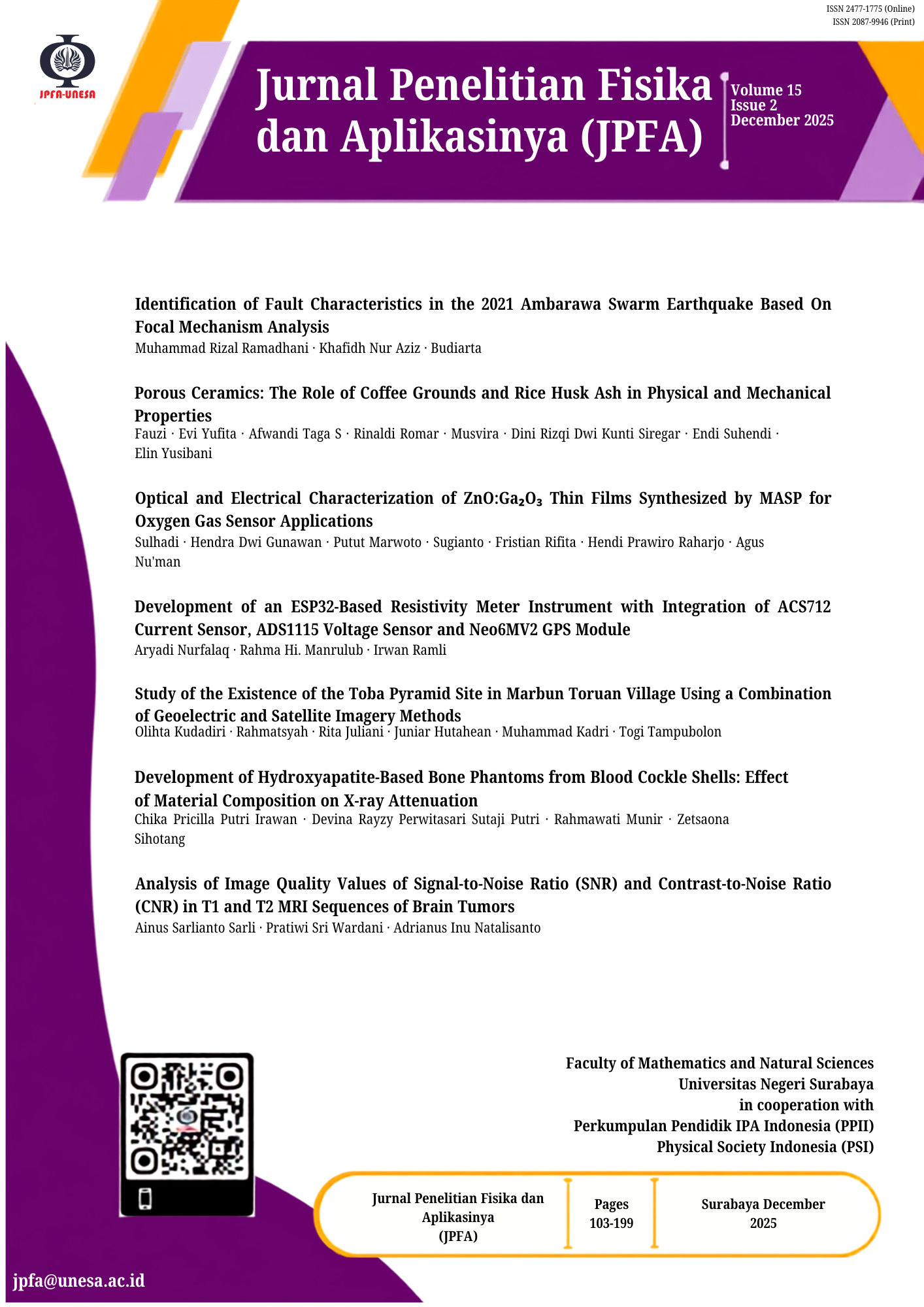
Development of an ESP32-Based Resistivity Meter Instrument with Integration of ACS712 Current Sensor, ADS1115 Voltage Sensor and Neo6MV2 GPS Module
DOI:
https://doi.org/10.26740/jpfa.v15n2.p145-158Keywords:
ESP32 based system, IoT integrationAbstract
This study aims to develop an ESP32-based resistivity meter instrument integrated with an ACS712 current sensor, an ADS1115 voltage sensor, and a Neo6MV2 GPS model. This IoT-based instrument can be operated remotely so that it can streamline measurements. The method used in this study is the R&D method where this method aims to create innovations in the form of new and applicable products, systems, or models, and test their effectiveness. The research stages start from hardware design assembled based on block diagrams, software design using the Arduino IDE using the C++ programming language, testing and data collection. The results of the study showed that the ADS 1115 sensor has an average measurement error (% error) of 5.1%, the ACS 712 current sensor has an average% error of 3.6%, and the Neo6MV2 GPS module has an average latitude difference of 0.000016 degrees (1.81 m) and longitude of 0.000025 degrees (2.83 m). Measurements can be performed remotely via smartphone using the ESP32 at a distance of 41 m. Comparison of the measurement data from the IoT resistivity meter with a standard resistivity instrument were obtained in the range of 7.771% - 12.815% with an average error of 9.625%. Based on these measurement results, the resistivity values this indicates that this instrument can be used to identify mined minerals and groundwater aquifers.
References
[1] Irianto, A. I., & Rahmawati, E. (2014). Prototipe Alat Ukur Resistivitas Tanah Dengan Metode Four-Point Probes. Prosiding Pertemuan Ilmiah XXVIII HFI. Yogyakarta.
[2] Usman, B., & Manrulu, R. H. (2018). Rancang Bangun Alat Geolistrik sebagai Pendeteksi Bawah Permukaan. Palopo: Program Studi Fisika FSAINS UNCP.
[3] Manrulu, R. H., Nurfalaq, A., & Hamid, I. D. (2018). Pendugaan Sebaran Air Tanah Menggunakan Metode Geolistrik Resistivitas Konfigurasi Wenner dan Schlumberger di Kampus 2 Universitas Cokroaminoto Palopo. Jurnal Fisika FLUX, 15(1), 6-12.
[4] Gawing, E. S., Suaedi, S., & Manrulu, r. H. (2022). Identifikasi Bidang Gelincir Longsor di Jalan Lingkar Barat Kota Palopo Menggunakan Metode Geolistrik Konfigurasi Dipole-Dipole . Applied Physics of Cokroaminoto Palopo Journal, 2(1), 9-14.
[5] Sukmawati, N. L., Manrulu, R. H., & Jusmi, F. (2021). Model 3D Akuifer Air Tanah Menggunakan Metode Geolistrik Schlumberger di Desa Alam Buana Kabupaten Luwu Timur. Applied Physics of Cokroaminoto Palopo Volume 2 No.2, 49-56.
[6] Namora, I., Jusmi, F., & Manrulu, R. H. (2022). Rancang Bangun Alat Penyiram Tanaman Otomatis Berbasis Mikrokontroler ATMEGA328P dengan Sensor Kelembaban Tanah V1. 2. Applied Physics of Cokroaminoto Palopo Volume 3 No. 1, 15-22.
[7] Lahallo, M., Suaedi, S., & Manrulu, R. H. (2022). Rancang Bangun Sensor Kelembaban Tanah Menggunakan Bahan Stainless Steel tipe 304 Berbasis Mikrokontroler Arduino. Applied Physics of Cokroaminoto Palopo Volume 3 No.2, 33-41.
[8] Yanti, N., Jusmi, F., & Manrulu, R. H. (2023). Rancang Bangun Smart Home Menggunakan Internet of Things Berbasis Mikrokontroler Nodemcu Esp8266. Applied Physics of Cokroaminoto Palopo Volume 4 No.1, 7-14.
[9] Widodo, W., Lapanroro, B. P., & Jumarang, M. I. (2018). Rancang bangun alat geolistrik berbasis arduino mega2560. Physics Communication Volume 2 No.1, 52-62.
[10] Huda, F., Harmadi, H., & Pohan, A. F. (2021). Rancang Bangun Prototipe Alat Geolistrik Menggunakan Arduino Uno R3 dan Transceiver nRF24L01. Jurnal Fisika Unand (JFU) Volume 10 No.4, 435-442.
[11] Rahman, A., Nurfalaq, A., & Manrulu, R. H. (2025). Rancang Bangun Alat Ukur Resistivitymeter Berbasis Arduino. Applied Physics of Cokroaminoto Palopo Volume 6 No. 1, 23-30.
[12] Sugiyono, P. D. (2017). Metode Penelitian Bisnis: Pendekatan Kuantitatif, Kualitatif, Kombinasi, dan R&D. Penerbit CV. Alfabeta: Bandung.
[13] Suryana, T. (2021). Antarmuka ublox NEO-6M GPS Module dengan NodeMCU ESP8266. Bandung: Universitas Komputer Indonesia
[14] Simanjuntak, L. T., Sitopu, M. W., & Aulia, T. (2025). Evaluasi Pengujian Akurasi Titik Koordinat GPS Neo 6MV2 Pada Sistem Monitoring Keberadaan Anak. Teknologi Rekayasa Jaringan Telekomunikasi, 5(1), 16-19.
[15] Pratama, Y. A., & Suharsono, S. (2025). Performance Evaluation of ADS 1256 for Geoelectric Data Acquisition System: Laboratory Scale Comparative Study. Jurnal Geofisika, 23(1), 23-32.
Downloads
Published
How to Cite
Issue
Section
License
Copyright (c) 2025 Jurnal Penelitian Fisika dan Aplikasinya (JPFA)

This work is licensed under a Creative Commons Attribution-NonCommercial 4.0 International License.
Author(s) who wish to publish with this journal should agree to the following terms:
-
- Copyright of articles published in Jurnal Penelitian Fisika dan Aplikasinya (JPFA) is held by Jurnal Penelitian Fisika dan Aplikasinya (JPFA).
- The author(s) grant JPFA the right to publish, reproduce, distribute, and make the article available in all forms and media.
- The published article is licensed under a Creative Commons Attribution-Non Commercial 4.0 License (CC BY-NC) that allows others to share the work with an acknowledgement of the work's authorship and initial publication in this journal for noncommercial purposes.
- Author(s) are able to enter into separate, additional contractual arrangements for the non-exclusive distribution of the journal's published version of the work (e.g., post it to an institutional repository or publish it in a book), with an acknowledgement of its initial publication in this journal.
The publisher publishes and distributes the article with copyright notice to Jurnal Penelitian Fisika dan Aplikasinya (JPFA) under the Creative Commons Attribution-NonCommercial 4.0 International License (CC BY-NC 4.0).
 Abstract views: 253
,
Abstract views: 253
, PDF Downloads: 92