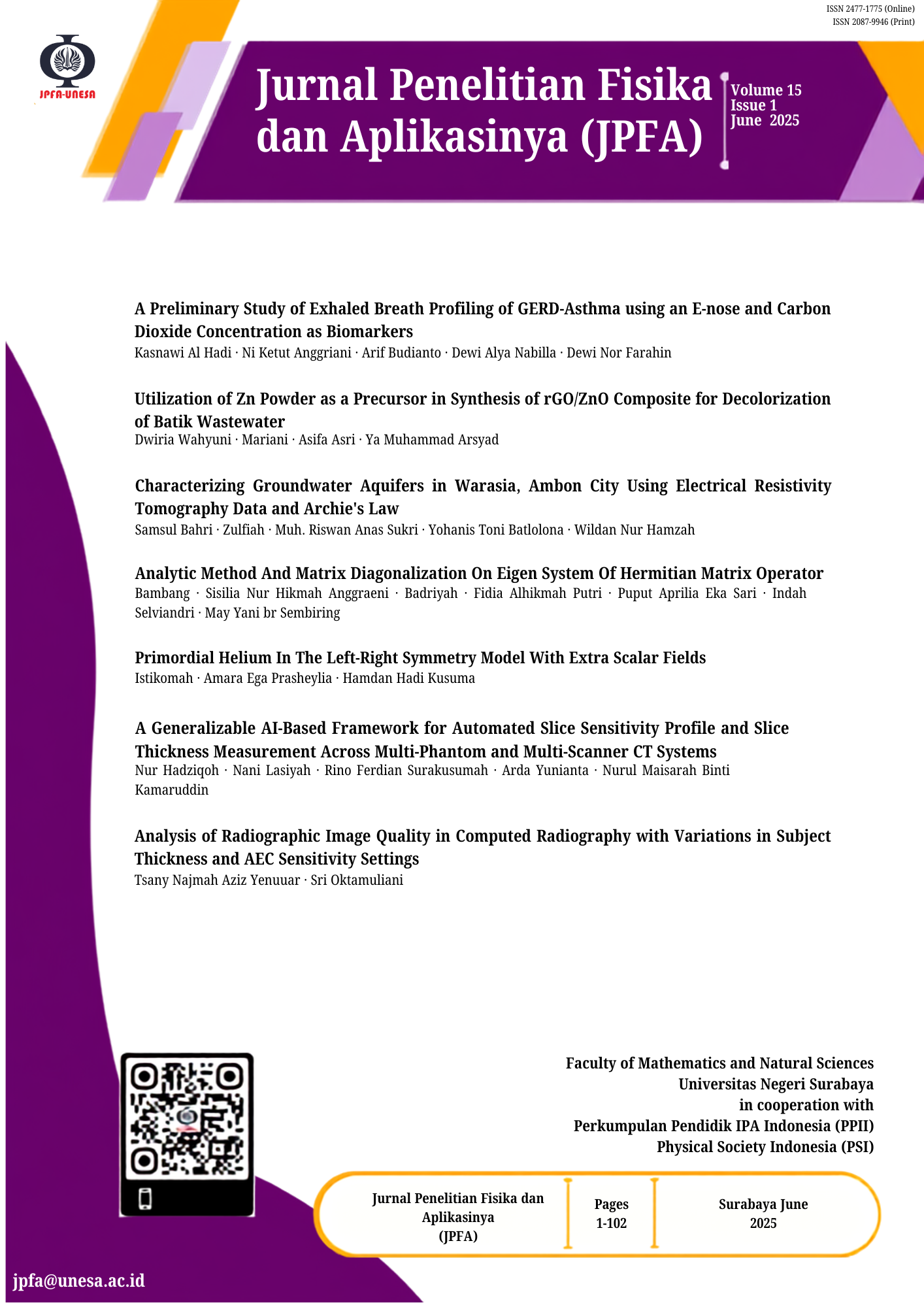
Analysis of Radiographic Image Quality in Computed Radiography with Variations in Subject Thickness and AEC Sensitivity Settings
DOI:
https://doi.org/10.26740/jpfa.v15n1.p89-102Keywords:
Computed Radiography, AuAtomatic Exposure Control, Signal-to-Noise Ratio, Exposure Index, Subject ThicknessAbstract
This study evaluates the influence of subject thickness variations and Automatic Exposure Control (AEC) sensitivity on radiographic image quality in Computed Radiography (CR) systems. A total of 16 radiographic images were analyzed, consisting of 12 images obtained from polymethyl methacrylate (PMMA) phantoms and 4 images from the TOR CDR phantom. Experiments were conducted using phantoms with thicknesses of 10, 15, 20, and 25 cm. Radiographic exposures were performed at a fixed tube voltage of 70 kV, with the AEC system automatically adjusting the tube current-time product (mAs). For each PMMA thickness, exposures were repeated three times to evaluate Signal-to-Noise Ratio (SNR), contrast, and Exposure Index (EI), while TOR CDR images were acquired once per thickness variation. Image quality was assessed through Signal-to-Noise Ratio (SNR), contrast, and Exposure Index (EI) using ImageJ software and One-way ANOVA statistical testing. Results demonstrated that while the AEC effectively maintains contrast (p = 0.202) and EI (p = 0.796) within optimal diagnostic ranges, the SNR decreases significantly as subject thickness increases (p = 0.001). Optimal image quality was achieved at 10 cm for the TOR CDR phantom and 15 cm for the PMMA phantom. The study concludes that although AEC regulates dose consistency, additional protocol optimization is necessary for subjects exceeding 20 cm to mitigate SNR degradation caused by scattered radiation.
References
[1] Walsh C, Gorman D, Byrne P, Larkin A, Dowling A, and Malone JF. Quality assurance of computed and digital radiography systems. Radiat. Prot. Dosimetry. 2008; 129(1–3): 271–275. DOI: https://10.1093/rpd/ncn047.
[2] Moore CS, Wood TJ, Avery G, Balcam S, Neeedler L, Beavis AW, and Saunderson JR. An investigation of automatic exposure control calibration for chest imaging with a computed radiography system. Phys. Med. Biol. 2014; 59(9): 2307–2324. DOI: https://10.1088/0031-9155/59/9/2307.
[3] Khotle T, De Vos H, Herbst CP, and Rae WID. Optimization of Exposure Factors and Image Quality for Computed Radiography. In: Dössel O and Schlegel WC (Eds). World Congress on Medical Physics and Biomedical Engineering 2009. IFMBE Proceedings. Munich: Springer; 2009: 251–254. Available from: https://hero.epa.gov/reference/8170435.
[4] Irsal M. Evaluasi Exposure Index terhadap Faktor Eksposi dengan Metode 15% kVp Rule Of Thumb Pada Pemeriksaan Radiografi Kepala Proyeksi AP. J. Ilmu dan Teknol. Kesehat. 2021; 12(2): 62–68. DOI : https://10.33666/jitk.v12i2.414.
[5] Wulandari PI. Exposure Index (Ei) Sebagai Alat Optimisasi Pada Sistem Radiografi Digital: Implementasi Dan Tantangan Bagi Radiografer. Jurnal Radiogr. Indones. 2023; 6(1): 1–10. DOI : https://10.55451/jri.v6i1.167.
[6] Mazzocchi S, Falchini M, Ruggieri C, and Bucciolini M. AEC set-up optimisation with computed radiography imaging. Radiat. Prot. Dosimetry. 2006; 117(1–3): 169–173. DOI: https://doi.org/10.1093/rpd/nci743.
[7] Kawashima H, Ichikawa K, Hanaoka S, and Matsubara K. Optimizing image quality using automatic exposure control based on the signal-difference-to-noise ratio: a phantom study. Australas. Phys. Eng. Sci. Med. 2019; 42(3): 803–810. DOI: https://doi.org/10.1007/s13246-019-00784-z.
[8] Thakur Y, Bjarnason TA, Hammerstrom K, Marchinkow L, Koch T, and Aldrich JE. Assessment of patient doses in CR examinations throughout a large health region. J. Digit. Imaging. 2012; 25(1): 189–
195. DOI: https://doi.org/10.1007/s10278-011-9390-1.
[9] Sparzinanda E, Nehru N, and Nurhidayah N. Pengaruh Faktor Eksposi Terhadap Kualitas Citra Radiografi. J. Online Phys. 2018; 3(1): 14–22. DOI : https://10.22437/jop.v3i1.4428.
[10] Frank ED, Long BW, and Smith BJ. Merrill’s Atlas of Radiographic Positioning and Procedures. 12th Edition. Vol. 2. St. Louis: Elsevier Health Sciences; 2013.
[11] Dance DR, Evans SH, Skinner CL, and Bradley AG. Diagnostic Radiology with X-Rays. In: Webb’s Physics of Medical Imaging. 2nd Edition. Boca Raton: Taylor & Francis; 2016. DOI: https://doi.org/10.1201/b12218-11.
[12] Rasad S. Radiologi Diagnostik. 2nd Edition. Jakarta: Balai Penerbit FKUI; 2005.
[13] Papp J. Quality Management in The Imaging Sciences. 4th Edition. St. Louis: Mosby Elsevier; 2011.
[14] Fitriana L and Utami HS. Perbedaan Nilai Image Noise dan Dosis Radiasi dengan Menggunakan Automatic Exposure Control (AEC) pada Pemeriksaan CT Scan. J. Kesehat. 2021; 12(2): 131–136. DOI: https://doi.org/10.38165/jk.v12i2.259.
[15] United Nations Scientific Committee on the Effects of Atomic Radiation (UNSCEAR). Sources, Effects and Risks of Ionizing Radiation. 2021 Edition. Vol. 4. New York: United Nations; 2022. Available from: https://www.unscear.org/unscear/en/publications/2021_2022.html.
[16] Doyle P, Gentle D, and Martin CJ. Optimising automatic exposure control in computed radiography and the impact on patient dose. Radiat. Prot. Dosimetry. 2005; 114(1–3): 236–239. DOI: https://10.1093/rpd/nch548.
[17] Alzyoud K, Hogg P, Snaith B, Flintham K, and England A. Impact of body part thickness on AP pelvis radiographic image quality and effective dose. Radiography. 2019; 25(1): e11–e17. DOI: https://10.1016/j.radi.2018.09.001.
[18] Moore CS, Wood TJ, Jones S, Saunderson JR, and Beavis AW. A practical method to calibrate and optimise automatic exposure control devices for computed radiography (CR) and digital radiography (DR) imaging systems using the signal-to-noise ratio (SNR) metric. Biomed. Phys. Eng. Express. 2019;
5(3). DOI: https://10.1088/2057-1976/ab123b.
[19] Funama Y, Sugaya Y, Miyazaki O, Utsunomiya D, Yamashita Y, and Awai K. Automatic exposure control at MDCT based on the contrast-to-noise ratio: Theoretical background and phantom study. Physica Medica. 2013; 29(1): 39–47. DOI: https://doi.org/10.1016/j.ejmp.2011.11.004.
[20] Kepler K and Vladimirov A. Optimisation strategies introduced for CR at health care centres in Estonia. Radiat. Prot. Dosimetry. 2008; 129(1–3): 127–131. DOI: https://doi.org/10.1093/rpd/ncn004.
[21] Jakubiak RR, Gamba HR, Neves EB, and Peixoto JE. Image quality, threshold contrast and mean glandular dose in CR mammography. Phys. Med. Biol. 2013; 58(18): 6565–6583. DOI: https://doi.org/10.1088/0031-9155/58/18/6565.
[22] Gonzalez L, Varela M, Ruiz S, and Salvador J. Evaluating phantom image quality parameters to optimise patient radiation dose in dental digital radiology. Radiat. Prot. Dosimetry. 2012; 151(1): 95–
101. DOI: https://doi.org/10.1093/rpd/ncr470.
[23] Fauzya SP. Effect of Tube Voltage (kV) on Radiographic Image Quality of TOR-CDR Phantom Object.
J. Fis. 2022; 12(2): 83–88. DOI: https://doi.org/10.15294/jf.v12i2.39746.
[24] Seeram E. Digital Radiography: An Introduction. Clifton Park: Delmar Cengage Learning; 2011.
[25] Paul TSR. Radiologic Technology at a Glance. 1st Edition. New York: Delmar Cengage Learning; 2012.
[26] Adler AM and Carlton RR. Introduction to Radiologic and Imaging Sciences and Patient Care. 6th Edition. Missouri: Elsevier; 2016.
[27] Chu RYL, Fisher J, Archer BR, Conway BJ, and Goodsitt MM. AAPM Report No. 31: Standardized Methods for Measuring Diagnostic X-Ray Exposures. New York: American Institute of Physics for the American Association of Physicists in Medicine; 1990. Available from: https://aapm.onlinelibrary.wiley.com/doi/book/10.1002/9780470171530.
[28] Fauber TL and Orth RC. Radiographic Imaging and Exposure. 5th Edition. Missouri: Elsevier Inc.; 2012.
[29] Rahmawanti P, Irsal M, and Sari G. Pengaruh Variasi Exposure Index terhadap Penilaian Kualitas Subjektif pada Pemeriksaan Lumbosacral. J. Teor. dan Apl. Fis. 2022; 10(1): 129–136. DOI: https://doi.org/10.23960/jtaf.v10i1.2922.
[30] Rashid ZM, Kbah SN, and Al-Sawaff ZH. An Estimation of X-radiation Dose using Kvp and Mas. Solid State Technol. 2020; 63(3): 4323–4327. Available from: https://www.researchgate.net/publication/345255840_An_Estimation_of_X-
radiation_dose_using_Kvp_and_Mas
[31] Kawashima H, Ichikawa K, Nagasou D, and Hattori M. X-ray dose reduction using additional copper filtration for abdominal digital radiography: Evaluation using signal difference-to-noise ratio. Physica Medica. 2017; 34: 65–71. DOI: https://doi.org/10.1016/j.ejmp.2017.01.015.
[32] Rupidara KE. Analisa Pengaruh Variasi Tegangan Tabung Sinar-X terhadap Profil Gray Level pada Citra Phantom TOR CDR. Undergraduate Thesis. Unpublished. Yogyakarta: Universitas Gadjah Mada; 2022.
[33] Wiharja U, Bahar AK. Analisa Uji Kesesuaian Pesawat Sinar-X Radiografi. Prosiding SEMNASTEK. 2019: 1–7. Available from: https://jurnal.umj.ac.id/index.php/semnastek/article/view/5166
[34] Mahesh M. The Essential Physics of Medical Imaging, Third Edition. Med. Phys. 2013; 40(7). DOI: https://doi.org/10.1118/1.4811156 .
[35] Marshall NW. An examination of automatic exposure control regimes for two digital radiography systems. Phys. Med. Biol. 2019; 54(15): 4645. DOI : https://10.1088/0031-9155/54/15/002.
[36] Matre K and Gilja OH. Medical Imaging. In: Fundamentals of Medical Ultrasonography. Berlin: Springer; 2011: 147–176.
[37] Zelviani S. Pengaruh Tegangan Tabung (Kv) pada Pemeriksaan Thorax terhadap Kualitas Citra Radiografi dengan Analisis Aplikasi Image-J. J. Fis. dan Ter. 2020; 7(2): 139–148. DOI : https://10.24252/jft.v7i2.18067.
[38] Seeram E. Digital Radiography: An Introduction. Clifton Park: Delmar Cengage Learning; 2011.
[39] Putra IK, Agung G, Ratnawati A, and Sutapa GT. Monitoring of Patients Using Radiodiagnostic Dosage EI (Exposure Index) on CR (Computed Radiography). Int. Res. J. Eng. 2020; 6(6): 45–49. DOI : https://10.21744/irjeis.v6n6.1029.
Downloads
Published
How to Cite
Issue
Section
License
Copyright (c) 2025 Jurnal Penelitian Fisika dan Aplikasinya (JPFA)

This work is licensed under a Creative Commons Attribution-NonCommercial 4.0 International License.
Author(s) who wish to publish with this journal should agree to the following terms:
-
- Copyright of articles published in Jurnal Penelitian Fisika dan Aplikasinya (JPFA) is held by Jurnal Penelitian Fisika dan Aplikasinya (JPFA).
- The author(s) grant JPFA the right to publish, reproduce, distribute, and make the article available in all forms and media.
- The published article is licensed under a Creative Commons Attribution-Non Commercial 4.0 License (CC BY-NC) that allows others to share the work with an acknowledgement of the work's authorship and initial publication in this journal for noncommercial purposes.
- Author(s) are able to enter into separate, additional contractual arrangements for the non-exclusive distribution of the journal's published version of the work (e.g., post it to an institutional repository or publish it in a book), with an acknowledgement of its initial publication in this journal.
The publisher publishes and distributes the article with copyright notice to Jurnal Penelitian Fisika dan Aplikasinya (JPFA) under the Creative Commons Attribution-NonCommercial 4.0 International License (CC BY-NC 4.0).
 Abstract views: 287
,
Abstract views: 287
, PDF Downloads: 109