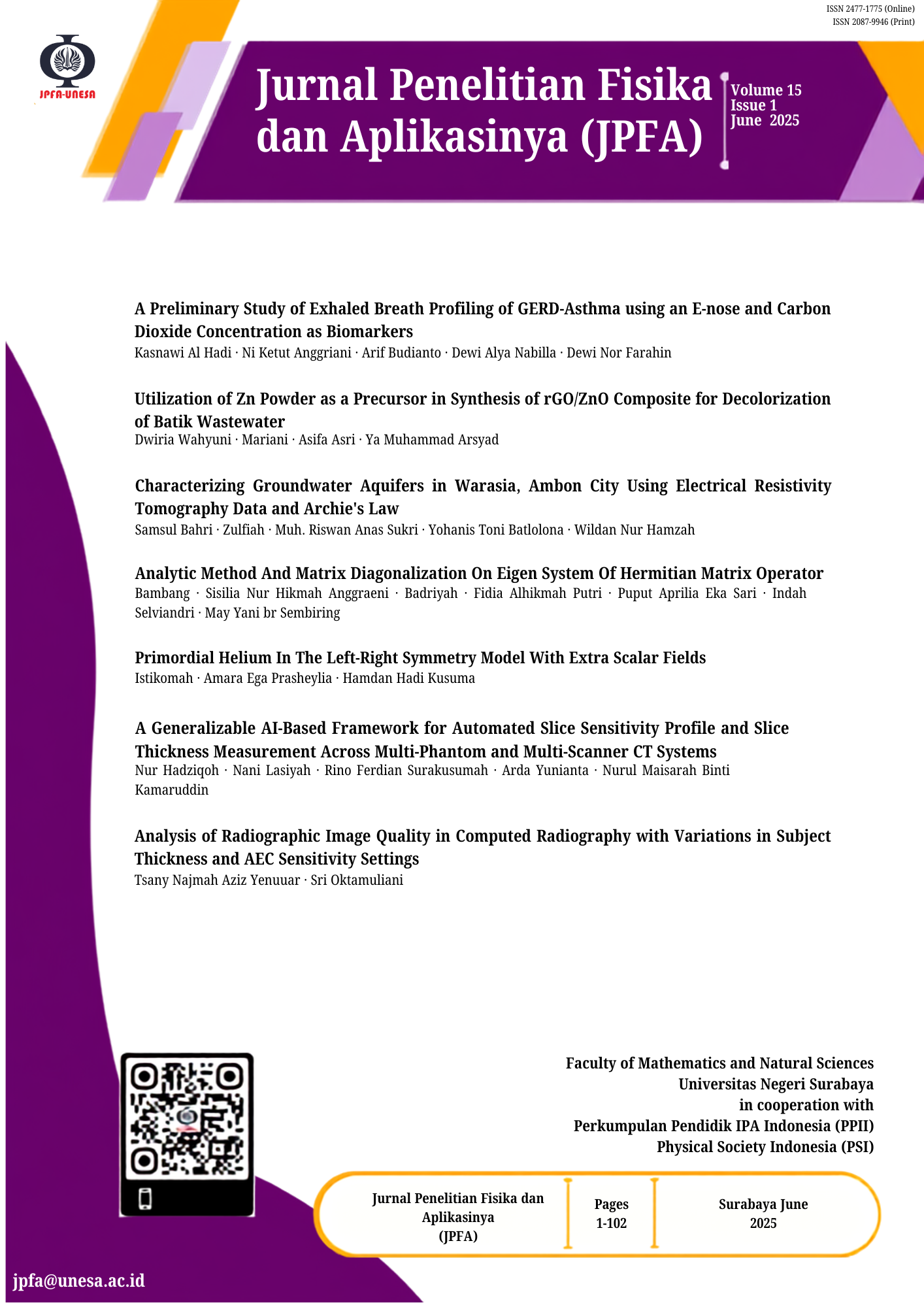
A Generalizable AI-Based Framework for Automated Slice Sensitivity Profile and Slice Thickness Measurement Across Multi-Phantom and Multi-Scanner CT Systems
DOI:
https://doi.org/10.26740/jpfa.v15n1.p71-88Keywords:
Slice Sensitivity Profile, CT Quality Assurance, Phantom Imaging, Full-Width at Half Maximum, Deep LearningAbstract
Slice Sensitivity Profile (SSP) and its Full Width at Half Maximum (FWHM) are critical indicators of longitudinal resolution and effective slice thickness in computed tomography (CT), forming a cornerstone of quality assurance (QA) protocols. This study introduces a robust and vendor-neutral framework for automated SSP and FWHM measurement using a deep learning-based approach, designed to overcome the limitations of manual, scanner-specific, and phantom-specific methods. A U-Net convolutional neural network was trained on annotated CT phantom images—including AAPM, Catphan, and ACR models—acquired across Philips, Siemens, and GE CT systems with varied slice thicknesses (1.0 mm and 5.0 mm). The pipeline includes automatic stair-step object segmentation, angular correction via Hough Transform, profile extraction, and real-time FWHM computation. Validation against manual measurements demonstrated strong correlation (r > 0.97) and mean absolute errors below 0.2 mm, with no statistically significant differences across stair-step positions (p > 0.05). The system showed excellent repeatability (CV < 1.5%) and reproducibility (CV < 2.5%), even with phantom repositioning and inter-operator variability. Additionally, the framework maintained consistency across all phantom types and scanner brands, confirming its cross-platform reliability and alignment with IEC 61223-3-5 and AAPM performance standards. These results position the proposed method as a generalizable and scalable QA solution, suitable for clinical integration, automated reporting, and longitudinal CT performance monitoring.
References
[1] Femke Vaassen, Vaassen F, Femke Vaassen, Colien Hazelaar, Hazelaar C, R. Canters, et al. The impact of organ-at-risk contour variations on automatically generated treatment plans for NSCLC. Radiotherapy and Oncology. 2021 Aug 27;163:136–42. DOI: https://doi.org/10.1016/j.radonc.2021.08.014
[2] Michael V. Sherer, Sherer MV, Diana Lin, Lin D, Sharif Elguindi, Elguindi S, et al. Metrics to evaluate the performance of auto-segmentation for radiation treatment planning: A critical review. Radiotherapy and Oncology. 2021 May 10;160:185–91. DOI: https://doi.org/10.1016/j.radonc.2021.05.003
[3] Muhammad Irsal, Irsal M, Nurbaiti, Nurbaiti, Aulia Narendra Mukhtar, Mukhtar AN, et al. Variation kVp and mAs on CT scan image quality using standard phantom. 2020;2296(1):020039. DOI: https://doi.org/10.1063/5.0030320
[4] Stanislav Nikolov, Nikolov S, Sam Blackwell, Blackwell S, Alexei Zverovitch, Zverovitch A, et al. Clinically Applicable Segmentation of Head and Neck Anatomy for Radiotherapy: Deep Learning Algorithm Development and Validation Study. Journal of Medical Internet Research. 2021 Jul 12;23(7). DOI: https://doi.org/10.2196/26151
[5] Fabian Isensee, Isensee F, Paul F. Jaeger, Jaeger PF, Simon A. A. Kohl, Kohl SAA, et al. nnU-Net: a self-configuring method for deep learning-based biomedical image segmentation. Nature Methods. 2020;18(2):203–11. https://doi.org/10.1038/s41592-020-01008-z
[6] Liesbeth Vandewinckele, Vandewinckele L, Vandewinckele Liesbeth, Michaël Claessens, Claessens Michaël, Claessens M, et al. Overview of artificial intelligence-based applications in radiotherapy : Recommendations for implementation and quality assurance. Radiotherapy and Oncology. 2020;153:55–66. DOI: https://doi.org/10.1016/j.radonc.2020.09.008
[7] Tucker Netherton, Netherton T, Dong Joo Rhee, Rhee DJ, Ibbott GS, Carlos Cárdenas, et al. Evaluation of a multiview architecture for automatic vertebral labeling of palliative radiotherapy simulation CT images. Medical Physics. 2020 Sep 15;47(11):5592–608. DOI: https://doi.org/10.1002/mp.14415
[8] Juan D. Saborido-Moral, Matías Fernández-Patón, N. Tejedor-Aguilar, Andrei Cristian-Marín, I. Torres-Espallardó, Juan M. Campayo-Esteban, et al. Free automatic software for quality assurance of computed tomography calibration, edges and radiomics metrics reproducibility. 2023 Oct 1;114:103153–103153. DOI: https://doi.org/10.1016/j.ejmp.2023.103153
[9] Robert P. Marini, Choirul Anam, Eko Hidayanto, Ariij Naufal, Geoff Dougherty. Automated Slice Thickness Measurement on the Nessoft CT QA Phantom. 2023 May 10;472–84. DOI: https://doi.org/10.32628/IJSRST52310386
[10] Dewi A. Insiano, Choirul Anam, Eko Hidayanto, Ariij Naufal, Anisa T. Maya. Optimal Threshold for Automatic Slice Thickness Measurement using Images of the American College of Radiology (ACR) CT Accreditation Phantom. 2022 Nov 1;437–44. DOI: https://doi.org/10.32628/IJSRST229651
[11] Nada S Amatullah, Khoirul Anam, Eko Hidayanto, Ariij Naufal, Geoff Dougherty. Automatic measurement of slice thickness in CT images of a siemens phantom. 2023 Apr 6;9(3):037003–037003. DOI: https://doi.org/10.1088/2057-1976/acc870
[12] Khoirul Anam, Ariij Naufal, Heri Sutanto, Zaenal Arifin, Eko Hidayanto, Li Kuo Tan, et al. Automatic slice thickness measurement on three types of Catphan CT phantoms. 2023 May 30;9(4):045017–045017. DOI: https://doi.org/10.1088/2057-1976/acd785
[13] Saiva Nur Inayah, Choirul Anam, Heri Sutanto, Ariij Naufal, Riska Amilia. Comparative Analysis of Low-contrast Detectability (LCD) using a 4-AFC: Filtered Back Projection (FBP) and Iterative Reconstruction (IR) Images. International Journal of Scientific Research in Science and Technology. 2025. DOI: https://doi.org/10.32628/IJSRST2512143
[14] S. Sofiyatun, Sofiyatun S, Khoirul Anam, Anam C, Ummu Mar’atu Zahro, Zahro UM, et al. An Automated Measurement of Image Slice Thickness of Computed Tomography. Atom Indonesia. 2021 Aug 5;47(2):121–8. DOI: https://doi.org/10.17146/aij.2021.1111
[15] S Bache, Ehsan Samei. A methodology for incorporating a photon‐counting CT system into routine clinical use. Journal of Applied Clinical Medical Physics. 2023 Jun 30;24(8). DOI: https://doi.org/10.1002/acm2.14069
[16] Nurul Magfirawati, S. Dewang, S. Astuty, Muliadin. Quality Control of Multi-Slice CT-Scan Plane using Phantom Chart Model 610 at Makassar Haji Hospital. 2022. DOI: https://doi.org/10.29303/ipr.v5i1.136
[17] Nicholas Becerra‐Espinosa, Lindsey Claps, Parham Alaei. Comparison of visual and semi‐automated kilovoltage cone beam CT image QA analysis. Journal of Applied Clinical Medical Physics. 2023 Nov 8. DOI: https://doi.org/10.1002/acm2.14190
[18] Nani Lasiyah, Lasiyah N, Khoirul Anam, Anam C, Eko Hidayanto, Hidayanto E, et al. Automated procedure for slice thickness verification of computed tomography images: Variations of slice thickness, position from iso-center, and reconstruction filter. Journal of Applied Clinical Medical Physics. 2021 Jun 9;22(7):313–21. doi: https://doi.org/10.1002/acm2.13317
[19] Ki Baek Lee, Lee KB, Ki Baek Lee, Ki Chang Nam, Nam KC, Ji Sung Jang, et al. Feasibility of the Quantitative Assessment Method for CT Quality Control in Phantom Image Evaluation. Applied Sciences. 2021 Apr 16;11(3570):3570. DOI: https://doi.org/10.3390/app11083570
[20] Kai Huang, Huang K, Dong Joo Rhee, Rhee DJ, Rachel B. Ger, Ger RB, et al. Impact of slice thickness, pixel size, and CT dose on the performance of automatic contouring algorithms. Journal of Applied Clinical Medical Physics. 2021;22(5):168–74. DOI: https://doi.org/10.1002/acm2.13207
[21] Indah R. Ilham, Choirul Anam, Heri Sutanto, Ariij Naufal, Riska Amilia. Impact of radiation dose and iterative reconstruction (IR) level on low-contrast detectability with 4-AFC approach. International Journal of Scientific Research in Science and Technology. 2024. DOI: https://doi.org/10.32628/IJSRST24116181
[22] Hajin Kim, Bo Kyung Cha, Kyuseok Kim, Youngjin Lee. Application of Adaptive Search Window-Based Nonlocal Total Variation Filter in Low-Dose Computed Tomography Images: A Phantom Study. Applied Sciences. 2024. DOI: https://doi.org/10.3390/app142310886
[23] Evi Setiawati, Chorirul Anam, W. Widyasari, Geoff Dougherty. The Quantitative Effect of Noise and Object Diameter on Low-Contrast Detectability of AAPM CT Performance Phantom Images. Atom Indonesia. 2023 Apr 15;1(1):61–6. DOI: https://doi.org/10.55981/aij.2023.1228
[24] Eugenio Galicia-Larios, Galicia-Larios E, C.A. Reynoso-Mejía, Reynoso-Mejía CA. Comparison between NEMA NU-2 and the new report of AAPM TG 126 for PET-CT image quality. 2021 Apr 30;2348(1):050017. DOI: https://doi.org/10.1063/5.005110
[25] Elvira Rizqi Widyanti, Widyanti ER, Choirul Anam, Anam C, Eko Hidayanto, Hidayanto E, et al. The impact of noise on the results of automated slice sensitivity profile measurements in computed tomography. 2021 May 29;26(2):657–63. DOI: http://dx.doi.org/10.52155/ijpsat.v26.2.3110
[26] Elvira Rizqi Widyanti, Khoirul Anam, Eko Hidayanto, Ariij Naufal, Mohammad Haekal. An evaluation of automated measurement of slice sensitivity profile of computed tomography image: field of view variations. Indonesian Journal of Electrical Engineering and Computer Science. 2023 Mar 1;29(3):1430–1430. DOI: http://doi.org/10.11591/ijeecs.v29.i3.pp1430-1437
[27] Dewi A. Insiano, Hasia Marto. Automatication of Thickness Slice Measurement Using Non-Rotation Method on Three Ladder Objects from Computed Tomography. Jurnal Penelitian Pendidikan IPA. 2025. DOI: http://doi.org/10.29303/jppipa.v11i3.9978
[28] Choirul Anam, Khoirul Anam, Ariij Naufal, Ariij Naufal, Toshioh Fujibuchi, Toshioh Fujibuchi, et al. Automated development of the contrast–detail curve based on statistical low‐contrast detectability in CT images. Journal of Applied Clinical Medical Physics. 2022 Jul 9. DOI: http://doi.org/10.1002/acm2.13719
[29] Choirul Anam, A. Naufal, Yanurita Dwihapsari, T. Fujibuchi, G. Dougherty. A Practical Method for Slice Spacing Measurement Using the American Association of Physicists in Medicine Computed Tomography Performance Phantom. Journal of Medical Physics. 2024. doi: http://doi.org/10.4103/jmp.jmp_155_23
[30] C. J. Calleja, Calleja CJ, R. C. Caballar, Caballar RC, Alyssa Gabrielle Peralta, Peralta A. Development of a low-cost imaging performance evaluation phantom for a generic multi-detector CT scanner. Journal of Physics: Conference Series. 2020 Mar 1;1505(1):012031. DOI: http://doi.org/10.1088/1742-6596/1505/1/012031
[31] Angelita D Ximenes, Angelita D Ximenes, Anam C, Khoirul Anam, Eko Hidayanto, Eko Hidayanto, et al. Automation of slice thickness measurements in computed tomography images of AAPM CT performance phantom using a non-rotational method. Polish Journal of Medical Physics and Engineering. 2022 Aug 23;28(3):133–8. DOI: http://doi.org/10.2478/pjmpe-2022-0016
[32] Andre Karius, Andre Karius, Christoph Bert, Christoph Bert. QAMaster: A new software framework for phantom-based computed tomography quality assurance. Journal of Applied Clinical Medical Physics. 2022 Mar 17;e13588–e13588. DOI: http://doi.org/10.1002/acm2.13588
[33] Ahmad Albngali. New Advances in CT Dosimetry: The Planar Average Equilibrium Dose. Saudi Journal of Radiology. 2023 Mar 29;1(RSSA):74–80. DOI: https://doi.org/10.55038/sjr.v1iRSSA.117
[34] Nurul Magfirawati Fira, Nurul Magfirawati Fira, Syamsir Dewang, Syamsir Dewang, Sri Dewi Astuty, Sri Dewi Astuty, et al. QUALITY CONTROL OF MULTI-SLICE CT-SCAN AIRCRAFT USING PHANTOM CHART MODEL 610 AT MAKASSAR HAJI HOSPITAL. Indonesian Physical Review. 2022 Feb 2;5(1):28–35. DOI: https://doi.org/10.29303/ipr.v5i1.136
[35] Nani Lasiyah, Lasiyah N, Khoirul Anam, Anam C, Eko Hidayanto, Hidayanto E, et al. Automated slice sensitivity profile measurement of the CT image of the AAPM CT performance phantom: Which stair object should be used? 2021 Apr 15. DOI: https://doi.org/10.21203/rs.3.rs-283773/v1
Additional Files
Published
How to Cite
Issue
Section
License
Copyright (c) 2025 Jurnal Penelitian Fisika dan Aplikasinya (JPFA)

This work is licensed under a Creative Commons Attribution-NonCommercial 4.0 International License.
Author(s) who wish to publish with this journal should agree to the following terms:
-
- Copyright of articles published in Jurnal Penelitian Fisika dan Aplikasinya (JPFA) is held by Jurnal Penelitian Fisika dan Aplikasinya (JPFA).
- The author(s) grant JPFA the right to publish, reproduce, distribute, and make the article available in all forms and media.
- The published article is licensed under a Creative Commons Attribution-Non Commercial 4.0 License (CC BY-NC) that allows others to share the work with an acknowledgement of the work's authorship and initial publication in this journal for noncommercial purposes.
- Author(s) are able to enter into separate, additional contractual arrangements for the non-exclusive distribution of the journal's published version of the work (e.g., post it to an institutional repository or publish it in a book), with an acknowledgement of its initial publication in this journal.
The publisher publishes and distributes the article with copyright notice to Jurnal Penelitian Fisika dan Aplikasinya (JPFA) under the Creative Commons Attribution-NonCommercial 4.0 International License (CC BY-NC 4.0).
 Abstract views: 87
,
Abstract views: 87
, PDF Downloads: 0