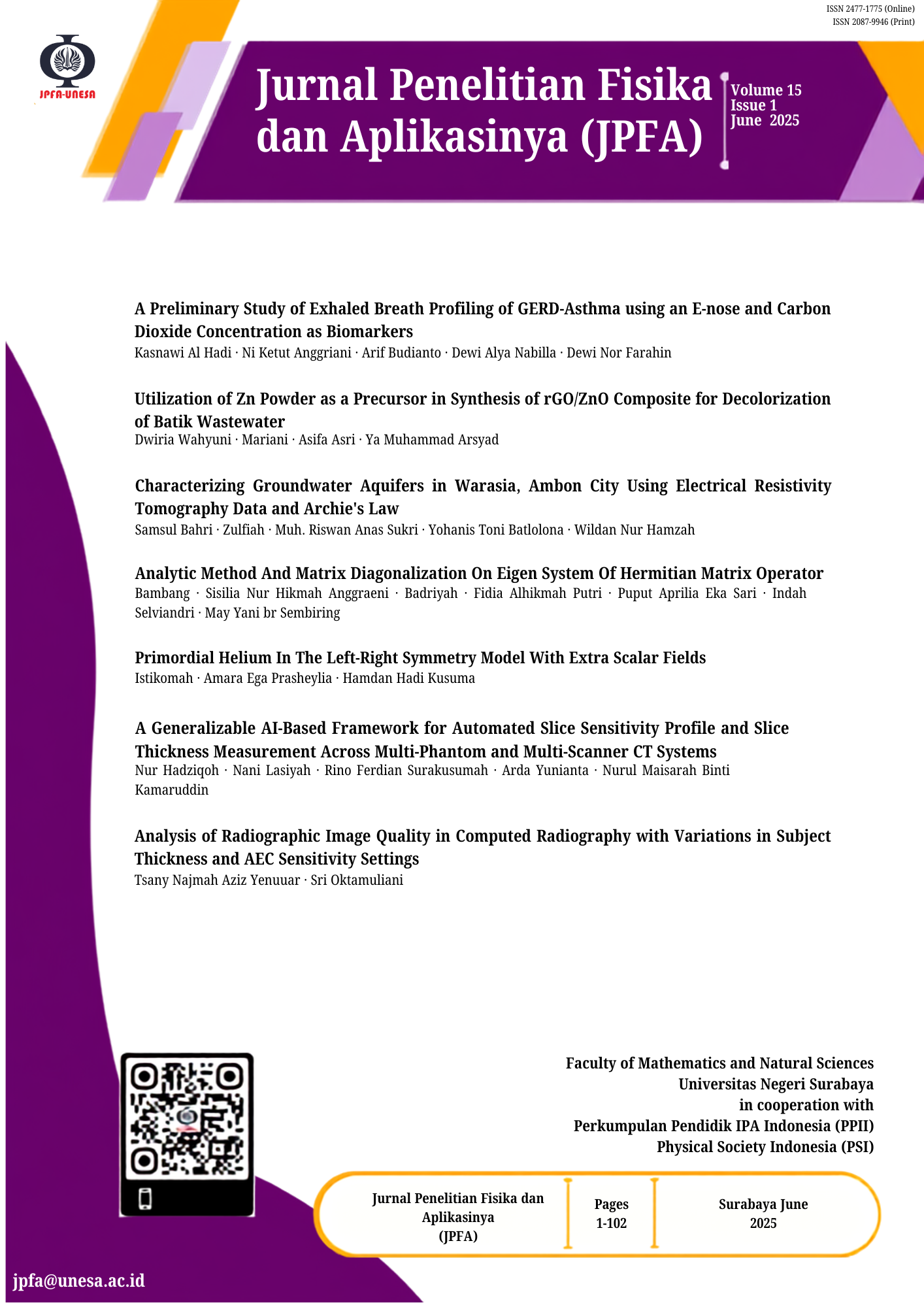
Utilization of Zn Powder as a Precursor in Synthesis of rGO/ZnO Composite for Decolorization of Batik Wastewater
DOI:
https://doi.org/10.26740/jpfa.v15n1.p12-26Keywords:
ZnO, rGO, Photocatalyst, Batik wastewaterAbstract
Batik wastewater contains high concentrations of synthetic dyes, significantly contributing to aquatic pollution. Photocatalysis is a promising method for degrading such dyes in textile effluents. This study aims to develop rGO/ZnO composites using zinc (Zn) powder as a precursor for photocatalytic applications. Reduced graphene oxide (rGO) was used as a substrate for ZnO particle formation. The composites were prepared by reacting Zn powder with rGO at varying loadings (5% and 10% by mass) in a neutral aqueous solution, followed by thermal treatment at 250 °C for 1 hour to facilitate Zn oxidation. The photocatalytic performance was evaluated by applying different masses of rGO/ZnO (0.2, 0.4, and 0.8 g) to degrade batik wastewater. Surface morphology and elemental composition were characterized using SEM-EDS. SEM analysis showed that rGO has a sheet-like structure, while ZnO exhibits spherical morphology. EDS confirmed the presence of Zn, C, and O as major elements with Nb impurity was identified in the composite. The carbon-to-oxygen (C/O) ratio increased after composite formation, reaching 4.23 for rGO/ZnO 5% and 3.79 for rGO/ZnO 10%. XRD characterization of rGO/ZnO confirms the presence of ZnO in the composite, with residual Zn peaks indicating incomplete oxidation of the Zn precursor. Photocatalytic activities modeled using pseudo-first-order kinetics reveal the 10% rGO/ZnO composite (0.8 g) shows the degradation efficiency of 67.91%, with a rate constant of 0.1623 h⁻¹. The efficiency may be affected by the complex nature of batik wastewater, particularly wax and resin residues that hinder photocatalytic activity. In conclusion, these findings highlight the potential of Zn powder as a precursor in the synthesis of rGO/ZnO composites with concentration of rGO and the mass variation of rGO/ZnO in the treatment of Batik wastewater affect the photocatalytic activity.
References
[1] Yuliana, “Risiko Penggunaan Pewarna Sintetis pada Pewarnaan Batik untuk Kesehatan Pengrajin,” Pros. Semin. Nas. Ind. Kerajinan dan Batik, pp. 1–6, 2022, [Online]. Available: https://proceeding.batik.go.id/index.php/SNBK/article/view/176
[2] S. Budiyanto, Anies, H. Purnaweni, and H. R. Sunoko, “Environmental Analysis of the Impacts of Batik Waste Water Polution on the Quality of Dug Well Water in the Batik Industrial Center of Jenggot Pekalongan City,” E3S Web Conf., vol. 31, 2018, doi: https://10.1051/e3sconf/20183109008.
[3] B. Albiss and M. Abu-Dalo, “Photocatalytic Degradation of Methylene Blue using Zinc Oxide Nanorods Grown on Activated Carbon Fibers,” Sustain., vol. 13, no. 9, pp. 1–15, 2021, doi: https://doi.org/10.3390/su13094729.
[4] K. Sirirerkratana, P. Kemacheevakul, and S. Chuangchote, “Color removal from wastewater by photocatalytic process using titanium dioxide-coated glass, ceramic tile, and stainless steel sheets,” J. Clean. Prod., vol. 215, pp. 123–130, 2019, doi: https://10.1016/j.jclepro.2019.01.037.
[5] H. Bel Hadjltaief, M. Ben Zina, M. E. Galvez, and P. Da Costa, “Photocatalytic degradation of methyl green dye in aqueous solution over natural clay-supported ZnO-TiO2 catalysts,” J. Photochem. Photobiol. A Chem., vol. 315, no. January, pp. 25–33, 2016, doi: https://10.1016/j.jphotochem.2015.09.008.
[6] S. Anita, T. A. Hanifah, G. F. Kartika, and P. H. Yanti, “Methylene Blue and Methyl Orange Dyes Removal using Low-Cost Composite of Banana Peel-TiO2Adsorbent,” J. Phys. Conf. Ser., vol. 1819, no. 1, 2021, doi: https://10.1088/1742-6596/1819/1/012060.
[7] S. Sutisna et al., “Batik Wastewater Treatment Using TiO2 Nanoparticles Coated on the Surface of Plastic Sheet,” Procedia Eng., vol. 170, pp. 78–83, 2017, doi: https://10.1016/j.proeng.2017.03.015.
[8] W. F. Khalik, L. N. Ho, S. A. Ong, Y. S. Wong, N. A. Yusoff, and F. Ridwan, “Decolorization and mineralization of Batik wastewater through solar photocatalytic process,” Sains Malaysiana, vol. 44, no. 4, pp. 607–612, 2015, doi: https://10.17576/jsm-2015-4404-16.
[9] P. Chantes, C. Jarusutthirak, and S. Danwittayakul, “A Comparison Study of Photocatalytic Activity of TiO2 and ZnO on the Degradation of Real Batik Wastewater,” 2015, doi: https://10.15242/iicbe.c0515033.
[10] C. B. Ong, L. Y. Ng, and A. W. Mohammad, “A review of ZnO nanoparticles as solar photocatalysts: Synthesis, mechanisms and applications,” Renew. Sustain. Energy Rev., vol. 81, no. March 2017, pp. 536–551, 2018, doi: https://10.1016/j.rser.2017.08.020.
[11] A. S. Merlano, L. M. Hoyos, G. J. Gutiérrez, M. A. Valenzuela, and Á. Salazar, “Effect of Zn precursor concentration in the synthesis of rGO/ZnO composites and their photocatalytic activity,” New J. Chem., vol. 44, no. 45, pp. 19858–19867, 2020, doi: https://10.1039/d0nj03683h.
[12] N. H. Mohammed and A. H. Al Khazraji, “Synthesis and study of zinc oxide nanoparticles and their nanocomposites,” J. Pharm. Negat. Results, vol. 13, no. 4, pp. 790–797, 2022, doi: https://10.47750/pnr.2022.13.04.105.
[13] J. N. Hasnidawani, H. N. Azlina, H. Norita, N. N. Bonnia, S. Ratim, and E. S. Ali, “Synthesis of ZnO Nanostructures Using Sol-Gel Method,” Procedia Chem., vol. 19, pp. 211–216, 2016, doi: https://10.1016/j.proche.2016.03.095.
[14] Sadraei R, “A Simple Method for Preparation of Nano-sized ZnO,” Res. Rev. J. Chem. A, vol. 5, no. 2, pp. 45–49, 2016, doi: https://10.1016/S0008-6215(02)00353-1.
[15] S. Ningsih, M. Khair, and S. Veronita, “Synthesis and Characterization of ZnO Nanoparticles Using Sol-Gel Method,” J. Chem. Sci, vol. 10, no. 1, pp. 59–68, 2021, [Online]. Available: http://journal.unnes.ac.id/sju/index.php/ijcs
[16] E. Kusrini, A. Suhrowati, A. Usman, M. Khalil, and V. Degirmenci, “Synthesis and Characterization of Graphite Oxide, Graphene Oxide, and Reduced Graphene Oxide from Graphite Waste using Modified Hummers Method and Zinc as Reducing Agent,” Int. J. Technol., vol. 10, no. 6, pp. 1094–1102, 2019, doi: https://doi.org/10.14716/ijtech.v10i6.3639.
[17] K. Lee et al., “Highly selective reduced graphene oxide (rGO) sensor based on a peptide aptamer receptor for detecting explosives,” Sci. Rep., vol. 9, no. 1, pp. 1–9, 2019, doi: https://10.1038/s41598-019-45936-z.
[18] Y. M. Volfkovich, A. Y. Rychagov, V. E. Sosenkin, S. A. Baskakov, E. N. Kabachkov, and Y. M. Shulga, “Supercapacitor Properties of rGO-TiO2 Nanocomposite in Two-component Acidic Electrolyte,” Materials (Basel)., vol. 15, no. 21, pp. 1–17, 2022, doi: https://10.3390/ma15217856.
[19] C. Liu, T. Zhang, L. Cao, and K. Luo, “High-Capacity Anode Material for Lithium-Ion Batteries with a Core-Shell NiFe2O4/Reduced Graphene Oxide Heterostructure,” ACS Omega, vol. 6, no. 39, pp. 25269–25276, 2021, doi: https://10.1021/acsomega.1c03050.
[20] K. Gupta and O. P. Khatri, “Reduced graphene oxide as an effective adsorbent for removal of malachite green dye: Plausible adsorption pathways,” J. Colloid Interface Sci., vol. 501, no. April, pp. 11–21, 2017, doi: https://10.1016/j.jcis.2017.04.035.
[21] M. Shabil Sha et al., “Photocatalytic degradation of organic dyes using reduced graphene oxide (rGO),” Sci. Rep., vol. 14, no. 1, pp. 1–14, 2024, doi: https://10.1038/s41598-024-53626-8.
[22] D. Wahyuni, Nurhasanah, M. Nurhanisa, and Mariani, “Kinerja Fotokatalis Tunggal ZnO/Reduced Graphene Oxide (Zno/rGO) dibawah Iradiasi Sinar Matahari untuk Mendegradasi Metilen Biru,” J. Ph J. Pendidik. Fis. dan Fis. Terap., vol. 4, no. 1, pp. 15–20, 2023, doi: https://doi.org/10.22373/p-jpft.v9i1.17228.
[23] S. K. Mandal et al., “Engineering of ZnO/rGO nanocomposite photocatalyst towards rapid degradation of toxic dyes,” Mater. Chem. Phys., vol. 223, no. June 2018, pp. 456–465, 2019, doi: https://10.1016/j.matchemphys.2018.11.002.
[24] I. Limón‐rocha et al., “Effect of the Precursor on the Synthesis of ZnO and Its Photocatalytic Activity,” Inorganics, vol. 10, no. 2, 2022, doi: https://10.3390/inorganics10020016.
[25] L. Zhu, Z. Liu, P. Xia, H. Li, and Y. Xie, “Synthesis of hierarchical ZnO&Graphene composites with enhanced photocatalytic activity,” Ceram. Int., vol. 44, no. 1, pp. 849–856, 2018, doi: https://10.1016/j.ceramint.2017.10.009.
[26] K. H. V., N. C. S., T. R., G. D. Prasanna, N. G., and M. M. V., “An impact of RGO on the ZnO nanoparticles: structural, morphological, electrical, and gas sensing properties,” Sens. Technol., vol. 2, no. 1, p., 2024, doi: https://10.1080/28361466.2024.2310479.
[27] N. Song, H. Fan, and H. Tian, “Reduced graphene oxide/ZnO nanohybrids: Metallic Zn powder induced one-step synthesis for enhanced photocurrent and photocatalytic response,” Appl. Surf. Sci., vol. 353, pp. 580–587, 2015, doi: https://10.1016/j.apsusc.2015.06.062.
[28] A. M. Ilyas, J. D. Musah, S. W. Or, and A. O. Awodugba, “Precursor impurity-mediated effect in the photocatalytic activity of precipitated zinc oxide,” J. Am. Ceram. Soc., vol. 107, no. 12, pp. 8269–8280, 2024, doi: https://10.1111/jace.20062.
[29] J. H. Lin et al., “Photoluminescence mechanisms of metallic Zn nanospheres, semiconducting ZnO nanoballoons, and metal-semiconductor Zn/ZnO nanospheres,” Sci. Rep., vol. 4, pp. 1–8, 2014, doi: https://10.1038/srep06967.
[30] S. Abdolhosseinzadeh, H. Asgharzadeh, S. Sadighikia, and A. Khataee, “UV-assisted synthesis of reduced graphene oxide–ZnO nanorod composites immobilized on Zn foil with enhanced photocatalytic performance,” Res. Chem. Intermed., vol. 42, no. 5, pp. 4479–4496, 2016, doi: https://10.1007/s11164-015-2291-z.
[31] W. M. Liu, J. Li, and H. Y. Zhang, “Reduced graphene oxide modified zinc oxide composites synergistic photocatalytic activity under visible light irradiation,” Optik (Stuttg)., vol. 207, no. August, p. 163778, 2020, doi: https://10.1016/j.ijleo.2019.163778.
[32] Z. K. Bolaghi, S. M. Masoudpanah, and M. Hasheminiasari, “Photocatalytic activity of ZnO / RGO composite synthesized by one-pot solution combustion method,” Mater. Res. Bull., vol. 115, no. January, pp. 191–195, 2019, doi: https://10.1016/j.materresbull.2019.03.024.
[33] B. Xue and Y. Zou, “High photocatalytic activity of ZnO–graphene composite,” J. Colloid Interface Sci., vol. 529, no. April, pp. 306–313, 2018, doi: https://10.1016/j.jcis.2018.04.040.
[34] M. Hossein and H. Elahe, “Synthesis of cobalt-orthotitanate inverse spinel nano particles via a novel low temperature solvothermal method : structural , opto-electronical , morphological , surface characterization and photo-catalytical application in mineralization of Remazol Red ,” J. Mater. Sci. Mater. Electron., vol. 0, no. 0, p. 0, 2017, doi: https://10.1007/s10854-017-6861-2.
[35] C. Z. Zhang, Y. Yuan, and T. Li, “Adsorption and Desorption of Heavy Metals from Water using Aminoethyl Reduced Graphene Oxide,” Environ. Eng. Sci., vol. 35, no. 9, pp. 978–987, 2018, doi: https://10.1089/ees.2017.0541.
[36] J. Yang, S. Shojaei, and S. Shojaei, “Removal of drug and dye from aqueous solutions by graphene oxide: Adsorption studies and chemometrics methods,” npj Clean Water, vol. 5, no. 1, pp. 1–10, 2022, doi: https://10.1038/s41545-022-00148-3.
[37] D. Wahyuni, Nurhasanah, Y. Muhammad Arsyad, and Mariani, “Removal of mercury and iron in water using reduced graphene oxide/zinc oxide composite,” J. Phys. Conf. Ser., vol. 2945, no. 1, p. 012031, Jan. 2025, doi: https://10.1088/1742-6596/2945/1/012031.
[38] N. Zakaria, R. Rohani, W. H. M. Wan Mohtar, R. Purwadi, G. A. Sumampouw, and A. Indarto, “Batik Effluent Treatment and Decolorization—A Review,” Water (Switzerland), vol. 15, no. 7, 2023, doi: https://10.3390/w15071339.
Downloads
Published
Versions
- 2026-01-16 (3)
- 2026-01-16 (2)
- 2025-06-30 (1)
How to Cite
Issue
Section
License
Copyright (c) 2026 Jurnal Penelitian Fisika dan Aplikasinya (JPFA)

This work is licensed under a Creative Commons Attribution-NonCommercial 4.0 International License.
Author(s) who wish to publish with this journal should agree to the following terms:
-
- Copyright of articles published in Jurnal Penelitian Fisika dan Aplikasinya (JPFA) is held by Jurnal Penelitian Fisika dan Aplikasinya (JPFA).
- The author(s) grant JPFA the right to publish, reproduce, distribute, and make the article available in all forms and media.
- The published article is licensed under a Creative Commons Attribution-Non Commercial 4.0 License (CC BY-NC) that allows others to share the work with an acknowledgement of the work's authorship and initial publication in this journal for noncommercial purposes.
- Author(s) are able to enter into separate, additional contractual arrangements for the non-exclusive distribution of the journal's published version of the work (e.g., post it to an institutional repository or publish it in a book), with an acknowledgement of its initial publication in this journal.
The publisher publishes and distributes the article with copyright notice to Jurnal Penelitian Fisika dan Aplikasinya (JPFA) under the Creative Commons Attribution-NonCommercial 4.0 International License (CC BY-NC 4.0).
 Abstract views: 302
,
Abstract views: 302
, PDF Downloads: 281